
Cheap-looking petals, undersized vases, excessive colors, and poorly scaled arrangements can make even an expensive hotel lobby feel less refined.
The best artificial flower arrangement ideas for hotel lobbies use oversized statement pieces, controlled color palettes, realistic orchids, roses, hydrangeas, peonies, magnolia, and branches, premium vessels, and deliberate placement. Luxury comes from scale, restraint, botanical realism, architectural proportion, and consistency—not simply from adding more flowers.
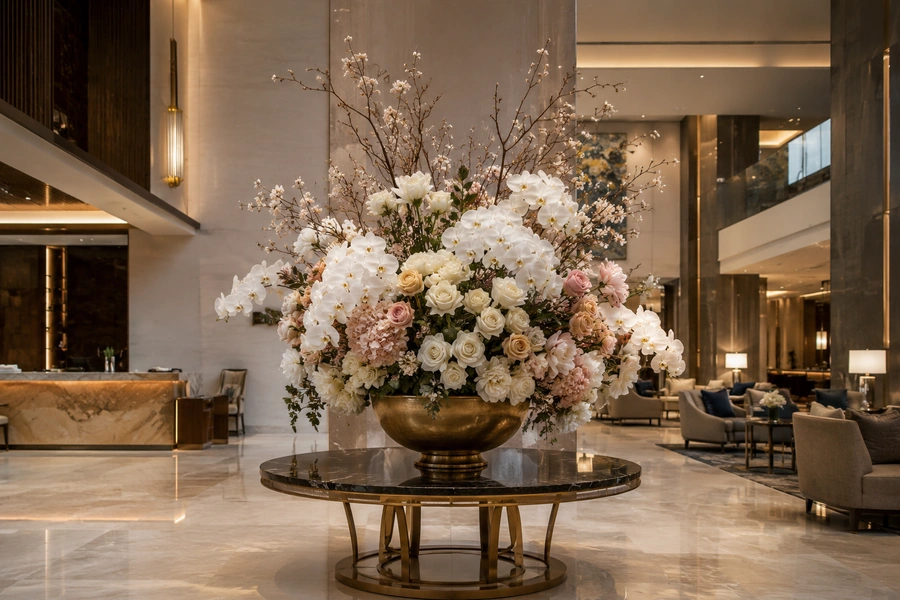
Hotel lobbies are increasingly multifunctional spaces for check-in, meetings, dining, working, and socializing rather than simple passageways. Hospitality Design identified this shift as a major 2025 trend, making décor choices more important because floral installations must create atmosphere without interfering with how guests use the space.
Which Artificial Flower Arrangements Make Hotel Lobbies Look Luxurious?
Luxury floral design is rarely about filling every available surface. Strong hotel arrangements create one or two memorable moments and allow the architecture to remain visible.
The most luxurious artificial flower arrangements for hotel lobbies are sculptural orchid displays, oversized flowering branches, monochromatic hydrangea or rose arrangements, floor-standing urns, asymmetric botanical compositions, and modular seasonal centerpieces. The arrangement should complement the lobby’s architecture instead of competing with it.
1. Oversized white orchid arrangement
White orchids are one of the safest choices for luxury hospitality interiors.
They work particularly well with:
- Marble
- Dark timber
- Brass
- Bronze
- Black stone
- Neutral upholstery
- Contemporary reception desks
Use several orchid stems at different heights rather than arranging every flower symmetrically.
A high-quality artificial orchid should have realistic flower centers, flexible stems, matte leaves, natural root details, and controlled color variation.
| Design Element | Luxury Direction |
|---|---|
| Flower | White or cream phalaenopsis |
| Container | Black, bronze, ceramic, or stone-look vessel |
| Shape | Tall and lightly asymmetric |
| Greenery | Minimal |
| Best location | Reception or console table |
| Viewing distance | Close to medium |
2. Tall flowering branches in a statement urn
Branches are particularly effective in tall lobbies because they visually connect furniture level with higher architectural volume.
Good artificial branch options include:
- Magnolia
- Cherry blossom
- Dogwood-style branches
- White flowering branches
- Autumn foliage
- Sculptural bare branches with small blossoms
Use them in a tall floor urn or large lobby table vessel.
The arrangement should feel deliberately irregular. Branches that are perfectly equal in height tend to look artificial.
3. Monochromatic hydrangea and rose centerpiece
Luxury does not require many colors.
A restrained arrangement using ivory hydrangeas, cream roses, and subtle greenery can look more expensive than a mixture of six bright colors.
This approach has long been used by leading hotel florists. The Ritz Paris’s resident florist has described restraint, limited flower species, and multiple shades of one color as useful principles for creating bold but sophisticated displays.
Possible palettes include:
| Hotel Style | Flower Palette |
|---|---|
| Classic luxury | Ivory + cream |
| Romantic boutique | Blush + dusty rose |
| Contemporary | White + deep green |
| Dark luxury | Burgundy + plum |
| Coastal | White + pale blue-green |
| Desert luxury | Champagne + terracotta |
| Tropical resort | White + controlled coral accents |
4. Sculptural reception arrangement
A reception arrangement should reinforce the desk, not hide the staff behind it.
Use an arrangement with:
- Controlled height
- Narrow base
- Strong vertical form
- Limited side projection
- Clean back view
White orchids, calla lilies, magnolia, protea-style flowers, and tall foliage work well.
The key operational question is simple:
Can guests and reception staff still see each other comfortably?
If not, the arrangement is too large or badly positioned.
5. Oversized lobby-table centerpiece
Large central tables can carry more dramatic arrangements.
A luxury formula might use:
Hydrangea volume + orchid movement + branch height + dark greenery
For example:
- Ivory hydrangeas
- White orchids
- Burgundy accent branches
- Magnolia leaves
- Bronze urn
Keep the number of flower varieties controlled.
The Four Seasons George V in Paris is well known for using bold, large-scale lobby floral displays as part of the arrival experience, illustrating how flowers can function almost as installation art rather than ordinary tabletop decoration.
6. Asymmetric contemporary arrangement
Asymmetry works particularly well in boutique and design-led hotels.
Build the arrangement with:
- One taller branch direction
- One lower floral mass
- Visible negative space
- Limited color
- Sculptural container
This creates a more editorial appearance than a perfect dome-shaped bouquet.
7. Seasonal modular centerpiece
Hotels frequently need décor changes for:
- Spring
- Ramadan
- Easter
- Summer
- Weddings
- Autumn
- Christmas
- Lunar New Year
- Valentine’s Day
Instead of replacing the complete arrangement, use permanent greenery and structural stems as the base.
Then swap:
- Flower heads
- Accent branches
- Ribbons
- Decorative ornaments
- Seasonal colors
This reduces storage and replacement cost while keeping the lobby fresh.
How Should Hotels Choose Flower Colors, Scale, and Containers?
An expensive artificial flower can still look cheap in the wrong vase. Likewise, an attractive arrangement can disappear when it is too small for a large lobby.
Hotels should select floral scale according to ceiling height, furniture dimensions, guest viewing distance, and lobby volume. Color should reinforce the hotel’s materials and brand identity, while containers should have enough visual weight to support the arrangement. Luxury usually comes from proportion and restraint rather than flower quantity alone.
Match the arrangement to the architecture
I divide hotel arrangements into four scale levels.
| Arrangement Level | Typical Location | Design Role |
|---|---|---|
| Small | Side table or restroom console | Accent |
| Medium | Reception or side console | Supporting focal point |
| Large | Central lobby table | Primary focal point |
| Oversized | Floor urn or atrium | Architectural statement |
A small orchid can look elegant on a reception console.
The same orchid may look insignificant in the center of a double-height atrium.
Use the one-third rule as a starting point
For tabletop arrangements, a practical visual starting point is to make the floral composition roughly proportional to the table or vessel rather than dramatically wider than its support.
However, luxury lobby designs often intentionally exaggerate vertical scale.
The final decision should consider:
- Ceiling
- Chandelier
- Artwork
- Furniture
- Columns
- Sightlines
- Walkways
Use fewer colors
A luxury palette often contains:
one dominant color + one supporting tone + greenery
For example:
White + champagne + dark green
or:
Blush + burgundy + olive foliage
Avoid mixing every flower color available simply because artificial flowers make year-round selection possible.
Hospitality design in 2025 increasingly emphasized spaces that feel authentic, grounded, and connected to place rather than visually excessive. This supports a more deliberate approach to floral styling instead of using oversized décor purely for spectacle.
Select the container carefully
The vessel may represent half the perceived quality of the arrangement.
Strong lobby options include:
- Ceramic urns
- Hand-finished metal vessels
- Stone-look planters
- Textured glass
- Bronze containers
- Black lacquer vessels
- Large sculptural bowls
Avoid undersized, lightweight plastic vases for premium installations unless they are concealed within a decorative outer container.
Match container and flower personality
| Flower Style | Strong Container Direction |
|---|---|
| White orchids | Black, bronze, stone |
| Roses and hydrangeas | Ceramic or glass |
| Flowering branches | Tall floor urn |
| Tropical flowers | Large dark vessel |
| Magnolia | Stone or textured ceramic |
| Minimal greenery | Sculptural metal |
| Seasonal flowers | Neutral reusable vessel |
A neutral vessel increases reuse because the flowers can change without replacing the container.
Where Should Artificial Floral Arrangements Be Placed in a Hotel Lobby?
Placement should support the guest journey. Flowers are most effective where they mark arrivals, transitions, seating zones, and important architectural moments.
Place artificial flower arrangements at reception, central lobby tables, console tables, lounge transitions, staircase landings, and carefully selected floor locations. Avoid blocking staff visibility, doors, accessible routes, signs, fire equipment, or customer circulation. Every arrangement should have a visual purpose and an operationally safe location.
Reception desk
Use a medium statement arrangement positioned away from the primary guest-staff interaction point.
Best options:
- Orchids
- Calla lilies
- Magnolia
- Narrow flowering branches
Avoid very wide hydrangea masses directly between guests and staff.
Central lobby table
This is the strongest location for a dramatic centerpiece.
The arrangement can be viewed from all directions, so it needs a complete 360-degree finish.
Check:
- Backside flower coverage
- Visible mechanics
- Vase stability
- Guest reach
- Lighting
- Photography angles
Console table
Console arrangements work well beneath:
- Artwork
- Mirrors
- Decorative lighting
- Hotel branding
Use a lower, wider arrangement when there is artwork directly above.
Use vertical branches when the wall is tall and visually empty.
Staircase zone
Large floor arrangements can soften a grand staircase.
The best approach usually places the arrangement beside the staircase rather than projecting into walking paths.
Tall urns with magnolia, orchids, or flowering branches work well here.
Lounge seating
Floral arrangements can visually define different seating groups.
However, lobby design trends are increasingly treating these spaces as flexible social environments. Flowers should therefore support conversation, work, food service, and movement rather than consuming useful surfaces.
Arrival photo point
Boutique and lifestyle hotels may create a distinctive botanical moment near the entrance.
This could include:
- Oversized flower urn
- Floral sculpture
- Faux flower wall
- Seasonal installation
- Flowers integrated with hotel signage
A photo point should still feel connected to the hotel’s materials and identity rather than looking like temporary event décor.
Check fire and circulation requirements
Artificial floral décor can be regulated as artificial decorative vegetation in commercial environments. For example, the 2024 International Fire Code requires covered artificial decorative vegetation to meet specified flame-propagation criteria under NFPA 701 or an alternative NFPA 289 route; exact requirements depend on occupancy, local adoption, and installation.
The 2025 California Fire Code similarly includes requirements for artificial decorative vegetation and NFPA 701 flame-propagation performance in covered applications.
Hotel procurement teams should therefore request product-specific documentation where required rather than accepting a general “fire retardant” marketing claim.
How Can Hotels Maintain Luxury Faux Flower Displays Efficiently?
Luxury artificial flowers lose their value when dust collects on petals, stems bend, containers show fingerprints, or old arrangements remain unchanged for too long.
Hotels should maintain artificial floral arrangements through scheduled dusting, gentle cleaning, reshaping, rotation, damage inspection, and seasonal refreshes. Modular designs make maintenance easier because individual flowers or foliage can be replaced without rebuilding the complete arrangement.
Use a simple housekeeping schedule
| Frequency | Task |
|---|---|
| Daily | Check obvious dust, moved stems, and guest damage |
| Weekly | Lightly dust exposed petals and leaves |
| Monthly | Detailed cleaning and reshaping |
| Quarterly | Check fading, glue, wire, and container condition |
| Seasonally | Refresh colors and accent stems |
| Annually | Review supplier performance and replace tired hero pieces |
Reception arrangements may require more frequent attention than flowers on a protected console.
Choose materials by cleaning requirement
| Material | Luxury Benefit | Maintenance Concern |
|---|---|---|
| Polyester petals | Soft layered realism | Dust and fraying |
| PU real-touch | Premium tactile feel | Surface compatibility |
| PE greenery | Easy cleaning | Must avoid excessive gloss |
| Wired stems | Easy reshaping | Wire should remain concealed |
| Natural wood branches | Organic appearance | Variation and cleaning |
| Molded stems | Durable | Lower grades can look artificial |
Keep spare hero flowers
For large lobby arrangements, store replacement:
- Orchids
- Peonies
- Roses
- Hydrangeas
- Foliage
- Branches
The hotel should not need to replace a complete arrangement because three prominent flowers are damaged.
Photograph the approved arrangement
After installation, photograph:
- Front
- Rear
- Both sides
- Top
- Vessel
- Flower positioning
Housekeeping or visual-merchandising staff can use these images to restore the arrangement after cleaning.
Build arrangements in removable modules
One large lobby urn can contain several removable floral modules.
For example:
| Module | Components |
|---|---|
| Structural | Branches and permanent foliage |
| Volume | Hydrangeas and leaves |
| Hero flowers | Orchids, roses, peonies |
| Seasonal | Color accents |
| Finishing | Moss or decorative filler |
This allows fast changes without requiring specialist florists every time.
My insights: What Makes Artificial Flower Arrangement Ideas for Hotel Lobbies Look Luxury
The biggest mistake is assuming luxury comes from using more flowers. It usually comes from stronger editing.
Artificial flower arrangements make hotel lobbies look luxurious when they combine architectural scale, limited colors, believable flower varieties, controlled asymmetry, premium vessels, negative space, and disciplined maintenance. The arrangement should feel designed for that specific hotel—not purchased as a generic bouquet and placed wherever an empty table happens to exist.
My seven luxury rules
| Rule | Luxury Effect |
|---|---|
| 1. Scale confidently | Prevents arrangements disappearing in large spaces |
| 2. Limit flower varieties | Creates visual clarity |
| 3. Control the palette | Makes the display feel curated |
| 4. Use premium vessels | Raises perceived quality |
| 5. Keep some irregularity | Improves realism |
| 6. Coordinate with architecture | Makes flowers feel permanent |
| 7. Maintain obsessively | Prevents faux flowers looking tired |
Luxury often means fewer flower varieties
One of the most useful lessons from high-end hotel floral styling is restraint.
The Ritz Paris approach cited by Architectural Digest emphasizes limited species and tonal color relationships rather than filling the vessel with every available flower.
I would apply the same principle to artificial arrangements.
Instead of:
- Roses
- Peonies
- Hydrangeas
- Orchids
- Tulips
- Lavender
- Sunflowers
- Five foliage varieties
try:
White orchids + magnolia leaves
or:
Blush hydrangeas + deep burgundy roses
The result often feels more expensive.
Use one hero arrangement
A lobby does not need five competing statement arrangements.
I prefer:
one hero piece + two supporting pieces
For example:
- Hero: oversized central table arrangement
- Support 1: reception orchids
- Support 2: staircase urn
This creates hierarchy.
Build the arrangement around the hotel’s identity
A coastal hotel might use:
- White orchids
- Pale greenery
- Driftwood-style branches
- Textured stone vessel
An urban luxury hotel might use:
- Burgundy hydrangeas
- Dark foliage
- Black lacquer
- Brass accents
A Mediterranean property might use:
- Olive foliage
- White flowers
- Neutral ceramic
- Sculptural branches
The flowers should reinforce the sense of place.
Hospitality design commentary from 2025 emphasized authentic, immersive environments and stronger connections to nature and place, rather than décor that exists only for visual excess.
The strongest formula
For most luxury hotel lobbies, my preferred starting formula is:
60% structural foliage and branches
30% dominant flowers
10% accent flowers
This is a styling framework, not an industry standard.
It creates enough structure to avoid the appearance of a round bouquet while keeping the flowers visually important.
Final hotel-lobby rule
A luxury artificial floral arrangement should pass four tests:
Does it look believable from the guest’s normal viewing distance?
Does its scale match the architecture?
Does it support rather than obstruct hotel operations?
Can the hotel maintain it consistently?
When all four answers are yes, artificial flowers can become a convincing part of a high-end lobby rather than simply a low-maintenance substitute for fresh flowers.
Conclusion
Luxury hotel faux flowers depend on scale, restraint, realistic materials, premium vessels, intentional placement, modular design, and impeccable maintenance—not excessive color or flower quantity.