
Artificial plants offer permanent greenery, but buyers must understand their materials, quality levels, limitations, safety requirements, and intended environments before choosing them.
Artificial plants are manufactured imitations of living plants, flowers, trees, shrubs, grasses, or foliage. They reproduce natural appearance without growing, photosynthesizing, or requiring water. Modern products may use polyester, PE, PVC, PU, foam, wire, wood, and coatings for residential, commercial, event, scientific, and outdoor applications.
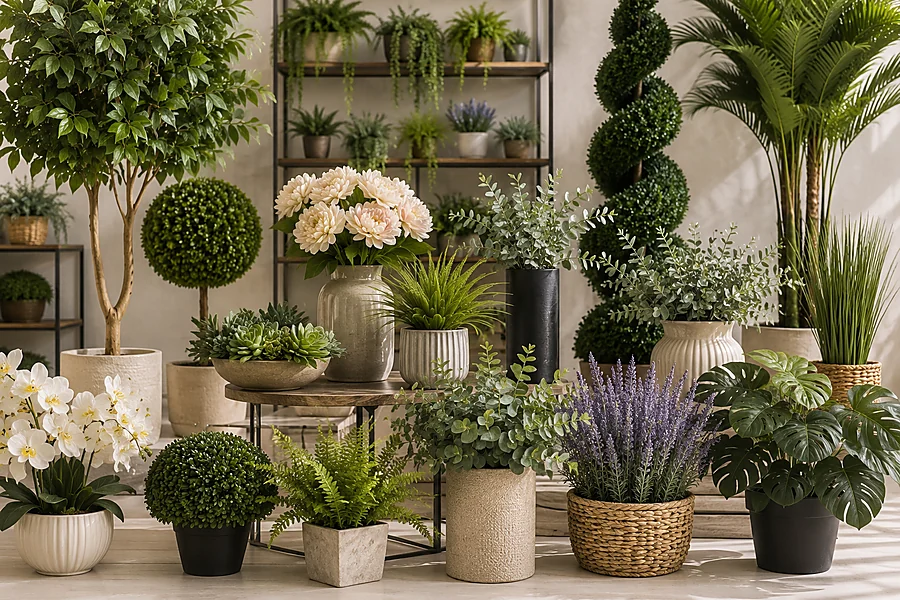
Artificial plants—also called faux plants, fake plants, imitation plants, or permanent botanicals—range from inexpensive molded decorations to highly detailed botanical replicas. Their most common purpose is residential or commercial decoration, although artificial botanical specimens can also serve educational, artistic, and scientific purposes.
What Is the Definition of Artificial Plants?
The term sounds simple, but it covers a wide product category containing different materials, formats, quality grades, and performance claims.
An artificial plant is a human-made object designed to imitate the visual form of a natural plant. It may copy a complete tree, flowering plant, shrub, vine, grass, succulent, leaf, or botanical arrangement. Unlike a living plant, it does not grow, reproduce, photosynthesize, or require biological care.
Artificial plant terminology
Several names are used for similar products.
| Term | Common Meaning | Typical Use |
|---|---|---|
| Artificial plant | Formal name for a manufactured plant imitation | Product catalogs and procurement |
| Faux plant | Design-focused term for an artificial plant | Interior décor and premium retail |
| Fake plant | Everyday description | General consumer use |
| Imitation plant | Product made to copy natural vegetation | Technical or commercial documents |
| Permanent botanical | Premium industry term | Hospitality and interior design |
| Silk plant | Traditionally a fabric-leaf product | Flowers and indoor foliage |
| Real-touch plant | Product with a soft or natural-feeling coating | Premium flowers and leaves |
| Preserved plant | A real plant treated to retain its appearance | Interior décor with natural material |
Artificial and preserved plants are not the same. An artificial plant is manufactured from nonliving components. A preserved plant began as natural vegetation and was treated to slow deterioration.
Are artificial plants alive?
No. Artificial plants imitate the appearance of botanical life, but they do not perform biological functions.
They do not:
- Grow new leaves
- Develop roots
- Need soil nutrients
- Absorb water biologically
- Produce flowers naturally
- Respond to seasons through living processes
- Recover from structural damage
- Provide the same experience as caring for living vegetation
This difference explains both their strengths and limitations. Artificial plants provide a controlled appearance, but they cannot reproduce the changing texture, growth, fragrance, and biological character of living plants.
Are faux, fake, and artificial plants different?
The products may be identical. The difference is usually marketing language.
“Artificial” is neutral and precise. “Fake” is informal and may suggest lower quality. “Faux” is commonly used in interior design and retail because it sounds more decorative or premium. “Permanent botanical” is often used for high-quality commercial products.
A buyer should not assume that a faux plant is better than a fake plant. Quality depends on the actual material, construction, color, scale, testing, and supplier control.
Are silk plants made from genuine silk?
Not necessarily. Many products described as silk plants use polyester fabric rather than natural silk. Others combine polyester leaves, molded plastic stems, metal wire, adhesives, and surface coatings.
For products subject to textile-labeling rules, the U.S. Federal Trade Commission distinguishes polyester from silk and requires accurate fiber-content disclosure. Buyers should therefore request the actual fiber or polymer instead of treating “silk” as a technical material specification.
A useful specification should say:
- Polyester fabric leaf
- Molded PE leaf
- PU-coated petal
- Flexible PVC foliage
- Genuine silk fabric, when applicable
- Natural wood trunk
- Steel-wire internal stem
What Types and Materials Are Used to Make Artificial Plants?
Artificial plants are made in many formats, from individual stems to complete commercial landscaping systems.
Common artificial-plant types include potted plants, trees, topiaries, palms, succulents, grasses, hanging plants, hedges, flower walls, garlands, planter inserts, green-wall panels, and individual floral stems. Their materials are selected according to realism, cost, flexibility, weight, weather exposure, and cleaning requirements.
Main artificial-plant categories
| Product Type | Examples | Common Application |
|---|---|---|
| Potted plants | Monstera, fern, snake plant | Homes, offices, hotels |
| Artificial trees | Olive, ficus, maple, magnolia | Lobbies and retail interiors |
| Palms | Areca, kentia, fan palm | Resorts, restaurants, terraces |
| Topiaries | Boxwood balls, cones, spirals | Entrances and formal spaces |
| Succulents | Agave, aloe, echeveria | Desks, planters, modern interiors |
| Hanging plants | Ivy, pothos, fern | Ceilings, shelves, balconies |
| Artificial flowers | Roses, orchids, peonies | Events, hospitality, retail |
| Green-wall panels | Boxwood, fern, mixed foliage | Walls, privacy screens, branding |
| Hedges | Boxwood or laurel screens | Restaurants and outdoor boundaries |
| Planter inserts | Grasses, shrubs, mixed flowers | Commercial outdoor planters |
| Garlands and vines | Eucalyptus, ivy, floral garlands | Events, railings, displays |
Polyester and silk-touch fabric
Polyester fabric is commonly used for layered flowers and softer leaves. It supports printing, color gradients, folds, veins, and lightweight construction.
It works well for:
- Roses
- Peonies
- Hydrangeas
- Dahlias
- Magnolia
- Flower garlands
- Large indoor installations
Its disadvantages include dust retention, fraying, crushing, water sensitivity, and weak outdoor performance when it has not been designed and tested for exterior use.
Polyethylene
Polyethylene, or PE, is widely used for molded foliage, boxwood panels, grasses, succulents, eucalyptus, and outdoor plant components.
Its strengths include:
- Low weight
- Moisture resistance
- Flexible molding
- Easy cleaning
- Detailed leaf texture
- Compatibility with UV stabilizers
PE does not automatically mean outdoor-safe. The resin, pigments, stabilizers, wall thickness, and construction all influence weathering performance.
Polyvinyl chloride
PVC can be rigid or flexible. It is often found in pine needles, Christmas greenery, leaves, stems, garlands, and economical structural components.
PVC provides good shape retention and moisture resistance, but glossy or poorly molded PVC can appear unrealistic. Exterior performance depends on the complete formulation, including pigments, stabilizers and, where applicable, plasticizers.
Polyurethane and real-touch materials
PU is often used for premium real-touch petals and leaves. It can reproduce the flexible, slightly thick surface of orchids, calla lilies, roses, anthuriums, and tropical foliage.
PU quality varies considerably. A strong product should resist:
- Stickiness
- Yellowing
- Surface peeling
- Dust attraction
- Hardening
- Color transfer
- Cracking during bending
For sheltered luxury interiors, PU can provide excellent close-up realism. Outdoor use requires product-specific weathering evidence.
Wire, foam, glue, and internal supports
The visible foliage is only one part of an artificial plant.
| Component | Function | Common Quality Problem |
|---|---|---|
| Steel wire | Allows stems to bend | Exposed or broken wire |
| Foam | Positions stems and fills planters | Weak pullout resistance |
| Adhesive | Connects leaves and flowers | Visible glue or loose components |
| Plastic trunk | Provides shape and structure | Cracking or unrealistic finish |
| Natural wood trunk | Improves realism | Moisture or pest concerns |
| Metal frame | Supports trees, hedges, and panels | Corrosion or poor stability |
| Planter ballast | Reduces tipping risk | Loose or high-positioned weight |
| Backing grid | Holds green-wall foliage | Brittle connectors |
A realistic leaf cannot compensate for a weak trunk, unstable planter, visible glue, or poor attachment.
Indoor versus outdoor artificial plants
Indoor products are designed primarily for appearance. Outdoor products must also withstand sunlight, temperature changes, moisture, cleaning, and wind-related movement.
| Requirement | Indoor Plant | Outdoor Plant |
|---|---|---|
| UV stabilization | Optional | Usually essential |
| Weather-resistant materials | Limited need | Required |
| Drainage planning | Usually unnecessary | Important |
| Wind stability | Low concern | Major concern |
| Fade testing | Less critical | Important |
| Corrosion-resistant hardware | Site-dependent | Often required |
| Secure anchoring | Rare | May be necessary |
ASTM G154 provides procedures for operating fluorescent UV weathering equipment using UV exposure, heat, and moisture. It supports controlled material comparisons but does not create one universal pass result or guarantee a fixed number of outdoor years.
What Are the Advantages and Disadvantages of Artificial Plants?
Artificial plants solve maintenance and environmental limitations, but they are not automatically better than living vegetation.
The main advantages of artificial plants are consistent appearance, low routine care, flexible placement, seasonal independence, and reusability. Their disadvantages include dust accumulation, fading, lack of biological functions, possible fire or material restrictions, storage requirements, and waste when short-lived products are frequently discarded.
Advantages
Consistent appearance
Artificial plants do not wilt, become dormant, grow unevenly, or lose leaves through normal biological cycles. This supports consistent brand presentation across hotels, stores, restaurants, offices, and event venues.
Flexible placement
They can be installed where living plants may struggle, including:
- Low-light rooms
- Windowless offices
- High shelves
- Retail displays
- Temporary events
- Air-conditioned spaces
- Hard-to-reach installations
- Areas without irrigation
Lower routine plant care
Artificial plants do not need watering, pruning, fertilization, or biological pest treatment. They still need cleaning, inspection, reshaping, and occasional repair.
Reusability
Durable artificial trees, flowers, garlands, and panels can be moved between events, seasons, branches, or marketing campaigns.
Predictable size and color
A supplier can reproduce an approved height, shape, color palette, and planter layout across several properties.
Disadvantages
They collect dust
Artificial plants may avoid soil and pollen produced by living plants, but they are not automatically allergy-free. Dust can accumulate on leaves and flower heads, and indoor dust may contain pollen, mold spores, pet allergens, and other biological particles. Regular cleaning helps reduce dust buildup.
They can fade or deteriorate
Sunlight, heat, moisture, unsuitable cleaning products, and weak formulations can cause:
- Fading
- Yellowing
- Chalking
- Brittleness
- Cracking
- Sticky coatings
- Loose leaves
- Adhesive failure
They lack natural sensory qualities
Artificial plants do not provide natural growth, fragrance, changing seasonal form, or the experience of caring for a living organism.
Low-quality products may look unrealistic
Common visual problems include:
- Excessive shine
- Flat green color
- Identical repeated leaves
- Visible molding lines
- Exposed glue
- Straight, unshaped branches
- Incorrect botanical scale
- Lightweight plastic planters
Disposal can be difficult
A product containing mixed plastic, fabric, foam, wire, glue, paint, and wood may be difficult to separate for recycling. Reuse, repair, modular construction, and replacement parts improve the practical value of artificial plants.
Artificial versus living plants
| Decision Area | Artificial Plants | Living Plants |
|---|---|---|
| Watering | Not required | Required |
| Growth | None | Natural growth |
| Light requirements | Minimal for survival | Species-dependent |
| Appearance | Controlled and consistent | Changes over time |
| Dusting | Required | Leaves may also need cleaning |
| Biological pests | No living-plant infestation | Possible |
| Fragrance | Normally absent | Species-dependent |
| Replacement | Based on damage or aging | Based on health and lifecycle |
| Outdoor durability | Requires appropriate materials | Depends on climate and species |
| Emotional connection | Decorative | Living-care experience |
The best choice depends on the purpose. A difficult-to-access ceiling installation may favor artificial greenery. A wellness space centered on horticulture may benefit more from living plants.
How Should Buyers Choose and Maintain Artificial Plants?
Product selection should begin with the installation environment and expected viewing distance—not the supplier’s lowest price.
Buyers should choose artificial plants by application, material, realism, dimensions, UV exposure, construction, planter stability, cleaning method, fire requirements, packaging, warranty, and supplier consistency. Samples should be inspected under actual lighting and tested before a large order.
Match the product to the location
| Location | Main Buying Priority |
|---|---|
| Hotel lobby | Premium realism and easy cleaning |
| Office reception | Consistency and low maintenance |
| Restaurant table | Compact scale and hygiene |
| Retail window | Strong color and camera appearance |
| Outdoor entrance | UV resistance and planter stability |
| Rooftop | Wind control and secure anchoring |
| Wedding venue | Close-up realism and reusable construction |
| Shopping center | Flame documentation and durability |
| Ceiling installation | Low weight and secure attachments |
| Green wall | Panel density, connectors, and access |
Inspect the sample
Check:
- Botanical scale and proportion.
- Natural color variation.
- Matte versus glossy surfaces.
- Leaf and flower attachment.
- Visible glue and molding marks.
- Stem and branch flexibility.
- Wire exposure.
- Odor after unpacking.
- Cleaning response.
- Recovery after packaging.
Photograph samples under daylight, warm interior lighting, cool retail lighting, and camera flash.
Verify special claims
Do not accept broad phrases such as:
- Weatherproof
- Fade-proof
- Fireproof
- Real silk
- Eco-friendly
- Non-toxic
- Commercial grade
- UV protected forever
Ask for the exact tested SKU, method, conditions, result, laboratory, acceptance criteria, and warranty.
Commercial venues may also impose flame-performance requirements on decorative materials. NFPA 701 addresses fire-test methods for textiles and films, and recent NFPA development materials explicitly address artificial decorative vegetation. Buyers should confirm the applicable local code and venue requirement for the complete installed product.
Clean artificial plants safely
Use the least aggressive effective method.
| Product | Suggested Starting Method |
|---|---|
| PE or PVC foliage | Microfiber cloth or soft brush |
| Large plastic tree | Damp wipe after testing |
| Polyester flowers | Dry brush or careful spot cleaning |
| Real-touch PU | Lightly damp cloth after compatibility test |
| Green-wall panel | Soft brush or low-pressure rinse if approved |
| Glittered plant | Gentle dry dusting |
| Electrical pre-lit plant | Follow the manufacturer’s instructions |
Avoid strong solvents, abrasive pads, uncontrolled pressure washing, and unapproved coatings. EPA guidance notes that frequent cleaning reduces indoor dust buildup, while some cleaning-product ingredients can cause irritation when used improperly.
Use a maintenance schedule
| Timing | Task |
|---|---|
| Weekly | Remove visible debris and check loose components |
| Monthly | Dust or wipe customer-facing plants |
| Quarterly | Inspect color, stems, planters, and fasteners |
| After storms | Check outdoor stability and damage |
| Seasonally | Rotate, repair, or replace faded accents |
| Before storage | Clean, dry, reshape, and label |
| Before reuse | Inspect packaging damage and missing parts |
Store plants correctly
Artificial plants can be damaged even when they are not displayed.
Store them:
- Clean and completely dry
- Away from direct sunlight
- In cool, ventilated conditions
- With flower heads protected
- Without excessive carton compression
- Away from strongly dyed materials
- With SKU and location labels
- With branches supported rather than sharply folded
My insights: What Is the Complete Definition of Artificial Plants, and What Should Buyers Know
A dictionary-style definition explains what artificial plants are. A commercial definition must also explain how they are made, where they can be used, and how their performance is verified.
Artificial plants are manufactured botanical replicas whose value depends on five connected factors: visual realism, material suitability, structural quality, environmental performance, and maintainability. The best artificial plant is not the product that looks most realistic in one photograph—it is the product that continues to meet its intended purpose after installation, cleaning, handling, and aging.
Use a five-part definition
| Definition Layer | Buyer Question |
|---|---|
| Botanical imitation | Which natural plant is being copied? |
| Material system | What are the leaves, stems, coatings, and supports made from? |
| Intended environment | Is it designed for indoor, sheltered, or outdoor use? |
| Performance requirement | Must it resist UV, moisture, fire exposure, or repeated handling? |
| Maintenance model | Can it be cleaned, repaired, stored, and reused? |
My central insight is that “artificial plant” describes how the item is created, not how well it performs.
Two products can both be artificial olive trees while having completely different quality levels. One may use thin glossy leaves, weak glue, and an unstable planter. Another may use matte molded foliage, natural branch variation, reinforced construction, controlled color, and a secure commercial base.
Quality should be defined by use
For close-up hospitality décor, prioritize:
- Natural leaf texture
- Botanical accuracy
- Premium trunks
- Hidden attachment points
- Easy cleaning
For outdoor commercial décor, prioritize:
- UV-stabilized materials
- Weather-resistant construction
- Secure anchoring
- Drainage
- Replaceable parts
- Written warranty terms
For event rental, prioritize:
- Low weight
- Repeated reshaping
- Strong connections
- Compact packing
- Modular replacement
- Reorder consistency
Artificial plants should be managed as assets
Businesses should assign each major artificial plant:
- A product code
- Supplier record
- Material specification
- Installation location
- Cleaning method
- Inspection schedule
- Warranty file
- Replacement trigger
- Storage location
This improves consistency and helps facilities teams identify whether fading, damage, or repeated repairs are related to a specific SKU, production batch, or installation environment.
Final definition
An artificial plant is more than a plastic decoration. It is a designed botanical imitation made from a system of materials, pigments, supports, coatings, and connections.
Its success depends on whether that system matches the buyer’s real need.
A high-quality artificial plant should:
- Look appropriate at the intended viewing distance.
- Use materials suited to its environment.
- Remain structurally secure.
- Recover from shipping and shaping.
- Be practical to clean.
- Meet applicable venue requirements.
- Maintain acceptable color.
- Support repair or replacement.
- Arrive in protective packaging.
- Perform consistently across repeat orders.
Conclusion
Artificial plants are manufactured botanical replicas. Their true quality depends on realism, materials, construction, environmental suitability, safety documentation, maintenance, and long-term performance.