
Outdoor greenery can make commercial spaces feel fresh fast. But poor artificial plants fade, crack, tip over, and make a business look careless.
The best artificial outdoor plants for 2025 are UV-resistant, weather-ready, realistic, easy to clean, stable in planters, and suitable for commercial use. B2B buyers should focus on boxwood panels, topiaries, palms, olive trees, eucalyptus, ferns, lavender, geraniums, hanging baskets, and mixed greenery displays.
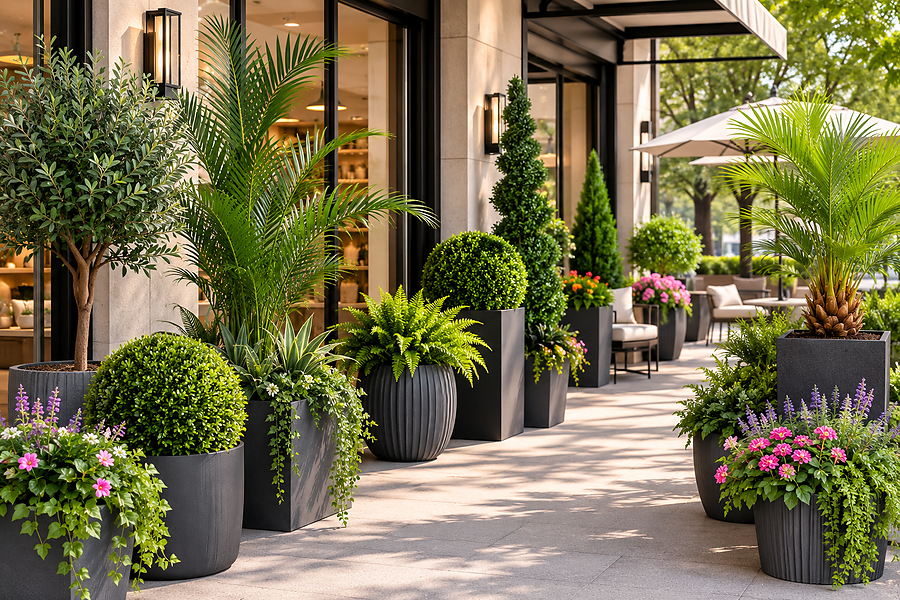
Artificial plants and flowers are becoming a larger commercial décor category. Persistence Market Research projects the global artificial plants and flowers market to grow from US$3.5 billion in 2025 to US$5.6 billion by 2032, with a 6.8% CAGR. This growth matters for retailers, hotels, restaurants, event rental companies, property managers, and wholesalers that need low-maintenance outdoor greenery with stronger visual consistency.
What Are the Best Artificial Outdoor Plants for B2B Buyers in 2025?
Many outdoor faux plants look good in photos. Only some are strong enough for storefronts, patios, hotels, events, and high-traffic commercial areas.
The best artificial outdoor plants for B2B buyers in 2025 are UV-resistant boxwood, topiary trees, faux palms, olive trees, eucalyptus, ferns, lavender, geraniums, hanging baskets, artificial hedges, and mixed greenery panels. They should match the business space, weather exposure, and maintenance plan.
Start with plants that solve commercial problems
B2B buyers do not buy outdoor plants only for decoration. They buy them to solve business problems. A retailer wants better curb appeal. A hotel wants a more welcoming entrance. A restaurant wants a patio that looks fresh every day. A property manager wants greenery without daily watering. An event rental company wants reusable décor that survives transport and installation.
That is why the “best” outdoor artificial plant depends on use case. A UV-resistant boxwood wall may be perfect for a retail photo corner. A pair of artificial topiaries may be better for a boutique entrance. A faux palm may work better for a resort patio. Eucalyptus and olive trees may suit modern cafés, hotels, and wellness brands.
| Artificial Outdoor Plant | Best B2B Use | Main Benefit |
|---|---|---|
| Boxwood panels | Storefront walls, privacy screens, photo zones | Structured and repeatable |
| Topiary trees | Entrances, hotel doors, retail fronts | Formal and polished |
| Faux palms | Resorts, restaurants, pools, patios | Tall tropical impact |
| Olive trees | Hotels, cafés, luxury retail | Soft Mediterranean style |
| Eucalyptus | Modern stores, spas, restaurants | Natural and neutral |
| Ferns | Hanging baskets, shaded patios | Soft texture |
| Lavender | Wellness, beauty, cafés, balconies | Color with calm mood |
| Geraniums | Window boxes, sidewalk planters | Bright curb appeal |
| Mixed greenery panels | Retail walls, event backdrops | Fast visual coverage |
Choose outdoor plants by viewing distance
A plant near a hotel entrance must look realistic up close. A greenery wall across a storefront must look full from the street. A patio planter must look good from seated guest level. A hanging basket must look natural from below.
This viewing distance changes the buying decision. For close-up areas, choose matte leaves, natural color variation, and high-quality stems. For large walls or distant displays, volume and coverage matter more. For outdoor event rentals, modular structure and durability matter most.
How Should Buyers Compare UV-Resistant Outdoor Artificial Plants?
UV resistance is one of the most important buying points. Without it, outdoor artificial plants can fade quickly in direct sun.
B2B buyers should compare UV-resistant outdoor artificial plants by checking material type, UV labels, weatherproof construction, leaf finish, color stability, stem strength, base weight, supplier samples, packaging, and reorder support. A low unit price is not enough.
UV protection protects the business image
Outdoor artificial plants are exposed to sunlight, heat, dust, rain, and wind. Scientific research on outdoor material exposure explains that solar UV radiation causes gradual photodegradation in synthetic materials used outdoors. For artificial plants, this can show up as pale leaves, yellowing, brittle stems, chalky surfaces, and weak plastic.
The Spruce also notes that many faux plants are not designed for outdoor conditions and recommends outdoor-safe products made with UV-resistant and weatherproof materials such as PE, polyblend plastics, or PVC.
Check the label, then test the sample
Product labels are useful, but they are not enough. A buyer should still request samples and test them. Place samples in sun and shade. Wipe the leaves. Bend the stems. Check whether leaves detach. Look at the product under daylight, warm light, and camera flash.
| Quality Check | What to Look For | Why It Matters |
|---|---|---|
| UV label | UV-resistant, UV-protected, fade-resistant | Helps slow sun fading |
| Material | PE, PVC, polyblend, treated plastic | Better outdoor durability |
| Leaf finish | Matte, not glossy | Looks more realistic |
| Color | Natural green tones, not neon | Protects premium appearance |
| Stem strength | Flexible and secure | Supports installation |
| Base | Weighted or easy to anchor | Helps with wind |
| Cleaning | Wipeable surfaces | Reduces maintenance pressure |
| Packaging | Protected leaves and branches | Lowers shipping damage |
Understand “UV-resistant” correctly
UV-resistant does not mean fade-proof forever. It means the product is made to resist fading better than standard indoor artificial plants. A UV-resistant plant in full afternoon sun will still age faster than one under an awning or shaded patio.
A 2025 outdoor artificial plant guide recommends looking for UV-resistant materials, weatherproof construction, and labels such as UV-resistant, UV-protected, weatherproof, outdoor-safe, and fade-resistant. It also names PE, polyblend plastics, and PVC as common outdoor-friendly materials.
For B2B buyers, this means the safest approach is layered protection: buy UV-rated plants, use partial shade, rotate planters, clean regularly, and replace worn parts before the display looks old.
Which Artificial Outdoor Plants Work Best for Commercial Spaces?
A commercial plant display should support the customer journey. It should not block doors, collect too much dust, or look random.
The best artificial outdoor plants for commercial spaces are those matched to the business purpose. Retailers often need boxwood, geraniums, lavender, and hanging baskets. Hotels need palms, olive trees, topiaries, and premium planters. Restaurants need eucalyptus, ferns, herbs, and compact greenery.
Best choices for retail stores
Retail stores need outdoor plants that attract attention from the street. Boxwood panels, window box flowers, lavender, geraniums, and topiaries work well because they create clean, visible shape.
Retail design is also becoming more experience-focused. Planterra notes that plants and high-quality faux greenery can help shape emotion, increase dwell time, and support retail experience. This makes outdoor artificial plants useful for storefronts, photo corners, seasonal displays, and entrance framing.
| Retail Area | Best Artificial Outdoor Plant | Display Goal |
|---|---|---|
| Entrance | Topiary trees, lavender planters | Welcome customers |
| Window boxes | Geraniums, petunias, greenery | Add color |
| Storefront wall | Boxwood panels, mixed greenery | Create photo-friendly impact |
| Sidewalk display | Weighted planters with shrubs | Guide attention |
| Seasonal campaign | Modular flowers and greenery | Refresh quickly |
Best choices for hotels and hospitality
Hotels need plants that feel premium and calm. Olive trees, palms, magnolia-style greenery, topiaries, and structured planters work well. A hotel entrance should not look cluttered. It should feel intentional.
For hospitality buyers, planter quality matters as much as plant quality. A realistic artificial olive tree in a cheap plastic pot can still look weak. Use ceramic, stone-look, fiberglass, metal, or concrete-style planters for a better guest impression.
Best choices for restaurants and cafés
Restaurants need outdoor plants that look warm, but they also need to be easy to clean. Eucalyptus, ferns, lavender, artificial herbs, geraniums, and compact shrubs are useful. They can soften patio edges, frame seating, and make an outdoor dining area feel more inviting.
Avoid plants that drop small parts or block service paths. Outdoor restaurant displays should be stable, wipeable, and easy for staff to move when needed.
Best choices for event rental companies
Event rental companies should focus on modular outdoor artificial plants. Boxwood panels, greenery walls, artificial hedges, garlands, arch greenery, and weighted potted plants can be reused across weddings, brand events, hotel activations, and retail pop-ups.
For rental use, the best plant is not only realistic. It must survive packing, transport, installation, cleaning, and repeat use.
How Can B2B Buyers Choose the Right Supplier and Maintain Outdoor Plants?
A strong outdoor plant display depends on both product quality and supplier reliability. A weak supplier can create hidden cost.
B2B buyers should choose suppliers that provide samples, material details, UV information, stable colors, strong packaging, realistic product photos, MOQ clarity, lead time transparency, and reorder support. After installation, buyers should clean, rotate, secure, and store plants properly.
Supplier checks before bulk ordering
A bulk order should never depend only on catalog images. Buyers should ask for close-up photos, videos, samples, carton details, MOQ, lead time, material information, and UV claims. For outdoor plants, ask whether the product is meant for full sun, partial shade, or covered outdoor use.
| Supplier Question | Why It Matters |
|---|---|
| Can samples ship before bulk order? | Reduces buying risk |
| What materials are used? | Confirms outdoor suitability |
| Is the product UV-resistant? | Protects against fading |
| Can the same SKU be reordered? | Supports long-term inventory |
| How are leaves packed? | Reduces crushing |
| What is the MOQ per style? | Helps buying plan |
| Can planters be customized? | Supports branded projects |
| Are replacement parts available? | Helps maintain displays |
Maintenance protects ROI
Outdoor artificial plants are low maintenance, not no maintenance. Businesses should build a simple care schedule.
| Timing | Maintenance Task | Best Practice |
|---|---|---|
| Weekly | Visual check | Remove debris and check loose parts |
| Every 2–4 weeks | Dust or wipe leaves | Use microfiber cloth or soft brush |
| Monthly | Rotate planters | Reduce one-sided fading |
| After storms | Check stability | Inspect bases, hooks, panels, and ties |
| Seasonally | Replace faded accents | Refresh only worn pieces |
| After campaigns | Store indoors | Clean, dry, reshape, and label boxes |
Use UV spray as extra protection
Clear UV protectant spray can help slow fading when used correctly. It works best on clean, dry, new plants. Test one hidden leaf first. Apply light coats. Let the plant dry fully before returning it outdoors.
Southern Living’s outdoor décor guidance recommends UV-protectant spray, shaded placement, and rotating larger outdoor décor pieces to reduce uneven fading.
Store seasonal displays like inventory
Seasonal plants should not be crushed into random boxes. Clean them first. Dry them fully. Reshape leaves and branches. Store them in roomy labeled cartons. Separate white flowers from dark dyed pieces to avoid color transfer.
For B2B buyers, good storage turns artificial plants into reusable inventory. Poor storage turns them into damaged stock.
My insights: The Best Artificial Outdoor Plants for 2025 B2B Buyers
Many buyers ask which outdoor artificial plant looks most real. That matters, but it is not enough for business use.
The best artificial outdoor plants for 2025 are the plants that balance realism, UV resistance, weather performance, installation safety, easy cleaning, supplier reliability, and long-term reuse. B2B buyers should choose plants by location, customer experience, and maintenance capacity, not only by style.
The best plant depends on the business goal
My main insight is that B2B buyers should not buy one “best” plant for every space. A retail storefront needs attention. A hotel entrance needs luxury. A restaurant patio needs warmth. An event rental company needs modular reuse. A property manager needs durability and simple care.
This changes the buying framework:
| Business Goal | Best Artificial Outdoor Plant Strategy |
|---|---|
| Increase storefront appeal | Use boxwood, geraniums, lavender, and topiaries |
| Upgrade hotel entrances | Use olive trees, palms, topiaries, and premium planters |
| Improve restaurant patios | Use eucalyptus, ferns, lavender, and compact shrubs |
| Build photo zones | Use boxwood panels and mixed greenery walls |
| Support event rentals | Use modular hedges, garlands, panels, and potted plants |
| Reduce maintenance | Choose UV-rated, wipeable, easy-clean materials |
| Protect margins | Buy durable products with reorder support |
Quality should beat quantity
A few premium outdoor artificial plants usually create a better commercial impression than many cheap ones. A pair of realistic topiaries can frame a doorway. A clean boxwood wall can become a branded photo spot. A well-placed olive tree can make a patio feel finished. Too many low-quality plants can make the space look fake and cluttered.
The strongest buyers think in systems
The best B2B buying strategy is a system. Choose UV-resistant products. Match plant types to business spaces. Test samples. Confirm supplier support. Use weighted planters. Build modular displays. Clean and rotate plants. Store seasonal pieces properly.
This system helps businesses protect visual quality and reduce replacement cost. It also helps buyers create outdoor displays that stay useful across seasons, campaigns, and locations.
In 2025, artificial outdoor plants are not just filler décor. They are commercial design assets. When buyers choose the right products and maintain them correctly, they can improve curb appeal, guest impressions, retail experience, and long-term décor ROI.
Conclusion
The best artificial outdoor plants for 2025 are realistic, UV-resistant, weather-ready, stable, easy to maintain, and matched to each B2B display need.