
Commercial interiors need greenery, but live plants can fail in low light, busy lobbies, and hard-to-maintain spaces. Poor choices waste money and weaken the design.
Eco-friendly artificial plants offer a practical way to bring nature-inspired design into commercial interiors in 2025. They reduce daily maintenance, avoid irrigation needs, support long-term visual consistency, and work well in offices, hotels, retail stores, healthcare spaces, and restaurants when buyers choose safer materials, durable construction, and responsible suppliers.
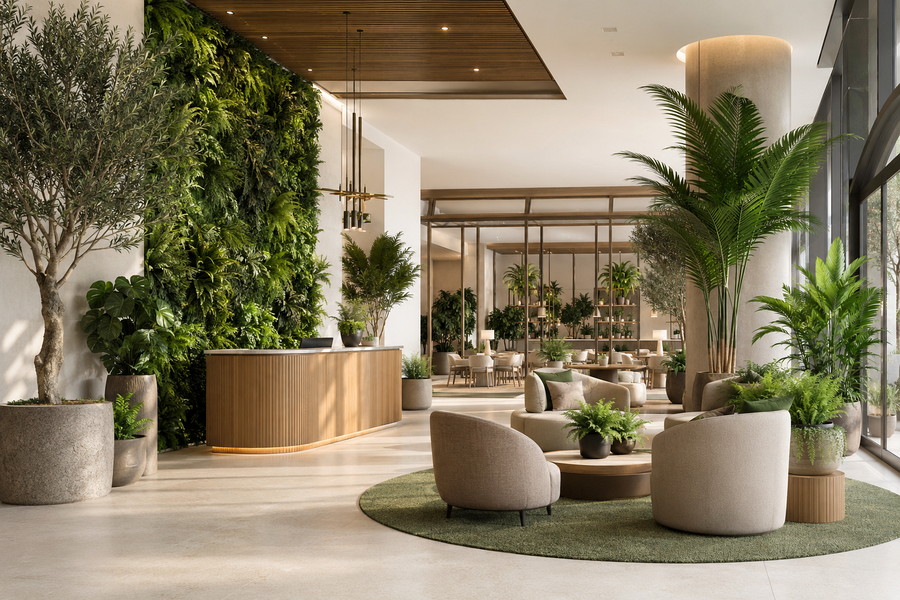
In 2025, sustainable commercial interior design is no longer only about recycled floors or low-energy lighting. It is also about smarter decorative choices that last longer, create a calmer space, and reduce waste from constant replacement. LEED v5 focuses on near-zero carbon, people, and resilience, while WELL recognizes biophilia through plants, natural patterns, green walls, daylight, and nature-inspired textures.
Are Eco-Friendly Artificial Plants Suitable for Outdoor and Indoor Commercial Spaces?
Many commercial spaces look unfinished without greenery. The problem is that real plants do not always match the building conditions, especially in low-light interiors, rooftops, corridors, and busy entrances.
Eco-friendly artificial plants can be suitable for both indoor and selected outdoor commercial spaces when the product is matched to the environment. Indoor areas need realistic texture and low-emission materials, while outdoor areas need UV-resistant, weather-safe, and durable construction to reduce fading, damage, and early replacement.
Match the Plant to the Space
Artificial plants are not automatically sustainable just because they require less care. They become more responsible when they are chosen for the right location and used for a long time. For indoor commercial interiors, the key needs are realism, stable color, safe materials, and easy cleaning. For exterior-facing areas, the key needs are UV resistance, weather resistance, and strong installation.
Commercial plant suppliers often position artificial foliage for offices, lobbies, hospitality spaces, healthcare settings, retail spaces, and high-traffic interiors. Some suppliers also offer UV-resistant and fire-rated options for commercial use, which matters when a project must meet building performance needs.
| Commercial area | Best artificial plant solution | Sustainability benefit |
|---|---|---|
| Office lobby | Statement trees and planters | Long-lasting first impression |
| Hotel entrance | UV-resistant exterior foliage | Less watering and replacement |
| Retail display | Modular artificial green wall | Reusable seasonal backdrop |
| Restaurant corner | Fire-rated faux greenery | Safer decorative layer |
| Healthcare corridor | Soil-free artificial plants | Easier cleaning and fewer allergens |
Think Beyond “Fake or Real”
A better question is not whether artificial plants are better than real plants in every case. They are not. Live plants can support air quality and deeper human-nature connection. But in commercial interiors with no daylight, high foot traffic, limited maintenance budgets, or strict hygiene rules, artificial plants may be the more practical choice.
A responsible design plan can combine both. Live plants can go where they can thrive. Eco-friendly artificial plants can fill low-light zones, high shelves, wall features, and branded photo areas. This hybrid approach helps the whole interior stay green, clean, and visually stable without forcing living plants into conditions where they will fail.
What Types of Businesses Benefit Most from Sustainable Faux Greenery?
Some businesses want a natural look, but they cannot manage daily watering, pruning, soil care, pest control, or constant plant replacement. This creates a gap between design goals and real operations.
Businesses that need attractive, low-maintenance, and consistent greenery benefit most from sustainable faux greenery. Offices, hotels, restaurants, retail stores, healthcare spaces, event venues, and multi-tenant buildings can use artificial plants to improve visual warmth while controlling maintenance, cleaning, and long-term replacement costs.
The Best Use Cases Are Operational
Artificial plants work best when the design problem is practical. A hotel may need a green lobby that looks fresh every day. A restaurant may need plants near dining areas without soil, insects, or watering schedules. A retail brand may need a reusable green wall for product launches. A corporate office may want biophilic design in conference rooms with limited daylight.
Research on biophilic office design shows that immersive biophilic environments can improve workplace satisfaction and cognitive performance while reducing stress. This does not mean every faux plant delivers the same wellness value as living nature, but it does show why green visual cues matter in work settings.
| Business type | Common pain point | Practical faux greenery solution |
|---|---|---|
| Corporate office | Low-light rooms and busy schedules | Large planters, green dividers, reception trees |
| Hotel | Need for year-round luxury appearance | Lobby trees, floral accents, exterior planters |
| Restaurant | Cleaning and pest control concerns | Soil-free tabletop and wall greenery |
| Retail | Frequent campaign changes | Modular artificial green walls |
| Healthcare | Hygiene and allergy concerns | Easy-clean artificial foliage |
| Event venue | Fast setup and repeat use | Reusable floral and greenery installations |
Greenery Also Supports Brand Feeling
Commercial interiors communicate before staff speak. A plain lobby can feel cold. A retail store without texture can feel flat. A hotel corridor without softness can feel forgettable. Artificial plants help soften hard surfaces, add depth, and guide movement through a space.
The best result comes from restraint. A few realistic trees can do more than a crowded mix of cheap plastic leaves. A green wall should match the brand color palette. Planters should look as considered as furniture. In sustainable commercial interiors, faux greenery should not look disposable. It should look planned, durable, and easy to maintain.
How Long Do Artificial Green Walls and Faux Plant Installations Last?
Cheap artificial plants often become waste quickly. They fade, collect dust, break, and make a commercial space look old before the next renovation cycle.
High-quality artificial green walls and faux plant installations can last for years when buyers choose commercial-grade materials, proper placement, UV protection where needed, fire-rated options where required, and a basic cleaning schedule. Longevity is the main factor that makes artificial greenery more sustainable.
Longevity Is the Sustainability Test
The EPA’s waste hierarchy places source reduction and reuse above recycling, and it identifies waste prevention as the most environmentally preferred strategy. This matters for artificial plants because the greenest faux plant is usually not the newest one. It is the one that stays useful, attractive, and safe for many years.
Commercial artificial plant providers often state that premium artificial plant installations can perform well for five to ten years or longer, depending on product selection, environment, and placement. That lifespan can reduce repeat purchasing, shipping, installation waste, and décor disruption.
| Factor | Why it matters | Better choice |
|---|---|---|
| Material quality | Weak plastic fades and cracks faster | Recycled, recyclable, or higher-grade polymers |
| UV exposure | Sunlight can damage indoor-grade products | Verified UV-resistant foliage |
| Fire requirements | Commercial interiors may require compliant décor | Fire-rated artificial plants |
| Cleaning access | Dust shortens visual life | Reachable layouts and washable leaves |
| Design style | Trendy pieces age faster | Natural, timeless plant species |
Maintenance Still Matters
Artificial plants are low maintenance, not no maintenance. They still need dusting, occasional cleaning, and periodic inspection. In a hotel lobby, staff can add plant cleaning to the normal housekeeping schedule. In an office, facility teams can dust large leaves and check planters during routine cleaning. In a restaurant, grease and dust may build faster, so the cleaning plan should be stricter.
Designers should also avoid placing artificial plants where they will look impossible. For example, a tropical tree in a dark, cold, narrow stairwell may feel fake. A shaded lobby planter with a realistic ficus, olive tree, fern mix, or trailing foliage may feel more natural. The best sustainable faux greenery lasts longer because it is visually believable, easy to clean, and suited to the space.
What Should Commercial Buyers Check Before Choosing Eco-Friendly Artificial Plants?
Many products are marketed as green, but not every artificial plant is truly eco-friendly. Some use petroleum-based plastics, mixed materials, weak coatings, or unclear sourcing.
Commercial buyers should check material transparency, recycled or recyclable content, UV resistance, fire safety, supplier documentation, durability, cleaning needs, and end-of-life options. A sustainable artificial plant should be safe for the interior, suitable for the environment, and designed to stay in use as long as possible.
Ask Better Purchasing Questions
Eco-friendly artificial plants should be judged like any other commercial interior material. Buyers should ask what the leaves, stems, wire, base, and planter are made from. They should ask whether the product contains recycled content or recyclable materials. They should ask whether coatings are low odor, stable, and suitable for indoor commercial use.
Some sustainability discussions warn that many faux plants are made from petroleum-based plastics and can be difficult to recycle if the materials are not clearly disclosed. More responsible purchasing means choosing non-toxic materials, checking recyclable plastics such as PET or HDPE when available, and avoiding vague green claims.
| Buyer question | Why it matters |
|---|---|
| Is the product rated for indoor or outdoor use? | Prevents early fading and replacement |
| Does it meet fire safety needs? | Supports commercial code review |
| What materials are used? | Helps assess toxicity and recyclability |
| Is there recycled content? | Supports circular material goals |
| Can parts be replaced? | Extends product life |
| How is it cleaned? | Protects appearance and hygiene |
| Is packaging reduced or recyclable? | Cuts project waste |
Safety Is Part of Sustainability
Commercial interiors must balance beauty with compliance. In the US, decorative elements in hospitality, healthcare, retail, office, and multi-occupancy buildings may need to meet fire safety expectations, and commercial fit-out guidance often points buyers toward verified fire-resistance certification instead of standard décor products.
Sustainability also includes indoor environmental quality. Commercial sustainable design often focuses on responsible materials, water and energy, and healthy interior conditions. Low-VOC finishes, recycled textiles, reclaimed materials, daylight, acoustics, and biophilic design all work together. Artificial plants should fit that wider plan instead of acting as a decorative afterthought.
My insights: How Can Eco-Friendly Artificial Plants Become a Sustainable Solution for Commercial Interiors in 2025
A commercial interior can look green without being sustainable. The real question is whether each plant choice reduces waste, supports the user experience, and fits the building’s long-term use.
Eco-friendly artificial plants become a sustainable solution for commercial interiors in 2025 when they are treated as long-life design assets, not disposable decorations. The best choices combine durable materials, realistic design, low maintenance, safe installation, flexible reuse, and honest environmental claims.
The Real Value Is Lifecycle Thinking
The most useful insight is simple: sustainability is not only about the plant itself. It is about the full lifecycle. A cheap artificial green wall that fades after one year is not sustainable. A premium modular green wall that can be moved, cleaned, repaired, and reused across several campaigns may be a better choice. A large artificial tree that replaces short-lived floral displays in a hotel lobby may reduce repeat purchasing. A reusable faux greenery backdrop for events can reduce waste from one-time installations.
This is where commercial interiors in 2025 are changing. Designers are not only asking, “Does it look good?” They are asking, “How long will it last? Can it be cleaned? Can it be reused? Does it support wellness? Does it reduce maintenance pressure? Does it align with the brand’s sustainability message?”
A Practical Selection Framework
| Sustainability goal | Artificial plant strategy | Result |
|---|---|---|
| Reduce waste | Choose long-life, repairable products | Fewer replacements |
| Reduce water use | Use faux greenery in no-irrigation zones | Lower operational burden |
| Support wellness design | Add biophilic visual cues | Warmer, calmer interiors |
| Improve flexibility | Use modular green walls and movable planters | Easier reuse |
| Improve transparency | Ask for material and safety documentation | Stronger purchasing decisions |
| Protect brand image | Avoid cheap, glossy, unrealistic products | More credible design |
The Best Approach Is Balanced
Eco-friendly artificial plants should not pretend to be living ecosystems. They do not clean air like healthy live plants, and they do not replace outdoor nature. But they can solve real commercial problems when used honestly. They keep greenery in places where living plants struggle. They reduce water and maintenance needs. They help brands create calm, welcoming, nature-inspired spaces with fewer operational risks.
The strongest 2025 strategy is a mixed strategy. Use live plants where there is light, care, and good growing conditions. Use eco-friendly artificial plants where durability, safety, hygiene, or access matters more. This balanced method makes commercial interiors greener in appearance and smarter in performance.
Conclusion
Eco-friendly artificial plants work best as durable, safe, reusable design tools that support sustainable commercial interiors without adding unnecessary maintenance or waste.