
Cold corners, empty walls, and oversized lobbies can make hotels feel unfinished. Poorly selected greenery, however, can look artificial and create unnecessary maintenance problems.
Hotel décor faux plants create stylish interiors by adding color, scale, softness, and nature-inspired character without daily watering or seasonal replacement. The strongest results come from realistic materials, carefully scaled arrangements, premium planters, layered lighting, safe placement, scheduled cleaning, and designs that reflect the hotel’s location and brand identity.
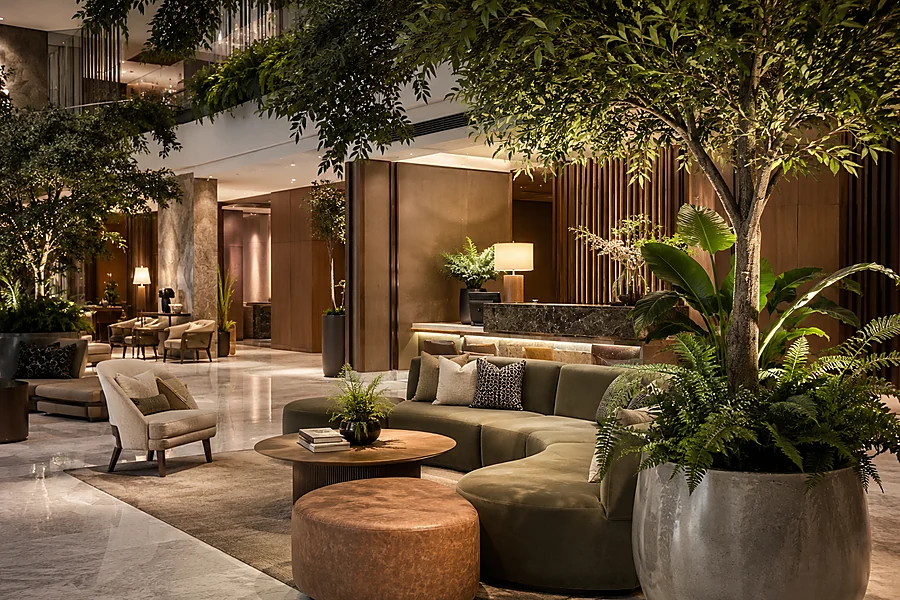
Nature-inspired hotel interiors succeed when greenery connects with natural light, materials, textures, movement, lighting, furniture, and memorable details, rather than serving as an isolated decorative artificial tree without broader integration.
Are Faux Plants a Good Choice for Hotel Interiors?
Hotel greenery must look attractive every day. Living plants can be unsuitable in dark corridors, air-conditioned rooms, high shelves, or areas where staff cannot provide consistent horticultural care.
Faux plants are a strong choice for hotels that need predictable, reusable, low-maintenance greenery in difficult locations. They work especially well in lobbies, guestrooms, restaurants, spas, corridors, meeting areas, and seasonal displays. They are less suitable when natural fragrance, living growth, or a genuine botanical experience is central to the hotel concept.
What advantages do artificial plants provide?
Artificial hotel plants do not require watering, fertilizing, pruning, soil replacement, or access to suitable growing light. This allows designers to place greenery according to visual need rather than biological survival.
They can also maintain a consistent shape across multiple properties. A hotel group can approve one olive tree, orchid arrangement, or planter insert and repeat the design in several branches.
| Hotel Requirement | Faux-Plant Benefit |
|---|---|
| Consistent brand appearance | Approved styles can be repeated across locations |
| Low-light interiors | No growing light is required |
| Difficult access | Less frequent servicing than living plants |
| Early installation | Displays can be prepared before opening or renovation |
| Seasonal campaigns | Products can be stored and reused |
| Predictable dimensions | Plant height and canopy remain controlled |
| Event flexibility | Stems and arrangements can be restyled |
| Water-sensitive surfaces | No routine irrigation near furniture or electronics |
What are the limitations?
Artificial plants are low maintenance, not maintenance-free. Dust, fingerprints, cooking residue, moisture, direct sunlight, and repeated guest contact can reduce their appearance.
Poor-quality products may also have:
- Glossy leaves
- Flat colors
- Exposed glue
- Identical repeated branches
- Weak stems
- Unstable planters
- Strong unpacking odors
- Fabric petals that fray
- Coatings that become sticky
Artificial greenery also does not provide every quality associated with living plants. It does not grow, release natural fragrance, respond to seasons, or create a genuine horticultural experience.
Faux, living, or hybrid?
A hybrid strategy is often the strongest hotel solution.
Living plants can be used in visible areas with suitable daylight and reliable maintenance. Faux plants can serve dark corridors, tall shelves, ceiling installations, windowless meeting spaces, and difficult-to-access displays.
| Hotel Area | Recommended Direction |
|---|---|
| Sunlit conservatory | Living or hybrid planting |
| Windowless corridor | Faux plants |
| Reception desk | Premium faux orchids or rotating fresh flowers |
| Restaurant tables | Compact faux, fresh, or hybrid arrangements |
| High atrium ledges | Lightweight secured faux greenery |
| Spa relaxation room | Faux or living plants based on light and humidity |
| Seasonal lobby display | Reusable faux structure with replaceable accents |
| Outdoor entrance | UV-rated faux plants or climate-suitable living plants |
The right question is therefore not whether faux plants are universally better. The hotel should decide where their consistency and installation flexibility create the most value.
Where Should Hotels Place Artificial Plants for Maximum Impact?
Adding small plants to every available surface can make an interior feel cluttered. Strong hotel styling uses fewer, better pieces to create hierarchy and guide movement.
Hotels should place artificial plants where they frame arrivals, soften hard architecture, define seating zones, improve empty corners, add privacy, or create memorable focal points. Plant scale should match the room, while planters must remain clear of doors, accessible paths, exit routes, service access, and guest sightlines.
Hotel entrances and reception areas
The entrance establishes the first visual impression. A matched pair of artificial topiaries, olive trees, or palms can frame the doorway and lead attention toward reception.
Inside the lobby, large statement trees can balance tall ceilings or wide areas. They should not hide reception staff, directional signs, security views, or door operations.
Effective reception options include:
- Tall olive trees for Mediterranean hotels
- Palms for tropical and resort properties
- Ficus or maple trees for contemporary urban hotels
- Flowering branches for luxury reception desks
- Orchids for compact premium arrangements
- Green walls behind reception or lounge seating
Large pieces should feel architectural. A small plant placed in an oversized lobby usually disappears visually and adds little value.
Lobby seating and circulation zones
Planters can separate seating areas without building permanent partitions. Long troughs with grasses or mixed greenery can define lounge zones, coworking tables, restaurant queues, and waiting spaces.
However, hotel furnishings and decorations must not obstruct required circulation. OSHA requires workplace exit routes to remain free and unobstructed, and the 2010 ADA Standards require continuous accessible routes through public spaces. Hotels should verify the final layout against applicable accessibility, building, and fire requirements.
| Placement Goal | Suitable Faux Plant |
|---|---|
| Frame reception | Matching topiaries or trees |
| Define a seating zone | Long planter with grasses |
| Fill a tall corner | Olive tree, ficus, or palm |
| Soften stone columns | Narrow trees or trailing greenery |
| Create privacy | Hedge panels or planter dividers |
| Build a photo point | Branded green wall |
| Hide service areas | Modular foliage screens |
| Draw attention upward | Secured hanging vines or ceiling greenery |
Guestrooms and suites
Guestroom plants should support calmness without taking useful space from luggage, work surfaces, or circulation.
Suitable choices include:
- A small orchid on a console
- A single fern or monstera in an empty corner
- Eucalyptus stems in a bathroom-safe vase
- A compact succulent on a desk
- A decorative branch beside a lounge chair
Avoid placing large arrangements where guests may repeatedly knock them over. Products near beds, food surfaces, or bathrooms should be easy to clean and made from suitable materials.
Restaurants, bars, and spas
Restaurant plants can define seating and soften acoustically hard interiors, but leaves should not touch food, glassware, serving stations, or guests.
Bar décor can use dramatic greenery above back counters or around shelving when attachment, cleaning access, and fire requirements are controlled.
Spa interiors benefit from restrained greenery, neutral colors, natural textures, and soft lighting. Current hotel-design commentary emphasizes atmosphere, layered illumination, and connection with the outdoors rather than decorative excess. Faux plants work best when they support those elements.
Corridors, meeting rooms, and event spaces
Corridor décor should be narrow and stable. Use wall-mounted greenery, compact planters, or recessed arrangements rather than wide branches that project into the path.
Meeting and event spaces benefit from modular plants that can be moved between layouts. Mobile planters should have commercial-rated casters, locks, stable bases, and documented filled weights.
How Should Hotels Choose Realistic and Safe Faux Plants?
A product can look convincing in a supplier’s photograph but appear shiny, undersized, unstable, or poorly constructed in a hotel.
Hotels should choose faux plants by botanical realism, material, size, color, viewing distance, lighting, construction, cleaning requirements, planter stability, fire documentation, and supplier consistency. Physical samples should be shaped, photographed, cleaned, handled, and compared under the hotel’s actual lighting before bulk approval.
Match realism to viewing distance
A lobby tree viewed from several meters away needs a believable silhouette, natural branching, and correct scale. A reception orchid viewed from close range needs better petal texture, flower centers, leaf details, and hidden glue points.
| Viewing Distance | Main Quality Priority |
|---|---|
| Close-up desk display | Petal texture, color gradients, clean construction |
| Guestroom corner | Natural silhouette and premium planter |
| Large lobby | Scale, canopy, trunk realism, stability |
| High shelf | Shape and visible color |
| Green wall | Density, mixed foliage, hidden backing |
| Ceiling installation | Low weight and secure attachment |
| Outdoor entrance | UV resistance and planter stability |
Check the complete material system
Modern faux plants may combine polyester, polyethylene, PVC, polyurethane, wire, glue, foam, fiberglass, natural wood, paint, and surface coatings.
The hotel should request a component specification rather than accepting a general term such as “silk plant.”
| Component | Quality Check |
|---|---|
| Leaves | Matte finish, natural veins, secure attachment |
| Flowers | Realistic color, clean edges, no visible glue |
| Stem | Flexible but supportive |
| Internal wire | Fully covered and protected |
| Trunk | Natural scale and secure construction |
| Adhesive | No residue, odor, or loose components |
| Planter | Stable, durable, and correctly scaled |
| Ballast | Contained and placed low |
| Top dressing | Secure, cleanable, and non-shedding |
| Packaging | Prevents permanent crushing |
Test samples in the hotel
Place the sample in its intended location and review it during daytime and evening operations.
A useful approval process includes:
- Unpack and record its condition.
- Allow time for odors to dissipate.
- Reshape the leaves and branches.
- Photograph it under actual hotel lighting.
- View it from normal guest distances.
- Wipe a hidden area with the proposed cleaning method.
- Test branch and flower-head attachment.
- Check planter stability.
- Repack and reopen it.
- Approve a signed master sample.
Hotel guests often notice lighting and distinctive objects because these elements contribute to the atmosphere and memory of a destination. Faux plants should therefore be reviewed with the lighting, furniture, materials, and surrounding decorative story—not as isolated catalog products.
Verify fire and installation requirements
Artificial greenery can be combustible. NFPA guidance states that combustible artificial decorative vegetation covered by NFPA 1 must meet the relevant NFPA 701 test methods. Local adoption, building use, installation size, and authority requirements vary, so hotels should obtain product-specific documentation and approval for the complete installation.
Ask the supplier for:
- Exact tested SKU
- Test method and edition
- Laboratory report
- Sample description
- Installation limitations
- Treatment durability
- Retesting requirements
- Confirmation that bulk production matches the tested construction
A certificate for one fabric or raw material may not cover the finished tree, backing grid, adhesive, planter filling, or ceiling installation.
Use a supplier scorecard
| Selection Area | Suggested Weight |
|---|---|
| Realism and visual quality | 25% |
| Construction and durability | 20% |
| Cleaning performance | 15% |
| Safety and test documentation | 15% |
| Packaging and delivery recovery | 10% |
| Reorder consistency | 10% |
| Price and commercial terms | 5% |
The lowest unit price should not outweigh visible defects, unstable planters, weak documentation, or high replacement labor.
How Can Hotel Teams Maintain Faux Plants Efficiently?
A beautiful installation can become dusty and neglected when responsibility is unclear. Maintenance should be assigned before the plants arrive.
Hotel teams should maintain faux plants through location codes, approved cleaning methods, routine inspections, damage records, modular replacement, and seasonal storage. High-touch restaurant and lobby plants need more frequent attention than protected plants in guestrooms or low-traffic areas.
Create an asset register
Record each major display using:
- Property and department
- Location code
- Product SKU
- Supplier
- Installation date
- Material
- Cleaning method
- Fire or UV documents
- Warranty
- Replacement parts
- Inspection frequency
- Storage location
This makes it easier to identify recurring defects, compare suppliers, and reorder matching products.
Use a practical cleaning schedule
| Location | Visual Check | Cleaning Direction |
|---|---|---|
| Reception desk | Daily | Light dusting as required |
| Main lobby trees | Weekly | Microfiber wipe or soft brush |
| Restaurant arrangements | Frequent | Method approved for food-service setting |
| Guestrooms | During normal room servicing | Inspect and dust |
| Green walls | Monthly or site-specific | Vacuum with soft attachment or approved method |
| High installations | Scheduled access | Professional maintenance |
| Outdoor products | Based on dust and weather | Approved wipe or gentle rinse |
| Stored seasonal décor | Before and after storage | Clean, dry, reshape, and label |
Always begin with the least aggressive method. Strong solvents, abrasive pads, excessive water, and unapproved sprays may damage color, coatings, glue, fabric, or electrical features.
Design for quick replacement
Modular hotel arrangements reduce downtime.
A strong system may use:
- Permanent artificial greenery as the base
- Replaceable flower stems for seasonal color
- Removable planter liners
- Interchangeable reception arrangements
- Replaceable green-wall panels
- Spare leaves, flowers, and connectors
- Standardized planters across several locations
This allows a hotel to replace one faded orchid, damaged branch, or wall panel rather than discarding the complete display.
Track the total cost
Artificial plants should be evaluated as operational assets, not only decorative purchases.
Total lifecycle cost = purchase + freight + installation + cleaning + repairs + storage + replacement + disposal
| Cost Factor | Common Oversight |
|---|---|
| Freight | Large trees have high dimensional volume |
| Installation | Tall products may need access equipment |
| Shaping | Compressed plants require staff time |
| Cleaning | Fine foliage takes longer than broad leaves |
| Repairs | Matching spare parts may be unavailable |
| Storage | Seasonal décor needs protected space |
| Replacement | Cheap products may lose realism early |
| Branch consistency | Reorders may use different colors or materials |
A more expensive plant can offer better value when it ships safely, requires less reshaping, remains consistent, and supports replaceable parts.
My insights: Why Are Hotel Décor Faux Plants the Secret to Stylish Interiors?
Faux plants are not a secret because they replace every living plant. Their value comes from giving hotel designers control over scale, placement, color, and long-term presentation.
Hotel décor faux plants become the secret to stylish interiors when they work as part of a complete guest-experience system. They should support the hotel’s story, guide movement, improve visual balance, complement lighting and materials, remain safe and clean, and continue looking intentional after months of operation.
Stylish interiors use greenery with a purpose
Every plant should perform at least one role:
| Design Role | Example |
|---|---|
| Create arrival impact | Large trees beside reception |
| Guide movement | Repeated planters leading toward elevators |
| Define zones | Green dividers between lounge areas |
| Soften architecture | Trailing greenery near stone or metal surfaces |
| Add privacy | Hedge planters around restaurant seating |
| Create a focal point | Oversized olive tree or green wall |
| Support brand identity | Regional plant forms and custom planters |
| Refresh seasonally | Replaceable floral accents |
Plants without a clear purpose often become clutter.
The planter is part of the plant
A realistic tree in a cheap, undersized pot will rarely look luxurious. The planter should match the hotel’s materials, scale, and service conditions.
Luxury properties may use stone, metal, ceramic-look fiberglass, or textured composite planters. Boutique hotels may use handcrafted baskets or locally inspired finishes. Resorts may choose lightweight but heavily ballasted commercial containers.
The hotel should confirm:
- Planter proportions
- Filled weight
- Stability
- Floor protection
- Drainage for exterior use
- Cleaning access
- Anti-theft hardware
- Replacement liner access
Faux plants should support—not imitate—biophilic design
Nature-inspired design is most effective when its elements are integrated. Artificial greenery should therefore be combined with natural light, exterior views, organic forms, timber, stone, water references, botanical patterns, tactile materials, and comfortable spatial layouts.
Biophilic design guidance warns that inserting one disconnected natural object into a built environment produces limited value. The strongest hotel interiors create a connected habitat rather than adding random decorative greenery.
The strongest hotel formula
A practical hotel décor formula is:
One architectural plant + one textural layer + one controlled accent
For example:
- A large olive tree as the architectural element
- Eucalyptus or fern foliage for texture
- Seasonal white orchids as the accent
This creates depth without overcrowding the room. It also keeps maintenance and replacement manageable.
Final design rule
Use fewer plants, choose a larger and more appropriate scale, and place each one deliberately.
A premium faux plant should look like part of the architecture. It should not block movement, hide signs, gather visible dust, or appear as an afterthought.
That is why well-planned hotel décor faux plants can transform stylish interiors: they provide reliable greenery while allowing the design, housekeeping, engineering, and brand teams to maintain consistent control.
Conclusion
Hotel faux plants create stylish interiors through realistic quality, deliberate scale, safe placement, layered design, simple maintenance, and a strong connection to the property’s identity.