
Outdoor planters can tip, slide, lift, or obstruct walkways when wind, tall foliage, lightweight containers, and weak installation methods combine.
The top five outdoor planter anchoring solutions are surface-mounted center anchors, multi-point anchor plates or tabs, concealed structural brackets, earth-anchor systems, and cable or strap tie-down systems combined with low ballast. The safest choice depends on planter geometry, total installed weight, wind exposure, substrate, drainage, and site-specific structural requirements.
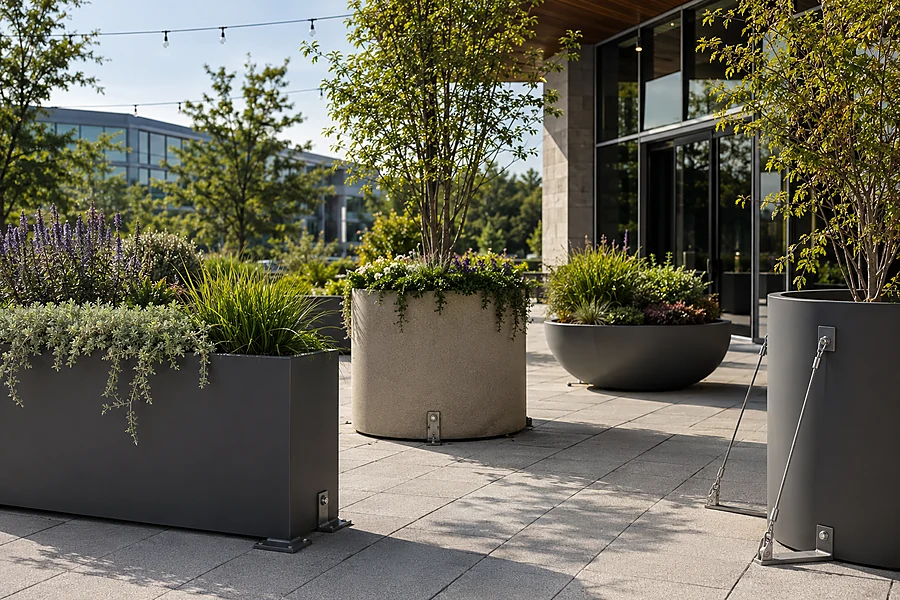
Commercial planter manufacturers offer anchor plates, surface-mount holes, welded bolt-down tabs, and concealed mounting systems because planter stability cannot be judged from empty weight alone. Landscape Forms, for example, recommends corrosion-resistant anchors appropriate to the supporting surface, while Tournesol specifies façade-appropriate anchors for its structural mounting systems.
Why Do Outdoor Planters Need Anchoring?
A planter may feel heavy when lifted, yet still overturn when wind pushes against a tall artificial tree, hedge, palm, or dense floral arrangement.
Outdoor planters need anchoring when wind, public access, planter height, narrow geometry, movable construction, theft risk, or elevated placement could cause sliding or overturning. Anchoring transfers part of those forces to a suitable supporting surface instead of relying only on planter weight and friction.
Wind creates both lateral and uplift forces
Wind does not simply push an outdoor planter sideways. Depending on its shape and location, wind can create lateral, overturning, and uplift effects.
FEMA guidance for exposed rooftop equipment recommends strengthening connections with hold-down connectors, anchors, and straps designed to resist wind forces. While commercial planters are not HVAC equipment, the same engineering principle applies: exposed items should be positively restrained when failure could create a hazard.
Planter risk increases with:
- Tall artificial trees
- Wide palm fronds
- Dense hedge screens
- Narrow planter bases
- Lightweight fiberglass construction
- Rooftop placement
- Building corners
- Coastal locations
- Open restaurant terraces
- Casters or smooth feet
The center of gravity matters
A planter with heavy material near the top can be less stable than one with the same total weight concentrated near the bottom.
That is why ballast should generally be positioned low and contained. Tall decorative liners, false bottoms, or lightweight foam should not place the majority of the mass high inside the planter.
| Condition | Stability Risk |
|---|---|
| Wide, low planter | Lower |
| Narrow, tall planter | Higher |
| Low artificial grass | Lower |
| Tall artificial palm | Higher |
| Ballast at bottom | Better stability |
| Ballast near top | Less effective |
| Sheltered courtyard | Lower exposure |
| Open rooftop | Higher exposure |
Public-space planters also affect circulation
Anchoring should never create a new accessibility or evacuation problem.
OSHA requires workplace exit routes to remain free and unobstructed.
The U.S. Access Board also states that protruding objects cannot reduce the required clear width of accessible routes. Its guidance explains that circulation-path rules apply to both interior and exterior routes.
This means the anchoring plan should consider not only whether the planter stays upright, but also whether the complete planter, foliage, brackets, cables, and fasteners remain safely outside required circulation space.
What Are the Top 5 Outdoor Planter Anchoring Solutions?
No single system works for every planter. A permanent concrete installation requires a different solution from a temporary event planter on soil.
The five strongest anchoring approaches are direct surface anchoring, multi-point anchor tabs, concealed structural brackets, earth-anchor systems, and secondary cable or strap restraint. Permanent public installations usually benefit from positive mechanical anchoring, while removable installations require carefully designed reversible systems.
1. Surface-mounted center anchor
A surface-mounted anchor connects the bottom of the planter directly to a structural surface.
Landscape Forms publishes a surface-mount method for its Rosa planter using a hole in the planter bottom and a corrosion-resistant anchor selected for the supporting surface. It also states that final anchoring hardware and procedure remain the installer’s responsibility.
This method works well for:
- Concrete plazas
- Hotel entrances
- Commercial patios
- Retail forecourts
- Fixed landscape installations
Advantages
- Hardware can remain largely hidden.
- The planter retains a clean appearance.
- One central connection can prevent casual movement.
- Installation can be relatively simple when the planter is designed for it.
Limitations
One central anchor may not provide adequate resistance for every tall or heavily wind-loaded planter.
The planter base also needs enough strength around the anchor point. Overtightening can damage some planter materials; Landscape Forms specifically warns against excessive tightening in its installation guidance.
Best for: compact or moderately sized surface-mount planters with manufacturer-approved base details.
2. Multi-point anchor plates or welded tabs
Larger planters often benefit from several connection points rather than one center bolt.
Planters Unlimited offers welded steel tabs for concrete bolt-down installation on some commercial metal planters. Tournesol also offers anchor-plate options across selected commercial planter ranges.
A multi-point system can distribute forces across the base.
Typical configurations include:
- Two anchor tabs
- Four corner tabs
- Internal base plates
- Concealed bolt-down flanges
- Manufacturer-supplied anchoring frames
| Feature | Benefit |
|---|---|
| Multiple connection points | Better force distribution |
| Steel tabs | Strong connection to metal planter body |
| Concealed internal plate | Cleaner exterior appearance |
| Replaceable bolts | Easier servicing |
| Corrosion-resistant hardware | Better outdoor durability |
When this solution is strongest
I consider this the strongest general solution for permanent freestanding commercial planters because it can resist movement in several directions while keeping the container independent from surrounding walls.
It is especially useful for:
- Long rectangular planters
- Artificial hedge dividers
- Tall trees
- High-traffic public spaces
- Windy hospitality terraces
The supporting slab and anchors still need to be suitable for the actual forces.
3. Concealed structural bracket or façade mounting
Some planters are mounted directly to a wall, façade, parapet, or structural frame instead of resting freely on the ground.
Tournesol’s commercial façade planter systems use mounting frames, cleats, appropriate building anchors, and safety bolts. Its Aloft system also integrates drainage with the supporting frame.
Its Wilshire planter system uses steel brackets and stainless mounting studs, while stating that final anchor hardware is selected by the contractor or project engineer.
This solution works for:
- Hotel balconies
- Building façades
- Parking structures
- Window-box installations
- Architectural terraces
- Elevated commercial planting
Why concealed mounting is effective
The structural frame can manage loads independently from the decorative planter wall.
A professional system may provide:
- Structural mounting frame
- Appropriate building anchors
- Planter cleats
- Safety bolts
- Integrated drainage
- Engineer-reviewed calculations
This is significantly more controlled than hanging a heavy planter from generic decorative brackets.
Major caution
Façade installation should not be improvised.
The wall construction, anchor type, waterproofing, load path, planter weight, wind exposure, and drainage all need to work together. Manufacturer and structural-project requirements should govern the final connection.
Best for: architectural and elevated installations where a structural frame can be incorporated.
4. Earth anchors for soil or landscaped sites
Concrete anchoring is not possible when planters sit on soil, gravel, decomposed granite, or landscaped areas.
For suitable ground conditions, commercial earth anchors can provide an underground tie-down point. Commercial ground-anchor systems are available in different lengths and can be connected to straps or cables.
A recent City of Berkeley project specification also illustrates a raised planter surface-mounted using an earth-anchor system, showing that ground anchoring can be incorporated into formal landscape design.
Potential applications include:
- Garden-event planters
- Outdoor venues
- Landscape paths
- Temporary hospitality installations
- Planters on suitable unpaved ground
Ground strength must be verified
Earth anchors depend heavily on soil conditions.
Loose fill, saturated soil, very soft ground, buried utilities, shallow landscaping systems, and unknown subsurface conditions can make a generic ground anchor unsuitable.
Therefore, anchor length should not be selected from planter height alone.
The design needs to consider:
- Soil condition
- Pullout resistance
- Planter load
- Wind exposure
- Connection hardware
- Corrosion
- Removal requirements
Best for: appropriate soft-ground installations where the anchor system has been selected for actual soil conditions.
5. Cable or strap tie-down with low ballast
Sometimes the planter cannot be drilled directly into the finished surface. A supplementary restraint system may then connect the planter or internal frame to an approved fixed anchor.
FEMA uses cables and straps as supplemental restraint methods for exposed rooftop components, illustrating how secondary connections can reduce the chance that equipment separates during high winds.
For planters, this concept may use:
- Concealed stainless cable
- Structural strap
- Internal eye bolt
- Fixed structural connection
- Low contained ballast
The cable or strap should connect to a suitable structural point—not to another lightweight decorative object.
Ballast supports the anchor; it does not replace it
Some commercial planter manufacturers offer counterweight systems as an alternative where direct floor fixing is not desired. Asgard, for example, describes planters that can either be anchored to the floor or fitted with a counterweight tray containing sandbags or blocks.
Ballast helps by:
- Increasing total mass
- Lowering the center of gravity
- Reducing casual movement
- Supporting temporary installations
However, ballast alone should not automatically be described as “anchoring.”
For demanding wind, rooftop, or public installations, I would treat it as one part of a stability system.
Top-five comparison
| Solution | Best Surface | Permanence | Visual Impact | Strongest Use |
|---|---|---|---|---|
| Center surface anchor | Concrete/masonry | Permanent | Very low | Compact commercial planters |
| Multi-point tabs/plates | Concrete/structural slab | Permanent | Low | Large planters and hedges |
| Concealed bracket/frame | Wall/façade | Permanent | Very low | Elevated architectural planters |
| Earth anchors | Suitable soil | Semi-permanent | Low | Landscape and event sites |
| Cable/strap + ballast | Site-specific | Removable/semi-permanent | Low when concealed | Restricted-drilling locations |
How Should Buyers Choose the Right Anchor for Each Surface?
The planter catalog should not determine the anchor by itself. The supporting site is just as important.
Buyers should choose planter anchors by identifying the substrate, planter size, installed weight, foliage height, wind exposure, drainage requirements, corrosion environment, removal needs, and manufacturer-approved attachment points. The final connection should be selected for both the planter and the supporting structure.
Concrete slab
A structural concrete surface can support many direct anchoring methods, including center anchors, multiple bolts, and anchor plates.
Before installation, the project team should confirm that drilling at the proposed location is permitted and appropriate.
Use manufacturer-designed planter holes or plates whenever possible rather than drilling randomly through the planter shell.
Pavers
Pavers create a more complicated condition.
Bolting only into a loose paving unit may not provide the same resistance as anchoring into structural material beneath it.
Potential options include:
- Anchoring into an approved structural base below
- Using a designed internal plate system
- Relocating the planter
- Using a reversible engineered restraint
The final method depends on the paving build-up.
Rooftops
Rooftop planters need extra caution because the installation can affect:
- Waterproofing
- Roofing membranes
- Drainage
- Structural loads
- Wind exposure
FEMA’s rooftop-equipment guidance emphasizes designed anchor and strap connections for high-wind exposure.
A planter should therefore not simply be drilled through the roof because an anchor is desired.
The roof assembly and building structure need to be considered together.
Decking
Timber and composite decks require confirmation that the planter connects to appropriate supporting structure rather than only a thin surface board.
Temporary planters may instead use:
- Low ballast
- Wider planter geometry
- Hidden structural connections
- Approved removable restraints
Façades and walls
Use a purpose-designed mounting system.
Tournesol’s façade planters illustrate this approach: the mounting frame is secured to the wall using anchors appropriate to the façade, and the planter then engages the frame and receives safety bolts.
Soil
Ground anchors may work, but the soil is part of the anchoring system.
Do not assume an anchor that performs in firm soil will have the same holding capacity in loose, saturated, disturbed, or shallow fill.
What Safety Checks Should Be Completed Before and After Installation?
Anchoring is not finished when the last bolt is tightened. Commercial installations need verification and inspection.
Safe planter installation requires checking the support surface, planter condition, hardware, drainage, clearances, foliage attachment, corrosion, and movement. Teams should inspect planters after installation, relocation, severe weather, impact, and any change to the plant height or ballast configuration.
Before installation
Use a basic site checklist:
| Question | Why It Matters |
|---|---|
| What is the supporting surface? | Determines anchor type |
| Is the planter designed for anchoring? | Prevents shell damage |
| What is the filled weight? | Affects structural and handling loads |
| How tall is the foliage? | Changes overturning leverage |
| Is the site windy? | Raises lateral and uplift risk |
| Is drainage required? | Prevents water accumulation |
| Is the site coastal? | Affects corrosion resistance |
| Must the planter move later? | Influences reversible systems |
| Is it near an exit? | Requires clear circulation |
| Is it on an accessible route? | Requires clearance review |
Check corrosion resistance
Landscape Forms specifically recommends corrosion-resistant anchoring hardware appropriate to the surface.
Coastal or poolside installations deserve additional attention because exposed metal hardware experiences more aggressive conditions.
Inspect:
- Bolts
- Nuts
- Washers
- Anchor tabs
- Cables
- Brackets
- Internal frames
- Base plates
Secure the plant inside the planter
Planter anchoring solves only half of the problem.
A tall artificial tree can pull free from an anchored planter when the stem is held only by lightweight foam.
Tournesol offers internal tie-down points on some large planters to retain trees.
For artificial installations, the main trunk or plant module should connect to a rigid internal structure where pullout could create risk.
Maintain exits and accessible routes
Planters should not migrate into circulation space after cleaning or maintenance.
OSHA requires exit paths to remain unobstructed.
The Access Board states that accessible-route clear width cannot be reduced by protruding objects and explains that the typical continuous minimum clear width is 36 inches, subject to specific permitted reductions and conditions.
Local building and accessibility requirements should still be checked because project conditions differ.
Inspect after severe weather
After strong wind or major storms, check:
- Planter tilt
- Base movement
- Loose bolts
- Enlarged mounting holes
- Cable tension
- Corrosion
- Cracked planter material
- Shifted ballast
- Loose artificial trunks
- Blocked drainage
A maintenance team should record the inspection and correct movement before returning the planter to normal use.
My insights: Which of the Top 5 Outdoor Planter Anchoring Solutions Is Best?
The strongest planter solution is not simply the biggest bolt. The most effective system matches the anchoring method to the planter, substrate, exposure, and future maintenance needs.
For most permanent freestanding commercial installations, I rank multi-point anchor plates or bolt-down tabs as the best overall solution. Surface center anchors are simpler, structural brackets lead for façade planters, earth anchors suit appropriate soil, and cable-plus-ballast systems are useful when direct attachment is limited.
My overall ranking
| Rank | Solution | Why It Ranks Here |
|---|---|---|
| 1 | Multi-point anchor plates/tabs | Strong force distribution and broad commercial use |
| 2 | Direct center surface anchor | Simple, concealed, and effective for suitable planters |
| 3 | Structural bracket/frame | Excellent for engineered wall and façade projects |
| 4 | Earth anchor system | Strong option where structural paving is unavailable |
| 5 | Cable/strap + low ballast | Flexible secondary solution for special conditions |
This ranking is a practical procurement judgment, not a substitute for site-specific structural design.
The planter should be designed for anchoring
My most important buying recommendation is to decide how the planter will be anchored before ordering it.
A buyer can request:
- Factory-drilled mounting hole
- Anchor plate
- Welded tabs
- Internal tie-down points
- Concealed mounting frame
- Replaceable liner
- Drainage positioned away from anchor locations
This is better than modifying a finished planter after delivery.
Anchoring and ballast solve different problems
A useful distinction is:
Ballast adds resistance through weight.
Anchoring transfers forces into another structure.
The strongest commercial systems may use both.
For example, a large artificial olive tree could use:
- A wide commercial planter
- Low precast ballast
- A rigid internal trunk frame
- Four planter anchor tabs
- Corrosion-resistant bolts
- Positive drainage
Each component controls a different failure mode.
Do not overlook maintenance access
A perfect anchor that cannot be inspected is not a perfect system.
The design should allow facilities teams to:
- Reach anchor bolts
- Inspect cables
- Clean drainage outlets
- Replace artificial plants
- Check ballast
- Remove the planter when authorized
- Identify corrosion
- Retighten approved hardware
The safest rule
For small sheltered installations, simple surface anchoring may be enough.
For tall trees, large privacy planters, rooftops, façades, coastal sites, and heavily trafficked commercial areas, the project should move away from improvised fixes and toward manufacturer-designed or professionally reviewed connections.
FEMA’s broader hazard guidance consistently emphasizes that inadequately anchored exterior equipment can become displaced under severe forces, while commercial planter manufacturers place responsibility for selecting suitable anchors on the installer or project professional.
That leads to the strongest buying rule:
Choose the planter, foliage, ballast, anchor, substrate, and maintenance plan as one system—not five separate decisions.
Conclusion
The best planter anchoring combines suitable geometry, low ballast, manufacturer-approved connection points, substrate-specific anchors, clear circulation, drainage, and routine inspection.