
Holding hundreds of artificial flower SKUs can trap cash in slow colors, bulky cartons, seasonal designs, and products customers may never order.
The best artificial flower dropshipping strategy is a supplier-backed, sample-approved catalog with no seller-held inventory. I recommend starting with 10–30 proven SKUs, requiring blind shipping, synchronizing stock, publishing realistic delivery times, controlling packaging and returns, and moving only proven bestsellers into local inventory after demand is validated.
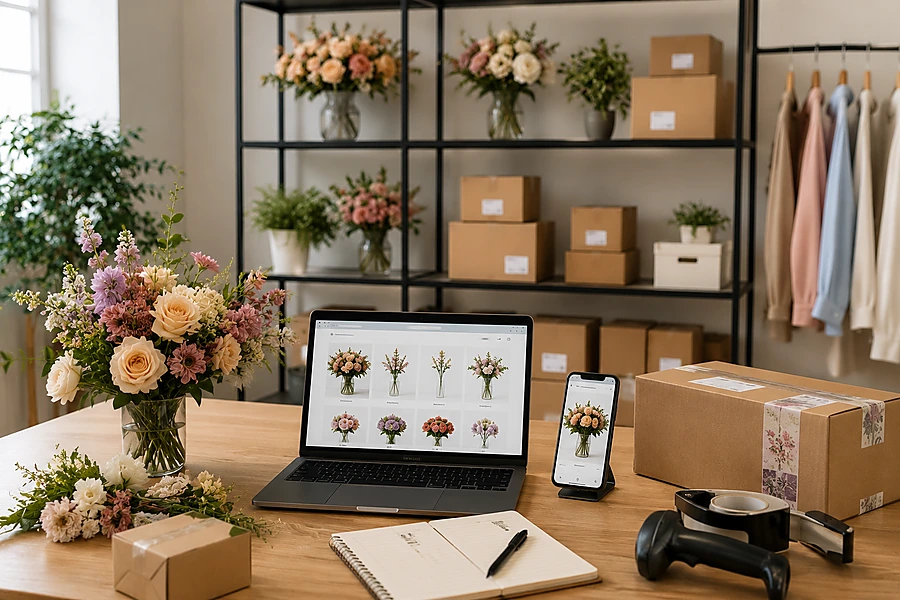
Dropshipping allows a retailer to sell products without keeping them in stock. A third-party supplier holds the inventory and ships individual orders directly to customers. The seller still remains responsible for product safety, customer communication, shipping information, refunds, and the overall selling experience.
How Does Artificial Flower Dropshipping Work?
Dropshipping removes the need to warehouse flowers yourself, but it does not remove sourcing, quality, shipping, or customer-service responsibilities.
Artificial flower dropshipping works when I list supplier-stocked flowers in an online store, collect the customer’s order, send the order to the supplier, and have the supplier pack and ship directly to the customer. I keep the retail margin while controlling the listing, pricing, customer relationship, and supplier standards.
The basic artificial flower dropshipping flow
The model normally has three parties:
| Stage | Seller | Supplier | Customer |
|---|---|---|---|
| Product selection | Chooses sellable SKUs | Provides catalog and stock | — |
| Listing | Creates photos, descriptions, and prices | Supplies specifications | Browses store |
| Order | Receives payment | — | Places order |
| Fulfillment | Sends order details | Picks and packs | Waits for delivery |
| Shipping | Sends tracking information | Ships parcel | Receives parcel |
| Support | Handles questions and complaints | Provides fulfillment evidence | Contacts seller |
| Returns | Manages policy and refund | Accepts or resolves agreed returns | Returns damaged/unwanted item |
Shopify describes dropshipping in essentially this way: the merchant does not stock or handle the item, while the supplier fulfills the order directly.
No inventory does not mean no operating capital
This distinction is important.
I may not need to buy 1,000 peony stems before launching, but I still need money for:
- Product samples
- Store software
- Photography
- Advertising
- Supplier payments
- Refund reserves
- Chargebacks
- Replacement shipments
- Customer service
- Packaging development
- Taxes and duties where applicable
The model reduces inventory risk, not business risk.
Why artificial flowers fit dropshipping well
Artificial flowers have several useful characteristics for this model.
They do not wilt during normal transit. They do not require refrigeration. Suppliers can keep standardized SKUs ready for repeated orders. The same rose, orchid, eucalyptus stem, or bouquet may remain sellable across multiple seasons.
However, the category also has specific problems:
- Large dimensional shipping volume
- Crushed flower heads
- Color inconsistency
- Supplier stockouts
- Weak stems
- Product photos that exaggerate realism
- Unexpected customs charges
- Long international delivery
- Difficult returns on bulky arrangements
This is why I do not recommend uploading thousands of supplier listings.
A smaller controlled assortment usually produces a stronger business.
Dropshipping is still retail
The seller does not escape responsibility because the supplier physically handles the parcel.
Shopify advises dropshipping merchants to review product safety requirements, choose reputable suppliers, test products themselves, communicate processing and shipping information, and maintain an accurate refund policy.
That creates my first rule:
Outsource inventory and fulfillment, not responsibility.
Which Artificial Flowers Are Best for Dropshipping?
A good dropshipping product should be visually attractive, relatively easy to pack, difficult to break, profitable after shipping, and available consistently.
The best artificial flowers for dropshipping are standardized, lightweight, repeatable SKUs with strong visual appeal and manageable packaging. I favor flower bundles, bouquets, garlands, hanging greenery, eucalyptus, roses, tulips, orchids, and modular wedding décor before oversized trees, fragile arrangements, or complicated custom installations.
Start with low-complexity SKUs
I divide artificial flowers into three dropshipping groups.
| Product Type | Dropshipping Fit | Why |
|---|---|---|
| Artificial flower stems | Excellent | Lightweight and easy to combine |
| Small bouquets | Excellent | High visual value |
| Eucalyptus bundles | Excellent | Broad décor use |
| Wedding garlands | Good | Strong event demand |
| Hanging greenery | Good | Compact before shaping |
| Artificial orchids | Good | Premium perceived value |
| Table arrangements | Moderate | Vase increases breakage and freight |
| Flower walls | Moderate | Larger cartons |
| Large planter inserts | Moderate | Dimensional shipping cost |
| Artificial trees | Weak for beginners | Bulky freight and return risk |
| Large assembled arches | Weak | High damage and logistics complexity |
Use a 10–30 SKU launch catalog
A common beginner mistake is adding hundreds of nearly identical flowers.
I prefer a small launch assortment such as:
- 3 rose colors
- 2 peony colors
- 2 hydrangea colors
- 2 eucalyptus styles
- 2 orchid products
- 3 wedding bouquets
- 3 garlands
- 2 hanging plants
- 3 seasonal accents
This makes stock monitoring, sample control, customer support, and advertising easier.
It also lets me identify real winners before expanding.
Choose products with good value-to-volume
Shipping can destroy the margin on artificial flowers because many products are light but physically large.
A 1 kg box of compressed flower stems may cost more to ship than another 1 kg product because carriers can charge by dimensional weight.
I therefore compare:
Revenue per shipped carton volume, not only revenue per kilogram.
| Product | Product Cost | Shipping Risk | Margin Potential |
|---|---|---|---|
| Small silk bouquet | Low–moderate | Low | Strong |
| Rose bundle | Low | Low | Strong |
| Garland | Moderate | Moderate | Strong |
| Potted orchid | Moderate | Moderate | Strong if premium |
| Ceramic arrangement | Higher | High breakage risk | Variable |
| Large tree | High | Very high | Difficult for beginners |
Avoid products that need extensive hand shaping
A flower can look excellent after ten minutes of steaming and styling but disappointing when a consumer opens the parcel.
For dropshipping, I prefer products that recover quickly.
I test:
- Flower condition immediately after opening.
- Reshaping time.
- Permanent petal creases.
- Stem bending.
- Flower-head attachment.
- Packaging recovery.
- Camera appearance after normal setup.
A product requiring professional floral skills should be sold with clear instructions or avoided in beginner catalogs.
Build products into bundles
Single artificial flower stems often have weak average order value.
Bundles can improve the economics.
Examples include:
- 12 ivory rose stems
- 24 mixed spring tulips
- Eucalyptus + white rose styling kit
- Wedding table centerpiece kit
- Bridal bouquet + bridesmaid bouquet set
- Mantel garland + matching flower stems
Bundling also creates differentiation. Instead of selling the exact single SKU found across many marketplace listings, I can create a coordinated solution.
How Do You Choose a Reliable Faux Flower Dropshipping Supplier?
The supplier effectively becomes the warehouse, packing team, and shipping department. A poor supplier can damage the store even when the marketing is excellent.
I choose a faux flower dropshipping supplier by testing real samples, stock stability, order-processing speed, packaging, tracking, blind shipping, return handling, communication, SKU consistency, and repeat-order color. I never approve a supplier only because its catalog is large or its unit price is low.
Order samples before listing anything
Shopify specifically recommends purchasing products from potential dropshipping suppliers to evaluate quality and determine actual processing and shipping performance.
For artificial flowers, I inspect:
| Area | Check |
|---|---|
| Petals | Texture, cutting, fraying, color |
| Flower head | Size, shape, attachment |
| Leaves | Shine, molding, color |
| Stem | Length, wire strength |
| Glue | Visibility and residue |
| Odor | Unacceptable chemical smell |
| Packing | Crushing and deformation |
| Recovery | Time needed to reshape |
| Listing accuracy | Does the delivered product match photos? |
| Repeatability | Can the same SKU be supplied later? |
I also order a second sample later when possible. One excellent sample does not prove consistent supply.
Require blind shipping
Customers should not open their flower order and find another retailer’s invoice, promotional card, or price.
A dropshipping agreement should state:
- No supplier retail invoice
- No supplier advertising
- No unrelated QR codes
- No competitor branding
- Your store name where required
- Neutral or approved packaging
- Correct return instructions
This becomes especially important on marketplaces.
Amazon’s published dropshipping guidance requires the marketplace seller to be clearly identified as the seller of record and prohibits fulfillment materials that identify another seller. The seller also remains responsible for returns.
eBay allows dropshipping from wholesale suppliers but states that the seller remains responsible for safe, timely delivery and buyer satisfaction. It does not allow the model where a seller lists an item and then purchases it from another retailer or marketplace for direct delivery.
Marketplace rules can change, so I review the current policy before launching on any third-party channel.
Create a supplier service-level agreement
I do not need a complicated legal document for every test supplier, but I need written operating rules.
| Supplier Metric | Target to Define |
|---|---|
| Order confirmation | Defined business-hour window |
| Processing time | Written range |
| Stock updates | Daily or real-time |
| Tracking upload | Defined deadline |
| Wrong SKU rate | Agreed corrective procedure |
| Damage | Photo evidence and replacement/refund rule |
| Stockout | Immediate notification |
| Packaging | Approved sample standard |
| Blind shipping | Mandatory |
| Returns | Named location and process |
The actual numbers depend on supplier location, product, and sales channel.
Demand inventory visibility
Stockouts are one of the biggest no-inventory risks.
The seller does not control the warehouse, so a popular dusty-pink rose may disappear while the product remains live in the store.
I therefore prefer suppliers that provide:
- API inventory sync
- App integration
- Regular CSV inventory
- Reserved stock agreements
- Low-stock warnings
- SKU discontinuation notice
- Restock dates
Shopify’s supplier integrations emphasize inventory and order synchronization because automation reduces the gap between what a store displays and what a supplier can actually fulfill.
Keep one backup supplier for core products
I avoid having five suppliers for every product because that creates consistency problems.
However, I prefer a backup option for core product families.
For example:
| Core Category | Primary Supplier | Backup Plan |
|---|---|---|
| Roses | Supplier A | Pre-approved similar rose |
| Eucalyptus | Supplier A | Supplier B |
| Wedding garland | Supplier B | Alternative SKU |
| Orchids | Supplier C | Temporary listing pause |
Do not silently replace one supplier’s ivory rose with another supplier’s version. Colors, lengths, petal counts, and packaging may differ.
How Do You Price, Fulfill, and Scale Without Holding Inventory?
A dropshipping store can generate revenue and still lose money when advertising, freight, refunds, and transaction costs are ignored.
I price artificial flower dropshipping products from complete order economics. The selling price must cover supplier cost, shipping, payment fees, advertising, refunds, customer support, duties, and target profit. I also publish realistic shipping times, automate tracking, and scale only SKUs that survive real customer orders.
Calculate contribution margin
A useful formula is:
Contribution profit = selling price − product cost − supplier shipping − transaction fees − variable advertising cost − expected refund/damage cost
Example:
| Cost Item | Illustrative Amount |
|---|---|
| Customer selling price | $59 |
| Supplier flower cost | $15 |
| Fulfillment/shipping | $12 |
| Payment/platform fees | $3 |
| Advertising | $12 |
| Damage/refund allowance | $3 |
| Contribution profit | $14 |
The example is illustrative, not an industry benchmark.
A product that costs only $10 can still be a bad dropshipping SKU when its carton costs $25 to deliver.
Do not promise unrealistic delivery
International dropshipping can create longer fulfillment windows.
In the U.S., the FTC says online sellers need a reasonable basis for advertised shipping promises. When no shipment period is clearly stated, sellers generally need a reasonable basis for expecting shipment within 30 days; delays can trigger notice, cancellation, and refund requirements.
Shopify also requires accessible shipping information and recommends telling dropshipping customers about processing, shipping origin, delays, and potential customs charges where relevant.
My product page therefore states:
- Processing time
- Estimated transit range
- Shipping origin
- Tracking availability
- Customs responsibility where relevant
- What happens after a delay
Honest eight-day delivery is better than advertising three-day delivery and repeatedly disappointing customers.
Solve returns before launching
Artificial flower returns can be expensive because return freight may exceed the supplier’s product cost.
I define separate processes for:
| Issue | Typical Resolution |
|---|---|
| Product arrives damaged | Photo evidence, replacement or refund |
| Wrong SKU/color | Supplier-funded correction where agreed |
| Missing item | Replacement or partial refund |
| Customer changed mind | Store return policy |
| Minor packaging compression | Reshaping guidance before replacement decision |
| Severe permanent crushing | Replacement/refund |
Shopify advises stores to publish a current refund policy explaining return timing, return address, costs, and contact information.
Use content to beat identical listings
Dropshipping fails when twenty stores use the same supplier picture, same title, same description, and same product.
I differentiate through:
- Original sample photography
- Styling videos
- Accurate dimensions
- Flower-head close-ups
- Color comparison photos
- Room-scale images
- Wedding theme collections
- Installation tutorials
- Care and reshaping instructions
- Product bundles
The seller may not manufacture the product, but the seller can own the merchandising experience.
Track the right metrics
| Metric | Why It Matters |
|---|---|
| Conversion rate | Tests listing and offer |
| Average order value | Measures bundling success |
| Contribution margin | Shows real profitability |
| Delivery time | Measures supplier performance |
| Damage rate | Shows packaging quality |
| Refund rate | Signals product or expectation problems |
| Stockout frequency | Measures supplier reliability |
| Repeat purchase rate | Tests long-term product value |
| Customer-service contacts | Reveals hidden friction |
Revenue alone is a weak success measure.
Move winners into a hybrid model
This is where the strongest no-inventory strategy becomes more interesting.
I use dropshipping to discover demand.
Suppose an ivory wedding garland sells consistently for three months. The supplier proves reliable. Customer reviews are positive. Advertising is profitable.
At that point, local inventory may become financially stronger because bulk purchasing can reduce:
- Unit cost
- Shipping cost per piece
- Delivery time
- Stockout risk
- Packaging variation
This does not mean the dropshipping strategy failed.
It means it succeeded at product validation.
My insights: What Is the Best No-Inventory Strategy for Dropshipping Artificial Flowers in 2025
Many guides describe dropshipping as a permanent zero-inventory business model. I think the stronger approach is to treat it as a controlled product-testing system.
The best no-inventory artificial flower strategy in 2025 is “sample first, dropship second, stock winners later.” I would launch a narrow supplier-backed catalog, validate quality and demand without inventory, automate fulfillment, monitor real contribution margin, and convert only proven high-volume SKUs into locally stocked or 3PL-fulfilled products.
My recommended seven-step model
| Step | Action | Goal |
|---|---|---|
| 1 | Select one clear niche | Avoid an unfocused catalog |
| 2 | Sample 10–20 products | Eliminate weak SKUs |
| 3 | Launch 10–30 listings | Reduce complexity |
| 4 | Use supplier-held inventory | Protect cash |
| 5 | Track orders and quality | Find real winners |
| 6 | Improve branding and bundles | Raise margin |
| 7 | Stock proven winners selectively | Improve delivery economics |
Step 1: Start with a niche
I would rather build a store around one strong use case than sell every artificial plant available.
Strong examples include:
- Artificial wedding flowers
- Luxury faux orchids
- Outdoor artificial greenery
- Seasonal floral décor
- Hotel floral arrangements
- Artificial flowers for event planners
- Neutral home décor florals
A focused niche makes advertising, photography, bundles, and supplier selection easier.
Step 2: Treat samples as mandatory inventory
The business may have no sellable stock, but I still consider approved samples essential.
Samples provide:
- Original content
- Measurement verification
- Packaging tests
- Quality control
- Supplier comparison
- Customer-service knowledge
It is difficult to sell a product confidently when the seller has never touched it.
Step 3: Prefer supplier relationships over retail arbitrage
A direct manufacturer, distributor, or specialist dropship wholesaler usually provides more control than buying from another retailer after receiving a customer order.
The supplier relationship should support:
- Blind shipping
- Stable SKU codes
- Wholesale pricing
- Inventory feeds
- Consistent packaging
- Return agreements
- Replacement procedures
- Repeat product supply
This is also safer for marketplace compliance. eBay explicitly allows wholesale-supplier dropshipping while prohibiting retail-marketplace arbitrage in its dropshipping policy.
Step 4: Keep customer ownership
The supplier fulfills the parcel.
The seller owns:
- The storefront
- Product promise
- Customer communication
- Refund decision
- Brand
- Reviews
- Advertising
- Product selection
- Customer lifetime value
That distinction is the real business.
Step 5: Build a transition threshold
I would define a rule before launch.
For example:
When a SKU reaches a consistent monthly sales volume and locally stocked fulfillment clearly improves contribution margin and delivery speed, evaluate a small wholesale purchase.
The threshold must use actual numbers from the business.
This avoids two mistakes:
Buying inventory too early: cash becomes trapped in products that have not proven demand.
Refusing inventory forever: proven products remain stuck with expensive per-order shipping and slower fulfillment simply because the original model was called dropshipping.
The strongest final model
I view dropshipping artificial flowers as a three-stage system:
Stage 1 — No inventory:
Test products with supplier fulfillment.
Stage 2 — Controlled hybrid:
Stock proven bests locally while continuing to dropship slower colors and long-tail products.
Stage 3 — Optimized supply chain:
Use wholesale purchasing or a 3PL for predictable high-volume SKUs while suppliers continue supporting new-product tests.
The result is a much stronger strategy than uploading thousands of artificial flower listings and hoping one becomes profitable.
The key advantage of dropshipping is not that the seller never owns inventory.
The real advantage is that the seller does not have to own inventory before knowing what customers actually want.
Conclusion
Dropship artificial flowers by sampling first, controlling suppliers, launching fewer SKUs, calculating true margins, and using no inventory to validate demand before stocking winners.