
A quiet storefront can hide great products. A weak display makes people walk past. A strong faux flower display gives them a reason to stop.
To create faux flower displays that drive foot traffic, design them as visual invitations, not simple decoration. Use realistic stems, layered heights, seasonal colors, clear focal points, brand-matched props, and lighting that makes the display visible from the street. The goal is to stop attention first, then guide people toward the door.
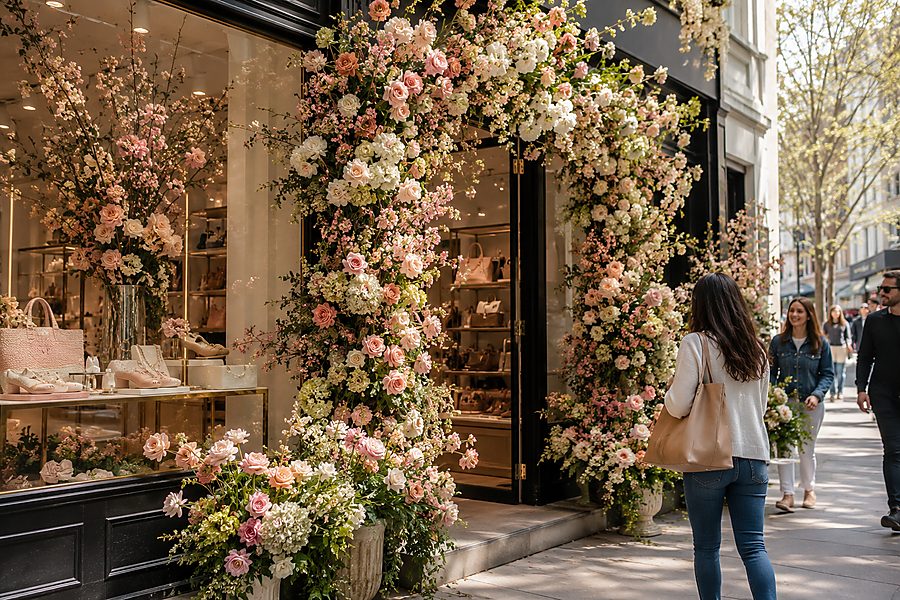
A good faux flower display works because it does three jobs at once. It catches the eye from a distance. It tells shoppers what the store feels like. It gives people a small moment they want to enter, photograph, or share. This is why the best displays are planned like retail tools, not placed like background decor.
Why Does Visual Merchandising Matter in Retail?
A beautiful product can still be ignored. If the storefront feels flat, shoppers may not slow down long enough to notice what is inside.
Visual merchandising matters because it shapes the first impression before a customer enters the store. Window displays, product placement, color, light, and layout help shoppers decide whether a brand feels interesting, trustworthy, and worth exploring.
A storefront should answer one fast question
Most passersby do not study a window. They scan it. In a few seconds, they ask one simple question in their mind: “Is this place for me?” A faux flower display can answer that question quickly. Soft blush roses and ivory orchids can signal romance and elegance. Bright sunflowers and citrus accents can signal energy and summer shopping. Deep burgundy peonies and gold props can signal luxury and holiday gifting.
Research on retail window displays shows that they can influence store-entry decisions and brand image. This means the display is not just a visual extra. It is part of the selling system. It gives people a first story about the brand before staff say a word.
Use flowers to frame the customer journey
A strong faux flower display should guide the eye in a clear order.
| Display Element | Purpose | Practical Example |
|---|---|---|
| Main floral focal point | Stops attention | A large arch, wall panel, or hanging cluster |
| Supporting greenery | Adds depth | Eucalyptus, vines, fern leaves, olive branches |
| Product zone | Connects beauty to sales | Handbags, dresses, candles, gifts, or signage |
| Lighting | Makes details visible | Warm spotlights, window LEDs, backlit sign |
| Entry cue | Moves people inside | Open doorway, arrow sign, welcome mat, offer card |
The key is balance. Too many flowers can look messy. Too few can feel unfinished. I recommend choosing one clear hero area and letting everything else support it. This keeps the display bold from the street and easy to understand up close.
What Are the Best Faux Flowers for Store Window Displays?
Cheap faux flowers can damage the look of a premium store. Stiff stems, flat colors, and shiny plastic leaves can make the whole window feel careless.
The best faux flowers for store window displays are realistic, durable, flexible, and color-stable. Choose silk, real-touch, latex-blend, or high-quality polyurethane stems with natural color variation, bendable branches, and petals that do not look too perfect.
Realism starts with imperfection
Real flowers are not perfectly even. Their petals curve. Their leaves bend. Their colors shift from the center to the edge. Modern faux florals are more convincing when they copy those small details. Real-touch petals, soft veining, slight color gradients, and bendable stems help the arrangement look less artificial.
For retail displays, I would avoid flowers that look overly glossy or identical. A wall of identical roses may look artificial from close range. A mix of roses, hydrangeas, orchids, vines, and soft filler creates more natural movement. Large blooms work well for long-distance impact. Smaller filler stems work well for detail shots and social media photos.
Match flower types to store goals
| Retail Goal | Best Faux Flower Choice | Why It Works |
|---|---|---|
| Luxury fashion | Orchids, roses, magnolias | Clean, polished, elegant |
| Bridal shop | Peonies, roses, hydrangeas | Romantic and soft |
| Café or bakery | Wildflowers, daisies, lavender | Friendly and relaxed |
| Beauty salon | Cherry blossoms, orchids, wisteria | Feminine and photo-friendly |
| Gift shop | Seasonal mixed stems | Easy to refresh for holidays |
Choose materials for the display location
Indoor faux flower displays can focus more on texture and softness. Semi-outdoor storefronts need stronger materials. If the display faces sunlight, choose UV-resistant artificial flowers and greenery. If the store entrance is exposed to wind, use wired stems, strong bases, cable ties, floral cages, and weighted props. If customers may touch the display, use secure stems and avoid loose small pieces.
Good faux flowers save labor because they do not wilt, need water, or require daily replacement. But they still need care. A quick weekly dusting, gentle reshaping, and monthly inspection will keep the display looking fresh.
How Should You Design the Display Layout?
Many stores buy beautiful faux flowers but place them in a way that feels random. The display looks full, yet it does not pull people toward the entrance.
A good faux flower layout uses height, depth, color contrast, and a clear focal point. Start with the largest structure, add greenery for shape, layer flowers in groups, and leave enough open space for products, signage, and the doorway.
Build the display from big to small
I recommend starting with the structure before adding flowers. Decide whether the display will be an arch, wall, window frame, hanging cloud, pedestal group, flower cart, or product table. Then add the large greenery first. Greenery gives the display shape and keeps the flowers from floating without context. After that, place the biggest blooms at eye level or slightly above eye level. Add medium flowers next. Finish with small filler, trailing vines, and accent textures.
This order helps the display feel planned. It also makes installation easier for teams that need to repeat the same look across several stores.
Use the “three-zone” method
| Zone | Where It Appears | What It Should Do |
|---|---|---|
| Stop zone | Top or side of window | Catch attention from across the street |
| Story zone | Center of display | Show the season, product, or campaign |
| Entry zone | Near the door | Invite people to walk in |
The stop zone can be a large floral arch, oversized bloom cluster, or bright color block. The story zone should connect the flowers with the product. For example, a spring clothing launch can pair cherry blossoms with pastel dresses. A skincare shop can pair white orchids with soft green leaves and clean resin stands. The entry zone should not be blocked. Flowers should frame the door, not fight it.
Keep the layout easy to photograph
A photo-friendly display can extend foot traffic beyond the street. People may stop, take photos, tag the store, and share the moment. To support this, keep one clean photo angle. Avoid cluttered backgrounds. Add a small sign, mirror, bench, swing, or branded neon element only if it fits the brand. The best displays feel shareable but not forced.
How Can Faux Flower Displays Support Seasonal Promotions?
A display that never changes can become invisible. People stop noticing it because it becomes part of the background.
Faux flower displays support seasonal promotions by using a reusable base with changeable accents. Keep the main structure, then update colors, props, ribbons, signs, and small floral details for each season, holiday, launch, or sales event.
Build one base and refresh the story
The smartest retail faux flower displays are not rebuilt from zero every month. They use a strong base. This base may include greenery panels, arches, neutral hydrangeas, white roses, or a simple botanical wall. Then the store adds seasonal layers. This lowers cost and keeps the window fresh.
For spring, add tulips, cherry blossoms, butterflies, and pastel signage. For summer, add sunflowers, lemon branches, tropical leaves, or brighter color blocking. For fall, add burnt orange mums, maple leaves, berries, and textured baskets. For winter, add white roses, frosted eucalyptus, pine, gold details, velvet ribbon, and warm lights.
Plan displays around commercial moments
| Season or Event | Faux Floral Direction | Retail Purpose |
|---|---|---|
| Spring launch | Cherry blossoms, tulips, soft greenery | New arrivals and fresh starts |
| Mother’s Day | Peonies, roses, handwritten-style signs | Gift buying |
| Summer sale | Sunflowers, citrus, bold colors | High energy and urgency |
| Wedding season | White orchids, roses, draped fabric | Romance and premium service |
| Holiday season | Frosted greenery, poinsettias, gold props | Festive gifting |
Do not let seasonal mean crowded
Seasonal displays often fail because they try to include too many symbols. A Valentine’s Day window does not need every heart, ribbon, rose, and red prop in the store. A luxury display may need only deep red roses, warm light, and one clean message. A playful display can use more color, but it still needs a clear center.
A good rule is to remove one item after the display feels finished. This keeps the layout clean and helps the flowers look more expensive.
My insights: How to Create Faux Flower Displays That Drive Foot Traffic
Some displays look beautiful but do not bring people inside. The missing link is usually strategy, not flowers.
The best faux flower displays drive foot traffic when they connect visual stopping power with a clear reason to enter. The display should attract attention, match the brand, create a photo moment, support the current offer, and make the doorway feel open and inviting.
Treat the display as a silent salesperson
My main insight is simple: a faux flower display should not only be pretty. It should sell the next action. A person walking by should understand what to do next. Should they enter to see a new collection? Take a photo? Scan a QR code? Ask about a wedding package? Buy a gift? Join a seasonal event?
This is where many displays fall short. They focus on flowers but forget the commercial path. A strong display uses flowers to create emotion and then uses structure to guide action.
The five-part traffic formula
| Step | Question to Ask | Display Choice |
|---|---|---|
| Attention | Will people notice it from far away? | Use height, color, contrast, and lighting |
| Trust | Does it look realistic and premium? | Use high-quality stems and clean installation |
| Relevance | Does it match the store and season? | Choose brand-fit flowers and colors |
| Interaction | Will people pause or take photos? | Add one photo-friendly focal point |
| Entry | Does it guide people inside? | Keep the doorway open and add a clear call-to-action |
Measure the display like a retail asset
A store should not judge a faux flower display only by how it looks. It should track how it performs. Count daily walk-ins before and after installation. Watch where people stop. Ask staff what customers comment on. Track QR scans, tagged photos, and sales of products placed near the display. Even simple notes can show what works.
If people take photos but do not enter, add a clearer entry cue. If people enter but do not buy, place a product story closer to the display. If people ignore the window, increase contrast, lighting, or height. Good displays improve over time because the store learns from real shopper behavior.
Conclusion
Faux flower displays drive foot traffic when they combine realism, structure, seasonality, brand fit, and a clear path from street attention to store entry.