
Many buyers search for faux plants, but not every supplier uses the term in the same way. That can create sourcing mistakes.
“Faux plants” means plants made to look like real greenery but created from man-made materials. In B2B buying, the term usually covers artificial plants, synthetic plants, fake plants, silk plants, plastic plants, faux trees, greenery panels, topiaries, hanging plants, and commercial botanical décor.
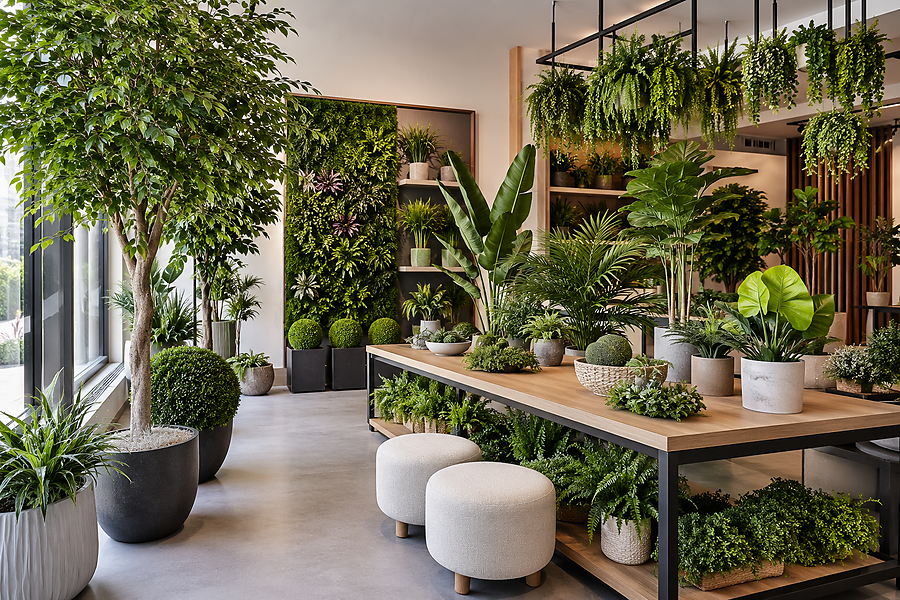
The word “faux” means not real or genuine, and it is often used for products made to look like something natural or more valuable. Merriam-Webster defines faux as imitation or fake, while “artificial” means made by humans to seem like something natural. For B2B buyers, the important point is simple: faux plants are not one product type. They are a broad sourcing category that must be judged by material, realism, durability, safety, packaging, and commercial use.
What Does “Faux Plants” Mean in Wholesale Buying?
A retail shopper may use “faux plants” to mean any decorative fake greenery. A B2B buyer needs a more exact meaning before placing bulk orders.
In wholesale buying, faux plants are non-living decorative plants made for homes, hotels, offices, restaurants, retail stores, events, rental companies, and commercial interiors. They can include stems, trees, hedges, wall panels, hanging baskets, potted plants, garlands, and custom installations.
Faux plants are a design term and a product category
“Faux plants” is often a more polished term than “fake plants.” It sounds better in design, retail, hospitality, and interior décor communication. A hotel buyer may not want to present “fake plants” to management, but “premium faux botanicals” sounds more refined. An interior designer may prefer “faux greenery” because it feels intentional. A wholesale catalog may use “artificial plants” because it is clearer for product classification.
This matters because the same product can appear under several names. A faux olive tree may also be called an artificial olive tree, synthetic tree, fake olive tree, permanent botanical, or decorative plant. The naming does not prove quality. It only helps buyers and sellers find the product.
The artificial flower and plant category is growing because buyers want long-lasting, low-maintenance décor. Grand View Research estimated the global artificial flowers market at USD 3.09 billion in 2024 and projected it to reach USD 4.49 billion by 2030, driven by demand for low-maintenance and long-lasting décor in homes and commercial spaces.
| B2B Term | Common Meaning | Best Use |
|---|---|---|
| Faux plants | Design-friendly term for imitation plants | Interior design, retail, marketing |
| Artificial plants | Formal product category | Catalogs, quotations, trade documents |
| Fake plants | Casual search term | SEO, buyer questions, informal use |
| Synthetic plants | Material-focused term | Commercial and technical buying |
| Permanent botanicals | Premium design term | Hotels, luxury interiors, showrooms |
| Faux greenery | Broad foliage term | Walls, garlands, hedges, panels |
The trade language may be different from marketing language
In international trade, faux plants and foliage often connect to artificial flowers and foliage classifications. Flexport lists HS heading 6702 as “Artificial flowers, foliage and fruit and parts thereof; articles made of artificial flowers, foliage or fruit,” with a plastic subcategory under 6702.10. Buyers should confirm the final HS code with a customs broker because material, product form, and destination country can affect classification.
For wholesale communication, the safest method is to use both plain and technical language. A buyer can ask for “faux plants for commercial interiors,” then specify “UV-resistant artificial greenery panels, PE leaves, weighted pots, and carton packing.” This reduces confusion and helps the supplier quote the right product.
Are Faux Plants Different From Artificial, Fake, or Synthetic Plants?
Many buyers treat these words as equal. In daily use, they often overlap. In B2B sourcing, each word creates a different buyer expectation.
Faux plants, artificial plants, fake plants, and synthetic plants usually describe the same broad category: non-living plants made to imitate real greenery. The difference is mostly tone, market positioning, and technical detail, not a strict product boundary.
The difference is mostly language
“Faux” sounds more stylish. “Artificial” sounds more formal. “Synthetic” sounds more material-based. “Fake” sounds more casual and can feel lower quality. None of these words guarantees product quality.
This is important because suppliers may use attractive words loosely. A “premium faux plant” may still have thin plastic leaves. A “fake plant” may actually be realistic and durable. A “silk plant” may not be made of real silk. Fortune Business Insights segments the artificial flowers market by materials such as polyester, plastic, silk, and nylon, which shows how many material types can sit under one broad product category.
Buyers should compare by specification, not name
| Term | Tone | Possible Risk | Buyer Response |
|---|---|---|---|
| Faux plants | Stylish and design-friendly | May be vague | Ask for material and use case |
| Artificial plants | Formal and neutral | Broad category | Request product specs |
| Fake plants | Easy search language | May sound cheap | Check realism and finish |
| Synthetic plants | Technical | May focus only on material | Check appearance and safety |
| Silk plants | Premium-sounding | May not be real silk | Confirm petal or leaf material |
| Permanent botanicals | Luxury positioning | May cost more | Confirm durability and maintenance |
Real meaning comes from the use case
A faux plant for a hotel lobby is different from a faux plant for a discount retail shelf. A faux plant for an outdoor restaurant patio is different from one for an office reception desk. A faux plant for a mall installation may need fire-retardant properties. A faux plant for a balcony may need UV resistance. A faux plant for a wedding rental company may need modular parts and strong packing.
This is why B2B buyers should define the project before choosing the term. Ask where the product will be used. Ask how close customers will stand to it. Ask whether it will be indoors or outdoors. Ask whether it needs to be cleaned by staff. Ask whether it will be reused, moved, or stored.
The label “faux plant” is only the first step. The real buying decision comes from performance.
What Types of Faux Plants Work Best for B2B Buyers?
A small tabletop faux plant may work for home décor, but it may not be strong enough for commercial use. B2B buyers need products that fit scale, traffic, and maintenance needs.
The best faux plants for B2B buyers include artificial olive trees, palms, boxwood hedges, greenery wall panels, topiaries, eucalyptus stems, faux ferns, hanging baskets, bamboo screens, and custom potted arrangements for hotels, offices, restaurants, retail stores, venues, and rental businesses.
Commercial buyers need plants with clear jobs
A hotel entrance may need two tall topiaries or palms to create a premium first impression. A restaurant patio may need boxwood dividers to create privacy. A retail store may need a faux greenery wall to support photos and brand display. An office may need low-maintenance potted plants that soften the space. An event rental company may need greenery panels, arches, garlands, and modular plant décor that can be used many times.
The demand is practical. Faux plants give businesses a consistent green look without watering, trimming, soil, pests, or wilting. Commercial artificial plant suppliers commonly market these products for hotels, offices, retail, restaurants, healthcare spaces, and high-traffic interiors because they keep a consistent look with lower maintenance.
| Business Type | Best Faux Plant Choice | Main Benefit |
|---|---|---|
| Hotel | Olive trees, orchids, palms, topiaries | Premium first impression |
| Restaurant | Boxwood hedges, hanging baskets, wall panels | Patio privacy and atmosphere |
| Office | Potted trees, ferns, moss panels | Calm low-maintenance greenery |
| Retail store | Greenery walls, window planters, seasonal stems | Visual merchandising |
| Event venue | Garlands, panels, arches, topiary sets | Reusable event décor |
| Rental business | Modular faux greenery and flower systems | Repeatable revenue |
| Spa or salon | Bamboo, orchids, eucalyptus | Clean wellness mood |
Outdoor projects need stronger specifications
Outdoor faux plants need a different buying standard. The Spruce notes that many fake plants are not intended for outdoor conditions and can fade quickly in the sun; it recommends outdoor-safe products made with UV-resistant and weatherproof materials such as PE, polyblend plastics, or PVC.
This is a key point for B2B buyers. Do not place indoor faux plants in full sun and expect them to survive. For outdoor commercial spaces, ask for UV-resistant materials, outdoor testing information, fade-resistance details, weighted bases, and replacement parts.
Public spaces may need fire-safety checks
Large faux greenery installations in public or commercial spaces may need fire-safety attention. Some suppliers offer inherently fire-retardant artificial plants and foliage designed for commercial use, with standards such as BS EN 13501 and DIN 4102 mentioned in product safety materials. Other suppliers market NFPA 701-certified fire-resistant artificial plant products for theatres, hotels, and public buildings.
Buyers should not guess here. Fire requirements depend on local rules, building type, installation size, and occupancy. For hotels, malls, restaurants, offices, event venues, and public interiors, ask the supplier for test reports and check requirements with the project team or local authority.
How Should B2B Buyers Check Faux Plant Quality Before Ordering?
A supplier photo can hide weak leaves, shiny plastic, poor color, and bad packing. Bulk orders need proof, not only attractive images.
B2B buyers should check faux plant quality by reviewing material, realism, UV resistance, fire rating, stem strength, leaf attachment, pot stability, packaging, MOQ, lead time, sample quality, and reorder consistency before placing wholesale orders.
Samples are the most important step
A sample tells buyers what a catalog cannot. Look at the leaf surface under natural light, warm light, and camera flash. Touch the leaves. Bend the stems. Shake the plant lightly. Check whether leaves fall off. Smell the product. Check the pot weight. Inspect the trunk, glue points, and base cover. A strong faux plant should look natural, hold its shape, and feel stable.
This matters because faux plants are often bought for spaces where customers see them closely. A restaurant guest may sit beside a plant for an hour. A hotel guest may stand beside a lobby tree while checking in. A retail customer may take photos in front of a greenery wall. Poor realism is easy to notice in those situations.
A practical B2B quality checklist
| Quality Check | What to Ask or Test | Why It Matters |
|---|---|---|
| Material | PE, PVC, polyester, silk-like fabric, wire, foam | Shows durability and use case |
| Realism | Matte finish, varied leaf size, natural color | Prevents cheap appearance |
| UV rating | Outdoor-safe or UV-resistant label | Slows outdoor fading |
| Fire performance | Test reports or fire-retardant option | Supports public-space compliance |
| Stem strength | Bend and shake test | Helps transport and installation |
| Leaf attachment | Pull gently on leaves | Reduces shedding |
| Pot stability | Weight and base size | Prevents tipping |
| Packaging | Carton strength and inner protection | Reduces shipping damage |
| Reorder support | Same SKU and color later | Protects long-term projects |
Packaging is part of the product
For B2B orders, packaging quality affects profit. Crushed leaves, bent trunks, and broken stems create extra labor and returns. Wholesale buyers should ask for carton dimensions, gross weight, inner protection, labeling, and pallet options. For hotel or event projects, cartons should be labeled by room, area, product type, or installation zone.
A low unit price is not always cheaper. If the plants arrive damaged, fade quickly, or cannot be reordered in the same color, the buyer pays in time, repairs, and client complaints.
My insights: What Does “Faux Plants” Really Mean? A Guide for B2B Buyers
Many buyers think “faux plants” is just a nicer word for fake plants. That is true in casual language, but not enough for business buying.
For B2B buyers, “faux plants” really means a commercial sourcing category for realistic, non-living greenery. The term should lead buyers to ask deeper questions about material, project use, durability, UV resistance, fire safety, packaging, customization, and reorder stability.
The term is simple, but the buying decision is not
My main insight is that “faux plants” is a marketing-friendly umbrella term. It does not tell buyers whether the product is outdoor-safe, fire-retardant, realistic, reusable, or suitable for commercial traffic. A buyer should never place a bulk order based only on the word “faux.”
A smart B2B buyer should translate the term into a product specification. Instead of asking for “faux plants,” ask for “UV-resistant PE faux boxwood panels for restaurant patios,” or “fire-retardant artificial olive trees for hotel lobby use,” or “realistic faux eucalyptus garlands for event rental inventory.” Clear language creates better quotes and fewer mistakes.
A smart sourcing framework
| Buyer Question | Better B2B Specification |
|---|---|
| What does faux mean here? | Non-living plant designed to imitate real greenery |
| Where will it be used? | Indoor, outdoor, hotel, office, retail, event, rental |
| What material is needed? | PE, PVC, polyester, silk-like fabric, or mixed materials |
| What risk matters most? | Fading, fire safety, shedding, tipping, crushing |
| How long should it last? | Short campaign, seasonal use, or multi-year installation |
| How will it ship? | Individual cartons, pallet packing, labeled project boxes |
| Can it be reordered? | Stable SKU, color, size, and supplier support |
Smart buyers use both marketing and technical language
Use “faux plants” when speaking to designers, retail customers, and online readers. Use “artificial plants” in quotations, specifications, and trade documents. Use “synthetic plants” when discussing materials. Use “UV-resistant artificial greenery” or “fire-retardant faux foliage” when the project has performance requirements.
This balance helps B2B buyers communicate clearly across teams. Designers care about appearance. Procurement teams care about cost and MOQ. Installers care about structure. Customs teams care about classification. End clients care about the final look.
The best faux plants are not just fake greenery. They are long-term commercial décor products. When buyers choose the right materials, ask for samples, check safety needs, and plan packaging, faux plants can support hotels, offices, restaurants, retail stores, event venues, and rental businesses with consistent, low-maintenance greenery.
Conclusion
Faux plants are realistic non-living greenery for décor, but smart B2B buying depends on material, durability, safety, packaging, use case, and supplier reliability.