
Wholesale silk flower orders can fail through high MOQs, poor carton mixes, unsafe payments, color errors, late production, or unclear delivery responsibilities.
To order silk flowers wholesale successfully, create a demand forecast, approve physical samples, negotiate MOQ by product family, control mixed-carton ratios, choose payment terms according to supplier risk, confirm Incoterms, and build a complete production-to-delivery timeline. Every detail should appear in the purchase order before the deposit is paid.
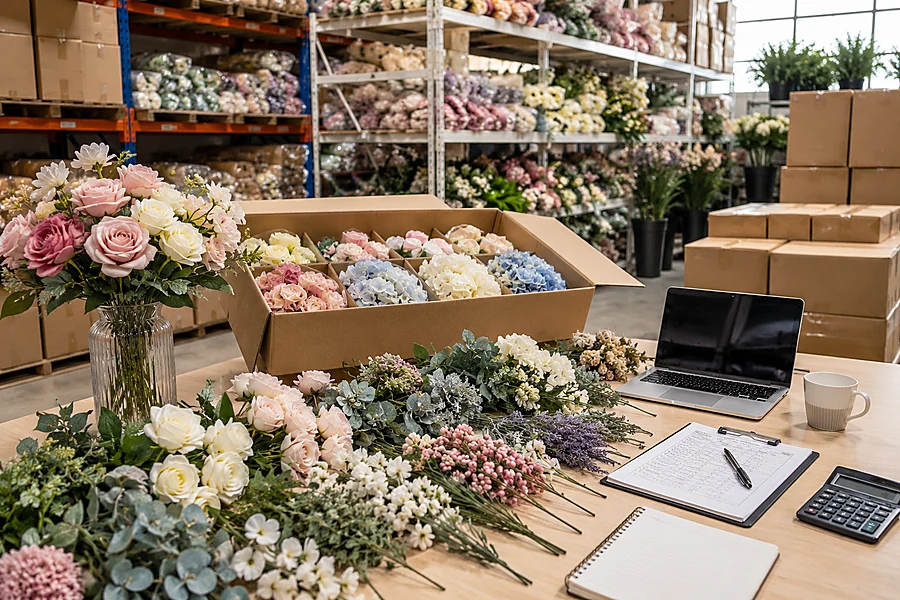
Artificial flowers are growing as buyers seek durable, low-maintenance décor. For wholesalers, hotels, decorators, importers, and event businesses, profitable sourcing requires full order control, not simply the lowest price alone.
What Should Buyers Prepare Before Ordering Silk Flowers Wholesale?
Many sourcing problems begin before the supplier sends a quotation. An unclear request produces unclear prices, unsuitable products, and changing terms.
Before ordering silk flowers wholesale, buyers should prepare a SKU list, target colors, material requirements, quantity forecast, sample plan, packaging standard, destination, required delivery date, quality checklist, and preferred trade terms. A complete RFQ helps suppliers quote accurately and reduces later changes.
Step 1: Define the sales channel
The same silk flower may not suit every market. A bridal bouquet requires close-up realism. A hotel arrangement needs easy cleaning. A retailer needs shelf-ready packaging. An event rental company needs durable wired stems that can be reshaped repeatedly.
| Buyer Type | Main Product Need | Key Order Priority |
|---|---|---|
| Wedding supplier | Roses, peonies, hydrangeas, garlands | Realism and color consistency |
| Event rental company | Arches, panels, bouquets, swags | Durability and reuse |
| Hotel buyer | Orchids, magnolia, arrangements | Premium finish and cleanability |
| Retailer | Bunches, stems, seasonal collections | Packaging and sell-through |
| Florist wholesaler | Broad flower and greenery selection | Reorder stability |
| Online seller | Compact products and protected cartons | Parcel-safe packaging |
Step 2: Build a focused SKU plan
Do not send a supplier a list of fifty unrelated products and ask for the “best price.” Separate products into clear families:
- Core flowers: roses, peonies, orchids and hydrangeas
- Supporting flowers: tulips, ranunculus and small roses
- Fillers: baby’s breath, lavender and small blossoms
- Greenery: eucalyptus, olive branches and ferns
- Installation products: garlands, flower panels and arch swags
- Seasonal products: Christmas, spring, autumn and Valentine collections
A focused assortment makes MOQ negotiation easier because related flowers may share materials, colors, cartons, or production processes.
Step 3: Send a complete RFQ
A strong request for quotation should include:
| RFQ Field | Example |
|---|---|
| Product | Silk-style peony stem |
| SKU or reference | Supplier code or attached image |
| Material | Polyester petals, PE leaves, wired stem |
| Color | Ivory, blush and dusty pink |
| Quantity | 600 pieces per style |
| Packing | 24 pieces per inner box |
| Branding | Barcode and private label |
| Destination | Named port or delivery address |
| Required date | Warehouse arrival date |
| Trade term | FOB named port or DDP address |
| Inspection | Pre-shipment QC required |
Step 4: Approve samples before the purchase order
Catalog photos cannot confirm petal texture, color, flower-head size, stem strength, packing recovery, or camera appearance. Order samples and test them under daylight, warm lighting, and photography.
Supplier programs vary widely. One real-touch wholesale program lists sample preparation at approximately 15 days and MOQ around 500–576 pieces per style, while other manufacturers offer smaller trial quantities or mixed-product orders. These are supplier-specific examples, not universal industry rules.
Your approved sample should become the production standard. Record:
- Flower-head diameter
- Total stem length
- Petal and leaf color
- Material and surface finish
- Number of flower heads
- Stem flexibility
- Packing method
- Label placement
- Acceptable tolerances
Keep one approved sample whenever possible. It provides a physical reference if the bulk order differs from what was agreed.
How Should Buyers Negotiate MOQs and Mixed Cartons?
A low unit price is not useful when the MOQ creates excessive inventory. However, quantities that are too small can increase production, packing, and freight costs.
Buyers should negotiate MOQs by product family, color, carton configuration, and annual volume. Mixed cartons should use controlled SKU ratios, clear labels, balanced quantities, and compatible product dimensions. The goal is to reach efficient production quantities without overbuying slow-moving colors.
Understand the four common MOQ structures
MOQ can be calculated in several ways.
| MOQ Structure | How It Works | Main Buyer Risk |
|---|---|---|
| Per SKU | Minimum quantity for each product code | Too many units of slow products |
| Per color | Minimum applies to every color | Excess inventory across palettes |
| Per carton | Buyer purchases full carton quantities | Limited assortment flexibility |
| Per order value | Different products can reach one total value | Complex price and packing rules |
Some artificial flower suppliers allow mixed-product or mixed-SKU orders, but the policy usually depends on product type, quantity, color, and carton configuration. Buyers should never assume that “mixed order available” means every flower, color, and carton can be freely combined.
Use a three-level MOQ plan
A practical ordering model separates products into three tiers.
| Tier | Product Type | Suggested Strategy |
|---|---|---|
| Tier A | Proven core sellers | Accept higher MOQ for better pricing |
| Tier B | Supporting colors and styles | Request moderate MOQ or mixed cartons |
| Tier C | New or trend products | Use samples or small trial orders |
For example, ivory roses and eucalyptus may support larger orders because they serve many wedding and hospitality designs. A trend color such as bright coral or metallic blue should begin with a lower test quantity.
Design mixed cartons carefully
Mixed cartons help buyers test more SKUs without purchasing a full carton of each color. However, mixed packing creates extra factory work and warehouse complexity.
A mixed-carton agreement should state:
- Master-carton size
- Total pieces per carton
- Number of SKUs or colors
- Quantity of each SKU
- Inner-box configuration
- Individual product labels
- Exterior carton markings
- Whether mixed cartons cost more
- Whether the same mix can be reordered
One supplier example allows multiple rose colors inside a master carton but requires buyers to confirm the applicable mixed-packing MOQ. Another wholesale seller lists mixed colors and styles while using defined inner-box and master-carton quantities. This illustrates why packing rules must be confirmed product by product.
Example mixed-carton matrix
| Carton | Ivory Roses | Blush Roses | Dusty Pink Roses | Eucalyptus | Total |
|---|---|---|---|---|---|
| A | 24 | 24 | 24 | 24 | 96 |
| B | 48 | 24 | 12 | 12 | 96 |
| C | 36 | 36 | 24 | 0 | 96 |
Carton A supports balanced market testing. Carton B gives more space to a proven color. Carton C simplifies a wedding-focused rose collection.
Check the cost of mixing
Mixed cartons may increase:
- Sorting labor
- Inner packaging
- Barcode management
- Quality-control time
- Carton labels
- Production changeovers
Ask the supplier whether the mixed-carton charge is included in the unit price. Also confirm whether products of different lengths can share a carton without bending or crushing each other.
Connect MOQ to landed cost
A lower MOQ may carry a higher unit price but reduce unsold inventory. A higher MOQ may lower the factory price but increase freight, storage, duty, and markdown risk.
Use this basic comparison:
Landed cost per sellable piece = product cost + packaging + inland freight + international freight + insurance + duties + clearance + local delivery + expected damage
The cheapest factory quote is not automatically the lowest landed cost.
Which Payment Terms Are Safest for Wholesale Silk Flower Orders?
Payment terms determine how financial risk is divided. New buyers should not use the same payment method for every supplier and order.
The safest payment term depends on supplier history, order size, documentation, inspection, and buyer leverage. Cash in advance protects the seller most. Letters of credit offer documentary protection. Documentary collections provide limited banking control, while open-account terms favor established buyers but expose sellers to greater credit risk.
Compare the main payment methods
The U.S. International Trade Administration identifies cash in advance, letters of credit, documentary collections, open account, and consignment as common international payment approaches. Cash in advance minimizes the exporter’s credit risk because payment is received before ownership transfers.
| Payment Method | Buyer Risk | Seller Risk | Best Use |
|---|---|---|---|
| Full advance | High | Low | Samples or very small orders |
| Deposit plus balance | Moderate | Moderate | Established factory orders |
| Letter of credit | Lower when structured correctly | Lower with compliant documents | Large or high-value transactions |
| Documentary collection | Moderate | Moderate to high | Established trading relationships |
| Open account | Low | High | Trusted long-term buyers |
| Escrow or platform protection | Moderate | Moderate | Smaller first transactions |
A letter of credit is a bank commitment to pay the exporter when the required compliant documents are presented. It can offer strong protection, but it also involves bank fees, detailed documentation, and the risk of discrepancies.
Use milestone payments for production orders
A practical factory arrangement may divide payment into stages, such as:
- Deposit after purchase-order confirmation
- Balance after completed production and inspection
- Final release before shipment or against agreed documents
The exact percentages should be negotiated. Do not treat one deposit structure as an industry rule.
For larger orders, connect payment milestones to evidence:
| Payment Stage | Required Evidence |
|---|---|
| Deposit | Signed pro forma invoice and approved sample |
| Production milestone | Factory update and production photos |
| Pre-shipment balance | QC report, packing photos and carton list |
| Final document release | Commercial invoice, packing list and shipping document |
Verify the payment recipient
Before sending funds:
- Confirm the beneficiary name matches the contracted supplier.
- Verify bank changes through a known contact.
- Do not rely only on a new email requesting a different account.
- Record the supplier’s company details in the purchase order.
- Use controlled approval for large transfers.
Payment-account fraud is separate from product quality. A reliable sample does not remove the need to verify banking details.
Confirm Incoterms separately
Payment terms and shipping terms are not the same. Incoterms® 2020 consists of 11 rules that clarify the buyer’s and seller’s tasks, costs, and risks for transportation, insurance, documentation, and customs responsibilities.
The purchase order should use a complete term, including the named place:
- FOB Xiamen Port, Incoterms® 2020
- CIF Los Angeles Port, Incoterms® 2020
- DDP buyer’s warehouse address, Incoterms® 2020
Writing only “FOB” or “DDP” creates uncertainty. The named port, terminal, or address is essential.
| Trade Term Issue | What to Confirm |
|---|---|
| Export clearance | Which party handles it? |
| Main freight | Who books and pays? |
| Insurance | Who arranges it, and at what coverage? |
| Import clearance | Who supplies documents and pays charges? |
| Final delivery | Port, warehouse, curbside, or inside delivery? |
| Risk transfer | At what point does risk move to the buyer? |
How Can Buyers Control Production and Delivery Lead Times?
“Lead time” is often used as though it means only manufacturing. In reality, the buyer needs to plan sampling, production, QC, packing, freight, customs, and final delivery.
Buyers can control wholesale silk flower lead times by separating sample, production, inspection, packing, shipping, customs, and last-mile stages. They should set milestone dates, approve materials early, avoid late changes, reserve peak-season capacity, and add a realistic delivery buffer.
Break the timeline into stages
| Stage | Planning Question |
|---|---|
| RFQ and quotation | How quickly will the supplier quote all SKUs? |
| Sample development | Are existing or custom samples required? |
| Sample shipping | How long will international delivery take? |
| Sample approval | Who has final approval authority? |
| Material preparation | Are fabrics, colors, stems, and packaging available? |
| Production | When does the order enter the factory schedule? |
| Quality inspection | When will inspection occur? |
| Packing | Is custom labeling or mixed packing required? |
| Freight booking | Has space been reserved? |
| Customs and delivery | What documents and appointments are needed? |
Supplier examples show how widely production schedules can vary. One artificial flower manufacturer lists approximately 25–35 days for container-load production, while another program lists 60–90 days for certain real-touch products after approval. Product complexity, customization, quantity, material availability, peak season, and factory capacity can all change the schedule.
Use a backward planning calendar
Start with the required warehouse-arrival date and work backward.
| Milestone | Illustrative Planning Window |
|---|---|
| Final warehouse arrival | Launch date minus safety stock period |
| Customs and local delivery | Add destination-specific allowance |
| International freight | Confirm with current forwarder quote |
| Inspection and packing | Reserve time before cargo handover |
| Bulk production | Use supplier’s written commitment |
| Sample approval | Complete before production begins |
| Sample development | Allow for revisions |
| RFQ and supplier selection | Compare full landed terms |
These are planning stages, not universal durations. International freight and customs schedules should be confirmed for the shipment route when the order is placed.
Avoid the four biggest lead-time mistakes
1. Approving colors too late
Production cannot proceed safely when the buyer is still changing ivory, white, blush, or greenery tones.
2. Adding SKUs after the deposit
New products may require materials, samples, labels, cartons, and revised production planning.
3. Treating inspection as optional time
The schedule should allow the supplier to correct problems before shipment.
4. Planning only to the port
Goods are not ready for sale when the vessel arrives. Customs clearance, unloading, warehouse receiving, inspection, and local transport still remain.
Put milestone dates in the purchase order
| Milestone | Required PO Entry |
|---|---|
| Sample approval | Date and approved sample reference |
| Production start | Confirmed start window |
| Production completion | Contractual target date |
| Inspection | Date and inspection standard |
| Cargo-ready date | Final packed-goods deadline |
| Shipment | Booked sailing or dispatch window |
| Required arrival | Named port or warehouse date |
| Delay procedure | Notice, corrective plan, and agreed remedy |
The supplier should notify the buyer early if material shortages, factory scheduling, customization, or packing problems affect the date.
My insights: How Should Buyers Order Silk Flowers Wholesale Successfully
Many buyers search for the lowest MOQ or longest payment term. Successful wholesale sourcing requires balancing all commercial terms as one system.
To order silk flowers wholesale successfully, buyers should connect demand forecasting, sample approval, MOQ planning, mixed-carton design, payment protection, Incoterms, production milestones, quality inspection, and delivery timing. The best order is not simply inexpensive—it is controlled, sellable, repeatable, and delivered when the buyer needs it.
The seven-part wholesale playbook
| Step | Buyer Action | Result |
|---|---|---|
| 1 | Define products by sales channel | Better product-market fit |
| 2 | Approve samples and specifications | Clear production standard |
| 3 | Set MOQ tiers | Less overstock risk |
| 4 | Design mixed cartons | Broader assortment with controlled quantities |
| 5 | Negotiate payment and Incoterms | Clear financial and shipping responsibility |
| 6 | Build a milestone calendar | Better delivery control |
| 7 | Inspect, document, and reorder | More consistent long-term supply |
MOQ and mixed cartons should work together
My main insight is that MOQ should not be negotiated independently from carton design. A supplier may reduce the MOQ but require inefficient cartons. Another may offer mixed cartons but increase labor or labeling charges. The buyer needs to evaluate the combined result.
A good agreement answers:
- How many pieces are required per SKU?
- Can colors be mixed?
- How many SKUs fit one master carton?
- Does mixed packing change the price?
- Can the same carton mix be reordered?
- Will every inner box have a scannable label?
- Are carton dimensions efficient for freight and storage?
Payment should follow proof
Do not release payments only because a date has arrived. Connect payments to approved evidence.
The deposit should follow signed specifications. The production payment should follow progress evidence. The balance should follow QC and packing confirmation. This does not remove every sourcing risk, but it creates a controlled process.
Lead time should end at the usable inventory date
The most important delivery date is not the factory completion date or vessel departure date. It is the date sellable inventory reaches the buyer’s warehouse in acceptable condition.
This means the sourcing calendar should include inspection, freight, customs, local delivery, receiving, damage checks, reshaping, labeling, and inventory entry.
Reorders should be planned during the first order
Keep a product record containing:
- Supplier and factory
- SKU and color code
- Approved sample images
- Flower-head and stem dimensions
- Material specification
- MOQ and mixed-carton ratio
- Inner and master-carton details
- Unit and landed cost
- Production duration
- QC results
- Customer sales performance
This record makes the second order faster and safer. It also helps buyers remove weak SKUs, increase proven colors, and negotiate stronger terms based on repeat volume.
Conclusion
Order silk flowers wholesale by controlling samples, MOQs, carton mixes, payment milestones, Incoterms, production dates, inspection, and delivery—not by comparing unit prices alone.