
Outdoor artificial flowers can attract customers and upgrade entrances. But without sun protection, petals can fade, crack, and make a business display look neglected.
To protect artificial flowers from the sun in 2025, B2B buyers should choose UV-resistant outdoor flowers, apply clear UV floral protectant spray, use partial shade, rotate displays, clean regularly, secure planters, and store seasonal flowers properly. The strongest protection starts before bulk ordering.
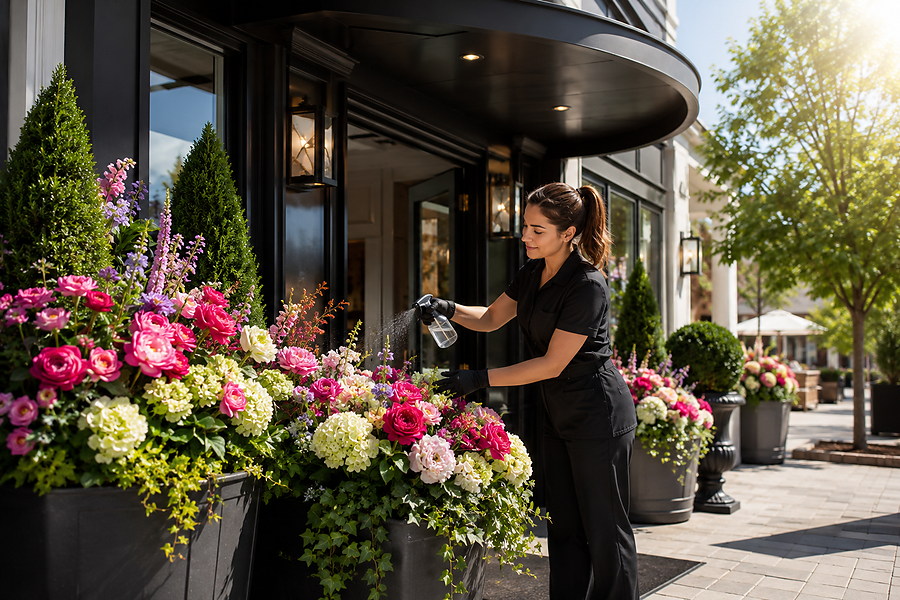
This matters for retailers, hotels, restaurants, event rental companies, florists, and property managers. Demand for artificial plants and flowers is rising, with the global market projected to grow from US$3.5 billion in 2025 to US$5.6 billion by 2032. Buyers are not only looking for low-maintenance beauty. They need commercial displays that stay presentable under real outdoor conditions.
Why Do Artificial Flowers Fade in the Sun?
A flower may be artificial, but it is not immune to sunlight. Faux petals, plastic leaves, dyes, glue, and coatings can still age outdoors.
Artificial flowers fade in the sun because ultraviolet radiation breaks down pigments, fabrics, plastics, and surface coatings. Heat, humidity, rain, dust, and wind can speed up this damage, especially when indoor-only flowers are used outside.
UV damage is a material problem
Most artificial flowers are made from polyester fabric, silk-like fabric, PE, PVC, plastic blends, wire, paint, glue, and coatings. These materials can look realistic at first, but sunlight slowly changes their surface.
Scientific research on UV exposure explains that solar UV radiation can damage plastics, causing yellowing, chalking, cracking, discoloration, and loss of strength over time. That same principle affects many outdoor artificial flowers, especially cheaper products made for indoor use.
| Sun Damage Problem | What It Looks Like | Business Risk |
|---|---|---|
| Color fading | Red turns pink, green turns pale | Storefront looks old |
| Brittle petals | Leaves crack or split | Display looks cheap |
| Surface chalking | Plastic looks powdery | Reduces realism |
| Weak glue | Flower heads loosen | Creates maintenance issues |
| Uneven fading | One side looks older | Hurts display consistency |
| Dust buildup | Colors look dull | Weakens first impression |
Outdoor exposure affects customer perception
For B2B buyers, fading is not only a product issue. It is a brand issue. A faded floral entrance can make a hotel, store, restaurant, or event venue look poorly maintained. Customers may not know the flowers are sun-damaged, but they will notice that the space feels tired.
Outdoor artificial flowers work best when they are treated as commercial display assets. That means the buyer should plan material quality, sun exposure, installation, cleaning, and replacement before the display goes outside.
What Is the Best Way to Protect Artificial Flowers from UV Damage?
There is no single permanent fix. The best protection is a layered system.
The best way to protect artificial flowers from UV damage is to start with UV-resistant outdoor flowers, then add clear UV floral protectant spray, shade, planter rotation, regular cleaning, and seasonal storage. UV spray helps, but it cannot fully save weak indoor flowers placed in harsh sun.
Start with UV-resistant flowers
A UV-resistant flower is made or treated to slow fading. It does not mean the flower will never fade. It means the flower is better prepared for sunlight than a standard indoor product.
The Spruce notes that many faux plants are not made for outdoor conditions and recommends outdoor-safe, UV-resistant, weatherproof materials such as PE, polyblend plastics, or PVC for exterior use. For B2B buyers, this is the first rule: never depend on spray alone if the base product is weak.
| Product Label | What B2B Buyers Should Understand |
|---|---|
| UV-resistant | Designed to slow sun fading |
| UV-protected | May include UV coating or UV-stable materials |
| Outdoor-safe | Suitable for exterior placement |
| Weather-resistant | Better against rain, wind, and temperature changes |
| Fade-resistant | Helps color last longer but does not make it permanent |
| Commercial-grade | Should be stronger, but still needs sample testing |
Use clear UV floral protectant spray
A UV floral spray adds a clear protective layer to the flower surface. Krylon’s Ultra UV Floral Protectant is described as a clear, non-yellowing indoor/outdoor spray that helps protect silk and dried flowers from fading, dirt, moisture, discoloration, and UV rays.
For commercial use, spray should be applied before flowers are installed outdoors. It works best on clean, dry, new products. Afloral recommends reapplying UV protectant spray every 6 to 12 months for outdoor artificial flowers and greenery.
| Step | What to Do | Why It Matters |
|---|---|---|
| Clean | Remove dust and debris | Helps spray bond evenly |
| Dry | Let flowers dry fully | Prevents cloudy coating |
| Test | Spray one hidden petal first | Checks color and texture reaction |
| Spray lightly | Apply thin, even coats | Avoids shine and dripping |
| Rotate | Cover all exposed sides | Improves protection |
| Cure | Let spray dry before display | Protects the finish |
| Reapply | Follow label or seasonal schedule | Maintains protection |
Use shade as a business strategy
Shade is one of the simplest ways to extend outdoor display life. Place artificial flowers under awnings, porch covers, balcony overhangs, pergolas, umbrellas, storefront canopies, or shaded walls.
Southern Living’s outdoor décor guidance recommends UV-protectant spray, shaded placement, and rotating large outdoor items to reduce uneven fading. For businesses, this means display placement can reduce replacement cost.
How Should B2B Buyers Choose Sun-Resistant Artificial Flowers?
A catalog photo does not prove outdoor performance. B2B buyers need to test quality before buying in bulk.
B2B buyers should choose sun-resistant artificial flowers by checking UV labels, material type, petal texture, color stability, stem strength, weather resistance, packaging, supplier sample policy, and reorder support. The best products look realistic and survive repeated outdoor display use.
Request samples before bulk ordering
Wholesale buyers should test samples outdoors before approving a large order. Place samples in direct sun, partial shade, and indoor lighting. Check them after several weeks. Bend the stems. Wipe the petals. Pull gently on flower heads. Test spray on one hidden area.
A flower that looks good in a showroom may fail in a sunny storefront. A strong B2B supplier should be able to provide product samples, material details, packing information, MOQ, lead time, and reorder support.
| Buyer Check | What to Ask Supplier | Why It Matters |
|---|---|---|
| UV rating | Is it UV-resistant or outdoor-safe? | Reduces fading risk |
| Material | PE, PVC, polyblend, polyester, real-touch? | Confirms outdoor suitability |
| Color control | Can future orders match the sample? | Supports multi-location displays |
| Stem strength | Is the stem wired and flexible? | Helps installation |
| Flower head | Is it securely attached? | Reduces shedding |
| Packaging | Are blooms protected in cartons? | Prevents crushing |
| MOQ | Minimum by SKU, color, or carton? | Helps buying plan |
| Reorder support | Will the same item remain available? | Protects future campaigns |
Choose flowers by business use
Different businesses need different outdoor flowers. A hotel entrance may need premium white orchids, magnolia, hydrangeas, or structured greenery. A retailer may need bright geraniums, petunias, lavender, and hanging baskets. A restaurant may need warm planter flowers that look good from the sidewalk. An event rental company may need modular UV-resistant stems that can be reused.
| Business Type | Best Outdoor Artificial Flower Strategy |
|---|---|
| Retail store | Bright UV-resistant window boxes and entrance planters |
| Hotel | Premium flowers in shaded entrances and lobby-adjacent areas |
| Restaurant | Durable planters with geraniums, lavender, greenery, and baskets |
| Event rental company | Modular flowers, garlands, arches, and reusable inserts |
| Property manager | Low-maintenance boxwood, shrubs, and seasonal flower accents |
| Florist wholesaler | Offer UV-resistant collections by color and display type |
Do not buy only by price
A cheaper flower may create higher replacement cost. If it fades in one month, breaks during installation, or arrives crushed, the buyer loses time and profit.
The U.S. artificial flowers market is expected to grow at a 5.0% CAGR from 2025 to 2030, supported by demand for durable, low-maintenance décor in homes, events, and commercial spaces. As more buyers enter the category, quality differences become more important.
How Can Businesses Maintain Outdoor Artificial Flowers Long Term?
Outdoor artificial flowers are low maintenance, not no maintenance. Sun protection must continue after installation.
Businesses can maintain outdoor artificial flowers by cleaning them regularly, rotating planters, checking for fading, securing stems, reapplying UV spray, replacing damaged pieces, and storing seasonal displays indoors when not in use.
Build a maintenance calendar
A business display should have a care schedule. This is especially important for hotels, restaurants, retail chains, shopping centers, wedding venues, and event rental companies.
| Timing | Maintenance Task | Best Practice |
|---|---|---|
| Weekly | Visual inspection | Check dust, loose stems, and tilted planters |
| Every 2–4 weeks | Clean flowers and leaves | Use microfiber cloth or soft brush |
| Monthly | Rotate planters | Reduce one-sided fading |
| After storms | Check stability | Inspect hooks, ties, bases, and panels |
| Every 6–12 months | Reapply UV spray | Follow spray label and exposure level |
| Seasonally | Replace faded stems | Refresh only damaged parts |
| After campaign | Store indoors | Clean, dry, reshape, and label boxes |
Keep displays modular
A modular display saves money. Use a durable greenery base, then add replaceable flower stems. If red petals fade faster than boxwood or eucalyptus, replace only the red flowers. If one side of a window box fades, refresh that side first.
This is useful for retailers and event rental companies. The same base can support spring flowers, summer geraniums, fall accents, and Christmas poinsettias. Modular design also makes storage and reinstallation easier.
Store seasonal flowers correctly
After a campaign, clean flowers before packing them. Let them dry fully. Reshape petals. Do not crush large flower heads. Keep white flowers away from dark red or strongly dyed pieces to avoid color transfer. Label boxes by season, color, client, or display zone.
Good storage turns artificial flowers into reusable inventory. Poor storage turns them into damaged stock.
My insights: How to Protect Artificial Flowers from the Sun in 2025 for B2B Buyers
Many B2B buyers ask, “What spray should we use?” That is useful, but it is not the full answer.
The best way to protect artificial flowers from the sun in 2025 is to manage the whole lifecycle: buy UV-resistant flowers, test samples, apply UV spray, place displays in partial shade, clean regularly, rotate exposure, replace faded parts, and store seasonal inventory properly.
The real B2B advantage is display control
My main insight is that sun protection is not just maintenance. It is business control.
A retailer protects curb appeal. A hotel protects guest impressions. A restaurant protects outdoor atmosphere. An event rental company protects reusable inventory. A wholesaler protects customer satisfaction. In every case, sun protection reduces complaints, early replacement, and brand damage.
A practical B2B decision framework
| B2B Question | Best Decision |
|---|---|
| Will the flowers face direct sun? | Buy UV-resistant outdoor-grade products |
| Is the display for a storefront? | Use bright but durable flowers and rotate planters |
| Is the display for hospitality? | Use premium flowers in shaded, high-impact areas |
| Is the order wholesale? | Test samples before bulk buying |
| Is the display seasonal? | Build modular pieces for reuse |
| Is the climate harsh? | Add UV spray, shade, and more frequent cleaning |
| Is the brand luxury? | Use fewer, better flowers with premium planters |
Spray helps, but product quality matters more
UV spray is valuable. It should be part of the system. But a spray cannot fully rescue low-quality indoor flowers in full sun. B2B buyers should invest first in outdoor-rated materials, then use spray as extra protection.
The best displays are protected before they fade
Once flowers are faded, the damage is already visible. Prevention is cheaper than replacement. That means buyers should spray before installation, rotate before fading becomes uneven, clean before dust builds up, and replace small parts before the whole display looks old.
For B2B buyers in 2025, artificial flowers should be treated like commercial assets. The right sun-protection plan keeps displays bright, realistic, and profitable for longer.
Conclusion
Protect artificial flowers from the sun by choosing UV-resistant products, applying UV spray, using shade, cleaning often, rotating displays, and storing seasonal inventory correctly.