
Many buyers use “artificial flower” and “fake flower” as the same thing. But in B2B sourcing, the wording can change how products are judged.
Artificial flower is usually the better professional term for wholesale sourcing, product catalogs, trade documents, and quality specifications. Fake flower is more casual and often carries a lower-quality meaning. Smart B2B buyers should compare materials, realism, durability, packaging, compliance, and use case instead of relying only on product names.
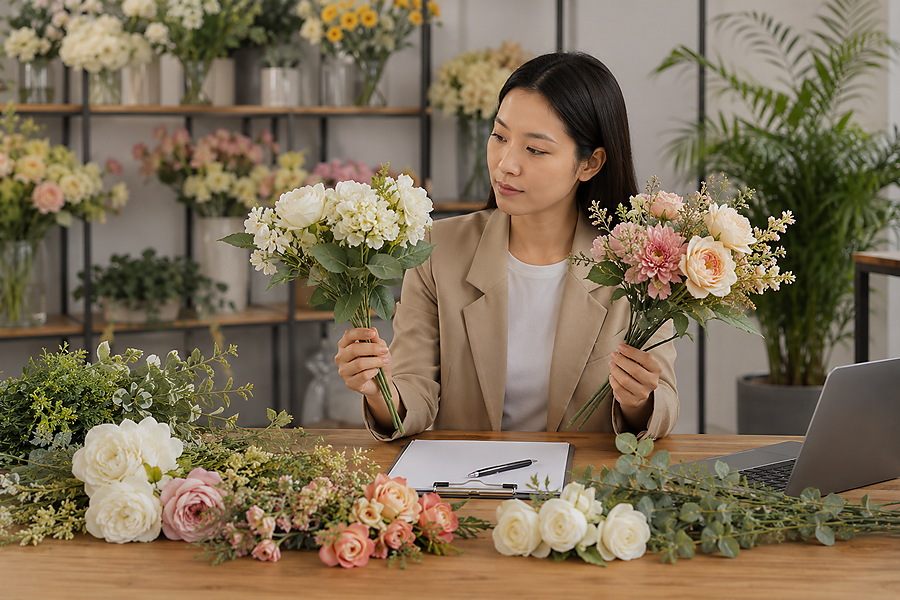
The artificial flower market is no longer only about cheap decorative stems. Grand View Research estimated the global artificial flowers market at USD 3.09 billion in 2024 and projected it to reach USD 4.49 billion by 2030, driven by demand for low-maintenance, long-lasting décor in homes and commercial spaces. This growth makes terminology more important for wholesalers, wedding decorators, hotel buyers, event rental companies, retailers, and interior décor suppliers.
What Does “Artificial Flower” Mean in B2B Sourcing?
A buyer may search for “fake flowers,” but a supplier, customs broker, or wholesale catalog will usually use more formal wording.
“Artificial flower” means a flower made from man-made materials instead of being naturally grown. In B2B sourcing, it is the broad professional category that can include silk flowers, polyester flowers, plastic flowers, latex flowers, foam flowers, real-touch flowers, flower heads, garlands, wreaths, panels, and floral arrangements.
Artificial flower is the trade-friendly term
For wholesale buying, “artificial flower” is usually the safer term because it sounds neutral and professional. It describes the product category without judging the quality. A luxury real-touch orchid, a silk rose stem, a plastic outdoor flower, and a hotel lobby floral arrangement can all fit under artificial flowers.
This matters in catalogs, quotations, invoices, product listings, customs classification, and B2B communication. Customs and tariff systems also use the language of artificial flowers. Flexport’s tariff data lists heading 6702 as “Artificial flowers, foliage and fruit and parts thereof; articles made of artificial flowers, foliage or fruit,” with subcategories for plastic artificial flowers. FreightAmigo also summarizes HS 6702 as covering artificial flowers, foliage, fruit, and parts, with 6702.10 for plastic items and 6702.90 for other materials.
Artificial does not mean one material
A common mistake is thinking artificial flowers are all plastic. In reality, the category can include many materials. Prestige Botanicals defines artificial flowers as man-made flowers that may use materials such as silk, polyester, plastic, foam, latex, or textile blends. Fortune Business Insights also segments the artificial flowers market by materials including polyester, plastic, silk, and nylon, with applications across residential and commercial use.
| B2B Term | What It Usually Means | Best Use |
|---|---|---|
| Artificial flower | Broad professional product category | Catalogs, quotations, trade documents |
| Silk flower | Premium artificial flower style or material claim | Wedding, home, hotel, event décor |
| Real-touch flower | Soft, more lifelike texture | Close-view arrangements |
| Plastic flower | Material-specific product | Outdoor, budget, mass-market use |
| Faux flower | Design-friendly marketing term | Retail, interior design, social content |
| Fake flower | Casual buyer term | Consumer search, informal conversation |
For B2B buyers, the word “artificial” should open a deeper product check. Ask what material is used. Ask whether it is indoor or outdoor. Ask whether it is UV-resistant. Ask whether the stem is wired. Ask whether the flower head is detachable. Ask how the product is packed. The category name is only the beginning.
What Does “Fake Flower” Mean in Buyer Language?
The word “fake” is easy to understand, but it can carry a negative tone. Some buyers hear “fake” and imagine shiny plastic, stiff stems, and dusty old décor.
“Fake flower” is a casual term for an artificial flower, but it often suggests lower quality or an obvious imitation. In B2B buying, the term can still be useful for search traffic, but product pages and quotations should usually use clearer terms such as artificial, faux, silk, or real-touch flowers.
Fake is a search word, not always a sales word
Many customers search with simple words. They may type “fake flowers for wedding arch,” “fake roses in bulk,” or “realistic fake flowers.” This means the word has SEO value. But on a professional product page, “premium artificial wedding flowers” sounds more credible than “premium fake wedding flowers.”
The tone matters because B2B buyers are usually buying for another audience. A wedding decorator sells to couples. A hotel buyer presents to management. A retailer sells to shoppers. A rental company shows products in a showroom. These buyers need language that helps them sell. “Artificial flowers” and “faux flowers” sound more polished. “Fake flowers” may still work in blog titles, FAQs, and search-driven content.
The stigma is changing
The old image of fake flowers is slowly changing because modern materials and styling have improved. Vogue reported that artificial florals are gaining new respect as designs become more realistic, with natural-touch materials, lifelike variation, and intentional imperfections helping products feel more elevated.
This change matters for B2B buyers. The product can no longer be judged by the label alone. A cheap product called “silk” may still look fake. A well-made product called “fake flower” in search wording may look premium in person. The quality depends on construction, material, finish, and styling.
| Buyer Wording | Possible Meaning | B2B Response |
|---|---|---|
| Fake flowers | Simple search term | Show realistic product photos |
| Realistic fake flowers | Buyer wants lifelike detail | Highlight texture and color variation |
| Cheap fake flowers | Price-sensitive buyer | Offer budget line with clear limits |
| Premium faux flowers | Design-focused buyer | Show styled applications |
| Artificial flowers wholesale | B2B sourcing intent | Provide MOQ, packaging, lead time |
| Silk flowers bulk | Wedding or event intent | Explain materials and color options |
A smart supplier can use “fake flower” for search discovery but use “artificial flower,” “faux flower,” and “silk flower” for product positioning. This keeps the content easy to find while making the brand feel more professional.
How Should B2B Buyers Compare Artificial, Faux, Silk, and Fake Flowers?
A buyer should not choose products by name alone. Terms can overlap, and suppliers may use them differently.
B2B buyers should compare artificial, faux, silk, and fake flowers by material, realism, durability, use case, price level, packaging, compliance, and reorder stability. The best choice depends on whether the flowers are for weddings, hotels, retail displays, outdoor use, interior décor, or event rentals.
The same flower can sit in several categories
A silk rose is an artificial flower. It may also be called a faux rose. A customer may call it a fake rose. A supplier may list it as a polyester flower. This overlap can create confusion in wholesale orders.
Silks Are Forever explains the relationship clearly: artificial and silk flowers refer to the same general product type, but all silk flowers are artificial flowers, while not all artificial flowers are silk flowers. This is a useful way to think about B2B buying. Artificial is the large category. Silk is a more specific style or material description. Faux is a more design-friendly word. Fake is a casual word.
Compare by application first
| Use Case | Best Term to Use | Product Priority |
|---|---|---|
| Wedding arches | Silk flowers, faux flowers, artificial wedding flowers | Realism, volume, wired stems |
| Hotel lobbies | Premium artificial flowers, real-touch flowers | Close-up realism and durability |
| Outdoor displays | UV-resistant artificial flowers | Weather and fade resistance |
| Event rentals | Reusable artificial flowers | Strong construction and packing |
| Retail resale | Faux flowers, silk flowers, artificial flowers | Packaging and style variety |
| Budget décor | Fake flowers, plastic flowers | Cost and basic appearance |
Material claims need proof
The word “silk” is often used as a quality signal, but many “silk flowers” are not pure silk. They may be polyester or silk-like fabric. This is not always a problem. Polyester can be durable and realistic when made well. The problem is unclear specification.
A B2B buyer should ask for material details instead of accepting the product title. Ask whether petals are polyester, silk-like fabric, latex-coated, PU, PE, PVC, or foam. Ask whether leaves are fabric or plastic. Ask whether the stems include iron wire. Ask whether the product has UV treatment. Ask whether the colors can be customized. These questions reduce disputes after bulk orders.
What Quality Checks Matter Before Wholesale Ordering?
A beautiful catalog photo is not enough for wholesale buying. Bulk orders need repeatable quality, strong packing, and stable production.
Before wholesale ordering, B2B buyers should check flower realism, petal material, stem strength, color consistency, attachment points, packaging, MOQ, lead time, customization options, and reorder stability. Samples should be tested under real lighting and handling conditions before large purchases.
Inspect the flower like a business asset
A buyer should test artificial flowers in the same way they will be used. If the flowers are for wedding arches, attach them to a frame. If they are for hotel lobbies, place them under warm lighting. If they are for outdoor commercial displays, check UV resistance. If they are for retail resale, inspect packaging and barcode needs.
Team Flower’s guide notes that high-quality artificial flowers should be botanically correct enough to mix with real flowers, and that not all products are created equal. This is especially true for B2B buyers because a poor sample becomes a bigger problem when multiplied across hundreds or thousands of pieces.
| Quality Check | What to Test | Why It Matters |
|---|---|---|
| Petal texture | Softness, thickness, shine | Affects realism |
| Color | Natural gradients, batch consistency | Protects large projects |
| Stem strength | Bendability and wire support | Helps installation |
| Flower head | Pull gently and shake | Prevents shedding |
| Packaging | Crush resistance and labeling | Reduces damage |
| Odor | Strong chemical smell | May affect indoor use |
| Lighting | Daylight, warm light, flash | Shows true color |
| Reorder | Same SKU and dye lot support | Protects long-term inventory |
Smart buyers also check trade details
For international sourcing, terminology connects to shipping and customs. HS 6702 is the broad artificial flower category, but plastic and non-plastic materials may fall into different subcategories. Buyers should confirm the final classification with a customs broker because exact codes can depend on material, product form, and destination rules.
Wholesale buyers should also ask for carton dimensions, gross weight, packing method, lead time, inspection process, and damage policy. A low unit price can become expensive if the flowers arrive crushed, colors do not match, or reorders are unstable.
My insights: Artificial Flower vs. Fake Flower: Key Differences for Smart B2B Buying
Many buyers ask whether artificial flowers and fake flowers are different. The better B2B question is how the wording affects sourcing, branding, and product quality.
The key difference is that “artificial flower” is the professional category term, while “fake flower” is a casual buyer term that may carry a lower-quality feeling. Smart B2B buying should focus less on the label and more on material, realism, durability, packaging, compliance, and commercial use.
The term should match the business purpose
My main insight is that B2B buyers should use different terms for different jobs. Use “artificial flowers” in invoices, catalogs, customs documents, and wholesale pages. Use “faux flowers” in design content, retail displays, and lifestyle marketing. Use “silk flowers” when the product is positioned as premium or wedding-ready. Use “fake flowers” carefully for SEO, FAQ pages, and casual buyer education.
This approach helps buyers and suppliers speak to both sides of the market. Trade teams need accurate product language. End customers need easy search language. Designers need elevated wording. Customs teams need category clarity.
A practical B2B wording guide
| Business Goal | Best Term |
|---|---|
| Formal wholesale quotation | Artificial flowers |
| Wedding decorator product page | Silk flowers or faux flowers |
| SEO blog title | Fake flowers, artificial flowers, faux flowers |
| Customs and shipping | Artificial flowers under HS 6702 |
| Hotel and interior design pitch | Premium faux botanicals |
| Outdoor commercial buying | UV-resistant artificial flowers |
| Event rental inventory | Reusable artificial flowers |
The real difference is quality control
In practice, the product name does not guarantee quality. A “silk flower” can look cheap. A “fake flower” can look realistic. A “faux flower” can be poorly made. A “premium artificial flower” still needs testing.
Smart B2B buyers should build a clear specification sheet. It should include flower type, material, size, color code, stem length, wire strength, packaging method, MOQ, lead time, sample approval, reorder rules, and use case. This turns a vague product name into a controllable buying decision.
For wholesale buying, the safest mindset is simple: use professional terms, but buy by evidence. Trust samples, not labels. Trust material details, not marketing words. Trust repeatable production, not one beautiful photo. This is how B2B buyers avoid cheap-looking products and build artificial flower collections that work for weddings, hotels, retail displays, rental businesses, and interior décor projects.
Conclusion
Artificial flower is the professional B2B term; fake flower is casual buyer language. Smart sourcing depends on materials, realism, durability, packaging, and clear specifications.