
Premium artificial flowers can still fail through weak stems, loose petals, inconsistent colors, visible glue, crushed packaging, or poor bulk inspection.
The best-quality artificial flowers combine realistic materials, secure construction, natural color variation, flexible stems, consistent production, documented AQL inspection, and protective packaging. B2B buyers should approve master samples, define defects, control colors under standard lighting, inspect bulk lots, and test the complete product-and-package system before shipment.
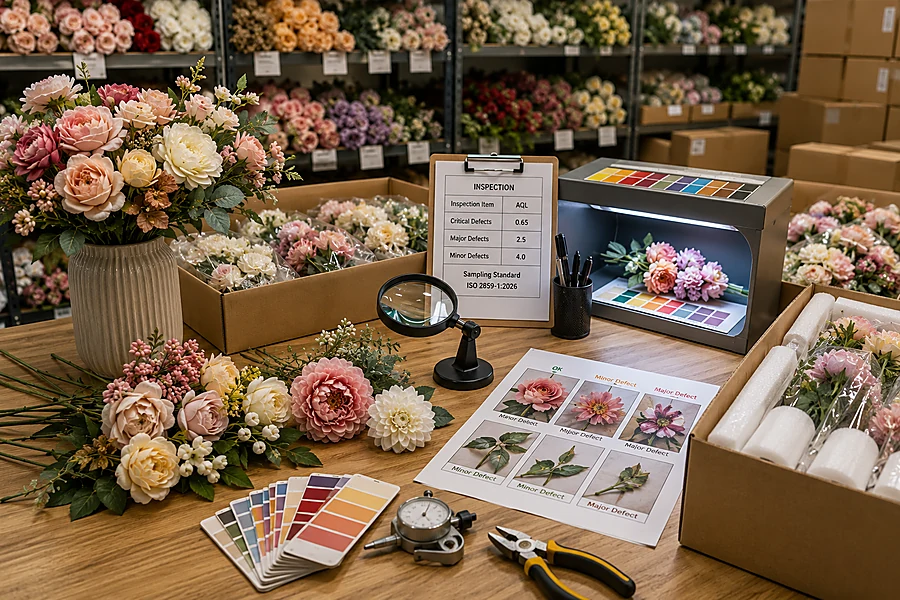
Artificial flower quality depends on materials, construction, color, shaping, packaging, and supplier consistency. Buyers using acceptance sampling should specify the exact ISO 2859-1 edition in every purchase document for clarity.
What Materials Define the Best-Quality Artificial Flowers?
A flower can feel soft but still have weak glue. It can look realistic but arrive crushed. Material quality must be evaluated as a complete product system.
The best-quality artificial flowers use soft, naturally colored petals, matte leaves, reinforced flexible stems, secure flower heads, clean attachment points, and materials suited to the final application. Indoor luxury flowers, rental flowers, and outdoor flowers require different material priorities.
Choose materials by use case
“Best quality” does not mean the same product for every buyer. A bridal flower must look convincing in close-up photographs. A hotel arrangement needs premium realism and easy cleaning. An event rental flower needs repeated bending and transport strength. An outdoor flower needs UV-resistant, weather-appropriate materials.
| Material or Component | Best Use | Quality Checks |
|---|---|---|
| Polyester or silk-style petals | Weddings, hotels, indoor arrangements | Soft texture, clean edges, natural layering |
| Real-touch or latex-style petals | Orchids, roses, premium close-up décor | Natural feel, non-sticky finish, stable color |
| PE leaves and greenery | Commercial and outdoor-ready products | Matte surface, flexible construction, secure attachment |
| PVC components | Durable foliage and structured products | Correct thickness, low odor, controlled shine |
| Wired stems | Bouquets, arches, rental installations | Bendable, secure, resistant to repeated shaping |
| Molded plastic stems | Outdoor plants and low-maintenance displays | Strong joints, realistic texture, no sharp edges |
| Metal internal wire | Large flowers and branches | Sufficient strength without exposed wire |
| Adhesive and connectors | All artificial floral products | No visible glue, loose heads, stains, or odor |
Inspect the full flower construction
A premium flower should remain secure when handled normally. Buyers should gently bend the stem, rotate the flower head, open the petals, wipe the leaves, and shake the product. The test should reveal loose heads, shedding, cracked stems, exposed wire, weak joints, or unstable leaves.
A flower should also recover after unpacking. Peonies and hydrangeas may require reshaping, but they should not remain permanently flattened. Wired stems should hold their new position without snapping or returning immediately to their original shape.
| Quality Area | Premium Standard | Common Defect |
|---|---|---|
| Petal edge | Clean and naturally shaped | Fraying, rough cutting, heat marks |
| Flower head | Secure and correctly centered | Loose, tilted, detachable |
| Color | Natural gradients and batch consistency | Flat, neon, stained, mismatched |
| Leaves | Matte and realistically positioned | Glossy, thin, poorly molded |
| Stem | Flexible but supportive | Weak, brittle, exposed wire |
| Glue points | Hidden and controlled | Visible glue strings or stains |
| Odor | Low and acceptable | Strong chemical smell |
| Recovery | Reshapes after unpacking | Permanent crushing |
Match quality grade to the selling market
Luxury artificial flowers need better close-up realism, detailed color gradients, natural petal layering, and premium stems. Mid-market event flowers may prioritize durability, fullness, and repeat use. Retail promotional flowers may prioritize color impact, packaging efficiency, and competitive pricing.
Buyers should therefore create written quality grades rather than using vague terms such as “good,” “premium,” or “realistic.” A specification can define petal material, flower-head diameter, number of petals, leaf count, total stem length, wire thickness, color reference, packing method, and acceptable tolerances.
How Should Buyers Use AQL for Artificial Flower Inspections?
Checking a few cartons without a written sampling plan can miss serious production problems. AQL gives buyers a structured acceptance-sampling method.
Buyers should use AQL by defining the production lot, inspection level, defect classes, sampling standard, and acceptance criteria before inspection. Critical, major, and minor defects should be separated because loose wire, wrong colors, and small cosmetic marks do not create equal business risk.
What AQL means
AQL stands for acceptance quality limit. ISO 2859-1 provides sampling schemes indexed by AQL for lot-by-lot inspection, while ANSI/ASQ Z1.4 provides an attribute-sampling system using switching rules for a continuing series of lots. These systems help determine sample sizes and acceptance or rejection numbers based on the lot and selected inspection conditions.
AQL does not mean the buyer has agreed that every shipment may contain exactly that percentage of defects. It is an index used within the sampling system. The purchase order should identify the standard, edition, inspection level, AQL values, defect definitions, and any special inspection requirements.
Because ISO 2859-1 was updated in January 2026, purchase orders created from a 2025 quality manual should state whether they use the earlier ISO edition, ISO 2859-1:2026, or ANSI/ASQ Z1.4. This prevents the buyer, supplier, and inspector from using different sampling tables.
Separate critical, major, and minor defects
The buyer should define defects according to customer risk and product use.
| Defect Class | Artificial Flower Examples | Commercial Effect |
|---|---|---|
| Critical | Exposed sharp wire, prohibited substance, serious safety issue | Possible injury, compliance failure, product withdrawal |
| Major | Wrong SKU, severe color mismatch, detached flower head, broken stem, strong odor, crushed product that cannot recover | Product may be unsellable or unusable |
| Minor | Small glue mark, slight leaf position difference, minor removable dust | Product remains usable but appearance is reduced |
An illustrative buyer profile might require no critical defects and use stricter limits for major defects than minor defects. However, there is no universal AQL combination for every artificial flower order. The buyer should select values based on market position, product risk, supplier history, order size, and customer expectations.
Build an inspection checklist
A strong pre-shipment inspection should include more than visual appearance.
| Inspection Area | Check |
|---|---|
| Quantity | Carton, inner-box, and piece counts |
| Product identity | SKU, flower type, color, and size |
| Dimensions | Flower-head diameter, stem length, garland length |
| Construction | Stem strength, flower-head security, leaf attachment |
| Appearance | Petal shape, glue control, color, stains, odor |
| Function | Bending, reshaping, installation, connector strength |
| Packaging | Inner protection, carton markings, compression |
| Labels | Barcode, SKU, color, quantity, country information |
| Special claims | UV, flame-retardant, or material documentation |
| Carton condition | Dry, clean, undamaged, correctly sealed |
Inspect high-risk characteristics separately
Some quality characteristics need special tests rather than normal visual sampling. Buyers may require separate sample sizes or 100% checks for:
- Sharp exposed wire
- Correct barcode and SKU
- Custom logo placement
- Mixed-carton quantities
- Required safety labels
- Approved color code
- Metal detector requirements
- Flower-wall connectors
- Large planter stability
An AQL inspection should not replace production control. Suppliers should inspect incoming materials, first production pieces, in-process assembly, finished goods, and packaging before the buyer’s final inspection.
How Can Suppliers Control Color Consistency Across Production?
Color variation is one of the most common artificial-flower disputes. Ivory may arrive yellow, blush may become peach, and greenery may vary between cartons.
Suppliers can control artificial flower color by using approved master samples, documented color codes, controlled lighting, batch records, material-lot approval, instrument readings, production comparisons, and retained samples. Buyers should define acceptable variation before production.
Start with a physical master sample
Computer screens and catalog photographs cannot be the final color reference. Screen brightness, camera settings, editing, and lighting can change how flowers appear.
The buyer and supplier should approve a physical sample. It should be signed, dated, photographed, labeled with the SKU and color code, and stored safely. When possible, the buyer and factory should each retain one matching sample.
The master sample should define:
- Petal face color
- Petal edge color
- Flower-center color
- Leaf color
- Stem color
- Printed veins or markings
- Gloss or matte level
- Color gradient placement
Use controlled visual comparison
Color should be reviewed under consistent lighting. Comparing one sample near a sunny window and another under warm warehouse lighting can create false disagreements.
A practical color-control station should use the same light source, viewing angle, background, and observation distance. White, ivory, blush, champagne, lavender, and greenery colors are especially sensitive to lighting differences.
| Color-Control Stage | Required Action |
|---|---|
| Material approval | Compare fabric, plastic, pigment, and printed components |
| First production | Confirm assembled flower against master sample |
| In-process control | Check new material and dye lots |
| Final inspection | Compare randomly selected cartons |
| Reorder control | Compare new production with retained sample |
| Complaint review | Use batch records and retained references |
Add instrumental measurement where useful
The CIEDE2000 formula provides a standardized method for calculating color differences and is published as part of the ISO/CIE colorimetry framework. Buyers can use spectrophotometer measurements and ΔE00 values to support visual approval, especially for repeat programs and tightly controlled brand colors.
A ΔE00 limit should not be copied blindly from another product category. Petal texture, translucency, gloss, pattern, lighting, and human sensitivity can affect whether a difference is acceptable. The buyer and supplier should agree on a limit using approved samples and actual product trials.
A useful purchase specification may state:
Bulk flowers must visually match the signed master sample under the approved light source and remain within the agreed ΔE00 tolerance when measured at the specified petal location.
Control batch mixing
Flowers from different color batches should not be mixed randomly inside the same bouquet, garland, panel, or master carton unless the design intentionally uses variation.
Suppliers should record material lot numbers and production dates. When a color lot changes, the factory should compare the new material with the approved reference before assembly. For large hotel, retail-chain, or event-rental programs, enough material should be reserved to complete matching products in one production run whenever practical.
What Packaging Protects Artificial Flowers During Shipping?
A well-made artificial flower can become unsellable if petals are crushed, stems bend, glitter transfers, or cartons collapse.
Artificial-flower packaging should protect flower heads, control movement, prevent abrasion, support recovery after unpacking, and use efficient carton dimensions. Buyers should test the finished product and complete packaging system, not approve an empty carton or packaging material alone.
Pack according to product shape
Different artificial flower products need different packaging.
| Product Type | Main Risk | Packaging Solution |
|---|---|---|
| Large peony or hydrangea | Crushed flower heads | Head spacing, support rings, low compression |
| Long stem | Permanent bending | Stem ties and rigid carton length |
| Orchid | Broken petals and branches | Individual support and dividers |
| Glittered flower | Surface transfer | Separate bags or tissue barriers |
| Garland | Tangling and crushing | Controlled coils and dividers |
| Flower panel | Bent grid and compressed flowers | Flat support and corner protection |
| Ceramic arrangement | Vase breakage and flower crushing | Molded inserts and double-wall cartons |
| Mixed carton | SKU confusion | Inner labels and separated compartments |
Test the product-and-package system
ISTA explains that its procedures evaluate the complete packaged product and are not intended to certify an individual packaging material by itself. Its 1 Series challenges product-and-package integrity, while 3 Series procedures provide broader transport-simulation testing.
This distinction matters. A strong carton can still fail if flowers move inside it. A good insert can fail if the carton is stacked too high. The final test should use the actual product, inner packing, carton, closure method, labels, and planned shipping configuration.
Include practical packaging tests
A B2B packaging-validation plan may include:
- Carton drop testing
- Compression or stacking testing
- Vibration testing
- Repeated handling
- Temperature or humidity conditioning where relevant
- Post-test flower recovery
- Barcode scanning
- Carton-count verification
- Pallet stability testing
ISTA also recommends retesting when important details change, including product components, packaging materials, internal packaging, or closure methods.
Define the unpacking standard
Some flowers need shaping after shipping. This is acceptable when the flower recovers quickly and no permanent damage remains. Buyers should define the maximum acceptable preparation time.
For example:
| Unpacking Result | Acceptance Decision |
|---|---|
| Petals recover after light hand shaping | Acceptable |
| Stem straightens without visible damage | Acceptable |
| Flower remains permanently flattened | Major defect |
| Petals show deep creases or tearing | Major defect |
| Flower head detaches during unpacking | Major defect |
| Carton quantity or SKU is wrong | Major defect |
| Sharp wire becomes exposed | Critical defect |
Protect packaging consistency
The approved packaging standard should record:
- Pieces per inner box
- Inner boxes per master carton
- Product orientation
- Flower-head spacing
- Bag thickness
- Divider material
- Carton dimensions
- Carton board grade
- Gross and net weight
- Closure method
- Required labels
- Pallet pattern
- Maximum stacking height
If the supplier changes the carton, inserts, quantities, or compression ratio, the buyer should review and approve the new arrangement before shipment.
My insights: What Defines the Best Quality of Artificial Flowers in 2025
Many buyers judge quality by touching one sample. That is not enough. A beautiful sample does not prove consistent production or safe delivery.
The best quality of artificial flowers in 2025 is defined by five connected controls: suitable materials, secure construction, disciplined AQL inspection, measurable color consistency, and validated packaging. A supplier must reproduce the approved flower across the full production lot and deliver it without damage.
Use a five-part quality system
| Quality Pillar | Buyer Requirement |
|---|---|
| Materials | Match the use case and approved specification |
| Construction | Secure petals, leaves, stems, wire, and glue |
| AQL | Written defect classes and sampling requirements |
| Color | Master samples, lighting control, and batch records |
| Packaging | Tested product-and-package system |
My main insight is that these five pillars cannot be separated. Premium material with poor assembly creates loose petals. Strong construction with weak color control creates mismatched cartons. Good products with poor packaging arrive crushed.
Use a weighted supplier scorecard
| Quality Area | Suggested Weight |
|---|---|
| Product realism and material quality | 25% |
| Construction and durability | 20% |
| Color consistency | 20% |
| Inspection and process control | 15% |
| Packaging performance | 15% |
| Documentation and corrective action | 5% |
The exact weights can change by market. A wedding supplier may give more weight to realism and color. An event-rental business may emphasize construction. An online retailer may place more weight on packaging and damage rates.
Put quality requirements in the purchase order
The purchase order should include:
- Approved SKU and master sample.
- Material and construction specifications.
- Dimensions and tolerances.
- Color references and measurement method.
- Defect classifications.
- AQL standard, edition, inspection level, and limits.
- Functional and safety checks.
- Packaging configuration.
- Required reports and photographs.
- Reinspection and corrective-action rules.
This turns “best quality” from a subjective request into a measurable supply agreement.
Measure quality after delivery
Final inspection at the factory is important, but buyers should also record warehouse results:
- Carton damage rate
- Unsellable product rate
- Reshaping time
- Color complaints
- Loose flower heads
- Broken stems
- Incorrect quantities
- Customer returns
- Reorder consistency
These results should guide the next order. A supplier with a beautiful sample but high delivery damage is not a high-quality supplier. A slightly more expensive supplier with stable colors, lower defects, and better packaging may create stronger margins.
Conclusion
The best artificial flowers combine realistic materials, secure construction, controlled colors, documented AQL inspections, tested packaging, and reliable reproduction from approved sample to delivered bulk order.