
Choosing the wrong artificial flower supplier can create slow shipping, weak margins, inconsistent colors, excess inventory, customer complaints, and expensive returns.
I recommend dropshipping for testing new artificial flower SKUs with low inventory risk, while wholesale works better for proven products that need stronger margins, packaging control, and faster local fulfillment. The best artificial flowers dropshipping supplier supports reliable stock, samples, blind shipping, quality control, clear returns, and an easy path into wholesale.
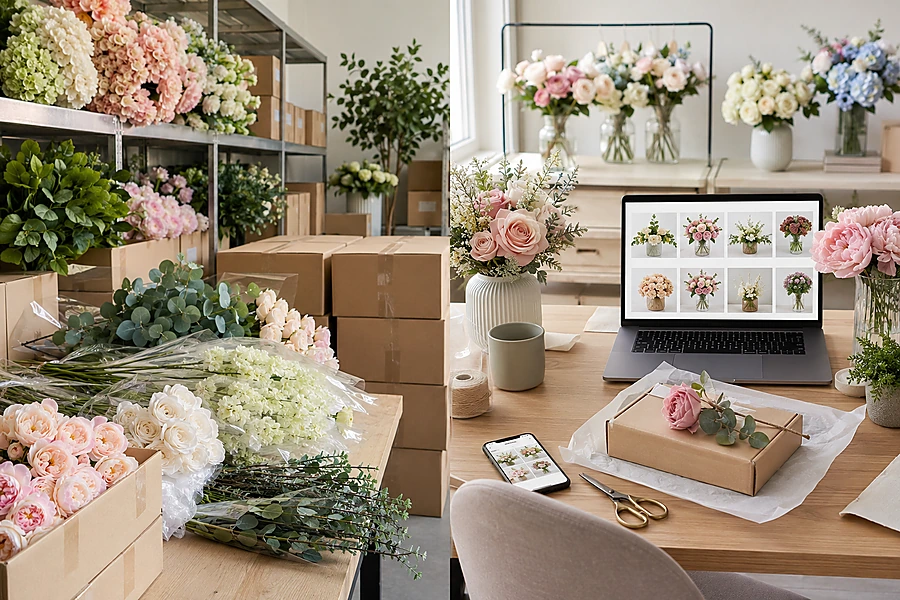
I do not judge a supplier by price alone. I compare product quality, fulfillment, inventory visibility, packaging, delivery time, return handling, customization, and landed cost. Shopify’s current guidance makes the core distinction clear: wholesale businesses purchase inventory in quantity, while dropshipping suppliers hold the inventory and fulfill customer orders individually.
What Is the Difference Between Wholesale and Artificial Flower Dropshipping Suppliers?
Both models can sell the same silk roses, faux orchids, greenery, bouquets, or artificial plants. The difference is mainly who owns the inventory and who fulfills the customer order.
I use a wholesale artificial flower supplier when I am ready to purchase cartons or larger quantities in advance. I use a dropshipping supplier when I want the supplier to hold stock and ship individual orders directly to customers. Wholesale gives me more control; dropshipping gives me lower inventory risk.
How wholesale works
With wholesale, I normally:
- Select the artificial flower SKUs.
- Approve samples.
- Meet the supplier’s MOQ.
- Pay for a bulk order.
- Import or receive the inventory.
- Store it myself or at a 3PL.
- Fulfill individual customer orders.
Shopify notes that manufacturers and wholesalers generally provide lower per-unit pricing because products are purchased in larger quantities. The trade-off is that the retailer needs working capital, storage, and inventory management.
Wholesale works well when I already know that ivory roses, white orchids, eucalyptus stems, or wedding garlands sell consistently.
How dropshipping works
With dropshipping, I normally:
- Add supplier products to my store.
- Market them without buying bulk inventory.
- Receive a customer order.
- Send the order to my supplier.
- Pay the supplier for that order.
- Let the supplier pick, pack, and ship it.
- Send tracking information to my customer.
The supplier owns or holds the inventory until the order is fulfilled. This reduces my need to invest heavily in stock before demand is proven.
Wholesale vs. dropship at a glance
| Buying Factor | Wholesale Artificial Flowers | Dropshipping Artificial Flowers |
|---|---|---|
| Upfront inventory | Higher | Low |
| MOQ | Usually required | Often single-unit or low quantity |
| Unit cost | Usually lower | Usually higher |
| Gross-margin potential | Higher | Lower |
| Stock risk | Buyer | Supplier |
| Quality-control access | Stronger | More limited |
| Packaging control | Strong | Supplier-dependent |
| Custom branding | Easier at volume | Usually limited initially |
| Shipping speed | Fast if locally stocked | Depends on supplier warehouse |
| Product testing | Requires stock commitment | Easy to test |
| Long-tail assortment | Expensive | Easier |
| Best use | Proven SKUs | New or uncertain SKUs |
A current hybrid supplier example
I particularly like suppliers that support both models because they let me test first and scale later.
For example, UK trade supplier Leaf Design Wholesale currently lists more than 1,000 artificial plant, tree, and flower lines held in stock, next-working-day dispatch, real-time stock information, wholesale ordering, and a dropshipping option for single items or smaller orders. Its wholesale account currently has a £150 + VAT minimum order. That is a useful example of the hybrid structure I would look for, although it is specifically a UK-focused supplier rather than a universal solution for every market.
I would rather build a long-term relationship with a supplier that can support both small test orders and bulk purchasing than change my complete supply chain every time a product becomes successful.
Which Supplier Model Gives Better Margins, Quality Control, and Shipping?
Dropshipping wins on flexibility. Wholesale normally wins on unit economics and operational control.
I choose dropshipping when reducing inventory exposure matters most. I choose wholesale when repeat sales justify buying cartons and I need lower unit costs, stronger packaging, faster domestic fulfillment, better color consistency, or custom branding. For established artificial flower stores, I usually prefer a hybrid model rather than choosing only one.
Wholesale usually wins the margin comparison
A wholesaler or factory may offer stronger pricing because I buy larger quantities.
My dropship supplier must also cover:
- Warehouse storage
- Individual picking
- Single-order packaging
- Shipping-label processing
- Inventory management
- Per-order handling
Those costs normally appear in the product price, service fee, shipping cost, or all three.
Shopify’s current wholesale comparison identifies better margins, greater packaging control, faster fulfillment from locally held stock, and better private-label opportunities as common wholesale advantages.
Dropshipping wins when demand is uncertain
Imagine I want to launch ten artificial peony colors.
With wholesale, I might have to purchase cartons of:
- White
- Ivory
- Blush
- Pink
- Dusty rose
- Champagne
- Lavender
- Blue
- Burgundy
- Peach
If only white, ivory, and blush sell well, the other colors trap working capital.
With dropshipping, I can test all ten while my supplier holds the inventory.
This is why I view dropshipping as a demand-validation tool.
My illustrative margin comparison
The numbers below are only an example.
| Cost Item | Dropship Bouquet | Wholesale Bouquet |
|---|---|---|
| Retail price | $59 | $59 |
| Product cost | $23 | $14 |
| Per-order shipping | $11 | $6 |
| Local pick/pack | Included | $3 |
| Payment/marketplace costs | $4 | $4 |
| Advertising | $10 | $10 |
| Contribution before overhead | $11 | $22 |
Wholesale can produce a stronger contribution margin when purchasing volume and consolidated freight reduce product cost.
However, the wholesale example also requires me to finance inventory before it sells.
Quality control is easier with wholesale
Artificial flowers have quality characteristics that are difficult to manage when I never see the stock:
- Petal color
- Flower-head diameter
- Stem length
- Fabric cutting
- Visible glue
- Leaf color
- Wire strength
- Packaging compression
- Unpacking odor
- Batch consistency
With wholesale, I can approve a master sample and arrange pre-shipment inspection before a large order leaves the factory.
With dropshipping, my customer may be the first person to see the exact unit shipped.
That is why I always order samples from a dropship supplier before listing a product.
Local wholesale wins on fast delivery
When I hold my best artificial flowers in a local warehouse or 3PL, I can normally offer more predictable customer delivery.
Shopify notes that international dropshipping can create long shipping times and specifically describes buying wholesale and moving inventory into a domestic fulfillment center as one way businesses improve delivery speed.
I therefore compare:
Dropship product cost + single-order freight
against:
Wholesale landed cost + local storage + domestic pick/pack + domestic delivery
The second model often becomes more attractive once volume increases.
How Do I Choose a Reliable Artificial Flowers Dropshipping Supplier?
A huge catalog does not make a supplier reliable. I need the supplier to reproduce the correct product and deliver it consistently.
I choose an artificial flowers dropshipping supplier by testing samples, stock visibility, fulfillment speed, blind shipping, packaging, tracking, return handling, communication, SKU consistency, and the ability to scale. I also prefer suppliers that understand artificial flower quality rather than general dropship companies selling thousands of unrelated categories.
I test the product first
Before I list any artificial flower, I order it to an address similar to my customer’s location.
I inspect:
| Quality Area | What I Check |
|---|---|
| Petals | Fraying, texture, color and shape |
| Flower head | Size and secure attachment |
| Leaves | Shine, molding and color |
| Stem | Length and flexibility |
| Glue | Visible residue |
| Odor | Strong chemical smell |
| Packaging | Crushing and protection |
| Recovery | How quickly the flower reshapes |
| Photos | Whether the real product matches the listing |
| Reorder | Whether the same SKU stays consistent |
I photograph the sample myself. I do not depend entirely on the supplier’s catalog images.
I require reliable stock information
A no-inventory store can still lose sales when the supplier runs out of stock without warning.
I look for:
- Real-time inventory
- Regular CSV feeds
- API or store integration
- Low-stock alerts
- Discontinuation notices
- Restock dates
- Stable SKU codes
Leaf Design Wholesale, for example, currently provides live stock information and downloadable stock/price data for trade customers, illustrating the type of inventory visibility I want from a supplier.
I require blind shipping
The customer bought from my store, so the parcel should not create confusion.
My supplier agreement should clarify:
- No competitor invoice
- No supplier retail pricing
- No unrelated promotional cards
- Neutral or approved packaging
- Correct return instructions
- My branding where agreed
I order a test parcel before approving this process.
I check packaging carefully
Artificial flowers are difficult because they are light but bulky.
A bouquet may have a low physical weight while occupying a large shipping carton. This increases dimensional-weight costs.
Bad packaging can also produce:
- Crushed peonies
- Folded hydrangeas
- Bent orchid petals
- Broken stems
- Permanently flattened leaves
I prefer a supplier that can reduce carton volume without permanently damaging the flower.
I evaluate specialized suppliers before giant catalogs
Alibaba currently lists many artificial flower wholesale suppliers and product categories, including suppliers offering artificial flowers with low-to-moderate minimum quantities on individual listings. It also has separate listings marketed for flower dropshipping, but MOQ and fulfillment structure vary from seller to seller. I would therefore use Alibaba primarily as a supplier-discovery and factory-sourcing platform, then verify dropship capability individually rather than assuming every artificial flower manufacturer supports one-piece fulfillment.
My supplier scorecard
| Supplier Requirement | Weight |
|---|---|
| Product quality | 25% |
| Repeat SKU consistency | 15% |
| Fulfillment accuracy | 15% |
| Shipping performance | 15% |
| Inventory visibility | 10% |
| Packaging quality | 10% |
| Returns/corrective action | 5% |
| Wholesale scaling option | 5% |
I do not give price the largest weight.
A supplier that saves me $2 per bouquet but creates refunds, late deliveries, and inconsistent colors can be much more expensive overall.
When Should I Switch From Dropshipping Artificial Flowers to Wholesale?
I do not switch simply because a supplier offers a cheaper carton price. I switch when the data show that inventory risk has fallen enough to justify the investment.
I move a proven artificial flower SKU from dropshipping to wholesale when sales become predictable, return rates remain acceptable, the supplier proves consistent, and the wholesale landed-cost advantage exceeds storage and fulfillment costs. I keep slow colors, new designs, and experimental products in dropship whenever possible.
I look for stable demand
Suppose my store sells these products:
| SKU | Monthly Sales | My Decision |
|---|---|---|
| Ivory rose bouquet | 180 | Consider wholesale |
| White orchid | 120 | Consider wholesale |
| Blush peony bundle | 90 | Pilot wholesale |
| Blue hydrangea | 12 | Keep dropship |
| Burgundy rose | 7 | Keep dropship |
| Seasonal poinsettia | Seasonal | Dropship or planned seasonal bulk |
I do not want to fill a warehouse with every variation.
I calculate the wholesale crossover
I compare:
Dropship cost per delivered order
with:
Wholesale landed cost + storage + pick/pack + local shipping + expected unsold inventory
When wholesale creates a meaningful saving after all those costs, I test a small bulk order.
I use a pilot order
I do not jump directly from dropshipping to a container.
My first wholesale order should confirm:
- Bulk color matches the sample
- Packaging protects the flowers
- Carton dimensions match the quote
- Labels scan correctly
- Damage stays acceptable
- Supplier lead time is realistic
- Local fulfillment works
Alibaba’s current artificial-flower supplier marketplace shows that minimum quantities vary widely by individual product and manufacturer. That flexibility can help buyers negotiate small pilot quantities before increasing volume.
I keep the long tail in dropship
This is where hybrid sourcing becomes powerful.
I might stock:
- Ivory roses
- White orchids
- Eucalyptus
- Blush peonies
But dropship:
- Purple roses
- Seasonal flowers
- Rare orchid colors
- New wedding trends
- Experimental bouquets
I get the better economics of wholesale without carrying every possible SKU.
My insights: What Is the Best Artificial Flowers Dropshipping Supplier, and Should I Choose Wholesale or Dropship
I do not believe the best artificial flowers dropshipping supplier is simply the company with the largest catalog or lowest price.
The best artificial flowers dropshipping supplier is a hybrid-ready partner that lets me test products without inventory, provides reliable stock and one-order fulfillment, protects my customer experience, and later gives me wholesale pricing, consistent batches, custom packaging, and stronger QC when a SKU proves demand. Dropship should test demand; wholesale should scale proven demand.
My ideal supplier has two operating modes
The strongest supplier relationship looks like this:
| Stage | Supplier Model | My Goal |
|---|---|---|
| New SKU | Dropship | Test customer demand |
| Early winner | Dropship + reserved stock | Reduce stockouts |
| Proven SKU | Small wholesale pilot | Validate bulk quality |
| Core bestseller | Wholesale + local 3PL | Improve margin and speed |
| New colors | Dropship | Continue testing |
| Seasonal designs | Flexible model | Avoid excess stock |
This approach protects cash at the beginning and protects margins later.
A supplier that offers both models gets an advantage
A current example is Leaf Design Wholesale in the UK. It offers a trade-only wholesale artificial plant and flower range, stock visibility, fast UK dispatch, and a dropshipping option for smaller or single-item orders. I would treat that combination as a strong structural benchmark for evaluating other suppliers in different regions.
The important point is not that one company is universally “the best.”
The important point is that the supplier model supports my growth without forcing me to rebuild the supply chain.
I separate product discovery from long-term sourcing
Large marketplaces can be useful for finding factories, designs, and price ranges. Alibaba currently has extensive artificial flower supplier listings and products advertised for dropshipping, but every supplier still needs individual verification for MOQ, blind shipping, stock availability, packaging, return handling, and order-processing speed.
For long-term sourcing, I prefer direct supplier relationships with documented SKUs and operating rules.
My final wholesale vs. dropship verdict
| Business Situation | Winner |
|---|---|
| Brand-new artificial flower store | Dropship |
| Testing many colors | Dropship |
| Low working capital | Dropship |
| Uncertain seasonal trend | Dropship |
| Proven high-volume SKU | Wholesale |
| Custom packaging | Wholesale |
| Private-label collection | Wholesale |
| Fast local shipping | Wholesale/3PL |
| Highest QC control | Wholesale |
| Broad long-tail catalog | Dropship |
| Mature artificial flower business | Hybrid |
My strongest buying rule
I use dropshipping as the testing laboratory and wholesale as the scaling engine.
I do not purchase 1,000 units because I think a flower will sell. I first use dropshipping to learn which colors, designs, price points, and bundles customers actually buy.
When the evidence becomes clear, I move the winners into wholesale.
That model gives me:
- Lower initial risk
- Better product discovery
- Less dead inventory
- Better long-term margins
- Faster shipping for bestsellers
- Stronger branding
- Better packaging control
- A wider test catalog
In practical terms, the best artificial flowers dropshipping supplier is the supplier that can help me move smoothly through this entire process.
Conclusion
I start artificial flower SKUs with dropshipping, move proven winners to wholesale, and choose suppliers that combine reliable fulfillment, quality control, stock visibility, and scalable pricing.