
Choosing attractive flowers is not enough. Bulky packaging, crushed petals, weak margins, stockouts, and highly seasonal demand can quickly damage an artificial-flower dropshipping store.
The best artificial flowers for dropshipping are roses, peonies, hydrangeas, orchids, tulips, eucalyptus stems, DIY flower boxes, wedding garlands, autumn mums, and Christmas poinsettias. These categories combine strong visual appeal, useful bundles, repeatable SKUs, multiple décor applications, and manageable fulfillment when suppliers control packaging, stock updates, shipping, and product consistency.
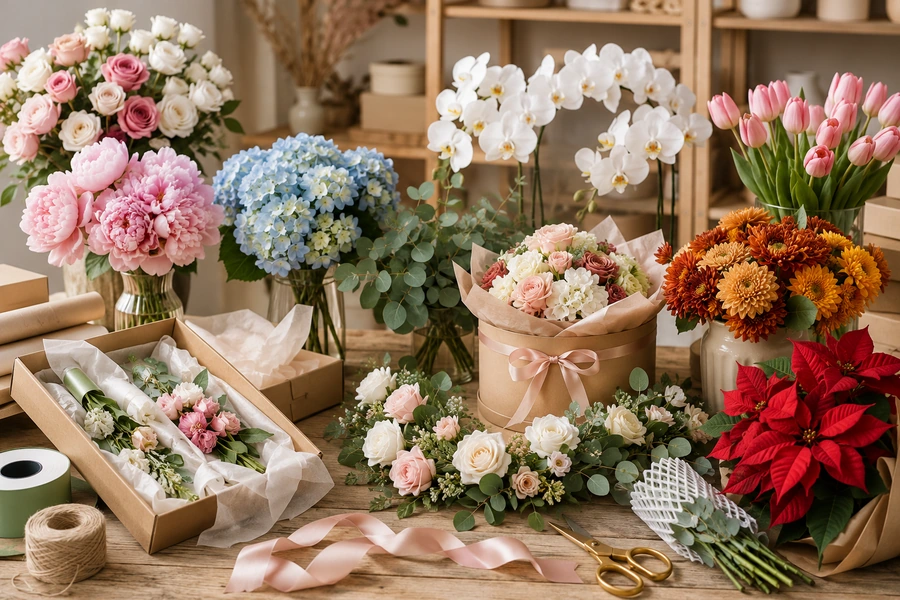
I rank these products by commercial flexibility rather than claiming one universal sales leaderboard. I favor artificial florals that can serve weddings, everyday home styling, gifts, events, and seasonal collections while remaining understandable online and practical for supplier-direct shipping.
Which Artificial Flowers Are Best for Dropshipping?
The best product range should balance year-round sellers with wedding and seasonal products. A store built only around Christmas flowers may produce strong short-term sales but weak demand during the rest of the year.
My top ten artificial-flower dropshipping categories are rose bundles, peonies, hydrangeas, orchids, tulips, eucalyptus and greenery stems, DIY flower boxes, wedding garlands, autumn mums, and Christmas poinsettias. I would launch the first six as core products and use the remaining four to increase order value, wedding relevance, and seasonal demand.
Top 10 artificial flower products
| Rank | Product Category | Best Market | Main Advantage | Main Risk |
|---|---|---|---|---|
| 1 | Artificial rose bundles | Wedding and home | Broad color and bundle potential | Crowded market |
| 2 | Artificial peonies | Wedding and luxury décor | Large romantic flower heads | Crushing |
| 3 | Artificial hydrangeas | Events and centerpieces | Fast visual volume | Bulky heads |
| 4 | Artificial orchids | Home and hospitality | Premium perceived value | Close-up realism |
| 5 | Artificial tulips | Home and spring décor | Simple, giftable bundles | Material quality |
| 6 | Eucalyptus and greenery | Wedding and home | Easy cross-selling | Color inconsistency |
| 7 | DIY flower combo boxes | Weddings and crafts | High value and convenience | Missing components |
| 8 | Wedding garlands and swags | Events | Higher order value | Dimensional shipping |
| 9 | Artificial mums and autumn sprays | Seasonal home décor | Strong fall theme | Short selling window |
| 10 | Poinsettias and Christmas picks | Holiday décor | Clear seasonal intent | Leftover inventory |
1. Artificial rose bundles
Roses are my strongest general starting product.
They can support:
- Bridal bouquets
- Bridesmaid bouquets
- Table centerpieces
- Home vases
- Flower walls
- Gift arrangements
- Valentine’s collections
- Memorial arrangements
I would avoid listing forty nearly identical rose products. I would begin with controlled collections such as ivory, blush, dusty rose, burgundy, champagne, and terracotta.
The seller can then create bundles:
12 ivory rose stems
24 blush wedding roses
Rose and eucalyptus centerpiece kit
Bridal bouquet flower box
Roses are easy for customers to understand, but they are also easy to compare across stores. Original photography, accurate flower-head dimensions, color comparisons, and useful bundles are essential.
2. Artificial peonies
Peonies provide large floral impact with relatively few stems.
They fit:
- Romantic weddings
- Luxury home décor
- Spring collections
- Bridal showers
- Hotel-style arrangements
Their large heads create strong visual value in photographs. Their weakness is packaging.
Compressed peony petals may arrive folded or flattened. I would test how quickly each sample recovers after unpacking and whether hand shaping restores its intended form.
3. Artificial hydrangeas
Hydrangeas are volume products.
One large head can fill a meaningful part of a centerpiece or flower wall. This makes them useful for event customers who need fast visual coverage.
Strong colors include:
- Ivory
- White
- Blush
- Sage
- Dusty blue
- Burgundy
- Autumn rust
Hydrangeas can generate dimensional shipping costs because their heads occupy significant carton space. UPS explains that large, lightweight parcels can be charged using dimensional weight rather than actual weight alone.
4. Artificial orchids
Orchids support a more premium position.
They work well for:
- Home offices
- Hotel-style interiors
- Reception desks
- Bathroom décor
- Gifts
- Minimalist arrangements
I would sell either individual stems or complete potted arrangements.
Close-up realism matters more than it does for distant flower walls. I inspect petal thickness, flower centers, leaves, roots, stems, and planter quality before listing any orchid.
5. Artificial tulip bundles
Tulips are simple, recognizable, and easy to merchandise by color.
They suit:
- Spring home décor
- Mother’s Day
- Kitchen and dining arrangements
- Gifts
- Easter collections
- Minimalist interiors
Soft-touch tulips can feel more convincing than hard, glossy products. I would show customers the full stem length, number of flowers, bundle width, and vase used in styled images.
6. Eucalyptus and mixed greenery stems
Eucalyptus is not technically a flower, but it belongs in nearly every artificial-floral dropshipping assortment.
It can support:
- Wedding bouquets
- Table garlands
- Wreaths
- Home vases
- Ceremony arches
- Floral craft boxes
It also raises order value because customers often purchase greenery with flowers.
I would stock only a few consistent foliage families, such as silver-dollar eucalyptus, seeded eucalyptus, olive, and fern. Too many similar leaves can make inventory management difficult.
7. DIY flower combo boxes
DIY flower boxes combine focal flowers, smaller blooms, fillers, and greenery in one coordinated color palette.
They are strong for:
- Bridal bouquets
- Centerpieces
- Baby showers
- Craft projects
- Event decorations
The current wedding market places strong value on personalization, cohesive stories, and products that help couples create connected details across proposals, showers, receptions, and other wedding moments.
A combo box should clearly show:
- Exact contents
- Number of flower heads
- Stem condition
- Included greenery
- Finished project possibilities
- Whether tools are required
8. Wedding garlands and arch swags
Garlands and floral swags can create higher average order values than single stems.
Useful products include:
- Eucalyptus table garlands
- Rose-and-greenery swags
- Ceremony arch corner arrangements
- Staircase florals
- Welcome-sign flowers
- Sweetheart-table arrangements
These products are visually valuable but can be harder to pack. I prefer modular swags that compress safely and recover quickly rather than fully rigid arrangements.
9. Artificial mums and autumn sprays
Artificial mums serve fall porches, harvest displays, Thanksgiving arrangements, wreaths, and seasonal planters.
Recent consumer décor coverage has highlighted faux mums and autumn florals as low-maintenance seasonal alternatives, including products marketed for outdoor displays.
I would treat these as seasonal campaigns rather than year-round core stock.
The main selling period should be planned in advance, and the supplier needs enough inventory before autumn demand begins.
10. Poinsettias and Christmas floral picks
Poinsettias offer clear customer intent.
They fit:
- Christmas trees
- Wreaths
- Garlands
- Table arrangements
- Shop displays
- Hotel holiday décor
I would sell red as the core option, then add controlled white, burgundy, champagne, or metallic versions.
The product should be modular. Wired poinsettia picks can be used across several applications, which makes them safer than one highly specific finished arrangement.
What Makes an Artificial Flower Profitable for Dropshipping?
A product can receive many clicks while losing money after advertising, supplier shipping, damaged goods, refunds, and transaction costs.
A profitable artificial flower should have strong visual appeal, enough retail value to absorb shipping, manageable carton dimensions, simple variants, consistent supplier stock, low damage, and clear bundle potential. I calculate contribution margin for the complete delivered order rather than choosing products from supplier cost alone.
Use complete order economics
I calculate:
Contribution profit = retail price − supplier product cost − shipping − payment fees − advertising − expected refund and damage cost
Illustrative example:
| Cost Item | Amount |
|---|---|
| Customer price | $54 |
| Supplier product cost | $16 |
| Shipping | $11 |
| Payment/platform fees | $3 |
| Advertising | $10 |
| Damage/refund allowance | $3 |
| Contribution profit | $11 |
These figures are examples, not market benchmarks.
A hydrangea set costing $10 may be less profitable than a $16 rose box when the hydrangeas need a much larger carton.
Favor strong value-to-volume
I compare how much retail revenue each product creates for the carton space it occupies.
| Product | Shipping Efficiency | Dropshipping Fit |
|---|---|---|
| Rose bundle | Good | Strong |
| Tulip bundle | Good | Strong |
| Eucalyptus stems | Good | Strong |
| DIY flower box | Good–moderate | Strong |
| Hydrangea heads | Moderate | Good if bundled |
| Garland | Moderate | Good |
| Large rigid arrangement | Weak | Limited |
| Flower wall | Weak for beginners | Specialized |
UPS states that dimensional weight reflects the space occupied by a parcel and may apply when a package is large compared with its actual weight.
This matters because artificial flowers are often lightweight but bulky.
Choose products with bundle potential
A single stem may not generate enough order value.
I prefer products that can form:
- Color bundles
- Bouquet kits
- Vase-ready sets
- Wedding table packages
- Seasonal porch sets
- Wreath-making kits
- Flower-and-greenery combinations
Bundles also reduce direct comparison with another seller’s single supplier SKU.
Limit variants during launch
Artificial flowers can create too many combinations.
A rose may be available in:
- Six lengths
- Twelve colors
- Three flower-head sizes
- Several bundle counts
I would launch only the strongest combinations.
A clear opening range might contain:
- Ivory wedding rose
- Blush wedding rose
- Burgundy event rose
- Terracotta autumn rose
- White home-décor rose
I would add variants after real orders show demand.
Keep inventory visibility accurate
Dropshipping removes seller-held stock, but it does not remove inventory management.
Shopify defines dropshipping inventory management as tracking and synchronizing store availability with supplier inventory. It recommends real-time tracking, unique SKUs, communication, and tools that reduce stockouts.
This is especially important for seasonal products. A Christmas listing that remains active after the supplier sells out can produce cancellations during the most time-sensitive part of the year.
How Should Sellers Choose Artificial Flower Suppliers and Packaging?
A supplier becomes the warehouse, quality checker, packing team, and shipping department. The customer still judges the store when the supplier fails.
I choose suppliers by ordering samples, testing packaging, verifying SKU consistency, checking inventory updates, reviewing shipping times, confirming blind fulfillment, and agreeing on returns and replacements. I require each flower to arrive in the condition shown on the listing, with no competitor invoice, severe crushing, unexpected substitution, or incorrect color.
Order samples before listing products
Shopify recommends purchasing products from potential dropshipping suppliers so merchants can assess product quality and actual shipping performance. It also states that sellers remain responsible for safety, shipping information, and accurate refund policies even when a third party fulfills the order.
For every artificial flower sample, I inspect:
| Quality Area | What I Check |
|---|---|
| Color | Accuracy under daylight and indoor lighting |
| Petals | Fraying, cutting, texture and creasing |
| Flower head | Diameter and attachment |
| Leaves | Gloss, color and molding |
| Stem | Length and wire strength |
| Glue | Visible residue |
| Odor | Unacceptable chemical smell |
| Packaging | Crushing and protection |
| Recovery | Reshaping time |
| Listing accuracy | Match with images and dimensions |
I would also order a later repeat sample. The first product may be excellent while the next production batch differs.
Test the final customer parcel
The supplier should send a normal customer order, not a specially prepared sample.
I check:
- Processing time.
- Tracking upload.
- Outer-carton condition.
- Supplier branding.
- Product protection.
- Flower compression.
- Missing pieces.
- Reshaping instructions.
- Delivery time.
- Return information.
The store should publish realistic processing and shipping details. Shopify says merchants should communicate shipping times and additional charges before purchase and inform customers about delays or order changes.
Require clear stock and SKU controls
My supplier checklist includes:
- Stable SKU codes
- Real-time or daily stock data
- Low-stock alerts
- Discontinuation notice
- Restock dates
- No substitutions without approval
- Batch-change notification
- Correct color naming
Shopify’s current inventory guidance identifies supplier diversity, integrated tools, data visibility, and communication as key controls for dropshipping stock.
Protect flower heads without excessive volume
Good packaging balances protection and freight.
For roses and peonies, I look for:
- Light head protection
- Controlled stem bending
- No sharp wire contact
- Enough space for petals
- Simple reshaping instructions
For combo boxes, I need:
- An item count
- Secure components
- Clear color separation
- No loose adhesive
- Replacement rules for missing pieces
I do not approve packaging only from a supplier photograph. I test the actual packed product.
Define return and damage procedures
Artificial flowers create unusual customer issues.
| Customer Problem | Recommended Process |
|---|---|
| Recoverable compression | Provide shaping guidance |
| Permanent crushed petals | Replace or refund |
| Wrong color | Supplier correction |
| Missing flower | Replacement component |
| Wrong SKU | Full correction |
| Customer changed mind | Published store policy |
| Late seasonal delivery | Clear policy-based resolution |
Shopify states that dropshipping stores should maintain a current, public refund policy that explains the return period, address, costs, and customer contact process.
How Should Sellers Market Wedding, Home, and Seasonal Artificial Flowers?
The same flower should not use one generic product page for every customer. A wedding buyer, home decorator, and Christmas shopper have different questions.
I market artificial flowers by use case. Wedding listings need timelines, color accuracy, quantities, and real-event images. Home-décor listings need dimensions, vase scale, materials, and room photography. Seasonal listings need early promotion, clear indoor or outdoor suitability, delivery deadlines, and coordinated bundles that increase average order value.
Wedding marketing
Wedding shoppers need trust because dates and colors matter.
Etsy’s current wedding-seller guidance says buyers value clear processing times, accurate delivery estimates, consistent information, customization, responsive communication, and photographs that show products in realistic wedding settings.
I would include:
- Bouquet dimensions
- Stem count
- Flower-head sizes
- Color comparisons
- Processing time
- Estimated delivery
- Close-up images
- Full-table or ceremony images
- Required reshaping
- Matching product suggestions
Etsy’s 2026 trend report also recommends terms such as “garden wedding,” “wildflower bride,” and “romantic bridal” when they genuinely match the product and listing.
I would not add unrelated trend phrases only to gain traffic.
Home-décor marketing
Home buyers need help judging scale.
A product page should show:
- Flower length
- Bundle width
- Recommended vase height
- Number of stems shown
- Close-up material
- Styled room image
- Neutral background image
- Available colors
I would create collections around rooms and moods:
Minimal White Orchid Décor
Romantic Peony Home Collection
Modern Eucalyptus and Rose Edit
Spring Tulip Table Collection
This sells a visual solution rather than an isolated flower.
Seasonal marketing
Seasonal products need earlier merchandising.
I would prepare autumn mums before fall demand and Christmas poinsettias before customers begin decorating.
Seasonal pages should state:
- Shipping deadline
- Indoor or outdoor recommendation
- Number of pieces
- Weather limitations
- Color
- Exact dimensions
- Storage guidance
- Matching wreath or garland options
I would also create multi-product sets:
Fall Porch Set: mums + eucalyptus + berry sprays
Christmas Tree Floral Set: poinsettias + gold leaves + berry picks
Keep product data accurate
Google Merchant Center requires merchants to keep availability aligned across the product feed, landing page, checkout, and structured data. Its product specification also supports details such as color, material, brand, price, availability, and shipping.
For artificial flowers, I would maintain separate data for:
- Color
- Material
- Stem count
- Size
- Bundle type
- Occasion
- Availability
- Shipping cost
- Delivery estimate
The ivory version should not use the blush product image. The 12-stem product should not show 24 stems without a clear explanation.
My insights: Which Top 10 Artificial Flowers Create the Best Dropshipping Mix for Wedding, Home, and Seasonal Décor
A good catalog does not need ten unrelated products. It needs ten categories that support each other throughout the year.
The strongest top-ten artificial-flower dropshipping mix uses roses, peonies, hydrangeas, orchids, tulips, and eucalyptus as the year-round foundation; DIY boxes and garlands as higher-value wedding solutions; and mums and poinsettias as controlled seasonal campaigns. This creates broad demand without making the complete store dependent on one occasion.
My recommended catalog structure
| Catalog Layer | Product Categories | Role |
|---|---|---|
| Year-round core | Roses, orchids, tulips, eucalyptus | Stable home and gift demand |
| Wedding core | Peonies, hydrangeas, combo boxes, garlands | Higher-value event orders |
| Seasonal layer | Mums and poinsettias | Short, focused campaigns |
| Bundle layer | Mixed flowers and greenery | Higher order value |
| Testing layer | New colors and trends | Demand validation |
I would launch fewer SKUs than the supplier offers
My first catalog might contain:
- 4 rose products
- 3 peony products
- 3 hydrangeas
- 3 orchids
- 3 tulip bundles
- 4 greenery products
- 4 DIY boxes
- 3 garlands
- 3 fall products
- 3 Christmas products
That creates 33 controlled listings instead of hundreds of weak supplier imports.
The goal is to learn:
- Which colors convert
- Which bundles raise order value
- Which products survive shipping
- Which suppliers maintain stock
- Which categories create repeat purchases
I would use dropshipping to test and wholesale to scale
Dropshipping is strongest during product discovery.
When an ivory rose bundle sells consistently, has low damage, and maintains healthy contribution margin, I would compare dropship economics with a small wholesale or local-fulfillment pilot.
The slow blue version can remain supplier-held.
This creates a hybrid model:
Dropship uncertain products.
Stock proven products.
I would make wedding products the bundle engine
Wedding buyers often need complete styling systems rather than one stem.
A rose listing can lead to:
- Matching peonies
- Eucalyptus
- DIY bouquet box
- Table garland
- Arch swag
Current Etsy guidance shows that wedding shoppers increasingly consider a connected series of moments and value cohesive, personalized details.
This makes wedding collections especially useful for cross-selling.
I would treat seasonal flowers as campaigns
Mums and poinsettias can perform well, but they should not dominate annual inventory planning.
I would use:
- Timed landing pages
- Early sample photography
- Clear delivery deadlines
- Limited color ranges
- Bundled décor kits
- Supplier stock monitoring
- Fast discontinuation after the useful selling window
This limits cancellations and unsold marketing work.
My final ranking rule
I do not choose products only because they look attractive.
I rank every artificial flower using six questions:
- Does it have more than one use?
- Can it create a useful bundle?
- Can the supplier ship it safely?
- Is the carton efficient enough?
- Can I show its size and color accurately?
- Can the supplier keep the SKU consistent?
Products that pass all six tests deserve a place in the store.
That is why roses, peonies, hydrangeas, orchids, tulips, eucalyptus, DIY flower boxes, garlands, mums, and poinsettias create a stronger dropshipping assortment than a random catalog of hundreds of artificial flowers.
Conclusion
Start with versatile roses, peonies, orchids, tulips, hydrangeas, and greenery. Add wedding bundles and controlled seasonal flowers only after testing suppliers, packaging, demand, and margins.