Building a flower brand usually requires products, packaging, warehousing, and cash, but branded dropshipping can remove the largest inventory commitment from the launch stage.
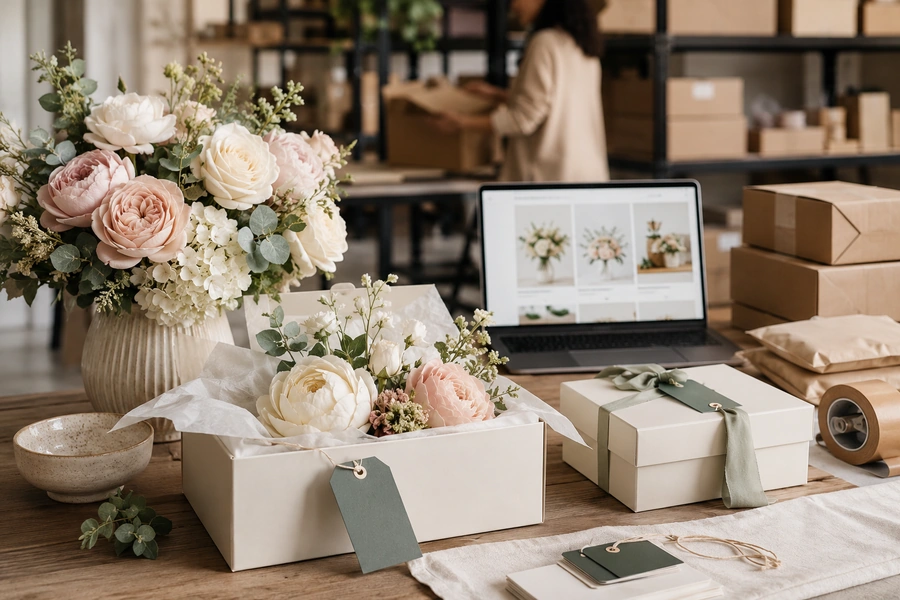
Branded dropshipping artificial flowers lets me sell supplier-held flowers under a distinct décor identity without storing normal retail inventory myself. I can combine curated products, original photography, custom inserts, logo packaging, branded collections, and controlled customer service while a supplier stores, picks, packs, and ships individual orders directly to customers.
The model sits between generic dropshipping and traditional private-label wholesale. Shopify describes branded dropshipping as adding brand identity through packaging, labels, inserts, and other customer-facing elements, while its private-label guidance distinguishes simple white labeling from products created specifically for one brand.
What Is Branded Dropshipping for Artificial Flowers?
Many stores sell the same supplier roses or peonies. Branded dropshipping changes how those products are presented, packaged, curated, and experienced.
Branded artificial-flower dropshipping means selling flowers that remain stored and fulfilled by a third-party supplier while presenting them through my own brand identity. Depending on supplier capability, branding can range from custom inserts and logo packaging to white-label products, exclusive color combinations, custom bouquets, or fully private-label designs.
Regular dropshipping, branded dropshipping, white label, and private label are different
I separate these four models before negotiating with a supplier.
| Model | Product | Branding | Inventory Held by Seller | Best For |
|---|---|---|---|---|
| Regular dropshipping | Generic supplier SKU | Minimal | No | Fast testing |
| Branded dropshipping | Generic or curated SKU | Store packaging/inserts | Usually no | Building brand identity |
| White label | Generic product sold under my brand | Product/packaging branding | Depends on supplier | Faster branded launch |
| Private label | Product customized for my brand | High | Can still be supplier-held | Long-term differentiation |
Shopify’s private-label guidance explains that white-label products are generic products branded for multiple sellers, while private-label products are developed specifically for one business.
For artificial flowers, the differences can be practical.
A white-label rose bundle might use the supplier’s existing ivory rose with my branded tag.
A private-label rose bundle might specify:
- My petal color
- My stem length
- My flower-head diameter
- My leaf arrangement
- My bouquet count
- My packaging
- My SKU
That deeper customization normally requires more supplier commitment.
Branded dropshipping does not require a warehouse
The main attraction is that I do not need to store every sellable flower myself.
Shopify defines dropshipping as a fulfillment model where a supplier stores products and sends orders directly to customers. The merchant still controls the store and customer relationship.
A typical branded artificial-flower order can flow like this:
Customer → branded online store → supplier → branded parcel → customer
My business controls:
- Product selection
- Brand
- Photography
- Pricing
- Product descriptions
- Bundles
- Advertising
- Customer communication
- Refund decisions
The supplier controls:
- Warehouse stock
- Picking
- Packing
- Carrier handoff
- Individual fulfillment
No inventory does not mean no investment
I still expect launch costs.
These can include:
- Samples
- Logo and visual identity
- Store design
- Packaging prototypes
- Branded cards
- Product photography
- Advertising
- Software
- Refund reserve
- Supplier deposits for packaging
- Trademark work where appropriate
The model removes much of the finished-goods inventory risk, not every business cost.
Artificial flowers fit branded dropshipping particularly well
Artificial flowers have several useful characteristics for this model.
They can be:
- Stored without refrigeration
- Sold year-round
- Organized by stable SKU
- Combined into branded color collections
- Bundled into wedding or home-décor kits
- Photographed repeatedly
- Shipped without freshness loss
However, the category also creates risks:
- Bulky dimensional freight
- Crushed flower heads
- Color variation
- Visible glue
- Different batch shades
- Poor-quality supplier photographs
- Long international delivery
- Customer disappointment over realism
That is why branding cannot replace quality control.
How Can You Build an Artificial Flower Brand Without Inventory?
A brand needs more than a logo on a generic carton. Customers need to recognize a consistent visual style and product promise.
I build an artificial flower brand without inventory by choosing a narrow niche, creating a strong name and visual identity, approving samples, curating a small product range, producing original content, standardizing branded packaging, defining supplier fulfillment rules, and controlling the customer experience even though the supplier holds the stock.
Step 1: Choose a clear décor niche
I would not begin with 2,000 unrelated artificial plants.
I would create one recognizable product world.
Possible niches include:
- Luxury wedding flowers
- Neutral home florals
- Romantic peony collections
- Artificial orchids
- Hotel-style arrangements
- Outdoor faux greenery
- Event floral kits
- Seasonal flower boxes
A focused niche makes branding easier because the customer understands what the store represents.
Step 2: Build a distinctive brand name
A brand name should do more than describe the products.
The USPTO explains that a trademark identifies the source of goods or services and helps customers distinguish one seller from another. It also notes that distinctive marks are generally stronger than descriptive or generic ones.
Before investing heavily in packaging, I would check for potentially conflicting marks in the markets where I plan to sell.
For a U.S.-focused business, the USPTO provides trademark-search resources and explains that federal registration can provide broader protection than unregistered rights alone.
This is business planning, not merely graphic design.
Step 3: Build a recognizable color system
Artificial flowers already contain many colors.
The brand itself should therefore remain controlled.
For example:
| Brand Element | Example Direction |
|---|---|
| Primary color | Warm ivory |
| Secondary color | Sage green |
| Accent | Dusty rose |
| Logo | Simple black wordmark |
| Packaging | Natural kraft + ivory |
| Photography | Soft neutral lighting |
| Product names | Romantic botanical naming |
I would then keep that system consistent across:
- Website
- Product cards
- Inserts
- Packaging
- Social media
- Ads
Step 4: Curate instead of copying a supplier catalog
This is one of the most important differences between generic and branded dropshipping.
I might take supplier products and reorganize them into collections such as:
The Ivory Wedding Collection
- Ivory roses
- Cream hydrangeas
- White orchids
- Eucalyptus
- Matching garland
The Terracotta Collection
- Burnt-orange roses
- Champagne peonies
- Beige grasses
- Warm eucalyptus
The products become easier to shop and harder to compare purely by supplier SKU.
Step 5: Use branded packaging in layers
Shopify defines brand packaging broadly, including visual design, packaging materials, secondary boxes, tissue, inserts, and other elements that shape the unboxing experience.
I do not need a fully printed luxury box on day one.
I can build branding progressively.
| Branding Level | Packaging |
|---|---|
| Level 1 | Neutral box + thank-you card |
| Level 2 | Logo sticker + branded card |
| Level 3 | Branded tissue + care card + sticker |
| Level 4 | Custom printed mailer |
| Level 5 | Custom product box + inserts |
| Level 6 | Fully customized product and packaging |
This lets me validate demand before making a large packaging commitment.
Step 6: Create original photography
Supplier images are useful for evaluating products.
They are weak foundations for a long-term brand when many stores use the same photographs.
I order samples and produce:
- Close-up petal images
- Styled vase photography
- Wedding-table scenes
- Color comparisons
- Size references
- Unboxing videos
- Reshaping tutorials
- Bouquet-building videos
The store then begins to look like a real décor brand rather than a supplier catalog.
What Should You Ask a Branded Dropshipping Supplier Before Launching?
The supplier becomes my warehouse and fulfillment team. A branding promise is useless when the wrong bouquet arrives in a damaged generic parcel.
Before launching, I ask suppliers about one-piece fulfillment, branding options, packaging MOQ, product MOQ, inventory visibility, order-processing time, shipping origin, tracking, returns, SKU consistency, sample approval, product safety, replacement claims, and whether branded orders can later move into deeper customization or wholesale purchasing.
Start by separating product MOQ from packaging MOQ
A supplier may dropship one flower bundle at a time but still require 500 printed boxes before using custom packaging.
These are different requirements.
Ask:
| Question | Why It Matters |
|---|---|
| Product order MOQ | Determines one-order fulfillment |
| Packaging MOQ | Determines branding investment |
| Custom-label MOQ | May differ from product MOQ |
| Custom-color MOQ | Determines product differentiation |
| Private-label MOQ | Determines future scaling |
| Packaging storage fee | Adds recurring cost |
| Reorder MOQ | Matters after packaging runs low |
Current Alibaba artificial-flower supplier listings illustrate how widely these numbers can vary. Some listings show customization for color, material, size, logo, packaging, label, and graphics, while individual product MOQs range from dozens to hundreds of pieces. Other supplier listings marketed toward dropshipping include some one-piece minimums. These examples show capability, not a universal rule for all suppliers.
Ask what “custom branding” actually includes
A supplier may use the phrase loosely.
I ask separately about:
- Logo sticker
- Swing tag
- Product label
- Thank-you card
- Care card
- Tissue paper
- Printed polybag
- Printed mailer
- Gift box
- Outer shipping carton
- Packing slip
- Return label
I also ask whether the supplier will store my packaging and automatically use it for every eligible order.
Order the complete branded experience yourself
Shopify recommends ordering products from potential dropshipping suppliers so merchants can assess product quality and real processing and shipping performance.
For artificial flowers, I order the same experience my customer will receive.
I inspect:
- Carton condition.
- Shipping label.
- Branding.
- Packing slip.
- Product protection.
- Petal compression.
- Color accuracy.
- Reshaping time.
- Visible glue.
- Odor.
- Stem damage.
- Delivery time.
I do not approve the supplier after seeing only one studio sample.
Check inventory visibility
Brand trust disappears quickly when bestsellers repeatedly go out of stock.
I prefer:
- Live inventory
- API integration
- Daily stock feed
- Low-stock warnings
- Discontinuation notice
- Restock dates
- Reserved inventory where possible
Shopify’s current dropshipping guidance emphasizes supplier fulfillment and inventory integration as central to operating the model efficiently.
Create a fulfillment specification
My supplier should know exactly what every order requires.
| Fulfillment Item | Requirement |
|---|---|
| Correct SKU | Must match order |
| Product inspection | Basic visible defect check |
| Reshaping | Defined if needed |
| Protection | Flower heads protected |
| Brand insert | Included |
| Supplier advertising | Not included |
| Tracking | Uploaded on time |
| Stockout | Immediate notification |
| Damage | Defined replacement process |
| Wrong product | Defined corrective action |
This turns branded dropshipping into an operating system rather than an informal arrangement.
Remember that the retailer remains responsible
Using a third party does not transfer every responsibility to the supplier.
Shopify tells dropshipping merchants to review product-safety requirements, use reputable suppliers, communicate shipping information, and maintain an accurate refund policy.
I therefore document:
- Materials
- Warnings where needed
- Product dimensions
- Shipping origin
- Delivery expectations
- Return process
- Customer contact information
Do not promise shipping speed the supplier cannot deliver
For U.S. online sales, the FTC’s Mail, Internet, or Telephone Order Merchandise Rule requires sellers to have a reasonable basis for the shipping time they advertise. If a seller provides no shipping time, the general rule is 30 days. When the promised shipment cannot be met, delay-consent or refund requirements can apply.
This makes supplier testing essential.
I would rather advertise a realistic delivery window than build my brand around a delivery promise I cannot control.
When Should You Move From Dropshipping to Wholesale or Private Label?
Branded dropshipping is strongest when demand is uncertain. It becomes less attractive when a product is already proven and per-order supplier costs begin limiting margins or delivery speed.
I move winning artificial flower SKUs toward wholesale or deeper private labeling when sales become predictable, returns remain low, repeat quality is stable, and the saving from larger purchasing exceeds storage and fulfillment costs. I keep new colors, seasonal designs, and slow-moving products in dropshipping until demand becomes clear.
Use branded dropshipping as the testing stage
Suppose I launch:
- Ivory rose bouquet
- Blush peony bundle
- Terracotta wedding flowers
- White orchid arrangement
- Burgundy hydrangeas
- Blue roses
After several months, the results may look like this:
| SKU | Demand | Sourcing Decision |
|---|---|---|
| Ivory roses | High | Consider wholesale/private label |
| White orchids | High | Consider wholesale |
| Blush peonies | Medium | Continue dropship or small bulk |
| Terracotta flowers | Seasonal | Flexible |
| Burgundy hydrangeas | Low | Dropship |
| Blue roses | Very low | Dropship or discontinue |
I do not buy every SKU in bulk merely because wholesale pricing is lower.
Move into wholesale when unit economics justify it
Shopify’s wholesale-versus-dropshipping comparison notes that holding wholesale inventory gives merchants stronger control over quality, personalized shipping, and packaging, while dropshipping avoids storage but provides less direct inspection of individual customer orders.
My calculation is:
Dropship delivered cost
versus
wholesale landed cost + storage + pick/pack + domestic shipping + expected unsold stock
When the second model wins consistently, I test a wholesale batch.
Move into private label when differentiation matters
I consider deeper private labeling after I understand what customers actually value.
For artificial flowers, I might customize:
- Petal color
- Flower-head size
- Stem length
- Bouquet count
- Leaf color
- Packaging
- Product name
- Mixed flower recipe
Shopify describes private-label dropshipping as a model in which the product is made specifically for the brand rather than merely receiving a generic label.
This is useful once my brand has enough sales data to know which differences customers will pay for.
Keep a hybrid catalog
My preferred mature model is not 100% dropship and not 100% inventory.
It looks like this:
Local or wholesale inventory
- Core ivory roses
- Bestseller orchids
- Eucalyptus
- High-volume wedding bundles
Dropship
- Rare colors
- Trend tests
- Seasonal flowers
- Long-tail arrangements
- New launches
This gives me speed and margin on the products that matter most while protecting cash on uncertain items.
My insights: What Is the Best Branded Dropshipping Artificial Flowers Strategy for Building Your Own Décor Brand Without Inventory in 2025
Many sellers begin by asking how to put their logo on a dropship product. I think the stronger question is how to make customers remember the brand even when the seller never touches the parcel.
The best branded dropshipping artificial flowers strategy in 2025 is to own the brand experience while the supplier owns the inventory. I would build a narrow décor identity, approve products physically, create original content, introduce branding gradually, control fulfillment standards, and move proven bests into white-label, private-label, or wholesale programs only after demand is validated.
My five-stage brand model
| Stage | Model | Main Goal |
|---|---|---|
| 1 | Generic sample testing | Find quality products |
| 2 | Curated dropshipping | Validate demand |
| 3 | Branded dropshipping | Build customer recognition |
| 4 | White/private label | Increase differentiation |
| 5 | Hybrid wholesale + dropship | Improve margin and speed |
Stage 1: Validate the flowers before the brand
I do not spend heavily on packaging for an unproven product.
First, I test:
- Realism
- Color
- Packaging recovery
- Delivery
- Customer interest
- Refund risk
A weak product inside beautiful packaging is still a weak product.
Stage 2: Brand the collection before customizing the product
My next step is curation.
I can create:
The Ivory Collection
The Garden Rose Collection
The Modern Orchid Collection
The Autumn Wedding Collection
without changing the flower mold.
This produces differentiation with much less financial commitment than immediate private-label manufacturing.
Stage 3: Upgrade the unboxing experience
Once orders become consistent, I add:
- Branded insert.
- Care and reshaping instructions.
- Logo sticker.
- Branded tissue.
- Custom shipping box when volume supports it.
This order reduces packaging risk.
Shopify’s 2025 packaging guidance emphasizes that packaging combines product protection with identity and can shape customer perceptions during ecommerce unboxing.
For artificial flowers, protection remains more important than decorative packaging alone.
A beautiful box is unsuccessful when the hydrangeas arrive permanently crushed.
Stage 4: Customize what customers actually care about
Once I have sales and review data, I can identify real problems.
Customers might say:
- Stems are too short.
- Ivory is too yellow.
- Bouquets need more greenery.
- Packaging is too compressed.
- Twelve stems are not enough.
- Leaves look too glossy.
Those comments become my private-label specification.
This is more useful than guessing which product changes will create value.
Stage 5: Stock only the proven winners
My final model is a brand that starts without inventory but does not become ideologically committed to never holding inventory.
No-inventory selling is a risk-control tool.
When a proven rose bundle can be purchased more efficiently in bulk and delivered faster from a domestic 3PL, moving that SKU into inventory can strengthen the brand.
The slower lavender version can remain dropship.
The real brand is everything the supplier cannot copy
Another seller may find the same artificial rose.
They cannot automatically copy:
- My brand name
- My photography
- My styling
- My product bundles
- My customer list
- My content
- My service
- My collection architecture
- My packaging experience
- My customer reviews
That is why I do not treat branded dropshipping as simply placing a logo on a box.
I treat it as building brand-owned assets around supplier-held products.
My final rule
The strongest 2025 strategy is:
Test without inventory.
Brand before scaling.
Customize after learning.
Stock only proven winners.
That sequence limits early inventory risk while giving the business a realistic path from generic dropshipping to a recognizable artificial-flower brand.
Conclusion
Build a no-inventory décor brand by testing first, curating tightly, branding gradually, controlling fulfillment, protecting your name, and moving only proven artificial-flower winners into deeper customization.