Fresh greenery can fill an event beautifully, but large installations may also bring recurring material, preparation, transport, replacement, and disposal costs.
I create full event decoration with faux greenery by concentrating reusable foliage in high-impact areas such as backdrops, arches, tables, entrances, lounges, and overhead installations. Modular boxwood, eucalyptus, ivy, artificial trees, garlands, and grasses can create visual volume without purchasing fresh plant material again for every event.
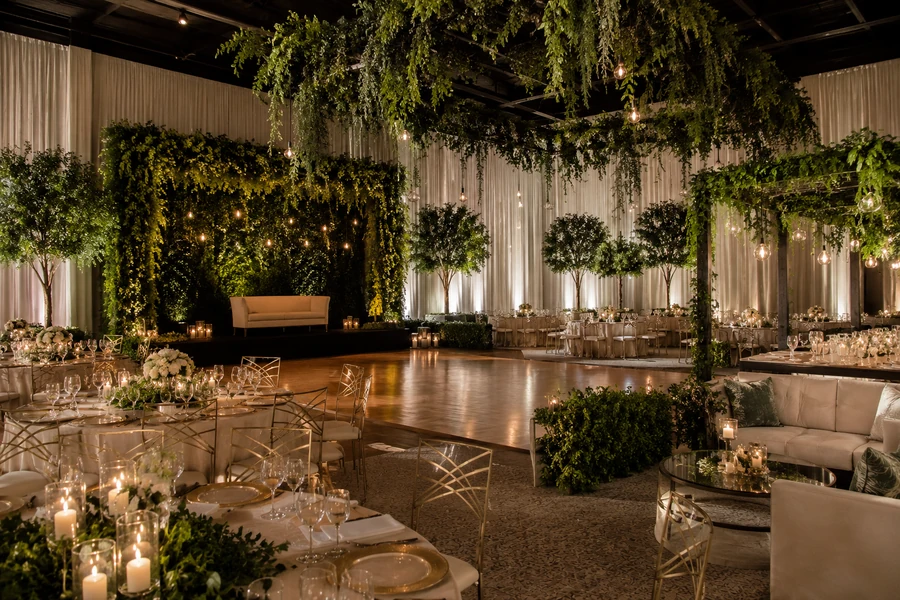
The strongest strategy is not to cover every surface. I build a reusable green foundation, move compatible pieces between ceremony and reception areas, and add smaller fresh or faux floral accents only where guests see them closely. Real wedding examples also show greenery working across ceilings, staircases, tables, pergolas, dance floors, and potted installations.
What Faux Greenery Works Best for Event Decoration?
A huge artificial greenery catalog can make buying harder. Different event zones need different shapes, densities, and levels of realism.
I use boxwood panels for large visual coverage, eucalyptus and ivy garlands for tables and structures, artificial trees for height, grasses for zoning, and loose foliage stems for detail work. The best event greenery is lightweight, modular, repairable, camera-friendly, easy to install, and compact enough for repeated transport and storage.
Boxwood and hedge panels create the fastest visual coverage
For large blank walls, photo areas, stage backgrounds, and sweetheart-table backdrops, artificial hedge panels are one of the most efficient tools.
A dense greenery wall can replace a visually empty surface with several square meters of color and texture.
Current event-rental businesses use artificial hedge walls for:
- Ceremony backdrops
- Reception dividers
- Sweetheart tables
- Photo booths
- Branded events
Rental operators specifically market modular artificial hedge systems because the same structure can serve different event functions.
I prefer panels with:
- Dense leaf coverage
- Hidden backing
- Strong connectors
- Matte foliage
- Replaceable sections
- Consistent green color
Very thin panels often reveal the frame under strong photography lighting.
Eucalyptus garlands are the most flexible table greenery
Artificial eucalyptus works across many event styles.
I use it on:
- Banquet tables
- Welcome signs
- Stair rails
- Ceremony arches
- Bar fronts
- Cake tables
- Mantels
- Chair backs
Eucalyptus also mixes easily with white, blush, champagne, burgundy, blue, or neutral floral palettes.
For long banquet tables, one reusable garland system can create continuous greenery without requiring individual fresh arrangements at every place setting.
Ivy and trailing vines add movement
Trailing greenery works well when I need softness rather than dense coverage.
Useful locations include:
- Pergolas
- Arches
- Ceiling installations
- Sign frames
- Stage structures
- Staircases
- Hanging chandeliers
I mix two or three leaf shapes rather than repeating one identical vine across a large installation.
That prevents the décor from looking mass-produced.
Artificial trees create volume without covering the room
One of the easiest ways to make an event feel greener is to add height.
Artificial olive trees, ficus, palms, or other potted trees can frame:
- Entrances
- Lounge areas
- Stages
- Bars
- Seating charts
- Photo zones
Current event-rental inventories include artificial palms, olive trees, fiddle-leaf trees, dracaenas, monsteras, agave, and other large faux plants, which shows how reusable plants can function as rentable event assets rather than one-time decoration.
Grasses work well for zoning
Artificial grasses are useful when I want greenery to define space without creating a solid wall.
I use long planter arrangements between:
- Cocktail areas
- VIP seating
- Dining zones
- Lounge furniture
- Registration spaces
- Corporate booths
They create volume at lower heights and can preserve more visibility than tall hedges.
My event-greenery matrix
| Greenery Type | Best Use | Visual Coverage | Reuse Potential |
|---|---|---|---|
| Boxwood panels | Backdrops and walls | Very high | Excellent |
| Eucalyptus garlands | Tables and arches | Medium | Excellent |
| Ivy vines | Hanging and detail work | Medium | Excellent |
| Artificial trees | Entrance and lounge zones | High | Excellent |
| Grasses | Dividers and planters | Medium–high | Excellent |
| Loose stems | Small arrangements | Low | Excellent |
| Faux moss | Bases and detail work | Medium | Good |
How Can Faux Greenery Make an Event Look Full Without Using Fresh Plants?
Full decoration is mainly about where the eye sees volume. Spending the same amount of greenery everywhere usually wastes both product and labor.
I make faux greenery look full by concentrating it at visual anchors, layering different leaf sizes, repeating green elements through the guest journey, and reusing the same modules in multiple locations. A dense ceremony backdrop, green table lines, entrance plants, and several overhead or floor installations can make an entire venue feel botanically connected.
Start with five visual anchors
I usually divide an event into these five zones:
- Entrance
- Ceremony or stage
- Dining tables
- Photo or feature wall
- Lounge or entertainment area
I do not need every zone to use the same amount of greenery.
The ceremony and photo zone often receive the highest density because they appear frequently in photographs.
Dining tables can use lower, simpler garlands.
Entrances may need only two large artificial trees.
Use a 60/30/10 greenery formula
For a lush event, I use this as a planning framework:
60% reusable base greenery
30% secondary foliage texture
10% floral or color accents
For example:
- 60% boxwood, eucalyptus, and artificial trees
- 30% ivy, fern, olive, or grasses
- 10% white roses or seasonal flowers
This is my styling framework, not an industry standard.
The advantage is that the expensive visual volume comes from reusable green products. The smaller accent layer can change between events.
Layer instead of overcrowding
One flat boxwood wall can appear artificial.
I improve depth by adding:
- Trailing eucalyptus at the top
- Several large olive branches
- Small areas of ivy
- Limited flowers
- Lighting or signage
This creates foreground, middle layer, and background.
The same principle works on arches.
Instead of covering every centimeter with identical leaves, I create:
structural greenery + trailing foliage + hero floral accents
Repeat one greenery family throughout the venue
Repeated materials make an event feel more complete.
For example:
Entrance: olive trees
Ceremony: olive and eucalyptus arch
Tables: eucalyptus garlands
Photo wall: boxwood with eucalyptus edge
Bar: eucalyptus and olive stems
The décor looks connected even when each individual installation is relatively simple.
Recent wedding coverage shows greenery being repeated across overhead installations, staircases, tents, reception areas, and potted displays to create a consistent botanical atmosphere.
Move ceremony décor to the reception
This is one of my favorite ways to reduce the amount of inventory required.
A ceremony arrangement can become:
- Sweetheart-table décor
- Stage decoration
- Bar greenery
- Photo-area foliage
- Cake-table styling
A 2025 Brides example specifically highlighted a wedding that repurposed ceremony floral installations at the reception, creating continuity while avoiding separate décor for every location.
Faux greenery makes this especially practical because it does not depend on water, floral refrigeration, or same-day freshness.
Create scale with inexpensive visual volume
I would spend more of the greenery budget on pieces that cover space.
| Event Product | Visual Impact per Piece |
|---|---|
| Small table stem | Low |
| Garland | Medium |
| Artificial tree | High |
| Hedge wall | Very high |
| Large arch | Very high |
| Hanging canopy | Very high |
| Long grass planter | High |
This is why a few large modular installations can make a venue look fuller than hundreds of small individual decorations.
Is Buying, Renting, or Mixing Faux Greenery More Cost-Effective?
Artificial greenery does not automatically mean cheaper. Purchase price, delivery, setup labor, storage, cleaning, repairs, and transport all affect the real cost.
I rent faux greenery for one-time or location-specific events, buy modular greenery when I expect repeated use, and use a hybrid model for event businesses with changing themes. The lowest-cost option is the one with the best cost per successful event after transport, installation, maintenance, storage, and replacement are included.
Renting makes sense for one event
Rental is useful when:
- I need the décor once
- Storage is unavailable
- Installation is complicated
- Delivery distance is manageable
- A professional backdrop structure is required
- The design is unlikely to be reused
Current rental companies offer artificial flower walls, hedge walls, arches, potted trees, and greenery installations as complete event products.
The value is not only the décor itself.
A rental may include:
- Delivery
- Setup
- Stand or frame
- Breakdown
- Pickup
This can be valuable for private clients who do not want to manage logistics.
Buying makes sense for event professionals
I would consider purchasing when I run:
- Wedding-planning services
- Event rentals
- Hotel events
- Corporate activations
- Venue decoration
- Photo-booth services
Reusable greenery can then become an inventory asset.
A basic collection might include:
| Inventory Item | Suggested Role |
|---|---|
| 1 modular hedge wall | Photo and ceremony backdrop |
| 2–4 artificial trees | Entrances and lounge areas |
| 8–12 eucalyptus garlands | Tables and structures |
| 4 grass planters | Space dividers |
| Loose ivy | Arches and detail work |
| Neutral foliage stems | Repairs and custom styling |
Calculate cost per event
I use:
Cost per event = total ownership cost ÷ number of successful uses
Total ownership cost includes:
- Purchase
- Freight
- Frames
- Setup hardware
- Storage
- Cleaning
- Repairs
- Replacement foliage
- Local delivery
- Staff labor
Suppose a reusable greenery backdrop costs $1,200 fully landed and prepared.
If I successfully use it 20 times before major replacement, the product portion averages $60 per event.
That is only an illustrative example. Real costs depend on the product, labor, transport, storage, and local market.
A hybrid system often works best
I like to own the evergreen base and rent special pieces.
Own:
- Boxwood walls
- Eucalyptus
- Basic arches
- Neutral artificial trees
- Grasses
Rent or source for special projects:
- Very large custom trees
- Specialty colored flowers
- Unusual hanging structures
- Custom branded installations
- Rare themed greenery
This keeps inventory flexible.
How Should Event Teams Install, Store, and Reuse Artificial Greenery Safely?
Reusable décor only saves money when it survives handling. Poor installation can damage greenery, frames, venues, or guest circulation.
I design faux greenery for repeated installation using modular sections, labeled attachment points, spare leaves, reusable frames, protective storage, and written setup instructions. In public venues, I also check exit routes, accessible circulation, flame-performance requirements, overhead loads, electrical additions, and venue rules before installation.
Design every installation for breakdown
I avoid permanently gluing entire event systems together.
Instead, I prefer:
- Hook-and-loop systems
- Reusable mechanical clips
- Cable ties where appropriate
- Numbered panel sections
- Detachable garlands
- Replaceable flower clusters
- Modular planter inserts
This makes damaged components easier to replace.
Label the inventory
Every reusable module should have:
- SKU
- Size
- Set number
- Installation position
- Storage location
- Cleaning method
For a large greenery wall, I might label panels:
A1 – A4
B1 – B4
This speeds up installation and helps staff identify missing parts.
Protect exit routes
Decorative greenery should never block emergency movement.
OSHA requires exit routes to remain free and unobstructed and says decorations must not obscure exit doors or exit visibility.
I therefore avoid positioning:
- Hedge walls in front of exits
- Artificial trees inside exit paths
- Garlands over exit signs
- Heavy planters where they narrow required travel paths
Protect accessible circulation
For U.S. projects, ADA Standards generally require a 36-inch minimum clear width for accessible walking surfaces, subject to specified exceptions and turn conditions.
That means décor teams need to consider the finished installation, not the empty floor plan.
A tree canopy, planter, backdrop base, sign stand, or trailing vine can all reduce usable space.
Venue-specific requirements may be stricter.
Check fire requirements before buying
Artificial greenery can be subject to fire-performance requirements in commercial event venues.
The 2024 International Fire Code includes provisions for artificial decorative vegetation. Section 807.4.1 requires covered artificial vegetation to meet NFPA 701 flame-propagation criteria or an alternative NFPA 289 heat-release route. The same chapter also states that decorative objects should not obstruct exits or their visibility. Local adoption and venue requirements determine what applies to an individual event.
I therefore request:
- Exact product identification
- Test method
- Laboratory report
- Material covered
- Production consistency
- Any installation restrictions
I do not accept “fireproof” or “fire retardant” as enough information by itself.
Store by shape, not just product type
Poor storage creates hidden costs.
I store:
Garlands: loosely coiled, not tightly compressed.
Hedge panels: flat or vertically supported.
Artificial trees: protected around foliage and trunk.
Grasses: upright where possible.
Loose stems: grouped by SKU.
Flower accents: in shallow cartons to protect heads.
Build a post-event inspection process
After every event, I check:
| Check | Action |
|---|---|
| Missing leaves | Replace |
| Broken clips | Repair |
| Bent stems | Reshape |
| Dust | Clean |
| Stains | Treat using approved method |
| Loose panels | Reconnect |
| Frame damage | Repair before storage |
| Missing labels | Replace |
| Crushed flowers | Reshape or replace |
The best time to repair décor is after the event, not two hours before the next installation.
My insights: How Can Faux Greenery for Events Create Full Decoration Without Fresh Plant Costs
The biggest saving does not come from replacing every fresh leaf with a fake one. It comes from changing how the decoration system is designed.
I create full event decoration without recurring fresh plant costs by building a reusable greenery infrastructure: large modular backdrops, versatile garlands, artificial trees, movable planter inserts, and neutral foliage bases. I then reuse, relocate, layer, and refresh those assets with small accent elements instead of purchasing complete botanical installations for every event.
My strongest strategy is “base once, style many times”
I think event companies should separate decoration into two layers.
Layer 1: permanent reusable structure
- Green walls
- Artificial trees
- Eucalyptus
- Ivy
- Grass planters
- Neutral arches
Layer 2: event-specific styling
- Flowers
- Signs
- Ribbons
- Lighting
- Brand colors
- Seasonal details
This means one green wall can become:
Wedding: white roses + couple’s sign
Corporate event: logo + neutral foliage
Birthday: colored florals + neon sign
Holiday event: pine accents + ornaments
The same core inventory creates several different products.
Design for square-meter impact
I judge greenery partly by how much visual space one item can influence.
A boxwood wall covers a large background.
An artificial tree creates several feet of vertical volume.
A garland connects an entire banquet table.
A hanging installation changes the ceiling.
That is why my priority is:
Buy visual coverage before buying small details.
Keep close-up greenery premium
Not every leaf needs the same realism.
A hedge wall viewed from three meters can use a durable dense commercial leaf.
A eucalyptus stem placed directly beside a guest’s plate needs better color, texture, and shape.
I divide products into:
| Viewing Distance | Quality Priority |
|---|---|
| Close-up | Highest realism |
| 1–3 meters | Strong color and shape |
| Background | Density and consistency |
| Overhead | Silhouette and structural fullness |
This lets me control budget without making the event look cheap.
Reuse does not mean identical events
One fear about reusable greenery is that every event will look the same.
The solution is modularity.
A neutral greenery base can change through:
- Flower color
- Lighting
- Draping
- Signs
- Table linens
- Vessel style
- Furniture
- Layout
Greenery-only and foliage-led wedding designs are also flexible across minimalist, rustic, formal, and modern aesthetics.
My full-decoration formula
For a medium or large event, I would start with:
Entrance: two artificial trees
Ceremony: modular green arch
Photo area: full hedge backdrop
Tables: repeated eucalyptus garlands
Lounge: several potted plants
Bar or stage: loose trailing foliage
Accent layer: limited flowers or brand colors
This creates greenery from the first guest arrival through the main event space without requiring a unique fresh botanical installation at every location.
Final buying rule
Faux greenery works best when I stop treating it as a cheap copy of fresh foliage.
I treat it as reusable event infrastructure.
The most valuable pieces should:
- Cover significant visual space
- Work with several themes
- Pack efficiently
- Install quickly
- Repair easily
- Photograph well
- Meet venue requirements
- Survive repeated use
That is how faux greenery can create a full, premium event atmosphere while reducing repeated spending on fresh plant material.
Conclusion
Build reusable greenery around walls, garlands, trees, arches, and planters, then change smaller accents between events. Full decoration comes from smart coverage, layering, and reuse.