
Fresh flowers create memorable events and hotel lobbies, but repeated purchasing, handling, replacement, and disposal can turn visual beauty into a continuing operating expense.
Artificial flowers usually cost less over multiple uses, while real flowers offer natural scent, movement, and one-time authenticity. For a small single event, fresh flowers can remain competitive. For hotels, rental companies, and repeat venues, durable artificial displays often reduce cost per use when storage, cleaning, repairs, and replacement are properly controlled.
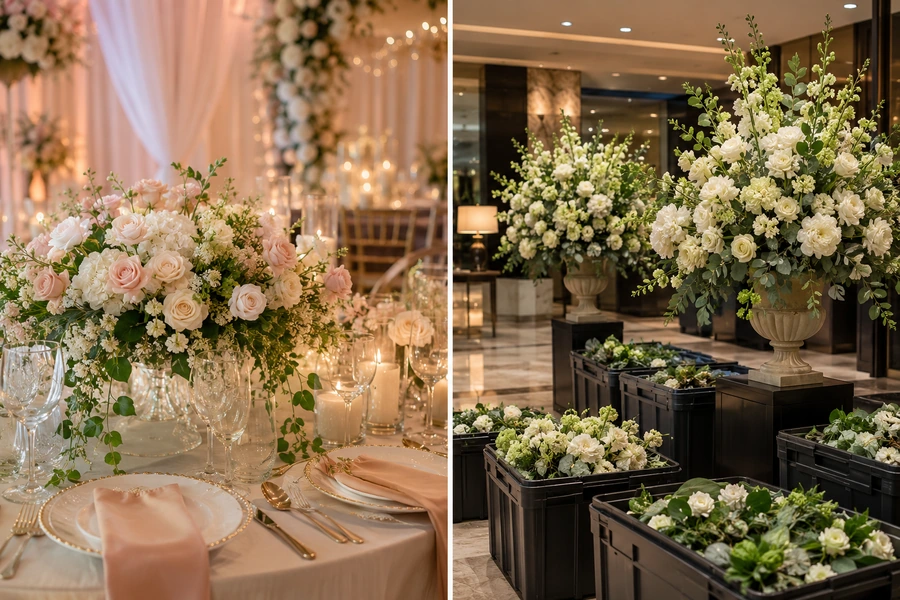
A 2025 U.S. wedding-cost guide estimated average wedding-flower spending at about $2,200, with most couples spending from $500 to $3,500. Location, design size, flower type, seasonality, and labor can move the final amount significantly. Artificial products are not automatically cheaper, however; premium silk flowers can cost as much as fresh products upfront.
Are Artificial Flowers Cheaper Than Real Flowers for Events?
A low artificial-flower price does not guarantee a low finished event cost. Realistic materials, design labor, shipping, frames, storage, and setup can make premium faux installations expensive.
Artificial flowers are usually cheaper for repeat events, large background installations, rental inventories, and products that can be reused. Fresh flowers can be cost-effective for small arrangements, local seasonal designs, or events where no storage is available. Buyers should compare completed installation costs instead of comparing individual stem prices.
Compare the complete event package
A fair event comparison includes much more than flowers.
| Cost Category | Fresh Flowers | Purchased Artificial Flowers | Rented Artificial Flowers |
|---|---|---|---|
| Flowers or products | Purchased for each event | Purchased initially | Rental charge |
| Design labor | Required | Required initially and during reshaping | Often partly included |
| Conditioning | Water, trimming and preparation | Unpacking and shaping | Light shaping |
| Delivery | Time-sensitive | Normal or freight delivery | Rental delivery or parcel shipping |
| Installation | Required | Required | Required |
| Breakdown | Removal and disposal | Removal and packing | Return preparation |
| Storage | Normally unnecessary | Required between events | Normally handled by rental provider |
| Replacement | Every event | Damaged components only | Provider-dependent |
| Reuse | Very limited | Potentially high | Built into rental model |
| Resale value | Minimal | Possible | None for renter |
The correct question is therefore not:
Which stem is cheaper?
The stronger question is:
What does the complete floral design cost per successful event?
Fresh flowers can be competitive for small events
Fresh flowers may provide good value when an event uses:
- One bridal bouquet
- Several table arrangements
- Seasonal local flowers
- Simple bud vases
- Minimal installation labor
- A naturally attractive venue requiring little decoration
Fresh-flower cost rises when the design needs extensive arches, hanging installations, floral walls, table runners, imported flowers, or hundreds of matching arrangements.
The 2025 wedding guide from Brides notes that seasonality, location, flower choice, arrangement size, and labor all influence fresh-floral pricing. It also recommends local or seasonal products, repurposing ceremony flowers, and focusing spending on a smaller number of important installations.
Artificial flowers perform better when they are reused
Suppose an event company purchases one artificial flower wall and uses it once.
The first-event cost includes:
- Product purchase
- Freight
- Frame
- Assembly
- Installation
- Breakdown
- Storage preparation
The artificial wall may not look inexpensive at that stage.
When the same wall is used for ten weddings, corporate events, hotel functions, and photo shoots, its purchase and preparation costs are divided across ten bookings.
I calculate:
Artificial cost per use = total ownership cost ÷ successful number of uses
Total ownership cost should include repairs, cleaning, storage, transport, and eventual replacement.
Rental can reduce the one-event commitment
Artificial-flower rental gives event buyers access to reusable products without purchasing and storing them.
One U.S. rental supplier’s 2026 comparison lists fresh reception centerpieces at $165–$250 and its silk-rental alternatives at $28–$55. Its other published comparisons also show lower rental prices for garlands, floral runners, and larger centerpieces. These are supplier-provided examples, not universal market averages, but they illustrate why rental can work for one-time events.
Rental quotations should still identify:
- Delivery charges
- Return shipping
- Damage deposits
- Late fees
- Setup
- Breakdown
- Cleaning responsibilities
- Missing-item charges
Premium faux can equal premium fresh
The Knot warns that realistic silk flowers can be as expensive as fresh flowers, or sometimes more expensive, especially when buyers choose high-end materials and detailed construction.
Premium artificial prices can reflect:
- Hand-layered petals
- PU or real-touch coatings
- Detailed flower centers
- Natural-looking wired stems
- Custom color
- Specialist arrangement labor
- High-quality vessels
- Fire-performance documentation
- Custom packaging
Artificial flowers create savings mainly through reuse, predictability, and reduced replacement, not because every artificial stem is cheap.
Which Option Costs Less for Hotels Over Time?
Hotels operate every day. A lobby display is therefore not a one-time decoration, and a low initial price may have little relationship to annual operating cost.
Artificial flowers usually cost less for long-term hotel displays because the purchase is front-loaded and the arrangement can remain in service with cleaning and limited replacement. Fresh flowers create recurring purchasing, delivery, conditioning, design, and disposal costs. Luxury hotels may still select fresh flowers when scent, seasonality, and daily botanical authenticity support the guest experience.
Use an annualized hotel cost model
I calculate fresh-flower cost as:
Fresh annual cost = arrangement charge × replacement frequency + delivery + service labor + emergency replacement + disposal
I calculate artificial-flower cost as:
Artificial annualized cost = purchase price ÷ planned service life + installation + cleaning + repairs + replacement stems + storage
This comparison should be completed separately for each hotel zone.
| Hotel Zone | Fresh-Flower Cost Pattern | Artificial-Flower Cost Pattern |
|---|---|---|
| Main lobby | High recurring design cost | Higher initial investment |
| Reception desk | Regular small replacement | Low cleaning and repair |
| Restaurant tables | Many repeated units | Initial volume purchase |
| Guestrooms | Delivery and replacement across rooms | Standardized reusable products |
| Ballroom events | Event-specific buying | Reusable modular inventory |
| Spa reception | Frequent appearance checks | Consistent long-term display |
| Seasonal installation | New botanical materials | Reusable base with changed accents |
Fresh flowers provide a changing experience
A hotel may intentionally use fresh flowers because the arrangement provides:
- Natural scent
- Seasonal variation
- A changing arrival experience
- Local botanical storytelling
- Visible evidence of daily care
- A traditional luxury signal
These benefits have value even when they cost more.
A cost comparison should not assume that fresh and artificial flowers deliver exactly the same guest experience. They solve different design and operational goals.
Artificial displays provide financial predictability
Artificial hotel arrangements can be specified by:
- Exact dimensions
- Approved colors
- Defined flower recipe
- Vessel type
- Cleaning method
- Replacement parts
- Planned service life
The hotel can repeat the same design across guestrooms, restaurants, meeting rooms, or several properties without depending on weekly botanical availability.
This predictability can make budgeting easier.
Artificial flowers still require labor
Artificial arrangements are not maintenance-free.
Hotel teams still need to:
- Remove dust
- Wipe leaves
- Reshape stems
- clean vessels
- Replace damaged flowers
- inspect visible glue and wire
- rotate seasonal accents
- check stability
A complex artificial arrangement with hundreds of small leaves may require more cleaning labor than a simple display with several large orchids.
I therefore include housekeeping time in the comparison.
Use modular hotel arrangements
My preferred hotel system separates the display into modules.
| Module | Expected Use |
|---|---|
| Vessel | Long-term |
| Structural branches | Long-term |
| Main greenery | Long-term |
| Volume flowers | Replace when damaged |
| Hero flowers | Premium replaceable layer |
| Seasonal accents | Changed several times annually |
This approach prevents the hotel from discarding an entire arrangement because several flowers become worn.
What Hidden Costs Should Buyers Include in a Fair Comparison?
Product quotations often exclude important operating costs. Ignoring them can make either option appear cheaper than it really is.
A fair comparison should include design labor, delivery, setup, breakdown, conditioning, refrigeration, water, cleaning, storage, repairs, damage, disposal, replacement frequency, safety documentation, and staff time. Buyers should also consider whether flowers can be moved, reused, rented, resold, repaired, or standardized across several locations.
Hidden costs of real flowers
Fresh-flower quotations may include or exclude:
- Florist consultation
- Design development
- Stem preparation
- Refrigerated handling
- Delivery time windows
- Installation crews
- Vessel rental
- Water management
- Event breakdown
- Disposal
- Emergency flower substitutions
- Weekend or holiday labor
Fresh-flower prices can also change with season, location, product availability, and design complexity.
Buyers should ask whether the quotation includes the complete installed result.
Hidden costs of artificial flowers
Artificial flowers may create different expenses:
- Sample approval
- International freight
- Import charges
- Dimensional shipping
- Reshaping
- Frame construction
- Planters or vessels
- Storage rooms
- Protective cases
- Cleaning
- Repairs
- Color-matched replacement parts
- End-of-life disposal
Large artificial flower walls and trees can consume significant warehouse and vehicle space.
That cost matters for event-rental companies.
Labor can change the winner
A complicated fresh installation may require several florists working within a narrow venue-access window.
A complicated artificial installation may require:
- Unpacking
- Steam reshaping
- Panel assembly
- Frame construction
- Anchoring
- Lighting integration
- Repacking after the event
I record setup and breakdown hours during the first use.
This provides better data than estimating labor from product photographs.
Storage has a real cost
Artificial flowers save money only when they remain usable between events.
Poor storage can cause:
- Crushed petals
- Broken stems
- Dust accumulation
- Missing components
- Color transfer
- Deformed garlands
- Damaged backing panels
Storage planning should specify:
- Required floor area
- Shelving
- Protective cartons
- Climate conditions
- Inventory labels
- Cleaning area
- Transport access
A product reused ten times with expensive storage may not deliver the same savings as a compact product reused ten times.
Safety and compliance can affect cost
Commercial hotels and event venues may require documentation for artificial decorative vegetation. The 2024 International Fire Code states that covered artificial vegetation must meet specified NFPA 701 flame-propagation criteria or an alternative heat-release route. Local adoption, occupancy, and venue rules determine the final requirement.
Compliance costs can include:
- Product testing
- Laboratory reports
- Approved materials
- Replacement of unapproved products
- Installation review
- Venue documentation
Buyers should confirm requirements before placing a bulk order.
Décor must not create circulation costs or risks
OSHA requires workplace exit routes to remain free and unobstructed, and exit doors must not be hidden by decorations.
The U.S. Access Board shows a typical minimum clear width of 36 inches for accessible walking surfaces, with defined exceptions and reductions.
Hotels and venues should therefore check the finished arrangement, vessel, stand, frame, trailing foliage, and electrical accessories—not only the flower dimensions.
When Should Events and Hotels Choose Fresh, Artificial, or Hybrid Flowers?
Cost is important, but the cheapest option may not create the desired experience. I choose the flower system after defining visual priorities, viewing distance, reuse, maintenance, and logistics.
I choose fresh flowers for scent, seasonal storytelling, close guest interaction, and premium one-time moments. I choose artificial flowers for repeat installations, large visual coverage, difficult-access areas, stable colors, and predictable operations. A hybrid design usually offers the strongest balance when fresh hero flowers are combined with reusable artificial structure and greenery.
Choose real flowers when authenticity leads
Fresh flowers are strongest for:
- Bridal bouquets
- Close-up dining tables
- VIP suites
- Special hotel celebrations
- Local seasonal displays
- Fragrant entrance arrangements
- Small premium events
Their natural irregularity, scent, and changing condition can become part of the intended experience.
Choose artificial flowers when reuse leads
Artificial flowers are strongest for:
- Event-rental inventories
- Flower walls
- Ceremony arches
- Hotel ballroom packages
- Difficult ceiling installations
- Repeated corporate events
- Multi-property hotel standards
- Dark interior areas
- Long-duration displays
They are especially useful where guests see the overall shape from a medium or long distance.
Use a hybrid model to control cost
The Knot reports that some couples combine the two formats, using fresh flowers on guest tables while using silk flowers in other locations.
A hotel or event hybrid system might use:
Fresh
- Bridal bouquet
- Reception desk hero flowers
- Restaurant table accents
- Fragrant local flowers
Artificial
- Arch structure
- Green walls
- Hanging installations
- Large branch displays
- Background arrangements
- Reusable ballroom décor
This puts natural flowers where guests notice scent and texture while using artificial products where volume and reuse create greater value.
Compare by visual zone
| Viewing Zone | Stronger Cost Strategy |
|---|---|
| Directly beside guests | Fresh or premium faux |
| Reception viewing distance | Premium faux or hybrid |
| Large background wall | Artificial or rental |
| Overhead installation | Artificial |
| One-time small dinner | Fresh |
| Repeated hotel ballroom | Artificial modular system |
| Seasonal hotel lobby | Hybrid |
| Event-rental catalog | Artificial |
Use the same quotation brief
To make supplier comparisons fair, I provide both the fresh florist and artificial supplier with the same design brief.
It should define:
- Number of arrangements
- Finished dimensions
- Flower palette
- Venue access
- Installation time
- Breakdown requirements
- Vessels
- Delivery
- Required documentation
- Viewing distance
- Expected reuse
Comparing a premium fresh florist proposal with a box of unarranged artificial stems does not produce a useful answer.
My insights: Which Option Wins the Artificial vs Real Flowers Cost Comparison for Events and Hotels
The correct winner changes with time. Fresh flowers can win the first-use comparison, while artificial flowers often win after repeated use.
Artificial flowers usually provide better long-term cost control for hotels, venues, and event companies that reuse standardized displays. Real flowers remain valuable for sensory, seasonal, and high-touch experiences. The strongest cost strategy is often hybrid: invest in reusable artificial volume and structure, then use fresh flowers selectively where scent and close-up authenticity create noticeable value.
My cost decision framework
| Buying Question | Fresh Wins When | Artificial Wins When |
|---|---|---|
| How many uses? | One event | Repeated events |
| Is scent important? | Yes | No |
| Is storage available? | No | Yes |
| Is the installation large? | Budget allows it | Reusable coverage is needed |
| Is the design seasonal? | Local flowers are suitable | Exact colors are required |
| Will guests view closely? | Natural detail is important | Premium faux quality is available |
| Is consistency essential? | Natural variation is acceptable | Standardization is required |
| Does the venue change often? | Fresh florist handles each setup | Modular products can travel |
The break-even point matters more than the purchase price
I define the artificial break-even point as:
Artificial total ownership cost ÷ avoided fresh cost per use
For example, if an artificial lobby display costs the same as several fresh replacement cycles, it begins producing savings only after those cycles have been completed.
The actual result depends on:
- Cleaning
- Repairs
- storage
- useful life
- replacement frequency
- fresh-flower contract pricing
Every hotel should use its real invoices rather than a generic online percentage.
Reuse must be planned before purchase
Artificial flowers do not create savings when they are:
- Used once
- Stored badly
- Difficult to transport
- Too trend-specific
- Impossible to repair
- Replaced before their planned service life
I prefer neutral reusable foundations such as:
- White orchids
- Ivory hydrangeas
- Eucalyptus
- Olive foliage
- Magnolia branches
- Green walls
Seasonal color can be added through smaller replaceable modules.
Cost per guest can help event buyers
For events, another useful measure is:
Floral cost per guest = total floral cost ÷ guest count
This helps buyers compare a 40-person dinner with a 300-person wedding.
However, guest count is not the only factor. A small event with one complex floral ceiling may cost more than a large event using simple table greenery.
My final recommendation
I use the following rule:
For one-time sensory impact, price fresh first.
For repeat visual coverage, price artificial or rental first.
For luxury with cost control, price a hybrid system.
The goal should not be to prove that one flower type is always cheaper.
The goal is to purchase the right amount of authenticity, visual volume, reuse, and operational convenience for the event or hotel.
Conclusion
Fresh flowers deliver sensory authenticity, while artificial flowers offer repeat value. Events and hotels save most by comparing lifecycle costs and combining both strategically.