
Business interiors need to look fresh every day. But fresh flowers can become expensive, and weak artificial flowers can make a space feel cheap.
Silk flowers are worth the investment for business interiors when they are realistic, durable, easy to clean, and matched to the brand environment. They help hotels, offices, restaurants, retail stores, salons, and event venues create a polished floral look with lower daily maintenance and longer display life.
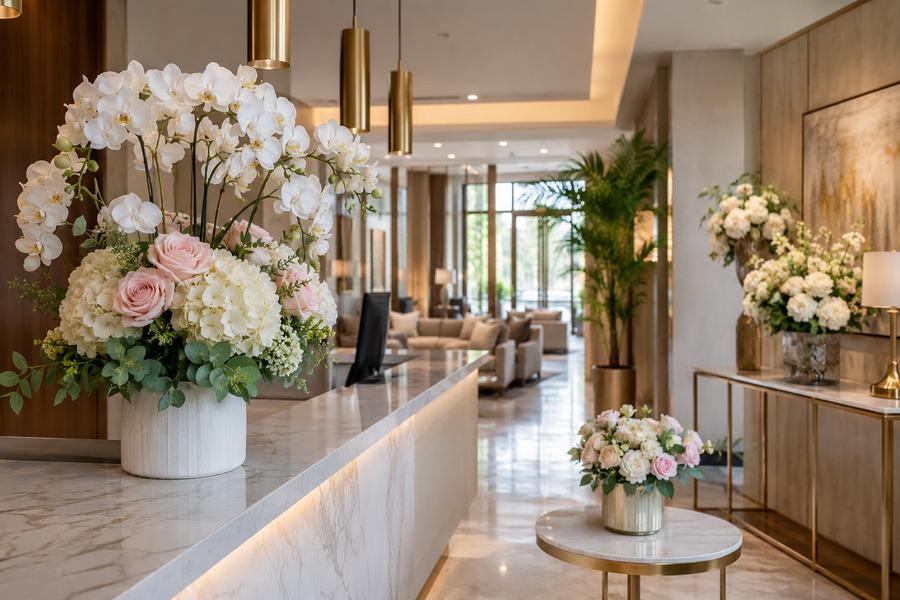
The value of silk flowers is not only about replacing fresh flowers. It is about creating reliable atmosphere. The global artificial flowers market was estimated at USD 3.09 billion in 2024 and is projected to reach USD 4.49 billion by 2030, driven by demand for long-lasting, low-maintenance décor in homes and commercial spaces.
Why Do Business Interiors Use Silk Flowers?
A business space can feel unfinished without natural texture. But live plants and fresh flowers are not always easy to maintain in busy commercial settings.
Businesses use silk flowers because they provide long-lasting visual freshness without watering, wilting, daily replacement, or strict light conditions. They work well in hotel lobbies, office receptions, restaurants, retail displays, spas, clinics, showrooms, and event spaces.
Commercial décor needs consistency
A business interior is part of the customer experience. A hotel guest notices the lobby before they reach the room. A restaurant guest feels the table atmosphere before the food arrives. A retail customer judges the store before touching a product. A client sitting in a reception area forms an impression before the meeting begins.
Silk flowers help businesses control that impression. They do not depend on season, delivery timing, or daily floral care. They can be styled once and refreshed on a schedule. This makes them useful in spaces where the visual standard must stay stable.
Biophilic workplace research has examined how greenery in offices can support well-being, productivity, and psychological comfort. Silk flowers do not replace all the benefits of living plants, but they can support the visual side of biophilic design in places where live plants are hard to manage.
| Business Space | Common Floral Need | Best Silk Flower Choice |
|---|---|---|
| Hotel lobby | Premium first impression | Orchids, magnolia branches, tall arrangements |
| Office reception | Calm and professional mood | White roses, eucalyptus, hydrangeas |
| Restaurant | Warm table atmosphere | Low centerpieces, greenery, soft florals |
| Retail store | Brand display and seasonal styling | Flower walls, window arrangements |
| Spa or salon | Clean wellness feeling | Orchids, lavender, soft greenery |
| Event venue | Reusable visual impact | Arch flowers, floral panels, large stems |
Silk flowers solve practical problems
Fresh flowers need water, trimming, cleaning, replacement, and correct timing. Live plants need light, soil, pest control, and staff care. Silk flowers avoid many of these issues. They are especially useful in low-light corners, air-conditioned lobbies, high-traffic entrances, windowless reception rooms, and spaces where daily plant care is not realistic.
This does not mean silk flowers are always the best answer. They need to look real, stay clean, and fit the space. A dusty artificial bouquet can hurt a business image. A realistic silk orchid in a quality planter can improve it.
What Are the Benefits of Silk Flowers for Commercial Spaces?
Some buyers see silk flowers as a one-time décor purchase. A smarter view is to treat them as long-term interior assets.
The main benefits of silk flowers for commercial spaces are lower maintenance, longer display life, stable appearance, flexible styling, better cost control, and fewer interruptions to daily operations. They can also support brand consistency across multiple locations.
They reduce recurring floral work
Fresh flowers are beautiful, but they often need recurring orders. They may wilt faster in warm rooms, near windows, or under strong lighting. They may need staff attention during busy service hours. For a restaurant, hotel, or office, this becomes part of operating cost.
Silk flowers can reduce that pressure. Once the right arrangement is installed, the team mainly needs to dust, reshape, and clean it. This is useful for businesses that want a polished look without weekly floral replacement.
| Benefit | Why It Matters for Business |
|---|---|
| Long display life | Reduces replacement frequency |
| No watering | Avoids spills, soil, and plant-care mistakes |
| Stable color | Keeps brand styling consistent |
| Easy seasonal updates | Base arrangements can be refreshed with accents |
| Lower disruption | Staff do not need to manage daily floral care |
| Reusable styling | Arrangements can move between spaces or events |
They support predictable budgeting
Fresh floral costs can change by season, supply, flower type, and delivery needs. Silk flowers are usually a larger upfront purchase, but they can be easier to budget over time. A hotel can invest in lobby arrangements and use them for months or years. A retail store can use a greenery wall as a permanent display base, then update flowers by season. An event venue can reuse floral pieces for weddings, corporate events, and photo zones.
This is where silk flowers can become profitable. The investment makes sense when the product is used often enough to justify the cost.
They avoid exaggerated air-quality claims
Some businesses choose live plants because they believe plants clean indoor air in a major way. That claim is often overstated. The American Lung Association states that houseplants do not improve indoor air quality in normal homes in a meaningful way.
This does not mean living plants are useless. They can still support mood, texture, and natural beauty. But if a business wants greenery mainly for visual comfort and atmosphere, high-quality silk flowers can be a practical option.
What Should Buyers Check Before Investing in Silk Flowers?
A poor silk flower purchase can waste money quickly. Low-quality petals, weak stems, and bad colors can make a business interior look less professional.
Before investing in silk flowers, business buyers should check realism, material quality, color tone, stem strength, arrangement scale, cleaning needs, fire-safety requirements, supplier reliability, packaging, and replacement support.
Realism is the first test
Business interiors are often close-view spaces. Guests may stand beside a hotel arrangement. Clients may sit near reception flowers. Restaurant customers may see table florals from less than a meter away. This means realism matters.
Good silk flowers usually have soft petals, natural color gradients, varied leaf shapes, and flexible stems. Poor flowers often look too glossy, too flat, or too perfect. The best arrangements copy nature without looking messy.
| Quality Check | What to Look For | Why It Matters |
|---|---|---|
| Petal texture | Soft, layered, not shiny | Improves close-up realism |
| Color | Muted tones and natural gradients | Prevents a cheap look |
| Stem strength | Bendable wire and secure flower heads | Supports arrangement shaping |
| Leaves | Matte finish and varied size | Adds natural movement |
| Base | Stable planter or vase | Prevents tipping in public areas |
| Cleaning | Wipeable surfaces | Keeps the display fresh |
| Reorder support | Same colors and styles available later | Helps multi-location projects |
The flower must match the brand
A luxury hotel may need white orchids, magnolia branches, and large sculptural arrangements. A modern office may need simple greenery, white hydrangeas, and neutral vases. A café may prefer wildflower-style arrangements with softer casual shapes. A beauty salon may use blush roses, orchids, or cherry blossoms.
The wrong style can make even expensive flowers feel out of place. A corporate law office may not need bright tropical flowers. A luxury spa may not need busy mixed bouquets. The best silk flower investment supports the brand mood.
Safety and maintenance matter in public spaces
Commercial interiors may have stricter safety needs than private homes. Large artificial floral installations near exits, ceilings, walls, or public corridors may need fire-safety review depending on local rules and building type. Buyers should ask suppliers for fire-retardant options or test documentation when needed.
Maintenance should also be planned before purchase. A complex flower wall may look impressive, but it may collect dust if the team cannot clean it easily. A simple orchid arrangement may be easier to maintain in a reception area. A large lobby display may need scheduled cleaning by facilities staff.
How Can Businesses Get the Best Return From Silk Flower Décor?
Silk flowers are worth the investment only when they are used strategically. Random arrangements rarely create strong value.
Businesses can get the best return from silk flower décor by choosing timeless designs, placing arrangements in high-visibility areas, using modular pieces, cleaning them regularly, and refreshing seasonal accents instead of replacing the full display.
Place flowers where they influence perception
The best locations are the places customers notice first or remember most. These include entrances, reception desks, lobby tables, restaurant host stands, retail windows, checkout counters, meeting rooms, spa rooms, and event photo areas.
A small arrangement in a hidden corner has limited value. A strong arrangement on a reception counter can shape the first impression every day. A floral wall in a retail store can become a photo spot. A hotel lobby display can support the entire brand atmosphere.
| High-Value Placement | Why It Works |
|---|---|
| Reception desk | Creates an immediate welcome |
| Hotel lobby table | Builds premium atmosphere |
| Restaurant tables | Improves guest experience |
| Retail window | Helps attract foot traffic |
| Meeting room | Softens a formal space |
| Spa treatment room | Supports calm and wellness |
| Event backdrop | Creates reusable photo value |
Use modular designs
A modular silk flower system gives better return than one fixed arrangement. For example, a business can keep a greenery base and change flowers by season. A hotel can use neutral orchids year-round and add holiday accents in winter. A retail store can keep a wall panel and change floral colors for campaigns. An event venue can move floral swags from a ceremony arch to a photo backdrop.
Modular design lowers replacement cost. It also keeps the interior from feeling stale.
Track cost per month
A simple way to judge value is to divide the total cost by the number of months the arrangement is used. A $600 silk floral installation used for 24 months costs $25 per month before cleaning and maintenance. A fresh arrangement replaced weekly may cost much more over the same period.
This is not the only factor. Fresh flowers offer scent, natural softness, and emotional value. But for businesses that need stable long-term décor, silk flowers often provide stronger cost control.
My insights: Silk Flowers for Business Interiors-Are They Worth the Investment
Many businesses ask whether silk flowers are worth it because they compare them with one fresh bouquet. That comparison is too narrow.
Silk flowers are worth the investment for business interiors when they improve first impressions, reduce recurring maintenance, support brand consistency, and stay in use long enough to lower the monthly décor cost. The best value comes from realistic products, smart placement, and regular cleaning.
The real question is use frequency
My main insight is that silk flowers should be judged by visibility and duration. A high-quality lobby arrangement that customers see every day has strong value. A cheap bouquet placed in a hidden corner has weak value. A reusable floral wall for retail photos can support marketing. A dusty arrangement on a forgotten shelf can hurt the brand.
This means businesses should not buy silk flowers only to “fill space.” They should buy them to solve a clear interior problem. The flowers may create warmth, soften hard surfaces, support a luxury mood, guide attention, or make a reception area feel more cared for.
A practical investment framework
| Question | Best Decision |
|---|---|
| Will customers or clients see it often? | Invest in higher quality |
| Does it match the brand style? | Choose colors and flowers carefully |
| Can staff clean it easily? | Avoid overly complex designs |
| Will it be used for at least one year? | Better chance of strong ROI |
| Can it be refreshed seasonally? | Choose modular arrangements |
| Does it look real up close? | Test samples before buying |
| Is the space public or regulated? | Check safety requirements |
The best investment is fewer, better pieces
A business does not need silk flowers everywhere. Too many arrangements can look cluttered and collect dust. A better strategy is to choose a few high-impact areas and use premium pieces there.
For example, one large orchid arrangement in a hotel lobby can look more professional than many small bouquets around the space. One greenery wall in a retail store can create stronger visual value than several small pots. One elegant centerpiece in a conference room can make meetings feel more polished.
Silk flowers are worth the investment when they are treated like part of the interior design plan. They should be realistic, brand-matched, durable, and maintained. When those conditions are met, they can help business interiors feel fresh, welcoming, and professional without the daily work of fresh floral care.
Conclusion
Silk flowers are worth it for business interiors when they look realistic, match the brand, reduce maintenance, and stay beautiful long enough to justify the investment.