
Retail stores need more than products on shelves. A flat display gets ignored, and ignored products do not build traffic, emotion, or sales.
Faux flowers for retail displays can boost sales and branding in 2025 by creating eye-catching windows, seasonal product stories, reusable campaign sets, and stronger visual identity. They help retailers guide attention, refresh store layouts, support social sharing, and keep displays polished without the daily cost and waste of fresh flowers.
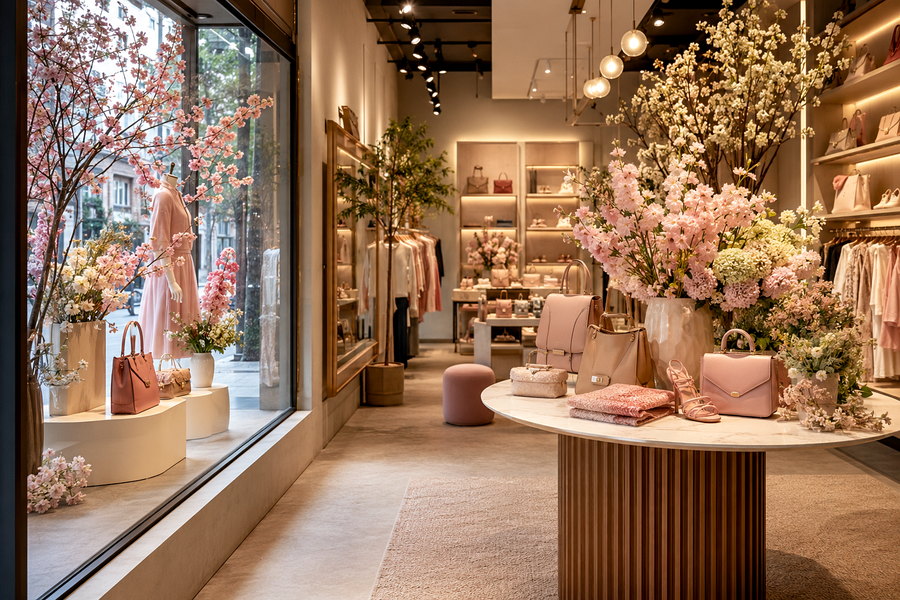
In 2025, retail display design is moving toward immersive, brand-led experiences. Visual merchandising is often described as “silent selling,” because displays help tell the brand story and show products in a stronger light. A well-designed window can also turn a passerby into a store visitor.
Why Use Faux Flowers for Retail Displays?
Retail displays often lose impact when they look too plain, too temporary, or too hard to maintain. Fresh flowers are beautiful, but they can wilt during a campaign and create extra work for store teams.
Retailers use faux flowers because they create long-lasting visual impact with less maintenance. They keep color, shape, and volume through the full campaign period, which makes them useful for window displays, product tables, pop-up stores, seasonal launches, and branded photo spots.
Faux Flowers Solve the Display Consistency Problem
A retail display must look strong on day one and day thirty. This is where faux flowers give stores a clear advantage. Fresh flowers can look uneven after a few days. Some stems open faster than others. Some colors fade. Some petals fall. Staff may need to replace arrangements, clean water, trim stems, and reset the display. Faux flowers reduce these problems because they hold the same shape and color for the full selling period.
Artificial floral displays are also easier to maintain because they do not need watering, dead-heading, trimming, or normal plant care. This matters in retail because teams already handle sales, inventory, customer service, and store operations. A display that looks premium but requires less daily attention is easier to scale across multiple store locations.
| Retail need | Faux flower benefit | Sales or branding value |
|---|---|---|
| Strong window display | Large color impact from the street | More attention from passersby |
| Seasonal campaign | Easy theme changes | Faster product storytelling |
| Product launch | Custom color and shape | Stronger brand recall |
| Social media spot | Photo-ready arrangement | More user-generated content |
| Multi-store rollout | Repeatable display design | Better brand consistency |
They Work Best When They Support the Product
Faux flowers should not overpower the merchandise. They should frame the product, guide the eye, and support the story. A skincare brand can use soft white orchids, clean greenery, and glass display risers to suggest freshness. A fashion boutique can use bold roses, oversized peonies, or sculptural floral walls to create drama. A jewelry store can use small, refined blossoms to add elegance without stealing attention from the pieces.
The key is intention. Every flower color, height, and texture should connect to the product category. Flowers near the entrance should attract attention. Flowers around the hero product should build emotion. Flowers near the checkout area can support impulse gifts, accessories, or small add-on items. When the arrangement has a job, it becomes a retail tool instead of a simple decoration.
How Can Faux Flowers Improve Visual Merchandising and Foot Traffic?
A store window has only a few seconds to stop someone. If the display has no depth, color, or focal point, many shoppers keep walking.
Faux flowers improve visual merchandising by adding height, texture, color, and clear focal points. They can make windows more noticeable, guide traffic through the store, and create memorable moments that encourage customers to enter, browse, take photos, and spend more time with featured products.
Floral Displays Create Visual Hierarchy
Good visual merchandising is not only about beauty. It is about direction. Customers need to know where to look first, what product matters most, and what feeling the brand wants to create. Faux flowers help build this visual hierarchy because they can be arranged in layers.
Large flowers can frame the hero product. Hanging vines can pull the eye upward. A floral arch can mark the entrance. A low floral runner can lead shoppers toward a feature table. A green wall can make a fitting room area or beauty counter more inviting. Shopify advises retailers to create a clear focal point, use different heights, add platforms or suspended elements, and test display lighting through the day. Faux flowers fit naturally into that method because they are easy to shape, suspend, repeat, and reuse.
| Display zone | Floral display idea | Customer effect |
|---|---|---|
| Store window | Oversized floral frame | Stops passersby |
| Entrance | Floral arch or product pedestal | Creates a welcome point |
| Main table | Low flowers around hero products | Keeps focus on merchandise |
| Fitting room | Soft greenery and mirrors | Improves comfort and photo value |
| Checkout | Small floral accents | Supports add-on purchases |
Foot Traffic Needs a Reason to Enter
A strong retail display gives people a reason to step inside. It can create curiosity, seasonal emotion, or a photo moment. A 2025 review of window display research found that attractive and well-aligned window displays can influence consumer decisions, store entries, sales performance, and customer experience.
Faux flowers help because they create high visual volume without daily replacement. A store can build a Valentine’s Day red rose wall, a spring garden window, a summer tropical display, an autumn dried-flower mood, or a winter white floral installation. These themes can be planned in advance and adjusted with lighting, signage, and product placement.
The best displays do not only look pretty. They connect the outside view to the inside journey. A shopper should see the window, understand the message, enter the store, and find the same theme repeated in a lighter way near key products. This makes the campaign feel complete.
Are Faux Flowers Cost-Effective for Seasonal Retail Campaigns?
Seasonal retail displays need to change often. This can create high costs if every campaign needs new fresh flowers, new props, and new installation labor.
Faux flowers can be cost-effective for seasonal retail campaigns because they are reusable, easy to store, and suitable for repeated styling. They may cost more at the start, but high-quality stems, panels, arches, and floral props can support many campaigns when they are planned as modular assets.
Reuse Is the Main Cost Advantage
A fresh floral display is usually a short-term expense. It may look beautiful, but it must be replaced quickly. A faux floral display can become part of a brand’s visual merchandising kit. The same cream roses used for a bridal campaign can be mixed with gold leaves for holiday gifting. The same green vines used in a spring window can be used later for a wellness display. The same floral wall can move from a flagship store to a pop-up booth.
The artificial flowers market was valued at USD 1.78 billion in 2025 and is projected to reach USD 2.91 billion by 2034, with commercial use listed as part of market demand. This growth reflects a broader shift: artificial flowers are no longer only small home décor items. They are also used in commercial interiors, events, hospitality, and retail environments where long-lasting decorative impact is important.
| Campaign type | Reusable faux flower asset | How it saves cost |
|---|---|---|
| Valentine’s Day | Red and pink flower wall | Reused yearly with new signage |
| Spring launch | Pastel floral arch | Restyled with different products |
| Summer sale | Tropical leaves and bright blooms | Combined with bold sale graphics |
| Holiday gifting | White florals and metallic accents | Works across luxury categories |
| Pop-up event | Modular floral panels | Easy transport and fast setup |
Cost Control Needs Better Planning
Faux flowers save money only when retailers buy with a plan. Random low-quality stems may look cheap and may not last. A better approach is to build a flexible floral library. This library can include core greenery, neutral blossoms, brand-color flowers, seasonal accent stems, floral panels, and installation hardware.
Stores should also track display performance. Shopify recommends monitoring foot traffic, viewing time, sales of featured items, and social media reaction to judge display success. This helps retailers understand which floral themes create the best results.
A cost-effective display is not the cheapest display. It is the display that can be reused, cleaned, repaired, photographed, moved, and tied to product sales. When faux flowers are treated as campaign assets, they can reduce waste and give visual teams more freedom.
How Do You Style Faux Flowers to Strengthen Retail Branding?
Some floral displays look attractive but still feel generic. If customers cannot connect the display to the brand, the flowers become decoration instead of communication.
Faux flowers strengthen retail branding when their color, scale, texture, and placement match the brand identity. A luxury brand may use sculptural monochrome florals, while a youthful brand may use bold color blocks, playful shapes, and photo-friendly installations.
The Flowers Must Speak the Brand Language
Branding is not only a logo. It is the feeling customers remember. Faux flowers can support that feeling when they match the store’s visual system. A minimalist skincare store may need white, green, and beige arrangements with clean lines. A romantic fashion brand may need soft pink roses, peonies, and flowing vines. A modern streetwear brand may use artificial flowers in unexpected colors, oversized forms, or graphic shapes.
Modern faux floral design has improved in realism. Vogue reported that perceptions are changing as materials and designs advance, and designers now focus on natural variation, movement, texture, and slight imperfections instead of overly perfect fake stems. This is important for branding because cheap-looking flowers can weaken trust. Premium-looking faux flowers can make the store feel more designed, more cared for, and more memorable.
| Brand style | Best floral direction | Avoid |
|---|---|---|
| Luxury | Monochrome, sculptural, refined textures | Too many colors |
| Youth fashion | Bold color blocking and playful forms | Flat arrangements |
| Beauty | Clean blossoms, soft greenery, smooth shapes | Dusty or rough finishes |
| Jewelry | Small, elegant accents and negative space | Oversized flowers near products |
| Lifestyle retail | Natural mixed stems and warm planters | Plastic shine |
Branding Works Better With Repetition
A single floral moment may attract attention, but repetition builds recognition. A retailer can repeat the same floral color at the window, entrance, feature table, fitting room, and packaging counter. This creates a stronger campaign path. Customers see one story from outside to inside.
Lighting also matters. Soft spotlights can make petals look more realistic. Backlighting can create drama for window displays. Warm light can make neutral flowers feel more premium. Cool light can support skincare, wellness, and modern tech retail.
The display should also leave room for products. A common mistake is building a floral wall that gets photographed more than the merchandise. A better method is to place the product inside the floral story. For example, a handbag can sit on a pedestal surrounded by flowers at the base. A perfume bottle can stand inside a small floral frame. A mannequin can wear the new collection while flowers create movement around the outfit. The product must remain the hero.
My insights: How Can Faux Flowers for Retail Displays Boost Sales and Branding in 2025
A flower display can attract attention, but attention alone is not enough. Retailers need displays that connect beauty with product strategy, customer movement, and brand memory.
Faux flowers boost sales and branding in 2025 when they are designed as reusable visual merchandising systems. The strongest displays combine realistic flowers, clear product focus, seasonal flexibility, brand colors, lighting, social media value, and measurable sales goals.
Faux Flowers Should Be Treated as Retail Infrastructure
The strongest insight is that faux flowers should not be treated as disposable décor. They should be treated as retail infrastructure. A good floral kit can support the store for months or years. It can move between windows, pop-ups, product launches, influencer events, trade shows, and checkout displays. This makes it useful for both sales and branding.
Retail is also becoming more experiential. Shopify describes experiential retail as memorable in-person shopping that engages customers live, and it notes that retailers need experiences that stand out without becoming gimmicks. Faux flowers support this because they create a strong physical moment that online shopping cannot fully replace.
| Sales goal | Floral display method | Measurement |
|---|---|---|
| Increase store entry | Bold window floral frame | Foot traffic count |
| Promote hero product | Flowers around one product zone | Featured item sales |
| Improve brand recall | Use brand colors and repeat motifs | Customer feedback |
| Support social sharing | Photo wall or floral mirror area | Tagged posts and saves |
| Reduce display cost | Modular reusable flower panels | Cost per campaign |
| Improve store experience | Floral zones along traffic path | Dwell time |
The Best Displays Balance Emotion and Function
Faux flowers work because they create emotion quickly. Shoppers understand flowers without explanation. Flowers can suggest romance, freshness, celebration, softness, luxury, care, or seasonal change. This emotional signal helps products feel more desirable.
But emotion must be supported by function. The display needs clear product zones. It needs safe installation. It needs proper lighting. It needs easy cleaning. It needs a storage plan after the campaign ends. It also needs a simple way to measure results.
In 2025, retail teams should ask four practical questions before building a faux floral display. What product should this display sell? What brand feeling should it create? Where should the customer look first? How will the team measure whether it worked?
When these questions are answered, faux flowers become more than decoration. They become a flexible sales tool, a brand storytelling tool, and a practical way to refresh retail spaces without constant replacement.
Conclusion
Faux flowers help retail displays sell better when they attract attention, frame products, repeat brand identity, support seasonal campaigns, and stay reusable across many selling moments.