Businesses often want natural-looking spaces, but live plants can create watering, lighting, replacement, pest-control, and maintenance demands that do not suit every commercial location.
Faux greenery means non-living decorative foliage made to imitate natural plants. It includes artificial trees, plants, hedges, green walls, garlands, vines, grasses, and foliage arrangements. Businesses choose artificial greenery because it gives them predictable appearance, flexible placement, lower horticultural maintenance, reusable décor, and greater control over commercial design.
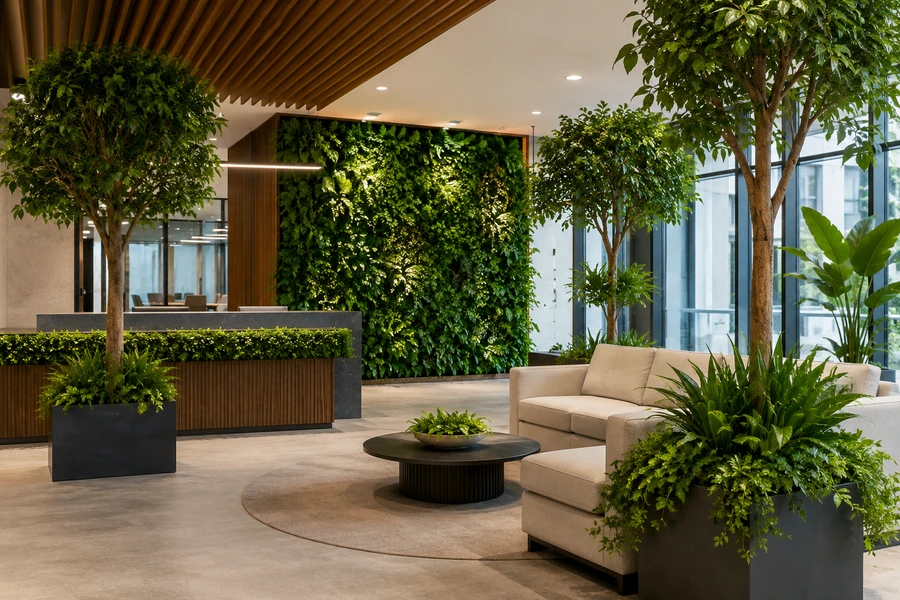
The word “faux” means imitation or not genuine, so faux greenery is essentially another design-friendly term for artificial greenery. For business buyers, however, the label does not define quality. A commercial product still needs to be evaluated by material, realism, construction, intended location, maintenance, safety documentation, and expected service life.
What Does Faux Greenery Actually Mean?
“Faux greenery” sounds like one product category, but suppliers use the term for many different forms of manufactured botanical décor.
I define faux greenery as decorative, non-living foliage designed to reproduce the visual form of real plants. The category can include artificial plants, trees, leaves, hedges, wall panels, garlands, hanging vines, topiary, grasses, and mixed botanical installations. “Faux” describes imitation; it does not describe a specific material or quality level.
Faux greenery is an umbrella term
In commercial buying, I would place all of these products under the faux-greenery category:
| Faux Greenery Type | Typical Commercial Use |
|---|---|
| Artificial trees | Hotel lobbies, offices, malls |
| Potted plants | Reception areas, guestrooms, retail |
| Boxwood/topiary | Entrances and formal interiors |
| Green-wall panels | Restaurants, offices, photo areas |
| Artificial hedges | Privacy and zoning |
| Eucalyptus/ivy garlands | Events and hospitality |
| Hanging greenery | Restaurants and retail ceilings |
| Ornamental grasses | Planter dividers |
| Loose foliage stems | Floral arrangements |
| Artificial palms | Resorts and leisure spaces |
The products share one basic purpose: they provide the visual language of greenery without relying on a living plant.
A current commercial artificial-plant supplier describes artificial trees and greenery as useful in offices where natural light or maintenance capacity is limited, while maintaining a consistent decorative appearance.
“Faux” does not mean one material
This is especially important for wholesale buyers.
Artificial greenery may contain:
- Polyethylene, or PE
- PVC
- Polyester fabric
- Polyurethane, or PU
- Metal wire
- Steel frames
- Fiberglass
- Natural wood trunks
- Adhesives
- Coatings
- Plastic grids
A modern faux olive tree may use molded polymer leaves, metal branches, a natural wood trunk, and a weighted base.
An artificial green wall may use molded foliage attached to a plastic backing grid.
A hanging eucalyptus garland may use polyester or molded leaves on wired stems.
The word faux tells me what the product imitates. It does not tell me how the product is made.
Faux greenery is not automatically premium
A low-cost glossy plastic plant and a highly detailed commercial artificial olive tree can both be described as faux greenery.
That means buyers should translate marketing language into specifications.
Instead of asking:
Do you sell premium faux greenery?
I would ask:
What is the leaf material, finished size, foliage density, trunk construction, recommended environment, cleaning method, packaging method, and warranty?
That question produces information I can actually use.
Is Faux Greenery the Same as Artificial Plants?
The terms overlap, but they are not always used in exactly the same way.
Faux greenery and artificial plants usually describe the same broad family of non-living botanical décor. “Artificial plants” is a clearer product term, while “faux greenery” is broader and more design-focused. Faux greenery can include complete plants as well as garlands, foliage panels, hedges, loose leaves, vines, and wall installations.
The difference is mainly language and scope
I would separate the common terms this way:
| Term | Typical Meaning |
|---|---|
| Faux greenery | Broad decorative greenery category |
| Artificial greenery | Formal version of faux greenery |
| Artificial plants | Complete manufactured plants |
| Fake plants | Casual consumer term |
| Synthetic plants | Material-focused term |
| Silk plants | Traditional marketing term, not always real silk |
| Faux botanicals | Premium interior-design terminology |
Merriam-Webster defines faux as something not real or genuine and made to imitate something else.
So there is no strict quality distinction between “faux” and “artificial.”
A faux green wall is greenery but not one plant
This explains why the wider term is useful in commercial design.
A restaurant might purchase:
- Two artificial olive trees
- Six grass planter inserts
- One large faux green wall
- Hanging ivy
- Eucalyptus garlands
Calling the complete project an artificial plant installation is possible, but faux greenery describes the mix more naturally.
Faux greenery is different from preserved greenery
I also separate artificial greenery from preserved plants.
Artificial greenery is manufactured.
Preserved greenery generally begins as natural botanical material and is treated to retain its appearance.
Architectural Digest has discussed artificial, preserved, and dried greenery as separate decorative approaches, which reflects this practical distinction.
For a commercial buyer, this affects:
- Cleaning
- Moisture sensitivity
- Storage
- Replacement
- Fire documentation
- Color consistency
- Product life
Artificial greenery does not replace every benefit of living plants
I do not describe faux greenery as a complete substitute for living horticulture.
It provides a visual botanical effect.
It does not grow, transpire, respond to seasons, or perform the biological functions of living vegetation.
This distinction matters when a project has genuine landscape, biodiversity, horticultural, or environmental goals.
I therefore treat faux greenery as a design and operational tool, not as a claim that artificial and living plants are identical.
Why Do Businesses Choose Artificial Greenery?
The strongest reason is control. Businesses want predictable décor in spaces where living plants may be difficult, expensive, or operationally inconvenient.
Businesses choose artificial greenery because it gives them consistent shape and color, no watering requirement, freedom from plant-lighting constraints, flexible placement, easier standardization, and reusable decorative assets. It is especially useful for hotels, restaurants, offices, retail stores, events, and difficult-access areas where appearance must remain stable.
1. Businesses can place greenery in difficult locations
Living plants need suitable environmental conditions.
Artificial greenery does not depend on photosynthesis, so I can use it in locations such as:
- Windowless corridors
- Interior reception desks
- Shopping-mall zones
- Hotel lift lobbies
- Dark restaurant corners
- High shelves
- Ceiling displays
- Event stages
Commercial suppliers commonly position artificial greenery for offices and other interiors partly because it does not require sunlight or watering.
That does not mean placement is unrestricted. Heat, outdoor UV, fire requirements, circulation, and cleaning still matter.
2. Appearance remains easier to standardize
A hotel group may want the same entrance arrangement in ten properties.
A retailer may need matching greenery across fifty locations.
Living plants naturally vary in:
- Height
- Leaf count
- Growth rate
- Seasonal appearance
- Condition
Artificial plants can be manufactured to a defined size, silhouette, and color range.
This makes them useful for repeat commercial rollouts.
3. Routine horticultural maintenance is reduced
Artificial greenery does not require:
- Watering
- Fertilizing
- Pruning
- Repotting
- Soil replacement
- Plant-light planning
That reduces one category of facility work.
However, I would never call artificial greenery maintenance-free.
It still needs:
- Dusting
- Wiping
- Reshaping
- Damage inspection
- Fastener inspection
- Replacement of broken leaves
- Outdoor fade checks
The maintenance changes from horticulture to asset care.
4. Businesses can reuse the same décor
This is valuable for event companies, hotels, seasonal retail programs, and exhibition businesses.
An artificial hedge wall can move from:
Wedding backdrop → corporate event → hotel event → photo activation
A eucalyptus garland can move from:
Banquet table → ceremony arch → retail window → seasonal display
A commercial hotel case study also shows artificial green walls and topiary being used to fill design gaps and reinforce the property’s interior atmosphere.
5. Artificial greenery can support space planning
Businesses do not use greenery only as decoration.
It can help define:
- Restaurant seating
- Office collaboration zones
- Reception queues
- Lounge areas
- Retail displays
- Hotel terraces
Long artificial planter inserts or hedge systems can create visual separation without requiring a conventional solid partition.
This is especially useful when layouts change frequently.
6. Artificial greenery can provide year-round visual consistency
A business may need an entrance to look similar in every season.
Artificial greenery lets the design team control:
- Height
- Shape
- Leaf color
- Foliage density
- Arrangement
That consistency is useful in photography, brand standards, multi-site projects, and hospitality interiors.
Do not assume artificial always means cheaper
I calculate lifecycle cost rather than assuming faux greenery automatically saves money.
My calculation includes:
purchase + freight + planter + installation + cleaning + repairs + storage + replacement
A premium 3-meter artificial tree can cost more initially than a small live plant.
The advantage becomes clearer when the product fits a location where repeated plant replacement, professional horticultural visits, or difficult maintenance access would otherwise be required.
How Should Businesses Choose High-Quality Faux Greenery?
Quality should be matched to the application. The best artificial greenery for a distant ceiling installation is not necessarily the best product for a reception desk viewed from 50 centimeters away.
I choose commercial faux greenery by checking realism, material, viewing distance, foliage construction, environment, UV requirements, fire documentation, installation, cleaning, packaging, and replacement parts. I also approve physical samples whenever possible because photographs rarely reveal gloss, leaf thickness, color accuracy, weak attachments, or packaging damage.
Start with viewing distance
I use three quality zones.
| Viewing Distance | Main Buying Priority |
|---|---|
| Close | Texture, edges, veins, joints, trunk realism |
| Medium | Shape, density, color variation |
| Far | Silhouette, scale, overall coverage |
A restaurant table plant needs better close-up detail than ceiling foliage four meters above the guest.
This allows buyers to spend more intelligently.
Check for natural irregularity
Real plants are rarely perfectly symmetrical.
I look for:
- Mixed leaf angles
- Several green tones
- Natural branch spacing
- Matte surfaces
- Variation in leaf size
- Hidden connections
Repeated identical leaf clusters often make artificial greenery look cheap.
Specify indoor and outdoor products separately
An indoor faux plant should not automatically be moved outside.
Outdoor products need materials and color systems designed for exposure.
ASTM G154-23 uses fluorescent UV, moisture, and heat to expose materials under controlled conditions, but ASTM states that the method by itself does not produce one universal performance result.
ASTM G155-25 uses filtered xenon-arc exposure and allows different test conditions that can produce significantly different results.
For outdoor faux greenery, I ask suppliers for:
- Exact tested SKU
- Material
- Test method
- Exposure cycle
- Test duration
- Color evaluation
- Physical evaluation
- Acceptance criteria
I do not accept “UV resistant” as complete evidence.
Check commercial fire requirements
Artificial greenery can be regulated as artificial decorative vegetation.
The 2024 International Fire Code states that covered artificial decorative vegetation must meet specified NFPA 701 flame-propagation criteria or an alternative NFPA 289 route, subject to the code’s application and exceptions.
Actual requirements depend on the property, occupancy, jurisdiction, and adopted code.
For commercial procurement, I therefore request:
- Exact product covered
- Test standard
- Laboratory
- Report number
- Materials tested
- Production consistency
- Installation restrictions
A simple “fire retardant” sticker is not enough for a serious project.
Protect circulation and exits
A beautiful planter is badly placed when it creates a hazard.
OSHA requires workplace exit routes to remain free and unobstructed.
The U.S. Access Board also explains that protruding-object requirements apply to interior and exterior circulation paths and that objects cannot reduce required accessible-route width.
This matters for:
- Tall planters
- Wide tree canopies
- Hanging foliage
- Green walls
- Freestanding hedge dividers
I review the complete installed dimensions, not only the planter footprint.
Use a simple commercial QC checklist
Before approving a bulk order, I check:
| QC Area | What I Inspect |
|---|---|
| Color | Batch consistency |
| Leaf finish | Matte versus glossy |
| Density | Hidden backing and gaps |
| Attachments | Loose leaves or branches |
| Size | Finished dimensions |
| Trunk | Texture and realism |
| Odor | Unacceptable chemical smell |
| Packaging | Crushing and deformation |
| Recovery | Reshaping time |
| Cleaning | Surface response |
| Outdoor claim | Supporting weathering evidence |
| Fire claim | Product-specific documents |
For repeat orders, I also keep an approved physical sample or documented color reference.
My insights: What Does Faux Greenery Mean, and Why Do Businesses Choose Artificial Greenery
The phrase sounds simple, but commercial buyers should understand it as more than a decorative label.
Faux greenery means manufactured botanical décor that reproduces the visual effect of living foliage without being alive. Businesses choose it mainly for operational control: predictable appearance, flexible placement, easier standardization, reusable design, and reduced horticultural care. Its real value depends on choosing the right specification for the exact commercial environment.
businesses are buying control, not simply fake plants
When I look at the strongest business case for faux greenery, the real benefit is predictability.
A business can define:
- Exact tree height
- Exact hedge length
- Approximate foliage density
- Planter dimensions
- Brand color direction
- Installation position
- Maintenance process
That makes artificial greenery easier to integrate into commercial specifications.
The strongest applications solve a real problem
I would not use artificial greenery simply because it exists.
I use it where it solves an operational or design problem.
| Business Problem | Faux Greenery Solution |
|---|---|
| No usable natural light | Artificial plant |
| Need instant privacy | Hedge/planter system |
| High maintenance location | Artificial greenery |
| Seasonal events | Reusable garland/wall |
| Multi-site brand rollout | Standardized artificial plants |
| Large blank wall | Faux green-wall system |
| Difficult ceiling access | Long-life hanging foliage |
| Need stable display color | Manufactured foliage |
I prefer hybrid commercial landscapes
The decision does not always have to be:
real plants OR artificial plants.
A hotel may use live plants in a naturally lit courtyard and artificial greenery in a dark lift lobby.
A restaurant may use live herbs outdoors and faux hanging foliage above indoor dining.
An office may use healthy living plants beside windows and artificial trees in areas without suitable light.
This lets each system do the job it handles best.
Artificial greenery should not be marketed as automatically sustainable
This is another important distinction.
Artificial products use manufactured materials, packaging, freight, and eventually require disposal.
Live plants also have maintenance, water, replacement, transport, and horticultural inputs.
The environmental comparison depends on:
- Product material
- Service life
- Frequency of replacement
- Transport
- Reuse
- Maintenance
- End-of-life handling
I therefore avoid broad claims that artificial greenery is inherently “eco-friendly.”
A better commercial goal is to buy durable, repairable products and use them for a long time.
My final business buying framework
I reduce the decision to six questions:
- What visual role does the greenery serve?
- How close will customers see it?
- Is the location indoor, outdoor, or exposed to strong window light?
- What safety and installation requirements apply?
- How will staff clean and repair it?
- What is its lifecycle cost compared with alternatives?
When those questions are answered, “faux greenery” stops being a vague décor term.
It becomes a practical commercial specification.
Conclusion
Faux greenery means artificial botanical décor. Businesses choose it for consistent appearance, flexible placement, reuse, and simpler care, but quality depends on materials, safety, and application.