
Outdoor topiary balls look simple, but weak UV protection, sparse leaves, unstable planters, poor frames, and inaccurate sizing can quickly damage an otherwise premium installation.
Buyers should evaluate artificial topiary balls by UV resistance, foliage density, diameter accuracy, frame strength, materials, installation method, planter stability, packaging, and warranty. For exposed outdoor projects, choose products specifically designed for exterior use and verify weathering evidence instead of relying on vague terms such as “weatherproof” or “fade-proof.”
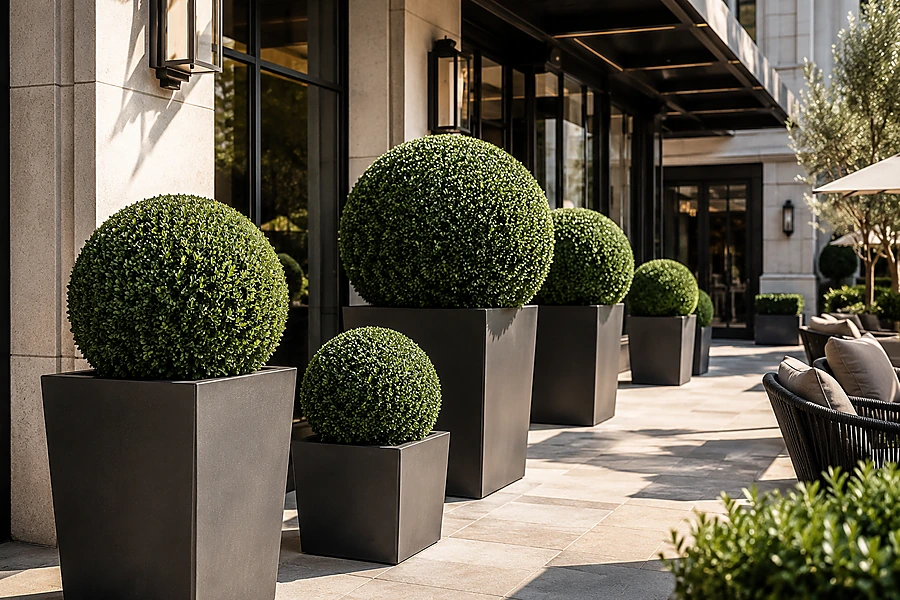
Artificial topiary balls are commonly used at hotel entrances, restaurants, retail stores, balconies, event venues, courtyards, and office buildings because their symmetrical shape provides controlled greenery without pruning. Current products are sold in many diameters—from compact 25–30 cm spheres to 50 cm or larger statement pieces—showing why buyers need exact dimensions rather than simply ordering “small,” “medium,” or “large.”
What Makes Artificial Topiary Balls Suitable for Outdoor Use?
An indoor boxwood ball may look identical to an outdoor version in product photography. The difference becomes visible only after months of sun, heat, rain, cleaning, and wind.
A good outdoor artificial topiary ball needs exterior-rated foliage, UV stabilization, weather-stable pigments, secure leaf attachment, a strong inner frame, corrosion-aware hardware, and a construction that can be safely fixed to its planter. UV resistance should slow deterioration, but buyers should not interpret it as permanent fade-proof performance.
Start with the foliage material
Artificial topiary balls can use several types of foliage construction:
| Material | Typical Strength | Buyer Concern |
|---|---|---|
| PE foliage | Flexible, moldable, easy to clean | Must still be UV-stabilized for exterior use |
| PVC foliage | Strong shape retention | Low-quality versions may look glossy |
| Polyester/fabric | Soft visual texture | Generally more vulnerable outdoors |
| Mixed polymer foliage | Can balance realism and strength | Exact composition may be unclear |
| Coated foliage | Extra surface protection | Coating can wear or change appearance |
For permanent exterior projects, I normally favor molded polymer foliage over delicate fabric because it handles moisture and cleaning more easily.
The material name alone is not enough. Standard PE is not automatically outdoor-safe, just as standard PVC is not automatically UV resistant.
Ask how UV protection is created
UV protection can be:
- Mixed into the polymer during production
- Added through stabilized pigments
- Applied as a factory coating
- Applied later as a surface spray
- Created through a combination of methods
For outdoor procurement, protection incorporated into the material is a stronger starting point because the product does not rely entirely on one exposed surface film.
Some commercial suppliers now distinguish between built-in UV stabilization and surface treatment and offer specific warranty tiers for UV-rated topiary products. One published warranty, for example, currently covers certain individual UV-rated artificial plants, bushes, topiary, and trees against excessive fading and cracking for 12 months, demonstrating why buyers must read the exact product terms rather than assuming all UV greenery receives the same coverage.
Do not treat “UV tested” as a complete answer
ASTM G154-23 uses fluorescent ultraviolet lamps, heat, and moisture to expose materials under controlled conditions. ASTM explicitly states that G154 by itself does not deliver a specific performance result and that the exposure conditions and evaluation method need to be defined.
ASTM G155-25 uses filtered xenon-arc light with heat and optional moisture. It also permits multiple exposure conditions that can produce significantly different results.
A useful supplier report should therefore state:
| Test Detail | Buyer Should Request |
|---|---|
| Tested item | Exact SKU, leaf, or finished ball |
| Standard | Method and edition |
| Light source | Fluorescent UV or xenon arc |
| Exposure cycle | Light, heat, condensation, spray |
| Duration | Total exposure hours |
| Color evaluation | Visual or measured change |
| Physical evaluation | Cracking, brittleness, leaf loss |
| Acceptance criteria | What counted as acceptable |
| Laboratory | Traceable name/report number |
A certificate that only says “UV tested 1,000 hours” is incomplete.
Look at density as well as UV protection
Fading is not the only outdoor problem.
Sparse topiary balls can expose:
- Inner plastic grids
- Clips
- Bare frame sections
- Uneven seams
- Planter mechanics
Good density creates a more natural appearance and helps the sphere remain visually consistent from different angles.
However, maximum density is not always ideal. Very dense balls can create greater wind loading and may trap more dust.
The right balance depends on the project.
What Size, Material, and Construction Should Buyers Choose?
Topiary balls are often purchased by diameter, but commercial buyers also need to consider viewing distance, planter size, doorway scale, and whether the sphere is standalone or mounted on a trunk.
Choose artificial topiary balls by finished diameter, foliage depth, inner-frame construction, seam quality, planter proportions, and viewing distance. Compact 25–30 cm balls suit small pots and tables, while 40–50 cm or larger spheres create stronger entrance and hospitality displays. Large products need stronger support, packing, and wind control.
Understand the main topiary formats
Standalone topiary balls
These are complete spheres without visible trunks.
They can be:
- Placed directly inside planters
- Used in decorative bowls
- Suspended where appropriate
- Mounted onto custom stems
- Combined into architectural arrangements
Their advantage is flexibility.
Stem-mounted single balls
A single boxwood sphere on a trunk creates a classic formal topiary shape.
Current commercial outdoor topiary examples are offered in sizes such as 36, 42, and 48 inches total height, with different foliage-ball widths. This illustrates why buyers should separate ball diameter from finished plant height when requesting quotes.
Double- and triple-ball topiary
Stacked spheres provide more height and visual drama.
They work well beside:
- Hotel entrances
- Formal restaurants
- Luxury retail doors
- Event entrances
- Commercial building receptions
The disadvantage is increased wind leverage.
The taller the arrangement becomes, the more important the planter, trunk, ballast, and anchor system become.
Match diameter to planter size
A useful visual starting point is:
| Topiary Diameter | Typical Design Direction |
|---|---|
| 20–30 cm | Tabletop, balcony, small planter |
| 30–40 cm | Residential entrance, café, compact commercial display |
| 40–50 cm | Hotel, restaurant, retail entrance |
| 50–70 cm | Large commercial statement planter |
| 70 cm+ | Architectural installation requiring stronger structural review |
These are design guidelines, not engineering rules.
The topiary should look proportional to the planter. A 50 cm sphere balanced on a very narrow pot may look visually unstable even before wind is considered.
Inspect how the sphere is assembled
Many artificial topiary balls use two hemispheres joined together.
Buyers should inspect:
- Number of shell sections
- Clip strength
- Cable-tie points
- Grid thickness
- Seam visibility
- Foliage coverage over joints
- Ability to reopen the product
- Replacement-leaf availability
Consumer and commercial products commonly use snap-fit hemisphere designs that are secured after assembly. The concept is simple, but bulk buyers should test whether repeated opening, shipping, and installation weaken the clips.
Check dimensional accuracy
When several balls appear in one entrance, even small size differences become visible.
Your purchase order can specify:
Nominal diameter: 40 cm
Permitted finished tolerance: buyer-approved value
Measurement: maximum finished diameter after normal shaping
Do not compare compressed carton dimensions with finished display dimensions.
Select natural color variation
Real boxwood is not one flat green.
Better artificial topiary often includes:
- Dark inner leaves
- Medium-green main foliage
- Slightly lighter new-growth tones
- Small changes in leaf angle
Avoid excessive neon green or strong plastic gloss for premium hospitality and retail projects.
How Should Outdoor Topiary Balls Be Installed Safely?
The sphere itself is usually lightweight. The real safety issue is the completed system: sphere, trunk, planter, ballast, anchor, surface, and wind exposure.
Outdoor topiary balls should be fixed securely to their supporting stem, frame, or planter. Large or elevated displays may need contained low ballast and positive anchoring. Installations should also maintain drainage, accessible circulation, exits, and clear door operation. A heavy planter should not automatically be assumed to be wind-safe.
Secure standalone balls
A ball sitting loosely on top of a planter can move or disappear.
Possible retention methods include:
- Internal ties
- Concealed wire
- Bolted mounting stems
- Rigid internal frames
- Lockable planter liners
- Manufacturer-designed fixing points
Avoid relying solely on decorative stones.
Secure trunk-mounted topiary
For a stemmed topiary, I treat the trunk connection and planter stability separately.
The trunk should connect to:
- A rigid base plate
- Internal support frame
- Crossbar
- Structural liner
Foam can help position the trunk, but foam should not be the only structural support for a large public-facing installation.
Put ballast near the bottom
Ballast increases total planter mass.
Suitable contained options include:
- Precast blocks
- Steel plates
- Sealed sandbags
- Paver blocks
- Manufacturer-designed weight modules
Low ballast is generally more useful for stability than the same weight placed high in a false-bottom planter.
Anchor exposed planters where needed
Permanent commercial installations may use:
- Center base anchors
- Multiple anchor tabs
- Concealed base plates
- Structural brackets
- Security cables
- Purpose-designed ground anchors
The correct method depends on the supporting surface and project loads.
Do not drill through waterproof membranes, structural slabs, façades, or utility zones without appropriate project approval.
Keep drainage working
Artificial topiary does not need irrigation, but outdoor planters still collect rain.
Drainage prevents:
- Standing water
- Unpredictable weight
- Odor
- Insects
- Corrosion
- Staining
- Freeze damage
Do not deliberately use rainwater as ballast.
Protect circulation
Artificial topiary is often placed beside entrances, where spacing matters most.
The U.S. Access Board explains that protruding-object rules apply to exterior as well as interior circulation paths and that objects cannot reduce required accessible-route clear width.
OSHA also requires workplace exit routes to remain free and unobstructed.
A commercial placement checklist should therefore include:
| Clearance Check | Question |
|---|---|
| Door operation | Does the planter interfere with door swing? |
| Exit route | Is the required route unobstructed? |
| Accessible path | Is required clear width maintained? |
| Sightlines | Does foliage hide signs or vehicles? |
| Drainage | Does runoff cross the walking route? |
| Hardware | Are cables or fasteners trip hazards? |
| Guest contact | Are rigid stems or wires exposed? |
Local regulations and project requirements should determine the final layout.
How Can Buyers Verify Quality, UV Claims, and Supplier Warranties?
A supplier’s product image cannot show long-term consistency. Wholesale buyers need a repeatable approval process.
Verify artificial topiary balls through physical samples, diameter measurements, leaf-density checks, pull and shake tests, UV documentation, packaging trials, installation testing, and written warranty terms. For large orders, bulk production should be inspected against the approved sample before shipment.
Approve a master sample
The approved sample should record:
- SKU
- Diameter
- Foliage type
- Leaf colors
- Frame material
- Number of halves
- Clip type
- Weight
- UV specification
- Packaging method
- Carton dimensions
Keep photographs and, where practical, a retained physical sample.
Use practical QC tests
| QC Test | What It Reveals |
|---|---|
| Diameter measurement | Size consistency |
| 360° visual check | Bare areas and seam visibility |
| Shake test | Loose foliage |
| Leaf pull check | Attachment weakness |
| Clip test | Frame connection strength |
| Compression test | Packaging recovery |
| Cleaning test | Surface/color stability |
| UV document review | Evidence behind outdoor claim |
| Installation trial | Fixing and planter compatibility |
Test packaging carefully
Topiary balls use substantial carton volume because a sphere cannot always be compressed safely.
Some designs are shipped as hemispheres to reduce freight space. This can improve logistics, but it transfers assembly work to the buyer or installer.
Ask the supplier for:
- Finished diameter
- Packed dimensions
- Units per carton
- Gross weight
- Carton volume
- Assembly time
- Required cable ties
- Assembly instructions
For wholesale imports, compare freight per finished ball, not only factory unit price.
Read the warranty, not the headline
Warranty policies vary significantly.
One current outdoor artificial boxwood topiary seller offers a one-year UV warranty on certain products, while another supplier publishes different warranty periods depending on the exact UV-rated product category.
That makes these questions essential:
- Which SKU is covered?
- Is full direct sun allowed?
- What counts as excessive fading?
- Is cracking covered?
- Are leaves falling off covered?
- Are coastal sites excluded?
- Are storms excluded?
- Is incorrect installation excluded?
- Is the remedy replacement, repair, refund, or credit?
- Is the warranty prorated?
- Who pays replacement freight?
- Does coverage include installation labor?
Check commercial fire requirements where applicable
Commercial venues may regulate combustible artificial decorative vegetation.
Current NFPA 101 development material states that combustible artificial decorative vegetation can be required to meet NFPA 701 flame-propagation criteria or an alternative heat-release criterion. Actual requirements depend on the adopted code, occupancy, jurisdiction, and installation.
Do not accept only a supplier statement saying “fire retardant.”
Request documentation that identifies the tested product and method.
My insights: What Should Buyers Know About Artificial Topiary Balls for Outdoor Decoration
Artificial topiary balls appear to be one of the simplest artificial greenery products. In commercial buying, that simplicity can hide important differences.
Buyers should treat outdoor artificial topiary balls as complete installed systems rather than decorative spheres. Long-term value depends on UV-stabilized foliage, natural density, accurate diameter, strong internal construction, secure fixing, stable planters, drainage, safe placement, packaging efficiency, and warranty evidence. The best product is the one that remains consistent after sun, shipping, cleaning, wind, and repeat installation.
My seven buyer checks
| Buyer Check | Why It Matters |
|---|---|
| 1. UV system | Controls premature outdoor aging |
| 2. Leaf density | Controls realism and frame visibility |
| 3. Diameter | Controls design consistency |
| 4. Inner frame | Controls shape and structural integrity |
| 5. Installation | Controls movement and loss |
| 6. Packaging | Controls damage and landed cost |
| 7. Warranty | Controls supplier accountability |
Do not buy only by diameter
Two 50 cm topiary balls can have very different commercial value.
Product A may have:
- Thin foliage
- Weak frame
- Generic plastic
- No test evidence
- Weak packing
Product B may use:
- Stable multi-tone foliage
- Reinforced grids
- Secure seams
- Outdoor-rated materials
- Documented warranty
- Replacement components
They are the same nominal diameter but not the same product.
The planter is half of the specification
Many buyers select the topiary first and find a planter later.
For outdoor commercial projects, I recommend reversing that approach.
Select the topiary and planter together.
Confirm:
- Sphere diameter
- Finished height
- Planter opening
- Planter footprint
- Installed weight
- Ballast
- Anchor method
- Drainage
- Decorative finish
This creates a more stable and visually balanced system.
Use modular construction for commercial portfolios
Hotels, restaurants, event-rental companies, and retail chains benefit from standardized products.
A useful program might use:
- 30 cm compact balls
- 40 cm standard entrance balls
- 50 cm statement balls
- One standard planter family
- Replaceable mounting inserts
- Matching spare foliage
This reduces training, storage, repairs, and reorder complexity.
Buy UV evidence, not UV language
My strongest sourcing rule is:
“UV resistant” is a product description. The test report and warranty are the purchasing evidence.
Ask which material is stabilized, which SKU was tested, under what conditions, what changed during exposure, and what remedy applies if the product fades excessively.
ASTM itself makes clear that accelerated UV practices require defined test conditions and evaluation criteria.
Final buying rule
For sheltered residential decoration, a basic topiary ball may be enough.
For hotels, restaurants, malls, retail entrances, rooftops, commercial landscaping, and long-term exterior projects, buyers should move toward:
verified outdoor foliage + strong frame + accurate dimensions + secure installation + stable planter + drainage + documented warranty.
That combination protects both appearance and total project value.
Conclusion
Choose outdoor artificial topiary balls by UV evidence, density, size, frame quality, installation, packaging, planter stability, and warranty—not by appearance or unit price alone.