
Dubai outdoor décor needs more than beautiful greenery. Heat, UV light, sand, customs paperwork, and delivery handling can all affect the final result.
The best artificial plant Dubai buyers should choose in 2025 is UV-resistant, heat-aware, sand-friendly, easy to clean, stable in weighted planters, and supported by clear customs documents and reliable last-mile delivery. Top choices include faux palms, boxwood panels, topiary trees, olive trees, eucalyptus, and UV-rated flowering inserts.
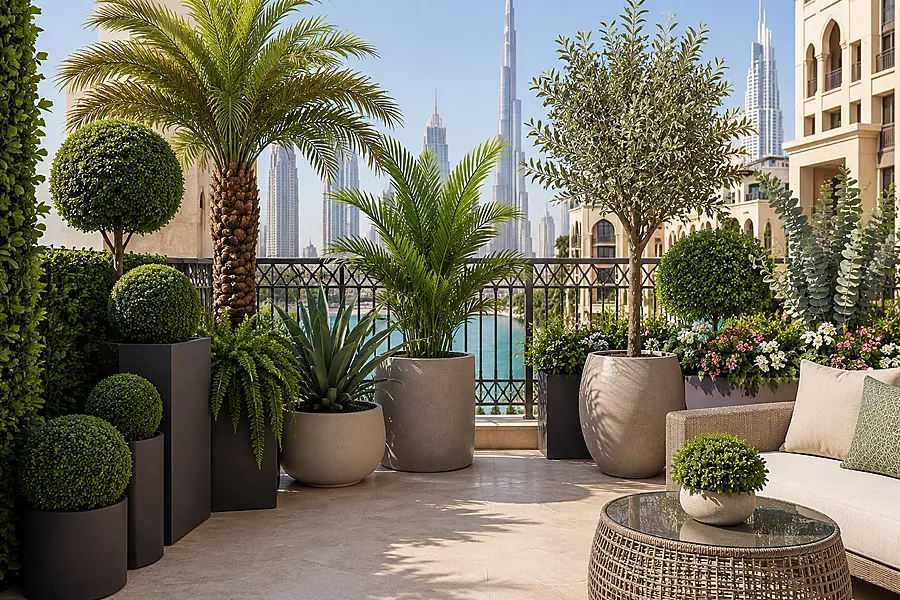
Dubai’s outdoor heat, UV light, and sand make artificial greenery a sourcing and logistics decision for hotels, retailers, restaurants, malls, offices, events, and property managers.
Why Does Dubai Need Heat-Proof Artificial Plants?
A normal indoor fake plant may look good inside a showroom. On a Dubai balcony, rooftop, storefront, or terrace, it can fade, bend, collect dust, or look old very quickly.
Dubai needs heat-proof artificial plants because strong UV light, high temperatures, sand, dust, wind, and occasional heavy rain can damage weak materials. Buyers should choose outdoor-safe artificial plants made from UV-resistant PE, PVC, treated plastic, or durable polyblend materials.
Heat and UV exposure change the buying standard
Artificial plants for Dubai should not be selected only by appearance. A beautiful silk-style indoor plant may not survive full-sun placement. Outdoor buyers should check material, UV label, leaf finish, stem strength, and planter stability before checking price.
Many faux plants are not designed for outdoor conditions. Outdoor-safe products should use UV-resistant and weatherproof materials such as polyethylene, polyblend plastics, or PVC for better exterior performance.
| Dubai Outdoor Challenge | Risk for Weak Plants | Better Buying Choice |
|---|---|---|
| Strong UV light | Faded leaves and flowers | UV-resistant materials |
| High heat | Brittle or warped plastic | PE, PVC, treated plastic |
| Sand and dust | Dull, gray-looking leaves | Easy-wipe foliage |
| Wind | Tipped pots or loose stems | Weighted planters |
| Rare heavy rain | Moisture in bases and cartons | Drainage-ready planters |
| Luxury setting | Poor realism becomes obvious | Matte, premium foliage |
Artificial plants reduce maintenance pressure
Live plants can work in Dubai, but they need irrigation, shade planning, soil care, pest control, and staff time. Artificial plants help businesses keep outdoor spaces green without daily watering or seasonal plant loss.
This matters for Dubai hotels, cafés, restaurants, villas, retail storefronts, beach clubs, rooftop lounges, and mall terraces. A stable artificial plant setup can protect brand appearance during busy seasons.
The wider market also supports this shift. Grand View Research projects the artificial flowers market to reach USD 4.49 billion by 2030, and Persistence Market Research projects the broader artificial plants and flowers market to reach US$5.6 billion by 2032.
What Are the Best Artificial Plant Choices for Dubai?
The best artificial plants for Dubai must balance realism, UV resistance, weight, cleanability, and delivery safety.
The best artificial plant choices for Dubai include UV-resistant boxwood panels, artificial topiary trees, faux palms, olive trees, eucalyptus, lavender, bougainvillea-style flowering inserts, geraniums, hanging baskets, and mixed greenery planters.
1. Faux palms for hotels, pools, and terraces
Faux palms fit Dubai’s hospitality style. They work well for hotel pool decks, beach clubs, rooftop lounges, resort terraces, and restaurant patios. Their height creates instant visual impact.
Choose palms with reinforced trunks, flexible fronds, matte leaves, and a heavy planter. Tall palms need strong bases because rooftop wind and guest movement can create safety risks.
2. UV boxwood panels for walls and privacy
Boxwood panels are useful for balcony screens, villa walls, restaurant partitions, retail backdrops, mall photo zones, and hotel terraces. They create quick green coverage and can hide plain walls or railings.
For Dubai use, boxwood panels should be dense, UV-resistant, flexible, and easy to brush or rinse. Avoid thin, glossy panels that look plastic under strong sunlight.
3. Topiary trees for entrances
Topiary trees are strong entrance plants. A pair of spiral, cone, ball, or square topiaries can frame a hotel door, salon entrance, boutique storefront, office lobby, villa gate, or restaurant walkway.
The main buying issue is stability. Use weighted pots, internal gravel, sandbags, or anchor-ready planters.
4. Olive trees and eucalyptus for shaded luxury spaces
Olive trees and eucalyptus work well in shaded terraces, cafés, spas, residential balconies, offices, and boutique hotels. They feel softer and more premium than basic plastic shrubs.
These are best for covered spaces, pergolas, lobby-adjacent terraces, and semi-outdoor seating areas where close-up realism matters.
5. UV-rated flowering inserts for color
Dubai spaces often need color, not only green. UV-rated bougainvillea-style stems, lavender, geraniums, hydrangeas, and mixed flowering inserts can brighten planters without watering.
| Plant Type | Best Dubai Use | Main Buying Priority |
|---|---|---|
| Faux palms | Hotels, pools, rooftops | Height and weighted base |
| Boxwood panels | Walls, screens, photo zones | UV stability and density |
| Topiary trees | Entrances and storefronts | Shape and planter weight |
| Olive trees | Cafés, balconies, luxury retail | Realism and soft style |
| Eucalyptus | Restaurants, spas, offices | Natural texture |
| Bougainvillea-style inserts | Resorts, villas, patios | UV color performance |
| Lavender | Wellness, cafés, balconies | Calm color and easy cleaning |
| Geraniums | Storefront planters | Bright curb appeal |
What Customs Details Should Dubai Importers Check?
A good plant order can still fail if documents, HS codes, duties, VAT, or importer details are wrong.
Dubai importers should check trade license coverage, importer records, HS code, commercial invoice, certificate of origin, packing list, bill of lading or airway bill, customs duty, VAT, and delivery terms before importing artificial plants. A customs broker should confirm the final classification and charges.
Start with import documents
For UAE imports, companies must have the correct trade license from the Department of Economic Development in the relevant emirate. Standard import documents include a commercial invoice, certificate of origin, and detailed packing list with weight, packing method, and HS code.
Dubai Customs also lists invoice, certificate of origin, and packing list among required documents for commercial incoming goods in relevant procedures.
| Customs Item | Why It Matters |
|---|---|
| Trade license | Confirms legal import activity |
| HS code | Affects duty, declaration, and inspection |
| Commercial invoice | Shows goods value and description |
| Certificate of origin | Confirms manufacturing country |
| Packing list | Shows carton count, weight, and packing details |
| Bill of lading / airway bill | Connects shipment to transport |
| Import declaration | Required for customs clearance |
| Broker review | Reduces delay and misclassification risk |
Understand duty and VAT basics
The UAE government states that customs duty is generally 5% of the value of goods plus cost, freight, and insurance. The UAE also applies 5% VAT on taxable goods and services, collected across the supply chain.
Artificial plant buyers should not assume the final landed cost is only the product cost. The landed cost may include product price, packing, inland transport, freight, insurance, duty, VAT, customs clearance, storage, and last-mile delivery.
| Cost Element | Buyer Question |
|---|---|
| Product cost | Is the price FOB, EXW, CIF, or DDP? |
| Freight | Air or sea? Full container or LCL? |
| Customs duty | What is the applicable HS code treatment? |
| VAT | Who pays and records VAT? |
| Clearance fee | Is broker service included? |
| Storage | Are port or warehouse delays possible? |
| Last-mile delivery | Is delivery to site, warehouse, or curbside? |
Use clear product descriptions
Artificial plant invoices should be specific. “Decorative items” is too vague. Better descriptions include “UV-resistant artificial boxwood panels,” “artificial palm tree with weighted planter,” or “plastic artificial eucalyptus stems for commercial décor.”
Clear descriptions help brokers classify goods more accurately and reduce avoidable clearance questions.
How Should Buyers Plan Last-Mile Delivery for Artificial Plants in Dubai?
Last-mile delivery is where many artificial plant projects lose quality. Plants can arrive safely at port, then get crushed, bent, delayed, or delivered to the wrong access point.
Dubai buyers should plan last-mile delivery by confirming carton size, delivery address type, unloading access, lift access, site timing, heat exposure, storage area, installation schedule, and damage inspection. Large artificial plants need careful handling from warehouse to final display.
Plan by product size
Artificial plants are bulky. A tall palm, topiary pair, flower wall panel, or boxwood roll may need more delivery planning than small stems. Large cartons may not fit small elevators, narrow service corridors, or mall delivery docks.
| Product | Last-Mile Risk | Planning Tip |
|---|---|---|
| Tall faux palms | Frond bending, base damage | Use upright handling where possible |
| Boxwood panels | Compression marks | Keep cartons flat and dry |
| Topiary trees | Pot cracking, tipping | Use protective wrapping |
| Olive trees | Branch bending | Reshape after delivery |
| Flowering inserts | Petal crushing | Avoid heavy stacking |
| Large planters | Lift and access limits | Confirm service elevator size |
Confirm site access before shipping
A delivery to a Dubai villa is different from delivery to a mall, hotel, restaurant, rooftop, event venue, or high-rise apartment. Ask the site team about parking, loading bay hours, security permits, service elevator rules, floor access, delivery timing, and installation restrictions.
For mall and hotel deliveries, some sites require advance booking. For restaurants and cafés, delivery may need to happen before opening hours. For rooftops, elevators and staircase access must be confirmed before large artificial trees are ordered.
Inspect before installation
Open cartons carefully. Check leaves, stems, pots, panels, labels, and accessories. Take photos of damage before installation. Separate items into “ready to use,” “needs reshaping,” “needs repair,” and “claim with supplier.”
| Delivery Check | What to Confirm |
|---|---|
| Carton count | Matches packing list |
| Product style | Matches approved sample |
| Color | Matches order and batch |
| Pot condition | No cracks or tipping risk |
| Leaf condition | No major fading, bending, or breakage |
| Accessories | Clips, panels, ties, labels included |
| Damage photos | Taken before installation |
My insights: Best Artificial Plant Dubai-Heat-Proof Choices, Customs & Last-Mile Delivery
Many Dubai buyers ask, “Which artificial plant looks most real?” That question matters, but it is not enough for commercial projects.
The best artificial plant Dubai strategy is to choose heat-proof, UV-resistant, sand-friendly greenery and manage the full buying journey: product selection, customs documents, landed cost, delivery access, site inspection, and long-term maintenance. Good plants need good logistics.
Dubai success depends on the full chain
My main insight is that Dubai artificial plant buying has three connected parts: product, customs, and delivery. If one part fails, the whole project suffers.
A premium faux palm can still disappoint if it is classified incorrectly, delayed at clearance, crushed in delivery, or installed in a lightweight pot. A boxwood wall can look weak if panels arrive compressed and nobody plans time to reshape them.
| Stage | Best Practice |
|---|---|
| Product choice | Choose UV-resistant, outdoor-safe materials |
| Sample approval | Test under Dubai sun and dust |
| Customs planning | Confirm HS code, documents, VAT, and duty |
| Landed cost | Include freight, clearance, storage, and delivery |
| Last-mile delivery | Confirm access, timing, and unloading |
| Installation | Use weighted planters and secure panels |
| Maintenance | Clean dust, rotate, and replace faded accents |
Match plant choices to exposure level
Full-sun areas need the strongest UV-rated products. Partial shade can use softer and more realistic olive, eucalyptus, or palm styles. Windy rooftops need compact shapes and heavier planters. High-end hotels need fewer, better pieces with premium pots.
| Dubai Location | Best Artificial Plant Strategy |
|---|---|
| Hotel entrance | Topiary trees, palms, premium planters |
| Rooftop lounge | Faux palms, weighted bases, UV greenery |
| Retail storefront | Boxwood panels, geraniums, topiary pairs |
| Restaurant patio | Eucalyptus, lavender, compact planters |
| Villa balcony | Olive trees, boxwood screens, flowering inserts |
| Mall display | Modular panels and easy-clean plants |
| Event venue | Reusable greenery walls and floral accents |
Customs and delivery should be planned before payment
B2B buyers should not wait until shipment arrival to ask about documents. The right time is before placing the order. Confirm product descriptions, HS code guidance, invoice details, packing list format, carton dimensions, delivery terms, and destination access.
This prevents delays, unexpected costs, and rushed installation problems.
The best Dubai artificial plant is a system
In 2025, the best artificial plant for Dubai is not just one product. It is a complete system: UV-resistant material, realistic design, weighted planter, correct customs paperwork, safe delivery, easy installation, and routine cleaning.
That system helps hotels, retailers, restaurants, malls, offices, apartments, event venues, and property managers keep outdoor greenery polished without daily watering or constant replacement.
Conclusion
Choose Dubai artificial plants by heat resistance, UV performance, cleanability, customs readiness, landed cost, secure delivery, planter stability, and long-term maintenance needs.