
Artificial flowers and greenery are no longer just backup decorations for places where real plants cannot survive. They are becoming serious design tools.
The latest innovations in artificial flowers and greenery include real-touch materials, more realistic petal textures, UV-resistant outdoor foliage, modular greenery walls, hanging vertical installations, eco-conscious materials, flexible stems, improved color variation, and photo-ready commercial displays. These upgrades are revolutionizing home décor, weddings, retail styling, hospitality design, and event installations.
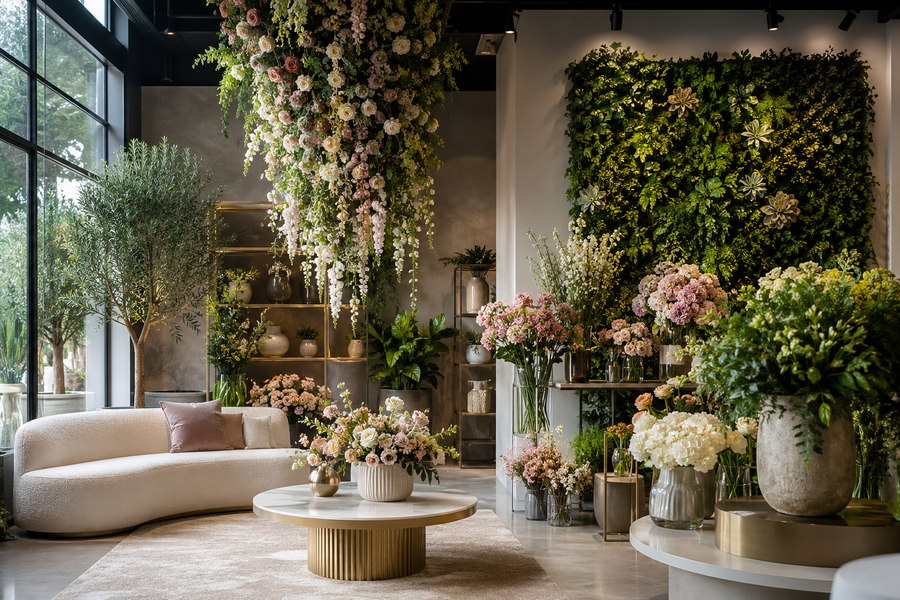
The market is growing because buyers want low-maintenance décor that looks realistic and lasts longer. Grand View Research reports that the U.S. artificial flowers market is expected to grow at a 5.0% CAGR from 2025 to 2030, driven by demand across homes, events, commercial spaces, and online retail.
Why Are Artificial Flowers and Greenery Changing So Quickly?
The category is changing because buyers expect more than “fake plants.” They want botanical realism, flexible styling, outdoor durability, and products that photograph beautifully.
Artificial flowers and greenery are changing quickly because modern buyers need décor that is realistic, reusable, low-maintenance, and flexible across many spaces. Innovations in materials, color, texture, UV protection, modular installation, and online product variety have made faux florals more useful for homes, weddings, hotels, restaurants, offices, and retail displays.
The New Standard Is Realism
Older artificial flowers often looked shiny, flat, or too symmetrical. Newer designs focus on natural imperfections. Better Homes & Gardens notes that modern faux flowers have improved dramatically in look and feel, and recommends choosing stems with realistic tone, texture, slight imperfections, and bendable stems.
That shift matters because artificial flowers are often used in close-view spaces: dining tables, entry consoles, bridal bouquets, corsages, reception desks, and retail displays. A realistic petal surface, soft color transition, or flexible stem can make the difference between “cheap fake” and “designer faux.”
What Is Driving Innovation?
| Driver | How It Changes Faux Floral Design |
|---|---|
| Home décor demand | More realistic stems, planters, and long-term arrangements |
| Wedding and event use | Better durability, modular arches, flower walls, garlands |
| Outdoor styling | UV-resistant foliage and weather-aware materials |
| E-commerce growth | More color options, SKU variety, and online-ready product photography |
| Commercial spaces | Larger greenery walls, low-maintenance lobby plants, branded backdrops |
| Sustainability interest | More attention to recyclable materials and longer product life |
| Social media | Photo-ready textures, lighting-friendly finishes, and dramatic installations |
What Are Real-Touch Artificial Flowers and Why Do They Matter?
Real-touch is one of the biggest innovations because it changes how artificial flowers feel, not just how they look.
Real-touch artificial flowers and greenery use softer, more flexible materials that imitate the texture, movement, and surface feel of natural petals or leaves. They matter because buyers now judge faux décor up close, especially in weddings, home styling, luxury events, restaurants, and hospitality interiors.
Real-Touch Materials Improve Close-Up Design
Real-touch flowers are often made with materials such as polyurethane, latex-like coatings, soft polymers, silk-like fabrics, and flexible plastic structures. Jamali Garden’s 2025 artificial plant guide describes the most realistic artificial plants as using combinations of polyurethane for flexible real-touch leaves, silk for soft sheen, and plastic for internal support.
This is important for products such as orchids, tulips, succulents, roses, peonies, and greenery stems. These items are often placed where people can touch them or view them closely.
Real-Touch Is Best for Focal Pieces
Not every faux flower needs premium real-touch material. Use real-touch flowers where realism matters most:
| High-Impact Use | Why Real-Touch Helps |
|---|---|
| Bridal bouquets | Seen closely in photos |
| Corsages | Worn on the body |
| Centerpieces | Viewed from table distance |
| Hotel lobby arrangements | Must look premium every day |
| Retail product displays | Supports brand image |
| Luxury home styling | Used long-term in visible spaces |
For background décor, such as high greenery walls or distant arch filler, mid-range materials can work if the product has good color and fullness.
How Is UV-Resistant Greenery Changing Outdoor Decor?
Outdoor faux greenery used to fade quickly. UV-resistant technology has made patios, balconies, porches, storefronts, and outdoor events more realistic and easier to maintain.
UV-resistant artificial flowers and greenery are designed to reduce fading from sunlight, making them better for outdoor planters, balcony décor, porch arrangements, patio walls, restaurant entrances, and event installations. This innovation helps faux décor stay brighter and more useful in high-light environments.
Nearly Natural notes that UV-resistant outdoor artificial flowers may cost more upfront, but they offer vivid color, longer-lasting durability, and low-maintenance outdoor styling for homes and commercial spaces.
Outdoor Innovation Is About Durability
Outdoor greenery faces sun, wind, dust, rain, and temperature changes. Better products now use UV-protected plastics, treated foliage, thicker stems, stronger attachment points, and more weather-aware construction.
Indoor Faux Flowers Are Not Automatically Outdoor-Safe
A silk rose that looks beautiful in a bouquet may fade quickly on a sunny porch. Outdoor use needs outdoor-rated or UV-resistant products.
| Outdoor Space | Best Innovation to Use |
|---|---|
| Front porch | UV-resistant flower bundles and greenery |
| Balcony | Faux hanging plants and trailing vines |
| Patio wall | Outdoor-safe greenery panels |
| Restaurant entrance | Durable potted faux plants |
| Outdoor wedding aisle | Weather-aware garlands and arch flowers |
| Retail storefront | Fade-resistant seasonal floral displays |
How Are Greenery Walls and Vertical Gardens Revolutionizing Spaces?
One of the most visible innovations is vertical greenery. Faux plants are no longer limited to pots and vases.
Faux greenery walls and vertical gardens are revolutionizing décor by turning blank walls, event backdrops, retail displays, office receptions, and restaurant interiors into photo-ready green spaces. Modular panels, hanging vines, mixed foliage, and artificial garden walls make large-scale botanical design easier to install and maintain.
TrustFloral’s 2025 artificial floral trend coverage highlights vertical artificial gardens and hanging greenery installations as major ideas in home décor and event design. It also points to unexpected artificial greens, including cabbage-like leaves, kale-inspired greenery, and tropical palms.
Modular Panels Make Big Designs Easier
Greenery walls used to require custom work. Now modular panels make it easier to build backdrops, privacy screens, retail walls, and event installations. Designers can connect boxwood, fern, eucalyptus, ivy, moss-style, or mixed greenery panels, then add flowers or signage.
Vertical Greenery Adds Impact Without Floor Space
A large plant takes up room. A greenery wall uses vertical space. That makes it useful for apartments, retail stores, event venues, restaurants, salons, office lobbies, and home offices.
Best Vertical Greenery Uses
| Use Case | Best Faux Greenery Innovation |
|---|---|
| Wedding photo backdrop | Greenery wall with silk flowers |
| Retail display | Branded wall with logo space |
| Home office | Small green wall behind desk |
| Restaurant | Feature wall with layered foliage |
| Balcony privacy | Outdoor-safe greenery panels |
| Event entrance | Green wall with neon sign |
| Salon or spa | Soft botanical wall for atmosphere |
| Trade show booth | Modular greenery and product display |
What Role Does Sustainability Play in Artificial Floral Innovation?
Sustainability is becoming part of the conversation, but it needs to be understood carefully. Artificial products are not automatically sustainable just because they last.
Sustainability in artificial flowers and greenery now focuses on longer product life, better reuse, recyclable or eco-conscious materials, reduced replacement frequency, and smarter storage. The most responsible faux décor is not disposable. It is well-made, reused often, maintained properly, and selected for long-term value.
Persistence Market Research projects the global artificial plants and flowers market to grow from US$3.5 billion in 2025 to US$5.6 billion by 2032, and identifies eco-friendly artificial plants, wedding and event arrangements, and online retail as key opportunities.
Small Viewpoint: Reuse Is the Most Practical Sustainability Benefit
A faux flower wall used once and discarded is not a strong sustainability story. A high-quality garland used for weddings, store displays, holiday styling, and home décor over several years creates better value.
More Responsible Faux Floral Practices
| Practice | Why It Matters |
|---|---|
| Choose better-quality stems | Longer useful life |
| Store flowers correctly | Prevents crushing and waste |
| Reuse event pieces | Lowers cost per use |
| Use modular designs | Easier repair and replacement |
| Buy neutral greenery bases | Easier to restyle across seasons |
| Replace parts, not whole displays | Reduces waste |
| Avoid one-use novelty pieces | Supports long-term décor planning |
How Are Artificial Flowers Becoming More Photo-Ready?
Social media, event photography, and e-commerce have changed how artificial flowers are designed. Products now need to look good through a camera, not only in person.
Artificial flowers are becoming more photo-ready through matte finishes, natural color gradients, realistic asymmetry, improved petal depth, flexible stems, fuller greenery bases, and better modular styling. These details help faux florals look convincing in wedding photos, product images, social media content, hotel interiors, and retail displays.
Lighting-Friendly Finishes Matter
Glossy petals and leaves reflect flash. Matte textures photograph better. Artificial florals with slight color variation also look more natural because real flowers are not one flat color.
Better Homes & Gardens recommends avoiding overly shiny stems and choosing petals with dimension, slight imperfections, and color variation for a more realistic look.
Camera Realism Is Different From Room Realism
A flower wall may look full in person but show seams on camera. A centerpiece may look fine from above but too stiff in close-up photos. A garland may look natural in a room but flat under direct flash.
Photo-ready styling means testing the design with a phone or camera before the final setup.
Photo-Ready Design Checklist
| Detail | Why It Matters |
|---|---|
| Matte leaves | Reduces glare |
| Layered flowers | Creates depth |
| Mixed greenery | Adds natural variation |
| Hidden mechanics | Prevents visible wires and foam |
| Asymmetry | Looks more organic |
| Natural spacing | Avoids factory-perfect design |
| Good lighting | Prevents harsh shadows |
| Clean surfaces | Dust shows in close photos |
How Is Customization Changing Faux Flower Buying?
Artificial flower buying is becoming more personalized. Buyers want the right stem, color, material, size, and use case.
Customization is changing faux flower buying by giving customers more control over color palettes, flower types, arrangement styles, event themes, SKU combinations, and display formats. Online retail growth also makes it easier for buyers to compare product styles, materials, and price tiers before ordering.
Grand View Research notes that online artificial flower sales are projected to grow from 2025 to 2030 as online platforms offer wider product variety and convenience.
Why Customization Matters
A wedding planner may need ivory orchids, blush roses, and eucalyptus garlands. A retailer may need seasonal bouquets in compact packaging. A hotel may need realistic faux orchids in ceramic pots. A restaurant may need durable greenery panels that are easy to clean.
A larger product range allows buyers to select by:
| Customization Need | Example |
|---|---|
| Color palette | Ivory, blush, terracotta, sage, burgundy |
| Flower type | Rose, peony, orchid, hydrangea, tulip |
| Material grade | Silk, real-touch, plastic, UV-resistant |
| Use case | Wedding, home, outdoor, retail, hotel |
| Format | Stem, bouquet, garland, wall panel, potted plant |
| Price tier | Budget, mid-range, premium |
| Season | Spring, summer, fall, winter, holiday |
Small Viewpoint: Innovation Is Also About SKU Planning
A supplier with many product formats can help buyers build a full décor system instead of buying random pieces. For example, one wedding collection can include bouquets, corsages, garlands, arch flowers, centerpieces, and greenery wall accents.
What Innovations Matter Most for Homes, Events, and Commercial Spaces?
Not every innovation matters equally in every setting. A home needs subtle realism. An event needs scale. A commercial space needs durability.
For homes, the most important innovations are realistic texture, better planters, and easy styling. For events, modular installations, reusable garlands, and photo-ready flowers matter most. For commercial spaces, UV resistance, cleanability, durability, and brand-friendly greenery walls create the strongest value.
Home Décor
Home buyers want faux flowers that look natural on a shelf, dining table, mantel, bathroom counter, or entry console. Real-touch stems, soft color palettes, and hidden bases matter most.
Weddings and Events
Events need flowers that install quickly, photograph well, and survive long setup windows. Modular arch flowers, greenery walls, hanging vines, garlands, and reusable centerpieces are strong innovations.
Retail, Hospitality, and Offices
Commercial buyers need products that stay attractive without daily care. Artificial flowers and greenery are widely used across commercial applications, and Grand View Research reports commercial artificial flower sales accounted for more than 58% of the market by application in 2024.
Innovation by Space
| Space | Most Useful Innovation |
|---|---|
| Home dining room | Real-touch stems and low centerpieces |
| Bathroom | Moisture-friendly faux greenery |
| Wedding venue | Modular arch flowers and greenery walls |
| Retail store | Branded floral displays and photo walls |
| Restaurant | Durable greenery panels and table flowers |
| Hotel lobby | Premium faux orchids and artificial trees |
| Outdoor patio | UV-resistant plants and garlands |
| Office | Low-maintenance potted greenery and wall panels |
My insights: How Are the Latest Innovations in Artificial Flowers and Greenery Revolutionizing Decor
The revolution is not only that faux flowers look better. The real change is that they now solve more design problems.
The latest innovations in artificial flowers and greenery are revolutionizing décor by making faux botanicals more realistic, durable, customizable, photo-ready, reusable, and suitable for both indoor and outdoor spaces. Real-touch materials, UV-resistant foliage, modular greenery walls, eco-conscious design, and flexible SKU systems are turning artificial botanicals into serious décor infrastructure.
Realism Is Now a Technical Feature
Realism is no longer only about color. It includes touch, bend, shadow, petal thickness, leaf veins, stem flexibility, and natural imperfection. The best artificial flowers now imitate the behavior of real plants, not just their shape.
Greenery Is Becoming Architectural
Artificial greenery is moving from pots to walls, ceilings, arches, entrances, and branded installations. Faux plants are now being used to shape space, guide photos, and create immersive experiences.
Outdoor Faux Décor Is a Growth Area
UV-resistant greenery has changed how buyers use artificial plants outside. Patios, balconies, restaurant entrances, hotel terraces, and outdoor event spaces can now use faux florals with less fear of fast fading.
Reuse Makes Faux Flowers More Strategic
Artificial flowers become more valuable when they are part of a repeatable system. A greenery wall can be reused for events. A garland can be restyled by season. A premium stem can move from wedding centerpiece to home décor.
Innovation Helps Both Designers and Buyers
Designers get more realism and flexibility. Buyers get better value, easier maintenance, and more predictable styling. Suppliers get more ways to build full product collections across home, event, retail, outdoor, and commercial categories.
Final Innovation Guide
| Innovation | Why It Matters |
|---|---|
| Real-touch petals and leaves | Improves close-up realism |
| Matte finishes | Reduces plastic shine |
| UV-resistant foliage | Supports outdoor use |
| Modular greenery walls | Makes large installations easier |
| Hanging vertical gardens | Adds height and luxury |
| Eco-conscious materials | Supports longer-life décor planning |
| Flexible stems | Improves natural shaping |
| Better online product variety | Helps buyers compare and customize |
| Photo-ready designs | Works for weddings, retail, and social media |
| Reusable event systems | Reduces cost per use |
The strongest future direction is clear: artificial flowers and greenery are becoming more realistic, more flexible, and more design-driven. They are no longer just substitutes for fresh plants. They are their own category of modern décor.
Conclusion
Artificial flowers and greenery are being revolutionized by real-touch materials, UV resistance, modular walls, vertical installations, eco-conscious design, and photo-ready styling. The best products now combine beauty, durability, and practical value across homes, events, and commercial spaces.