
Generic décor stores are easy to copy, leaving sellers exposed to price competition, inconsistent suppliers, weak customer loyalty, and products shoppers can find elsewhere.
Branded dropshipping is likely to shape the future of artificial flowers and home décor because it combines low-inventory product testing with recognizable design, packaging, content, and customer experience. Sellers can validate collections before buying stock, build brand-owned assets, and gradually move proven products into white-label, private-label, wholesale, or local fulfillment.
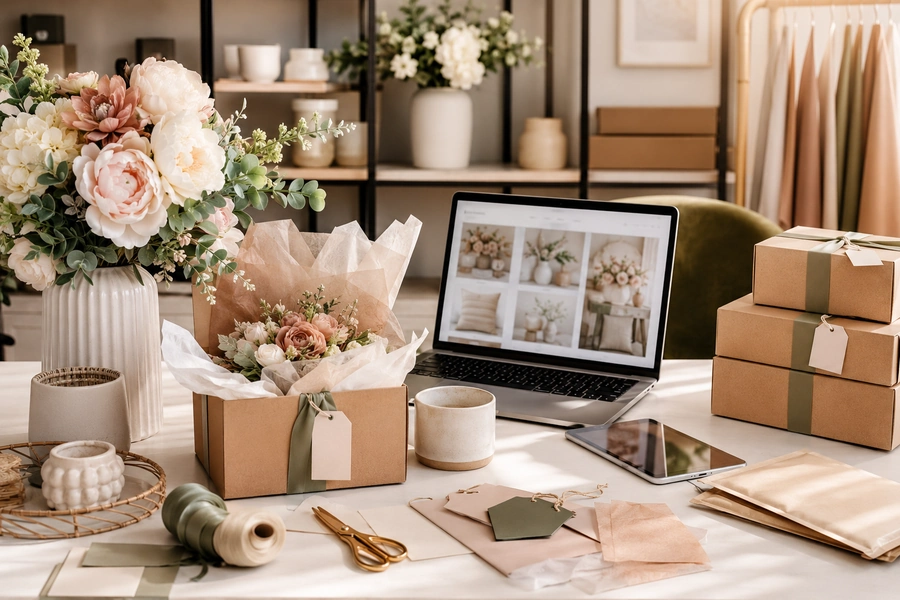
The model is not simply traditional dropshipping with a logo. Shopify defines branded dropshipping around customized packaging, labels, inserts, and other customer-facing brand elements, while private-label dropshipping goes further by selling products developed or presented specifically for one brand.
What Is Branded Dropshipping for Artificial Flowers and Home Décor?
Ordinary dropshipping focuses primarily on fulfillment. Branded dropshipping adds a recognizable commercial identity to the product, website, packaging, communication, and post-purchase experience.
Branded dropshipping means selling supplier-held products through a distinct brand while the supplier stores, packs, and ships customer orders. For artificial flowers and home décor, branding can include curated collections, original photographs, custom product names, coordinated colors, branded inserts, packaging, exclusive bundles, white-label products, or privately developed designs.
The seller owns the brand while the supplier holds the stock
In a standard dropshipping arrangement, the supplier handles inventory and fulfillment. Shopify describes this model as selling without personally handling inventory or shipping because the supplier sends products directly to customers.
The responsibilities normally divide like this:
| Business Area | Brand Owner | Dropshipping Supplier |
|---|---|---|
| Brand name and positioning | Controls | Does not control |
| Website and product pages | Controls | Provides basic information |
| Retail price | Controls | Sets supplier price |
| Product inventory | Does not normally hold | Stores |
| Order picking | Monitors | Performs |
| Packaging | Specifies where available | Executes |
| Shipping | Communicates expectations | Hands parcel to carrier |
| Customer support | Controls | Supplies order evidence |
| Refund decisions | Controls | Follows agreed claim process |
| Future customization | Requests and funds | Produces where capable |
This separation makes the model attractive to new décor brands. It reduces initial finished-goods inventory, but it does not remove responsibility for product quality, advertising, customer communication, shipping promises, or returns.
Branded dropshipping is different from generic dropshipping
A generic dropship store may upload the supplier’s complete catalog using unchanged images, titles, descriptions, and packaging.
A branded store makes deliberate choices.
| Generic Dropshipping | Branded Dropshipping |
|---|---|
| Hundreds of unrelated products | Focused product collections |
| Supplier photographs | Original or controlled content |
| Generic SKU names | Brand-owned product names |
| Plain supplier packaging | Approved branded experience |
| Price-led selling | Style, solution, and trust-led selling |
| Weak visual consistency | Defined brand identity |
| Limited customer memory | Recognizable positioning |
| Easy competitor comparison | Differentiated bundles and content |
The physical artificial rose may initially come from an existing supplier range. The brand creates additional value through selection, styling, instructions, packaging, merchandising, and service.
White label and private label are later stages
Branded dropshipping can begin without changing the actual product.
A seller might first add:
- A branded thank-you card
- Reshaping instructions
- Logo stickers
- Coordinated product collections
- Custom photography
- Branded product names
White labeling normally adds the seller’s identity to an existing product. Private labeling allows deeper product development under one brand, such as customized colors, dimensions, materials, arrangements, or packaging. Shopify’s current guidance distinguishes private-label goods developed for a particular business from generic white-label products that can be offered to multiple sellers.
For artificial flowers, deeper customization might include:
- Exclusive petal color
- Different flower-head diameter
- Longer stems
- Lower-gloss leaves
- Custom bouquet count
- Unique flower-and-greenery recipe
- Branded box
- Exclusive SKU
This creates a practical growth path from low-risk testing to proprietary products.
Why Is Branded Dropshipping Replacing Generic Dropshipping?
Generic products remain easy to launch, but they are also easy for competitors to copy. A recognizable brand creates assets that do not depend entirely on supplier access.
Branded dropshipping is becoming more important because shoppers can compare generic products quickly, while brands can compete through identity, curation, content, packaging, trust, and service. Artificial flowers and home décor are especially suitable because style, color coordination, visual presentation, bundles, and room-based solutions strongly influence buying decisions.
1. A brand reduces direct price comparison
When five stores sell the same “pink artificial peony bouquet” with identical photographs, customers can compare prices immediately.
A branded seller can present the product as part of a larger solution:
The Blush Hotel Collection
- Blush peony bouquet
- Champagne rose stems
- Sage eucalyptus
- Coordinating ceramic vase
- Table-styling guide
The customer is no longer comparing only one supplier SKU.
The seller has created:
- A color story
- A use case
- A bundle
- Original visual content
- A recognizable collection
Another retailer may find similar flowers, but it cannot automatically reproduce the complete brand system.
2. Home décor depends on visual identity
Artificial flowers and home accessories are highly visual products. Customers need to imagine how several items will work together inside a room, wedding, hotel, restaurant, or seasonal display.
A strong décor brand can own a recognizable visual language:
| Brand Direction | Possible Product Style |
|---|---|
| Quiet luxury | Ivory orchids, olive foliage, stone vessels |
| Romantic wedding | Blush peonies, roses, eucalyptus |
| Modern hotel | White orchids, sculptural branches, black containers |
| Rustic home | Wildflowers, terracotta, woven accessories |
| Coastal | White flowers, pale blue-green foliage |
| Dark luxury | Burgundy hydrangeas, plum roses, bronze vessels |
Shopify’s current ecommerce guidance stresses that online brands must communicate identity through every customer touchpoint because shoppers cannot experience a physical storefront or handle the product before buying.
That principle is particularly relevant to artificial flowers. Color, scale, material, and realism can be difficult to judge from an unstructured supplier listing.
3. Brand packaging extends the customer experience
The customer’s first physical interaction with a dropshipping business is often the parcel.
Packaging can communicate:
- Product quality
- Brand colors
- Care
- Gift suitability
- Product organization
- Reorder information
Shopify’s current packaging guidance treats packaging as both product protection and a visible part of brand identity. It also recommends keeping seasonal designs recognizable rather than abandoning the core brand style.
For artificial flowers, packaging must solve two jobs:
Protect the product
Prevent crushed flower heads, bent stems, lost leaves, and unnecessary compression.
Present the brand
Use approved cards, labels, tissue, instructions, or boxes without creating excessive shipping volume.
A beautiful package that permanently crushes a hydrangea is not successful branding.
4. Better product information can improve discoverability
A branded product system also supports cleaner ecommerce data.
Google Merchant Center recommends submitting accurate brand names, product identifiers, and manufacturer part numbers where applicable. It explains that these identifiers help distinguish products and connect customer searches with relevant listings. For custom products without an existing official brand, the manufacturer can use its store name as the brand and assign an appropriate MPN.
Google also recommends detailed, unique product information and structured ecommerce data so its systems can better understand products, variants, prices, availability, and shipping information.
For a growing artificial-flower brand, this supports a cleaner catalog:
- Unique product IDs
- Clear brand field
- Consistent SKU structure
- Accurate colors
- Material details
- Product variants
- Availability
- Shipping data
- Return information
Branding therefore affects more than the logo. It can improve how the entire product catalog is organized and presented.
5. Dropshipping enables faster collection testing
Artificial-flower trends can change by season, wedding palette, home style, or social-media influence.
Buying large quantities of every new color creates inventory risk.
Branded dropshipping allows a seller to test:
- New flower colors
- Seasonal garlands
- Wedding palettes
- Artificial orchid styles
- Decorative vases
- Faux greenery
- Coordinated room accessories
The seller can then move only proven products into larger purchasing programs.
Shopify’s 2026 dropshipping guidance continues to present supplier fulfillment as a model that reduces upfront inventory and logistics requirements.
The strategic benefit is not permanent avoidance of inventory.
It is learning what customers want before making a large inventory commitment.
How Can Sellers Build a Branded Décor Business Without Inventory?
A brand cannot be created by adding a logo to several unrelated supplier products. It needs a clear customer, visual promise, product system, and fulfillment standard.
Sellers can build a branded artificial-flower and home-décor business without inventory by selecting a focused niche, approving samples, curating limited collections, producing original content, introducing packaging gradually, synchronizing stock, documenting fulfillment rules, and controlling every customer-facing interaction from discovery through returns.
Step 1: Choose one recognizable market position
A focused position is easier to remember and operate.
Possible brand directions include:
- Luxury faux flowers for hotels
- DIY artificial wedding flowers
- Neutral artificial arrangements for homes
- Outdoor artificial greenery
- Seasonal floral décor
- Small-space botanical styling
- Artificial orchids and premium vessels
- Event-ready flower and greenery kits
A narrow starting point does not prevent later expansion.
It gives the brand a clear reason to exist.
Step 2: Approve physical samples
The brand owner should inspect the actual product before making claims about it.
For artificial flowers, check:
| Quality Area | Inspection |
|---|---|
| Petals | Texture, fraying, edges |
| Color | Accuracy under several lights |
| Flower center | Botanical realism |
| Leaves | Gloss, veins, attachment |
| Stem | Length, wire strength |
| Glue | Visible residue |
| Packaging | Compression and protection |
| Recovery | Reshaping time |
| Odor | Unacceptable smell |
| Repeat order | Batch consistency |
Original samples also support photography, videos, instructions, measurements, and customer-service training.
Step 3: Create brand-owned collections
Do not simply copy the supplier’s internal product categories.
Organize products around customer outcomes.
| Supplier Category | Stronger Brand Collection |
|---|---|
| Artificial roses | Romantic Reception Collection |
| Silk hydrangeas | Luxury Lobby Collection |
| Eucalyptus stems | Modern Wedding Greenery |
| Ceramic vases | Hotel-Inspired Vessel Edit |
| Garlands | Reusable Event Styling System |
| Artificial orchids | Minimalist Orchid Collection |
Collections make cross-selling easier and create a visual story competitors cannot reproduce by copying one listing.
Step 4: Introduce packaging in stages
Custom packaging frequently has its own MOQ even when the supplier offers one-piece product fulfillment.
A gradual model reduces risk:
| Launch Stage | Branding Level |
|---|---|
| Product testing | Neutral safe packaging |
| Early orders | Branded card and instructions |
| Growing demand | Logo label and tissue |
| Consistent volume | Custom mailer or product box |
| Proven bestseller | Fully branded packaging |
| Private-label stage | Custom product and packaging |
This prevents sellers from purchasing hundreds of printed boxes for a product that has not proven demand.
Step 5: Control the digital experience
A branded store should own:
- Product photography
- Product descriptions
- Dimensions
- Color names
- Styling guides
- Collection pages
- FAQs
- Shipping information
- Returns
- Customer support
- Post-purchase communication
Google recommends sharing detailed ecommerce product information through Merchant Center and structured data to help its systems understand and present products accurately.
This makes accurate product data part of brand-building rather than a technical afterthought.
Step 6: Automate without losing control
Inventory synchronization, automatic order transfer, tracking updates, and customer notifications can reduce manual work.
Shopify’s current automation guidance describes integrations across fulfillment and shipping workflows as a way to connect ecommerce operations inside the store system.
However, automation should not automatically replace:
- Sample reviews
- Packaging audits
- Stockout monitoring
- Customer complaint analysis
- Repeat-order QC
- Supplier performance reviews
The supplier may fulfill the parcel, but the brand owns the customer’s judgment of that parcel.
What Risks Must Branded Dropshipping Businesses Manage?
Branding can increase perceived value, but it also raises customer expectations. Every supplier failure becomes a brand failure in the customer’s mind.
Branded dropshipping businesses must manage product inconsistency, stockouts, slow fulfillment, packaging MOQ, dimensional shipping, inaccurate photographs, returns, trademark risk, and dependence on one supplier. The solution is written specifications, test orders, inventory visibility, realistic policies, backup plans, and a controlled transition toward wholesale or private label.
Product inconsistency can damage trust
Artificial flowers are sensitive to:
- Color variation
- Changed petal material
- Different stem lengths
- Lower flower density
- Visible glue
- Packaging compression
- Supplier substitutions
A customer ordering two matching bouquets several weeks apart expects them to coordinate.
I therefore request:
- Stable SKU codes
- Advance notice of design changes
- Batch photographs
- Retained approval samples
- No substitutions without approval
- Replacement procedures
Shipping promises remain the seller’s responsibility
Shopify reminds dropshipping merchants that they remain subject to the laws and regulations applying to retailers, including product, shipping, and refund obligations.
In the United States, the FTC requires online sellers to have a reasonable basis for advertised shipping times. When sellers cannot meet the stated time, delay-consent or refund requirements can apply; when no shipment period is stated, the general rule uses 30 days.
This means a décor brand should publish realistic information about:
- Processing time
- Shipping origin
- Estimated delivery
- Tracking
- Delays
- Customs where relevant
- Cancellation
- Returns
A branded box cannot repair customer trust after repeated late delivery.
Returns can be expensive for bulky décor
Artificial arrangements, flower walls, planters, and large stems can create high return-shipping costs.
Before launch, define how to handle:
| Customer Issue | Possible Resolution |
|---|---|
| Crushed but recoverable flowers | Reshaping guidance |
| Permanently damaged flower | Replacement or refund |
| Incorrect color | Supplier corrective action |
| Wrong SKU | Replacement |
| Customer changed mind | Published return policy |
| Missing component | Replacement part |
| Late delivery | Policy-based resolution |
Shopify allows merchants to define return eligibility, time periods, and who pays return shipping, but the chosen rules should be clear to customers before purchase.
Brand names need legal review
A memorable name is valuable only when the seller can use it responsibly.
The USPTO explains that trademarks identify the source of goods or services and commonly protect names and logos associated with them. It provides a searchable federal trademark database so applicants can investigate potentially conflicting marks before filing.
A seller should review relevant territories before investing heavily in:
- Printed packaging
- Labels
- Domain names
- Advertising
- Marketplace brand programs
- Private-label production
One supplier creates concentration risk
Depending entirely on one supplier can create problems when it:
- Discontinues a bestseller
- Raises prices
- Changes materials
- Loses stock
- Extends processing time
- Stops custom packaging
- Experiences shipping disruption
I prefer one primary supplier with approved alternatives for important product families.
Alternative suppliers should not be used silently. Their products should be sampled because one supplier’s “ivory rose” may not match another supplier’s version.
My insights: Why Is Branded Dropshipping the Future of Artificial Flowers and Home Décor
The future is unlikely to belong to stores that merely copy products from a supplier feed. Technology makes launching those stores easier, but that also makes them less distinctive.
Branded dropshipping is the likely future of artificial flowers and home décor because it connects low-risk product validation with brand ownership. Sellers can test supplier-held products, build original collections and content, improve packaging and data, learn from customers, and then convert proven winners into exclusive, private-label, wholesale, or locally fulfilled products.
The future model is a progression, not one fulfillment method
My preferred model has five stages:
| Stage | Sourcing Model | Primary Goal |
|---|---|---|
| 1 | Sample testing | Verify quality |
| 2 | Curated dropshipping | Validate customer demand |
| 3 | Branded dropshipping | Build recognition |
| 4 | White/private label | Increase differentiation |
| 5 | Hybrid wholesale + dropshipping | Improve margin and delivery |
This progression allows the business to protect cash early and improve control later.
The brand owns the assets competitors cannot easily copy
A competitor may locate the same artificial peony.
It cannot automatically copy:
- The brand name
- Customer relationships
- Original photography
- Styling guides
- Product reviews
- Email audience
- Collection structure
- Customer service
- Packaging system
- Product-development knowledge
These assets become more valuable than temporary access to one supplier catalog.
Product data will become part of brand equity
As shopping discovery becomes increasingly structured across search engines, merchant feeds, marketplaces, and automated shopping tools, sellers need consistent product identity.
Google’s current ecommerce guidance uses brand, MPN, GTIN, product variants, availability, shipping information, and structured data to understand and present products.
This suggests that a well-organized brand has an advantage over an anonymous catalog with changing titles, duplicated photographs, and unreliable product identifiers.
That is an inference from Google’s product-data requirements, not a guarantee of ranking or sales.
Artificial flowers are especially suitable for the model
Artificial flowers offer useful branded-dropshipping characteristics:
- They do not require refrigeration.
- They can remain available across seasons.
- Colors can form distinctive collections.
- Products can be bundled.
- Styling content adds value.
- Strong sellers can later be customized.
- Slow colors can remain supplier-held.
The category also creates enough quality variation for a trusted brand to matter.
Customers need help judging:
- Realism
- Color
- Scale
- Materials
- Packaging recovery
- Appropriate use
- Styling
A brand that explains those differences can compete on expertise rather than price alone.
Home décor supports expansion around the customer
An artificial-flower brand does not need to remain only a flower store.
After learning the customer’s style, it can add coordinated products:
- Vases
- Planters
- Wreaths
- Garlands
- Decorative branches
- Candleholders
- Table accessories
- Seasonal décor
- Storage products
- Styling kits
Shopify’s current home-décor ecommerce guidance highlights the category’s suitability for connected online and physical buying journeys, including shipping bulky items directly to customers when appropriate.
This creates a route from one-product dropshipping into a broader décor brand.
My final future-focused rule
The future is not simply dropshipping instead of inventory.
It is:
Use dropshipping to discover demand.
Use branding to create customer preference.
Use private label to create differentiation.
Use wholesale or local fulfillment to scale proven winners.
Businesses that follow this progression can remain flexible without being permanently dependent on generic supplier products.
Conclusion
Branded dropshipping turns supplier-held décor into a defensible business by combining low-risk testing, distinctive identity, reliable customer experience, and a clear path toward proprietary products.