
A large artificial tree can transform a business interior, but the wrong scale, canopy, trunk, or base can make an expensive space feel poorly planned.
The best large artificial trees for business interiors include olive trees for refined spaces, ficus for fuller greenery, palms for hospitality, birch for vertical structure, and custom broad-canopy trees for atriums. Buyers should choose by architecture, ceiling height, canopy width, realism, fire documentation, installation, circulation, maintenance, and lifecycle cost.
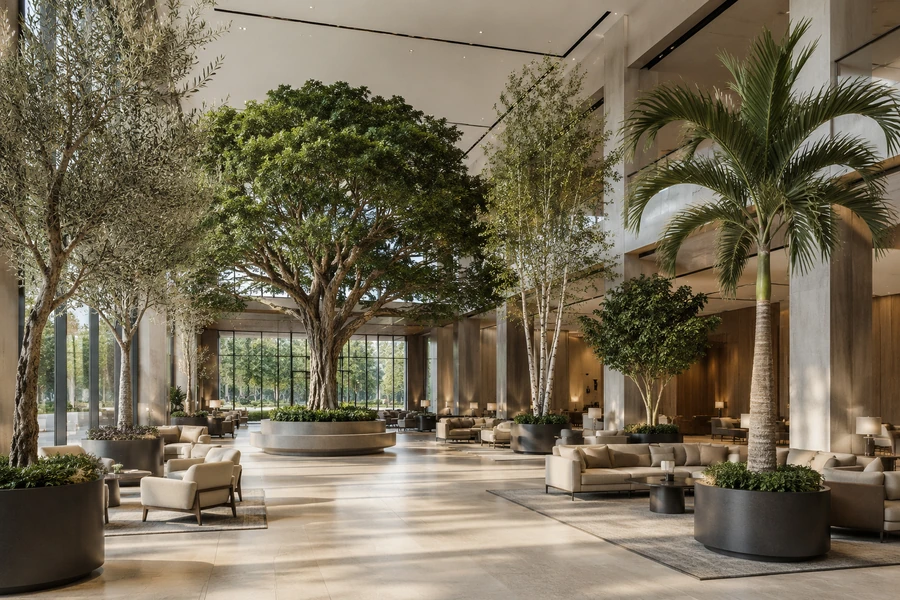
Large commercial trees should be treated as part of the interior rather than oversized accessories. Current commercial design guidance describes them as built assemblies with trunks, branches, canopies, and base systems that can affect ceiling clearance, furniture layouts, circulation, installation, and maintenance access.
Which Large Artificial Trees Are Best for Business Interiors?
A tree that works beautifully in a boutique office may feel completely wrong inside a resort, mall, restaurant, or double-height corporate atrium.
I choose the best large artificial tree by matching botanical character to the business environment. Olive trees provide refined open greenery, ficus trees create fuller volume, palms establish a tropical hospitality mood, birch provides slim vertical rhythm, and custom trees are strongest when a large atrium needs an architectural focal point.
1. Large artificial olive trees: best for modern luxury
The artificial olive tree is one of my strongest general recommendations for commercial interiors.
Its canopy is normally more open than a dense ficus. Its small leaves create texture without forming a heavy visual wall.
I would consider olive trees for:
- Premium offices
- Hotel reception areas
- Restaurants
- Luxury retail stores
- Property showrooms
- Spas
- Executive lounges
Current commercial-tree specialists also identify olive forms with contemporary, Mediterranean, hospitality, and premium retail environments.
Why olive trees work well
An olive tree gives me:
- Good vertical height
- A visible sculptural trunk
- Open sightlines
- Neutral green color
- Compatibility with stone, timber, plaster, brass, and concrete
- A relaxed but premium appearance
I especially like olives where the tree will be close to reception furniture or lounge seating because the open branch structure does not automatically create a solid visual barrier.
Main buying risk
Poor artificial olive trees can look thin rather than elegant.
I inspect:
- Branch count
- Natural asymmetry
- Leaf scale
- Leaf color variation
- Trunk taper
- Visible attachment points
A large tree needs enough foliage to suit the architecture without becoming an unrealistic green ball.
2. Large artificial ficus trees: best for full greenery
Ficus is my choice when the project needs more visual volume.
Large ficus trees work in:
- Office atriums
- Shopping centers
- Restaurants
- Healthcare waiting areas
- Hotel lounges
- Mixed-use developments
Commercial suppliers describe ficus and other broadleaf species as useful where a project needs fuller canopy coverage and stronger spatial presence.
What makes a good ficus look realistic
I look for:
- Several leaf shades
- Mixed branch directions
- Different branch lengths
- Matte rather than highly glossy leaves
- Natural gaps inside the canopy
- A trunk that remains convincing at close range
Perfectly even foliage normally reduces realism.
Nature contains irregular spacing. A premium artificial tree should reproduce some of that variation.
3. Artificial palms: best for hospitality and leisure
Palms have a very clear identity.
They immediately support:
- Resorts
- Spas
- Restaurants
- Entertainment venues
- Tropical retail concepts
- Pool-club interiors
- Leisure destinations
They create stronger theme recognition than olive or ficus trees.
Current commercial artificial-tree portfolios include palms as a major category for hospitality and entertainment projects because their silhouette communicates tropical character immediately.
Measure the fronds carefully
The main problem with large palms is not always height.
It is width.
Palm fronds can project toward:
- Lighting
- Signs
- Furniture
- Doors
- Walkways
- Balcony edges
- Sprinklers
I therefore request both:
Finished height
and
maximum finished canopy diameter
before approving a palm.
4. Birch-style trees: best for narrow vertical spaces
Birch gives a different effect.
Multiple pale trunks create height without requiring one massive dark trunk.
I use artificial birch where the project calls for:
- Contemporary interiors
- Scandinavian design
- Modern retail
- Wellness spaces
- Restaurant clusters
- Tall narrow areas
Several slim birches can create more rhythm than one very dense tree.
This is useful when the architecture needs vertical softness while floor area is limited.
5. Custom broad-canopy trees: best for atriums
Some business interiors are too large for standard decorative trees.
A major mall, casino, airport lounge, headquarters, hotel atrium, or entertainment project may need a fabricated tree designed around the building itself.
Commercial fabricators describe these large trees as coordinated assemblies rather than loose decorations. Canopy diameter, trunk form, mounting conditions, seating, balconies, pedestrian flow, and maintenance all need to be resolved together.
Possible forms include:
- Banyan
- Oak
- Large ficus
- Maple
- Sculptural olive
- Custom fantasy tree
- Column-wrapped tree
Best tree by commercial space
| Business Interior | My Starting Choice | Why |
|---|---|---|
| Corporate reception | Olive | Clean, premium, open canopy |
| General office lobby | Ficus | Fuller green presence |
| Luxury hotel | Olive or custom tree | Refined focal point |
| Resort | Palm | Strong hospitality identity |
| Restaurant | Olive, ficus, or tree cluster | Softens seating zones |
| Shopping mall | Large ficus or custom tree | Strong architectural scale |
| Spa | Olive, birch, bamboo-style form | Calm visual character |
| Luxury retail | Olive or sculptural custom tree | Supports premium materials |
| Large atrium | Custom broad canopy | Standard trees may look undersized |
How Should Businesses Choose the Right Tree Size and Canopy?
The most realistic artificial tree can still fail when it is too small for the room or too wide for the circulation space.
I size large artificial trees by measuring ceiling height, canopy diameter, usable floor area, viewing distance, furniture, lighting, signs, services, and delivery access together. Height alone is not enough. A successful tree should visually anchor the interior without crowding the ceiling or projecting into important circulation and operational zones.
Start with the room, not the species
This is one of the most useful commercial buying principles.
Current commercial-tree specialists recommend starting with architectural conditions rather than choosing the species first. Ceiling height, balcony lines, viewing distance, furniture, canopy space, and pedestrian flow often determine the appropriate tree form.
Before requesting quotations, I record:
- Floor-to-ceiling height.
- Lowest lighting fixture.
- Sprinkler and service locations.
- Maximum available floor footprint.
- Maximum canopy diameter.
- Main viewing distance.
- Nearby seating.
- Nearby doors and signs.
- Delivery-door dimensions.
- Freight-elevator dimensions.
Avoid undersizing large interiors
Undersizing is particularly common in commercial interiors.
A tree that feels enormous inside a showroom can look surprisingly small inside a double-height hotel or mall atrium.
A current commercial design guide identifies undersizing as a frequent specification mistake and recommends matching both height and canopy to the architectural volume rather than applying residential-scale expectations.
I use this conceptual starting point:
| Space | Tree Direction |
|---|---|
| Standard office | Tall decorative tree |
| Reception with higher ceiling | Large statement tree |
| Double-height lobby | Oversized tree |
| Major atrium | Custom tree system |
| Narrow corridor-side zone | Slim tree |
| Wide open seating zone | Broad canopy |
These are design categories, not code dimensions.
The actual measurements should come from the project.
Canopy width may matter more than height
Imagine two artificial trees that are both 10 feet tall.
Tree A: 4-foot canopy.
Tree B: 8-foot canopy.
They require completely different floor plans.
The wider tree may affect:
- Seating capacity
- Guest circulation
- Cleaning routes
- Signs
- Security cameras
- Lighting
- Doors
This is why every commercial quotation should state the maximum finished width after normal branch shaping.
Match the planter to the tree
A large tree in a small decorative pot often looks top-heavy.
The planter should have enough scale to visually support:
- Tree height
- Trunk thickness
- Canopy width
- Nearby furniture
Commercial projects frequently use:
- Large fiberglass planters
- GFRC containers
- Built-in planters
- Circular seating planters
- Stone-look containers
- Millwork surrounds
- Concealed structural bases
The decorative planter and the actual tree-support system may be separate components.
Check the guest viewing distance
A tree viewed from 10 meters does not need the same leaf-level detail as a tree beside a lounge chair.
I divide commercial realism into three zones:
| Viewing Distance | Main Quality Priority |
|---|---|
| Close | Leaf texture, trunk, attachments |
| Medium | Branching, color, silhouette |
| Long | Scale, canopy shape, overall botanical form |
For close-range lobby trees, I spend more attention on trunk finish and attachment concealment.
For a large atrium tree, overall form and scale become much more important.
Measure circulation after the branches are shaped
A boxed artificial tree may arrive narrow.
After branches are opened, the finished canopy can be substantially wider.
ADA guidance limits certain projections into circulation paths and makes clear that protruding-object requirements apply to circulation paths in rooms and spaces, not only corridors. Objects also cannot reduce the required width of accessible routes.
This means I assess the finished tree, not just the planter footprint.
What Materials, Safety, and Installation Details Should Buyers Check?
Once an artificial tree becomes large enough to influence the architecture, I stop treating it like ordinary décor.
I check foliage material, trunk construction, internal structure, fire-performance documentation, base design, branch attachments, installation method, access routes, and replacement components. In public commercial buildings, local code and project professionals should determine final fire, structural, accessibility, and egress requirements.
Compare the main trunk constructions
Large artificial trees can use very different structures.
| Construction | Main Benefit | Main Buying Concern |
|---|---|---|
| Natural wood trunk | Strong realism | Variation and project suitability |
| Molded fiberglass | Custom shape | Finish quality |
| Steel armature + sculpted finish | Strong for very large trees | Installation complexity |
| Molded polymer | Lightweight | Can appear artificial up close |
| Mixed construction | Balances realism and structure | Harder to specify |
For large atrium-scale fabrication, commercial specialists describe trunk, canopy, base, and internal structure as coordinated built components.
Look for believable foliage
I inspect the foliage under the lighting that the business actually uses.
Check:
- Gloss
- Color
- Leaf thickness
- Vein detail
- Leaf angle
- Branch spacing
- Repeated molds
- Visible plastic joints
- Exposed wire
- Glue
Strong daylight and commercial spotlights can reveal glossy plastic that looked acceptable in warehouse photographs.
Check the tree from every direction
Commercial trees often sit in open spaces.
A lobby tree may be seen from:
- Reception
- Lift lobby
- Café
- Upper floor
- Entrance
- Lounge
This makes 360-degree construction important.
I ask for sample photographs from all sides rather than only the best catalog angle.
Verify applicable fire documentation
This is especially important in hotels, malls, restaurants, offices, healthcare spaces, event venues, and other public interiors.
The 2024 International Fire Code contains specific requirements for artificial decorative vegetation. Where Section 807.4 applies, Section 807.4.1 requires the vegetation to meet specified NFPA 701 flame-propagation criteria, with manufacturer documentation, or an alternative NFPA 289 heat-release route. The code also contains occupancy-specific provisions and exceptions, so actual project requirements depend on the building and local adoption.
I do not accept only:
“Fire retardant artificial tree.”
I request:
- Exact tested product
- Test standard
- Test method
- Laboratory
- Report number
- Materials covered
- Foliage construction
- Trunk construction where relevant
- Production consistency
- Any installation restrictions
A certificate for one leaf material should not automatically be assumed to cover every component of a custom tree.
Keep exits visible and unobstructed
OSHA requires workplace exit routes to remain free and unobstructed. It also states that decorations cannot obscure exit doors or block the line of sight to exit signs.
I therefore check that a finished tree does not interfere with:
- Exit paths
- Exit signs
- Exit doors
- Fire equipment
- Door swings
- Emergency lighting
- Staff routes
A beautiful tree is not successful when it creates an operational problem.
Treat very large trees as project installations
Standard freestanding artificial trees may need only a properly sized stable planter.
Very large fabricated trees may require:
- Steel base plates
- Multiple anchor points
- Structural frames
- Floor connections
- Custom millwork
- Site assembly
- Professional installation
Commercial fabricators emphasize early coordination for large trees because canopy, mounting, structure, architecture, and installation access interact with each other.
The bigger the installation becomes, the less appropriate improvised anchoring becomes.
How Can Buyers Compare Quality, Maintenance, and Lifecycle Value?
Artificial trees remove horticultural care, but they do not remove maintenance. Dust, broken leaves, damaged branches, loose connections, and tired planters can reduce the value of an expensive commercial installation.
I compare large artificial trees by realism, structure, maintainability, replacement parts, installation cost, cleaning access, documentation, and expected service conditions. I calculate lifecycle value rather than comparing unit prices because a repairable premium tree can be less expensive than repeatedly replacing lower-quality trees across a business property.
Build a quality scorecard
I would use a scorecard like this:
| Buying Factor | Suggested Priority |
|---|---|
| Botanical realism | 20% |
| Correct architectural scale | 20% |
| Trunk and branch construction | 15% |
| Foliage consistency | 10% |
| Safety documentation | 10% |
| Installation system | 10% |
| Maintenance access | 5% |
| Spare parts | 5% |
| Packaging and delivery | 5% |
Price should be compared after minimum quality requirements are met.
Test the sample in real lighting
For standard large trees, I request one physical sample or representative branch/trunk section when possible.
I inspect it under:
- Daylight
- Warm lighting
- Cool lighting
- Spotlights
- Camera flash
- Smartphone photography
Artificial foliage that looks excellent in one lighting environment may appear too blue, yellow, or glossy in another.
Check packaging recovery
Trees commonly ship with branches compressed to reduce carton size.
A buyer should test:
- Condition at opening.
- Number of bent branches.
- Shaping time.
- Leaf loss.
- Permanent deformation.
- Final canopy dimensions.
The product should reach its approved appearance with reasonable setup rather than specialist reconstruction.
Plan cleaning before purchasing
A 7-foot olive tree and a 25-foot atrium tree have completely different maintenance needs.
Commercial-tree guidance also emphasizes maintenance access because large trees can require specialized equipment once canopies move well above normal working height.
For ordinary commercial trees, I prefer:
- Accessible branches
- Wipeable foliage
- Replaceable sections
- Removable decorative top dressing
For monumental trees, the design team should consider lift or access requirements from the beginning.
Buy spare parts
For important commercial installations, I request spare:
- Leaves
- Branches
- Connection hardware
- Trunk-finish materials
- Mounting hardware
- Touch-up materials
A damaged branch should not require replacing an entire artificial tree.
Calculate complete lifecycle cost
I use:
Lifecycle cost = product + freight + planter + installation + structural work + cleaning + repairs + replacement
For smaller trees, purchase price may dominate.
For very large custom trees, installation, access, fabrication, and maintenance can become significant parts of the budget.
Standardize business portfolios
A company with multiple offices, hotels, restaurants, or retail locations can simplify procurement by creating an approved artificial-tree collection.
For example:
| Standard Tree | Use |
|---|---|
| 7–8 ft olive | Meeting rooms and lounges |
| 9–10 ft olive | Reception |
| Large ficus | Open office or lobby |
| Tall palm | Hospitality property |
| Custom tree | Flagship atrium |
Standardization helps with:
- Replacement
- Supplier control
- Spare foliage
- Planter sizing
- Maintenance instructions
- Brand consistency
My insights: What Are the Best Large Artificial Trees for Business Interiors
The “best” tree is not one universal model. A business interior needs a tree that solves a specific spatial problem while supporting the brand and building operation.
The best large artificial trees for business interiors are olive trees for refined versatility, ficus trees for full green volume, palms for hospitality identity, birch for narrow vertical spaces, and custom trees for major atriums. I would choose among them by architectural scale, canopy footprint, realism, safety documentation, installation, maintenance access, and lifecycle value.
My top five commercial choices
| Rank | Artificial Tree Style | Best Use |
|---|---|---|
| 1 | Large olive tree | Best overall for premium business interiors |
| 2 | Large ficus tree | Best for fuller greenery |
| 3 | Artificial palm | Best for hospitality and leisure |
| 4 | Birch tree/group | Best for slim vertical styling |
| 5 | Custom broad-canopy tree | Best for large atriums and flagship spaces |
Why I rank the olive tree first
The olive tree is my strongest all-purpose option because its botanical character works across many businesses without forcing a strong theme.
It can suit:
- Corporate
- Hospitality
- Retail
- Residential development
- Restaurant
- Wellness
Its open canopy also makes it easier to preserve sightlines than many dense trees.
That does not make it the correct solution for every room.
A tropical resort still benefits more from palms. A massive atrium may need a custom canopy. A large office seeking maximum greenery may prefer ficus.
Choose by the problem the tree must solve
I use this simple decision process.
Need elegance without visual heaviness?
Choose olive.
Need to fill an empty corner or create green volume?
Choose ficus.
Need a clear tropical identity?
Choose palm.
Need height but have a narrow footprint?
Choose birch.
Need to transform a major architectural volume?
Choose a custom tree.
This is more reliable than choosing the species that happens to be fashionable.
Scale is more important than species
Current commercial specialists consistently frame large-tree selection around the room first: ceiling height, canopy diameter, circulation, sightlines, furniture, and installation conditions should guide the selection before species is finalized.
I agree with that approach.
A perfectly realistic olive tree that is half the required scale is still the wrong tree.
A well-proportioned ficus can create a stronger interior even when olive is more fashionable.
Use open trees in operationally complex spaces
Open canopies give businesses several practical benefits:
- Better sightlines
- Easier cleaning
- More visible signage
- Less visual crowding
- Better integration with lighting
- Greater appreciation of premium trunk detail
That is useful around reception areas and customer-service zones.
Dense canopies work better where the goal is screening, visual enclosure, or stronger green mass.
Use custom trees only when standard trees cannot solve the space
A custom artificial tree can be spectacular.
It can also require much greater coordination.
I would consider a custom system when the space has:
- Very high ceilings
- Large central atrium
- Integrated seating
- Architectural lighting
- Unusual canopy requirements
- Permanent flagship installation
- Brand-specific design goals
Commercial fabricators describe this type of tree as part of the built environment because its mounting, canopy, access, and structure are closely tied to the room.
For ordinary offices and small commercial lobbies, a premium standard tree is simpler to replace and maintain.
My final commercial buying checklist
Before approving a large artificial tree, I confirm:
- Finished height.
- Maximum canopy width.
- Trunk diameter.
- Tree style.
- Actual foliage materials.
- Leaf color and finish.
- Ceiling clearance.
- Lighting clearance.
- Circulation clearance.
- Planter dimensions.
- Base or fixing method.
- Fire documentation where required.
- Delivery route.
- Assembly method.
- Cleaning access.
- Spare branches and foliage.
- Warranty.
- Replacement process.
The best large artificial tree should not merely look realistic in a catalog.
It should look correctly scaled when installed, support the business’s interior identity, remain clear of critical circulation, provide appropriate documentation, and stay practical to maintain over its service life.
Conclusion
Choose large artificial trees by business style, architectural scale, canopy, realism, safety, installation, and maintenance. The best tree should look intentional long after installation.