
Outdoor commercial spaces need greenery that looks fresh every day. But real plants can struggle with heat, shade, wind, watering schedules, and heavy foot traffic.
The best outdoor synthetic plants for commercial spaces are UV-resistant, weather-resistant, realistic, stable, and easy to clean. Strong choices include faux boxwood hedges, artificial palms, topiaries, outdoor ferns, greenery panels, hanging baskets, balcony planters, and mixed foliage arrangements for hotels, restaurants, offices, retail stores, and event venues.
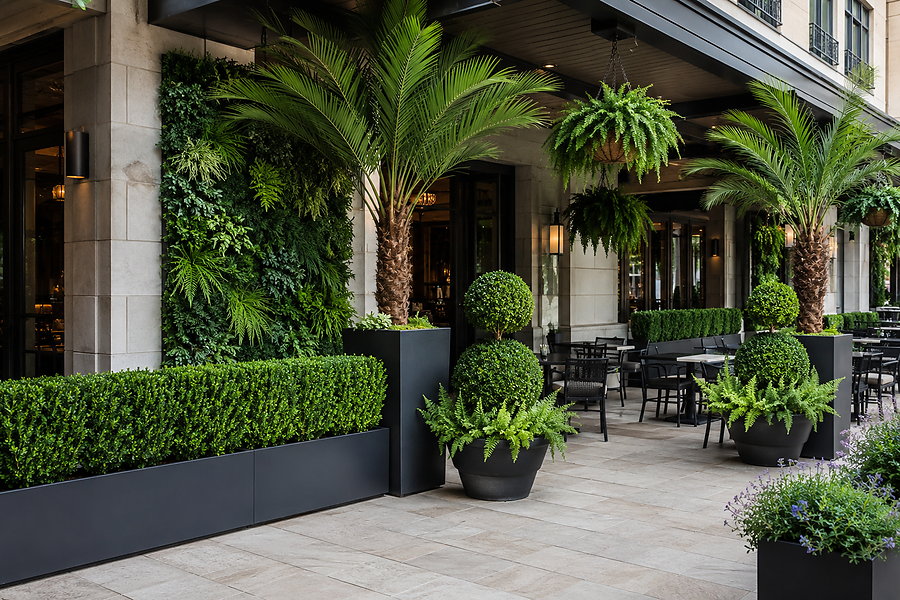
Synthetic plants are useful when a business needs a consistent green look with less daily maintenance. Outdoor-rated artificial foliage is commonly used for entryways, patios, rooftops, restaurants, retail spaces, hotels, offices, healthcare environments, multifamily communities, and other commercial properties that want greenery without the same care demands as live plants.
Why Choose Outdoor Synthetic Plants for Commercial Spaces?
A business exterior can lose appeal fast when plants wilt, dry out, or look patchy. Customers may not know the reason, but they notice when the entrance feels uncared for.
Outdoor synthetic plants are a good choice for commercial spaces because they provide year-round greenery, reduce watering and trimming needs, support brand presentation, and keep entrances, patios, rooftops, and storefronts looking consistent in difficult growing conditions.
Commercial greenery has to perform daily
A home garden can have natural changes. A commercial space has less room for failure. A hotel entrance should look polished every morning. A restaurant patio should feel inviting during every dining shift. A retail storefront should attract customers even during hot, dry, or low-light seasons. An office courtyard should stay tidy without becoming a maintenance burden.
This is where outdoor synthetic plants can help. They keep their shape, do not need irrigation, and can be installed in areas where real plants may struggle. They are especially useful in paved zones, shaded corners, covered patios, rooftop lounges, balcony edges, event entrances, and storefront planters.
The key is to choose products made for outdoor use. Gardening experts warn that many fake plants are not designed for exterior conditions and may fade quickly in direct sun. Outdoor-safe options should be labeled UV-resistant and weatherproof, with materials such as polyethylene, polyblend plastics, or PVC.
| Commercial Challenge | Synthetic Plant Solution | Best Use Area |
|---|---|---|
| Strong sunlight | UV-resistant foliage | Patios, entrances, rooftops |
| Low light | No need for photosynthesis | Covered walkways, shaded corners |
| High foot traffic | No soil mess or broken stems | Retail fronts, hotel lobbies, event zones |
| Water limits | No irrigation needed | Dry climates, paved areas |
| Brand consistency | Same look all year | Chain stores, restaurants, offices |
| Fast installation | Ready-made planters and panels | Seasonal displays and renovations |
They support a biophilic look without full plant care
Biophilic design uses nature-inspired elements to make built spaces feel more human, calm, and inviting. Research on workplace greenery and biophilic design has examined how greenery dose can affect well-being, productivity, and physiological or psychological outcomes in offices.
Synthetic plants do not replace the full ecological value of living plants. They do not clean air, support pollinators, or grow naturally. But they can still support the visual side of biophilic design in places where live planting is difficult. For commercial buyers, the goal is practical: use realistic greenery to soften hard surfaces, improve first impressions, and make outdoor spaces feel more finished.
What Are the Best Outdoor Synthetic Plants for Business Use?
Not every faux plant works for commercial projects. Small indoor plants may look weak outdoors, while delicate silk flowers may fade or fray in sun and rain.
The best outdoor synthetic plants for business use include faux boxwood hedges, artificial palms, topiary balls, outdoor ferns, UV-resistant hanging baskets, greenery panels, faux bamboo, artificial olive trees, balcony planters, and mixed foliage arrangements.
1. Faux boxwood hedges
Faux boxwood hedges are one of the strongest commercial picks. They work well for privacy screens, restaurant patios, café dividers, rooftop barriers, storefront edges, and event walkways. A good boxwood panel should look dense, matte, and evenly green without looking too plastic.
Boxwood is useful because it gives structure. It can hide service areas, separate dining zones, frame entrances, or create photo backdrops. For outdoor use, choose UV-stabilized panels and secure them to a strong frame.
2. Artificial palms
Artificial palms work well for hotels, pool areas, resorts, spas, restaurants, and warm-climate retail spaces. They add height and a relaxed mood. They are also useful in places where real palms may be hard to maintain or where root space is limited.
Choose palms with varied leaf lengths, strong trunks, and weighted bases. Avoid very glossy leaves because they can look fake and may show fading more clearly.
3. Outdoor topiaries
Topiary balls, cones, spirals, and double-ball trees are excellent for formal entrances. They work well outside hotels, office buildings, boutiques, restaurants, and wedding venues. Topiaries give symmetry and order, which makes them useful for premium commercial spaces.
Use matching pairs beside doors, reception entrances, or walkway starts. Make sure the planter is heavy enough to resist wind and accidental bumps.
4. UV-resistant hanging baskets
Hanging baskets add softness above eye level. They work well for cafés, porches, balconies, shopping streets, garden centers, and hospitality terraces. Good artificial hanging baskets should use UV- and weather-resistant materials, realistic textures, and matte finishes. Southern Living notes that UV- and weather-resistant materials help resist fading, and matte finishes often look more elevated than glossy foliage.
5. Greenery wall panels
Greenery panels can turn plain exterior walls into branded photo areas. They work well for restaurants, retail stores, event venues, hotels, fitness studios, and office terraces. Add signage, lighting, or seasonal flowers to make the wall more useful for marketing photos.
| Plant Type | Best Commercial Space | Main Benefit |
|---|---|---|
| Faux boxwood hedge | Restaurant patio, storefront, rooftop | Privacy and structure |
| Artificial palm | Hotel, resort, pool area | Height and tropical mood |
| Topiary | Office, boutique, hotel entrance | Formal first impression |
| Hanging basket | Café, balcony, porch | Soft color and vertical interest |
| Greenery panel | Retail, event venue, restaurant | Photo-friendly branding |
| Faux bamboo | Spa, wellness center, courtyard | Privacy and calm |
| Artificial olive tree | Modern hotel, office terrace | Natural luxury look |
The best pick depends on the business goal. A restaurant may need dividers and hanging baskets. A hotel may need palms and topiaries. A retail store may need greenery walls and window planters. An office building may need clean, architectural planters with olive trees or bamboo.
How Do You Choose Durable Synthetic Plants for Outdoor Areas?
A cheap plant may look good for a few weeks, then fade, crack, or fall apart. Commercial buyers need products that survive weather and public use.
Choose durable synthetic plants for outdoor areas by checking UV protection, weather resistance, material quality, color realism, planter weight, fire-safety requirements, attachment strength, and cleaning needs. Outdoor commercial plants should be selected like building materials, not simple decoration.
UV resistance is the first requirement
Sunlight can weaken many plastic and fabric materials. Research on UV effects shows that solar ultraviolet radiation can damage wood and plastics and shorten material service life, which is why outdoor materials often need stabilization or protective interventions.
For synthetic plants, this means UV resistance should not be optional. Look for labels such as “UV-resistant,” “UV-stabilized,” “outdoor-rated,” “weather-resistant,” “sun-resistant,” or “UV-fade-resistant.” If a product is only designed for indoor use, it should be placed indoors or in a fully covered outdoor area.
Material and construction matter
Good outdoor synthetic plants often use PE, PVC, polyblend plastics, or treated polyester. Leaves should be securely attached. Stems should bend without snapping. Greenery panels should have strong backing grids. Hanging baskets should use reliable chains or hardware. Large planters should be weighted.
| Quality Check | What to Look For | Why It Matters |
|---|---|---|
| UV rating | Outdoor-safe or UV-stabilized label | Slows fading |
| Weather resistance | Rain and wind suitability | Protects appearance |
| Matte finish | Soft, non-glossy leaves | Looks more realistic |
| Secure stems | Strong attachment points | Reduces shedding |
| Weighted base | Heavy planter or hidden weights | Prevents tipping |
| Modular design | Replaceable panels or stems | Lowers repair cost |
| Easy cleaning | Wipeable foliage | Keeps display fresh |
Check fire and code needs
Commercial spaces may have stricter safety rules than private homes. This is especially important for malls, hotels, restaurants, event venues, offices, and public corridors. The International Fire Code includes requirements for artificial decorative vegetation, so commercial buyers should check local fire code, occupancy rules, and fire marshal expectations before installing large faux greenery walls or trees.
This does not mean every outdoor planter needs the same documentation. It means larger commercial projects should ask suppliers about fire-retardant options, test reports, and local compliance needs. This is especially important when synthetic plants are near entrances, walls, ceilings, exits, restaurants, or event structures.
How Should Commercial Spaces Style and Maintain Outdoor Faux Greenery?
Synthetic plants are low maintenance, not no maintenance. Dust, pollen, wind, rain marks, and fading can still make them look old.
Commercial spaces should style outdoor faux greenery with scale, stability, realism, and maintenance access in mind. Use large planters, layered heights, clean spacing, secure hardware, and a simple cleaning schedule to keep synthetic plants looking professional.
Style for distance and close-up views
Commercial greenery is viewed in different ways. A driver may see it from the street. A customer may walk past it at arm’s length. A guest may take a photo beside it. This means the plants must work from far away and close up.
Use larger plants for building entrances. Use medium plants for patios and walkways. Use small plants for tables, shelves, and counters. Do not use tiny plants in large outdoor areas because they disappear. Do not use oversized plants in narrow paths because they block movement.
| Space | Best Styling Choice | Practical Tip |
|---|---|---|
| Hotel entrance | Paired topiaries or palms | Use weighted planters |
| Restaurant patio | Boxwood dividers and hanging baskets | Keep walkways clear |
| Retail storefront | Window boxes and greenery panels | Match brand colors |
| Office courtyard | Olive trees, bamboo, planters | Keep design clean and calm |
| Event venue | Modular greenery walls and arches | Store pieces between events |
| Rooftop lounge | UV-rated planters and privacy hedges | Secure against wind |
Keep the display believable
Outdoor synthetic plants look better when they are mixed in realistic ways. Combine different heights and textures. Use matte leaves. Avoid neon green colors. Place plants where real plants could naturally grow, such as planters, borders, walls, baskets, and entry points.
Do not install faux plants directly into garden beds where they may block light or interfere with drainage around real plants. Gardening experts warn that faux plants do not absorb water and can be dislodged by wind and rain, so containers and paved areas are usually more practical placements.
Build a maintenance routine
A commercial team should inspect outdoor synthetic plants monthly. Check for fading, loose stems, broken ties, dust, leaves trapped in panels, and planter movement. Outdoor-rated plants can often be cleaned with a gentle rinse, while non-weather-rated plants should be dusted or wiped with a damp cloth. Southern Living recommends gentle rinsing only for outdoor-rated artificial baskets and dusting or damp wiping for pieces that are not all-weather rated.
A simple routine can extend the display life. Rotate planters so one side does not fade faster. Replace faded stems before the whole display looks old. Store seasonal pieces indoors when they are not in use. Keep extra panels or stems for repairs.
My insights: What Are the Best Outdoor Synthetic Plants for Commercial Spaces
Many businesses choose synthetic plants only by appearance. That is risky because commercial outdoor greenery must handle sunlight, weather, safety needs, customer contact, and brand presentation.
The best outdoor synthetic plants for commercial spaces are the ones that combine visual realism with commercial performance. They should be UV-resistant, stable, easy to clean, code-aware, and suitable for the exact location, whether that is a hotel entrance, restaurant patio, retail storefront, office courtyard, rooftop, or event venue.
The best choice depends on the business function
My main insight is that synthetic plants should be selected by job, not just by plant type. A faux palm is not automatically better than a boxwood hedge. A greenery wall is not automatically better than a topiary. The best plant is the one that solves the commercial problem.
If the goal is privacy, faux boxwood hedges and bamboo screens work best. If the goal is luxury, topiaries, olive trees, and palms are stronger choices. If the goal is social media attention, greenery panels and floral wall features work well. If the goal is soft patio atmosphere, hanging baskets and mixed planters are better.
A practical buying framework
| Business Goal | Best Synthetic Plant Pick |
|---|---|
| Improve entrance appeal | Topiaries, palms, large planters |
| Create patio privacy | Boxwood hedges, bamboo screens |
| Build a photo spot | Greenery wall panels, floral accents |
| Add rooftop greenery | UV-rated planters and privacy screens |
| Reduce maintenance | Durable PE or PVC foliage |
| Support seasonal decor | Modular greenery with replaceable accents |
| Match premium branding | Matte leaves, realistic color, quality planters |
Commercial buyers should buy fewer, stronger pieces
A business exterior does not need random greenery everywhere. It needs strong pieces in the right places. One realistic topiary pair can make an entrance look more expensive. One boxwood divider can make a patio feel more private. One greenery wall can become a branded photo background. One set of balcony planters can soften a hard building edge.
The best investment is usually not the cheapest plant. It is the plant that lasts longer, cleans faster, fades slower, and still looks realistic after months of use. For commercial spaces, that means outdoor-rated materials, UV stabilization, weighted containers, replaceable parts, and a maintenance plan.
Synthetic plants should make a business look cared for, not artificial. When the materials, scale, and placement are right, outdoor faux greenery can give hotels, restaurants, offices, retail stores, and event venues a reliable green look without the daily demands of live landscaping.
Conclusion
Outdoor synthetic plants work best for commercial spaces when they are UV-resistant, weather-ready, realistic, stable, easy to maintain, and chosen for a clear business purpose.