
Outdoor artificial plants can look fresh at first, then fade fast. Strong sunlight, heat, dust, and rain can expose poor product quality quickly.
UV-resistant artificial plants are faux plants made or treated to slow fading, discoloration, cracking, and brittleness caused by sunlight. In 2025, the best options use outdoor-safe materials, realistic finishes, stable construction, clear UV claims, and simple maintenance. They are ideal for commercial patios, hotels, retail storefronts, balconies, restaurants, and events.
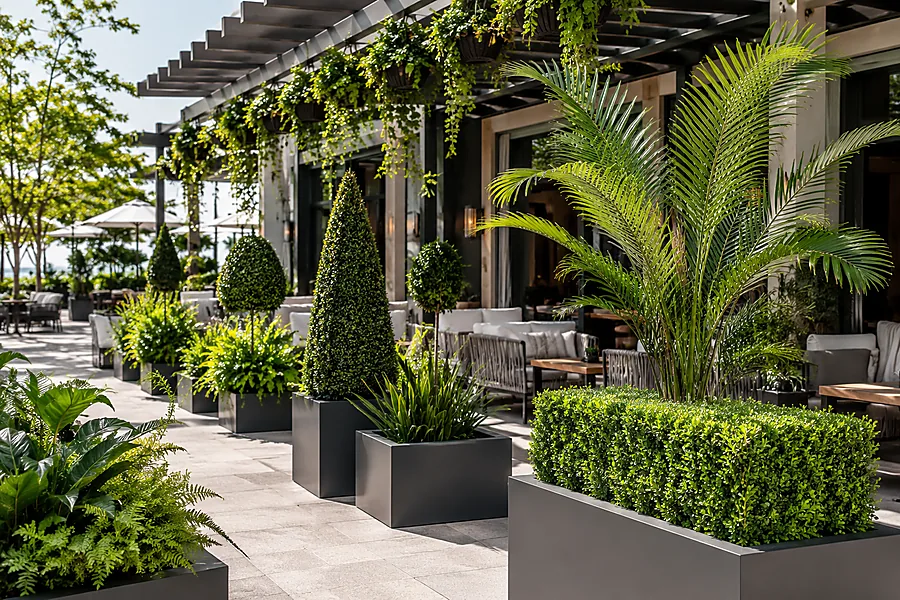
Artificial greenery is becoming a stronger commercial décor category because buyers want long-lasting, low-maintenance products. The global artificial flowers market was estimated at USD 3.09 billion in 2024 and is projected to reach USD 4.49 billion by 2030, driven by demand for low-maintenance, long-lasting décor in homes and commercial spaces. The broader artificial plants and flowers market is also projected to grow from US$3.5 billion in 2025 to US$5.6 billion by 2032.
What Are UV-Resistant Artificial Plants?
Many buyers think any fake plant can go outside. That mistake often leads to fading leaves, brittle stems, and cheap-looking displays.
UV-resistant artificial plants are synthetic plants designed to resist sunlight damage better than standard indoor faux plants. They usually use UV-stabilized plastics, outdoor-safe materials, fade-resistant pigments, or protective coatings to slow color loss and material aging.
UV resistance is about slowing damage
UV-resistant does not mean the plant will stay perfect forever. It means the material is designed to perform better under sunlight than normal indoor artificial greenery.
Outdoor artificial plants face UV rays, heat, rain, wind, dust, and temperature changes. The Spruce notes that many faux plants are not designed for outdoor conditions and recommends outdoor-safe, UV-resistant, weatherproof materials such as PE, polyblend plastics, or PVC for exterior use. Love Grows Wild also recommends checking labels for terms such as UV-resistant, UV-protected, weatherproof, outdoor-safe, and fade-resistant before placing faux plants outside.
| Term | What It Usually Means | Buyer Note |
|---|---|---|
| UV-resistant | Designed to slow sun fading | Better than indoor-only plants |
| UV-protected | Treated or made with UV protection | Ask how protection is added |
| Outdoor-safe | Suitable for exterior conditions | Still check sun exposure limits |
| Weatherproof | Better resistance to rain and temperature shifts | Does not mean damage-proof |
| Fade-resistant | Color designed to last longer | Still needs maintenance |
Common materials used in outdoor faux plants
Outdoor artificial plants often use PE, PVC, polyblend plastics, or treated synthetic materials. These materials are usually easier to clean than delicate silk-style leaves. They also work better for boxwood panels, topiaries, artificial hedges, patio plants, hanging baskets, and commercial planters.
Standard indoor silk plants may look realistic indoors, but they often perform poorly in full sun. They can fade, fray, or lose shape faster than outdoor-rated products.
Are UV-Resistant Artificial Plants Truly Fade-Proof?
“UV-proof” sounds attractive, but it can create unrealistic expectations. Sunlight is powerful, especially in full-sun commercial locations.
UV-resistant artificial plants are not truly fade-proof forever. They are designed to slow fading and material breakdown. Their lifespan depends on material quality, UV protection method, sunlight intensity, climate, placement, cleaning, rotation, and maintenance.
UV-resistant is not the same as permanent
A plant under a shaded awning will usually last longer than the same plant in full afternoon sun. A display in a dusty roadside planter will age faster than one in a protected hotel courtyard. Wind, salt air, rain, and pollution can also shorten display life.
Some suppliers now describe built-in UV stabilization, not only surface coating. For example, one UV-resistant artificial plant supplier states that selected PE products use inherent UV stabilization and that selected items have been tested to ASTM G154 by SGS, with warranty support for qualified bulk orders. This type of claim is useful for B2B buyers because it gives more detail than a vague “UV-resistant” label.
| UV Protection Type | Strength | Limitation |
|---|---|---|
| Surface UV spray | Easy to apply and refresh | Can wear down over time |
| UV coating | Adds protection to the surface | May weaken from abrasion and weather |
| UV-stabilized material | Protection is built into material | Usually higher cost |
| Tested outdoor product | Better proof for B2B buyers | Ask for test details and warranty terms |
UV spray can help, but it is not magic
Clear UV protectant spray can add protection to artificial flowers, silk stems, dried flowers, and some decorative materials. Krylon’s Ultra UV Floral Protectant is described as a clear, non-yellowing indoor/outdoor spray that protects silk and dried flowers from fading, dirt, moisture, discoloration, and harmful UV rays.
Still, UV spray should not replace outdoor-grade plants. It works best as extra protection. Clean the plant first, let it dry fully, test one hidden area, and apply thin coats according to the product label.
How Should B2B Buyers Choose UV-Resistant Artificial Plants?
A B2B buyer needs more than a nice product photo. Outdoor displays must survive shipping, installation, sun, dust, cleaning, and customer-facing use.
B2B buyers should choose UV-resistant artificial plants by checking material, UV protection type, sample quality, realism, stem strength, base stability, weather rating, supplier testing, packaging, MOQ, lead time, and reorder support. The best choice balances appearance, durability, and total display cost.
Match the plant to the commercial location
A hotel entrance needs a premium look. A retail storefront needs curb appeal. A restaurant patio needs easy cleaning. A mall display needs repeatable SKUs. A rooftop lounge needs secure weighted planters. An event rental company needs modular pieces that can be reused.
| Commercial Use | Best UV-Resistant Plant Type | Main Buying Priority |
|---|---|---|
| Retail storefront | Boxwood panels, topiary, geraniums | Color stability and visibility |
| Hotel entrance | Olive trees, orchids, palms, topiary | Premium realism |
| Restaurant patio | Eucalyptus, ferns, compact shrubs | Easy cleaning |
| Mall display | Green walls, hedges, planter inserts | Repeatable SKU supply |
| Balcony or terrace | Olive trees, lavender, palms | Wind stability |
| Event venue | Modular panels, garlands, hedges | Reuse and transport strength |
Ask better supplier questions
A weak supplier may only say, “Yes, outdoor.” A strong supplier should explain the material, UV protection, recommended use, sample process, packaging, and expected maintenance.
| Buyer Question | Strong Supplier Answer |
|---|---|
| What material is used? | PE, PVC, treated plastic, or polyblend |
| Is UV protection built in or coated? | Clear explanation of protection method |
| Can it be used in full sun? | Honest guidance by exposure level |
| Is testing available? | ASTM, ISO, SGS, or internal test details if available |
| Can I order samples? | Yes, before bulk production |
| Is the planter stable? | Weighted or anchor-ready options |
| Can I reorder later? | Stable SKU and color records |
| How is it packed? | Cartons protect leaves, stems, and panels |
Test before bulk buying
Samples protect B2B buyers. Place one sample in direct sun, one in partial shade, and one indoors as a control. Review color, leaf texture, brittleness, and cleaning performance after several weeks. For commercial buyers, this simple test can prevent a large purchasing mistake.
How Do You Maintain UV-Resistant Artificial Plants Outdoors?
UV-resistant plants are low maintenance, but they are not no maintenance. Dust and poor placement can make even good products look old.
Maintain UV-resistant artificial plants by cleaning leaves regularly, rotating planters, using partial shade, applying UV protectant when suitable, checking bases after wind, replacing faded parts early, and storing seasonal greenery indoors in labeled boxes.
Build a simple care schedule
Outdoor faux plants collect dust, pollen, road dirt, rain marks, and debris. This buildup can make the plant look faded even when the color is still strong.
| Timing | Maintenance Task | Best Practice |
|---|---|---|
| Weekly | Visual check | Remove trash, debris, and loose leaves |
| Every 2–4 weeks | Dust or wipe leaves | Use microfiber cloth or soft brush |
| Monthly | Rotate planters | Reduce one-sided fading |
| After storms | Check stability | Inspect bases, clips, ties, and panels |
| Seasonally | Refresh faded accents | Replace small pieces before full display looks old |
| After campaigns | Store properly | Clean, dry, reshape, and label boxes |
Use shade as free protection
Shade is one of the easiest ways to extend outdoor display life. Use awnings, pergolas, umbrellas, porch covers, balcony overhangs, or shaded walls when possible. Even UV-resistant products will usually age more slowly in partial shade than in full sun.
Keep displays modular
A modular display saves money. Use a UV-resistant greenery base, then add replaceable flowers or accent stems. If the red flowers fade faster than the boxwood wall, replace only the red flowers. If one side of a planter faces stronger sun, refresh that side first.
This is useful for hotels, restaurants, retailers, outdoor malls, event venues, and property managers.
My insights: UV-Resistant Artificial Plants-Everything You Need to Know in 2025
Many buyers ask, “Which UV-resistant artificial plant will never fade?” That is the wrong question. The better question is, “Which plant will stay attractive longest in my exact outdoor conditions?”
UV-resistant artificial plants in 2025 should be judged by material quality, UV protection method, realism, placement, maintenance, and supplier proof. The best plants are not maintenance-free or fade-proof. They are outdoor-ready, easy to clean, commercially stable, and chosen for the right exposure level.
The smartest buyers think in systems
My main insight is that UV resistance works best as a system. A good product matters, but placement, cleaning, rotation, and replacement planning matter too.
| Stage | Best Action |
|---|---|
| Before buying | Check material, UV claim, supplier proof, and samples |
| Before installation | Choose exposure level and secure planters |
| During use | Clean dust and rotate displays |
| During peak sun | Use shade and UV spray when suitable |
| After fading appears | Replace accents early |
| After season | Store cleaned pieces indoors |
Do not buy only by plant type
A boxwood panel, palm, olive tree, fern, or topiary can all work outdoors if made correctly. The real question is not only “What plant is it?” The better question is “Is this specific product made for outdoor UV exposure?”
For example, a premium UV-rated boxwood panel may work well on a retail wall. A cheap indoor boxwood panel may fade quickly. A UV-rated palm may work on a hotel terrace. A lightweight indoor palm may tip over or discolor.
B2B buyers should require proof
For wholesale and commercial orders, vague claims are not enough. Buyers should ask for material details, UV testing information, warranty terms, sample approval, packing photos, and reorder support. This is especially important for full-sun storefronts, hotels, restaurants, outdoor event venues, resorts, malls, and property projects.
The best 2025 strategy
Choose UV-resistant artificial plants first. Place them wisely. Protect them with shade where possible. Clean them regularly. Rotate them. Use UV spray as extra support. Replace small faded parts before the full display looks tired.
This approach protects visual quality and business value. In 2025, UV-resistant artificial plants are not just decorative shortcuts. They are practical outdoor design assets for commercial spaces that need greenery without watering, wilting, or daily plant care.
Conclusion
UV-resistant artificial plants last longer outdoors when buyers choose outdoor-safe materials, test samples, use shade, clean regularly, rotate displays, and replace faded accents early.