
Artificial plants look clean, reusable, and low-maintenance. But many are made from plastic, fabric, wire, glue, and mixed materials that are hard to recycle.
Artificial plants are not automatically eco-friendly, but they can be a lower-waste decor choice when they are high quality, reused for many years, repaired instead of replaced, and chosen instead of frequently discarded fresh flowers or short-lived seasonal decor. The most sustainable choice depends on material, lifespan, transport, and disposal.
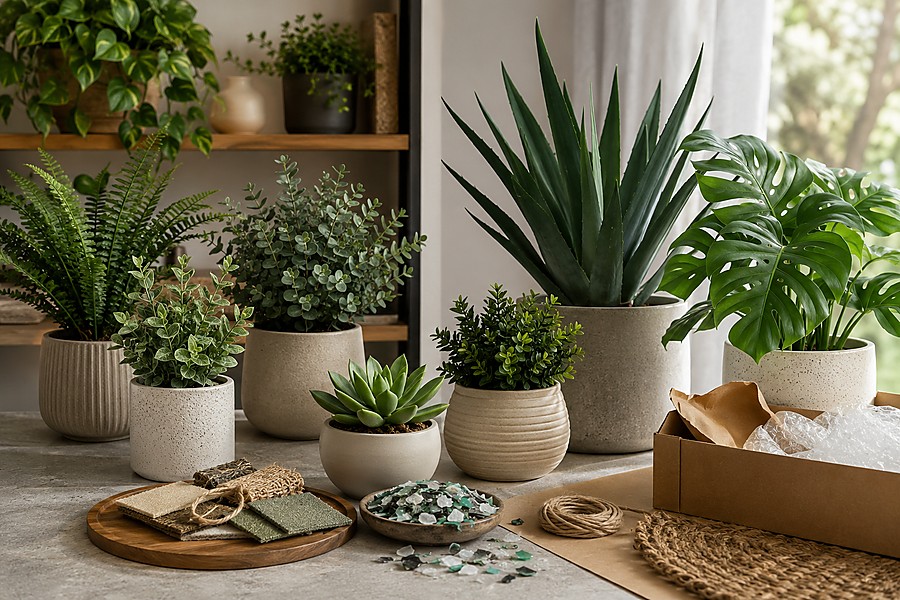
The honest answer is balanced. Artificial plants avoid watering, fertilizers, pesticides, wilting, and repeated replacement. But they also come with plastic production, overseas shipping, mixed-material construction, and end-of-life waste. A 2023 study of artificial plastic plants found that many products used polyethylene, polypropylene, and PET fabric parts, and some contained traces or high levels of elements such as bromine, lead, and antimony, which makes safe disposal and recycling more complicated.
What Makes Artificial Plants Less Eco-Friendly?
A fake plant can feel sustainable because it lasts longer than fresh flowers. But long life alone does not make a product green.
Artificial plants are less eco-friendly when they are made from virgin plastic, PVC, polyester, foam, metal wire, glue, and mixed materials that are difficult to separate and recycle. Their environmental impact also rises when they are cheaply made, shipped long distances, and thrown away after short-term use.
The material problem is the first issue
Most artificial plants are not made from one simple material. A single faux plant may include plastic stems, fabric leaves, metal wire, hot glue, foam, paint, and a plastic or cement base. This gives the plant shape and realism, but it also makes recycling difficult. The more materials a product contains, the harder it is to separate them at the end of life.
The 2023 study on artificial plastic plants is important because it shows that faux greenery is not just “decor plastic.” The study analyzed 203 parts from 175 artificial plants and found molded structures mainly made from polyethylene and polypropylene, while many fabric leaf parts were made from PET. It also found that some molded components contained bromine, lead, and antimony, with elemental signatures suggesting some material may have come from recycled electronic waste.
| Eco Concern | Why It Matters | Better Choice |
|---|---|---|
| Virgin plastic | Uses fossil-based raw materials | Recycled or lower-impact materials where available |
| Mixed materials | Hard to recycle after use | Simple construction and removable parts |
| Cheap quality | Short life creates more waste | Durable stems and realistic leaves |
| Chemical additives | May complicate disposal | Non-toxic material declarations |
| Poor packaging | Adds unnecessary waste | Recyclable cartons and minimal plastic wrap |
Recycling is not a safe assumption
Many buyers assume plastic decor can be recycled later. In practice, plastic recycling remains limited. The EPA reported that overall plastics recycling in U.S. municipal solid waste was 8.7% in 2018, while 27 million tons of plastic went to landfills that year. A Nature review also notes that global plastic recycling rates are around 9%, and that recycling has not kept up with rising plastic production.
This matters for artificial plants because many of them are not simple PET bottles or HDPE containers. They are decorative mixed-material goods. A local recycling system may not accept them. A buyer should not purchase a low-quality fake plant with the idea that recycling will fix the problem later. The more responsible plan is to buy fewer, buy better, and keep the product in use for as long as possible.
Are Artificial Plants Better Than Real Plants for the Environment?
Many people compare fake plants with living plants. That comparison is not always fair because they serve different purposes.
Artificial plants can be better than real plants in some situations, such as dark rooms, high-traffic commercial spaces, allergy-sensitive areas, or places where living plants would die quickly. But real plants are usually better when they are locally grown, well cared for, composted, and kept alive for years.
Real plants have benefits, but they also have inputs
Living plants are renewable and biodegradable in a way artificial plants are not. A healthy real plant can grow, be propagated, and eventually return to organic waste streams. Real plants can also support emotional well-being. A 2022 review on indoor plants found that indoor plants benefit psychological well-being, though outcomes depend on the setting and study design.
But real plants are not impact-free. They need water, soil, pots, transport, fertilizer, pest control, heating in greenhouses, and ongoing care. If a buyer replaces dying houseplants again and again, the environmental benefit becomes weaker. A real plant that lives for five years is very different from a real plant that dies after one month.
The same idea applies to fresh cut flowers. The University of Minnesota notes that many cut flowers sold in the U.S. are imported, often traveling long distances by air, truck, or cargo shipment, and imported flowers can require large chemical and water inputs during production. A UK flower carbon-footprint summary also found that emissions can be much lower for local, outdoor-grown flowers than for imported or heated-greenhouse flowers.
| Comparison | Real Plants | Artificial Plants |
|---|---|---|
| Materials | Organic, soil, pots, fertilizers | Plastic, fabric, wire, glue |
| Maintenance | Watering, pruning, light needs | Dusting and reshaping |
| Lifespan | Long if cared for well | Long if quality is high |
| End of life | Compostable plant matter | Often landfill waste |
| Best use | Homes with light and care | Low-light, high-traffic, hard-to-maintain spaces |
Do not choose real plants only for air purification
Some buyers choose living houseplants because they believe they clean indoor air in a major way. That claim is often overstated. The American Lung Association explains that houseplants do not improve indoor air quality in normal homes in a meaningful way, and it cites a 2019 review that estimated people would need 10 to 1,000 plants per square meter to match the VOC removal benefits seen in controlled research.
This does not mean real plants are useless. They can still add beauty, calm, and a sense of care. But if the goal is air quality, ventilation, filtration, and source control matter more. If the goal is visual greenery in a low-light room, a high-quality artificial plant may be practical.
How Can Buyers Choose More Sustainable Artificial Plants?
A buyer cannot make every artificial plant fully green. But better choices can reduce waste and avoid the worst habits.
Buyers can choose more sustainable artificial plants by selecting durable products, realistic timeless styles, recycled or safer materials when available, low-waste packaging, replaceable parts, and designs they will keep for many years. The most eco-friendly faux plant is the one that avoids quick disposal.
Buy for a long lifespan, not a trend
The biggest sustainability mistake is treating artificial plants like fast decor. A fake plant should not be bought for one party, one season, or one photo shoot unless it will be reused many times. A realistic olive tree, orchid, fern, palm, eucalyptus arrangement, or ficus can stay in style for years. A neon trend plant may feel old after one season.
Life-cycle studies on artificial Christmas trees are not exactly the same as everyday artificial houseplants, but they offer a useful lesson: reuse matters. The American Christmas Tree Association’s 2018 LCA summary says an artificial Christmas tree has a more favorable environmental effect than a live option when it is reused for at least five years. For artificial plants, the same logic applies in a practical way. The longer the product stays in use, the more its manufacturing and shipping impact is spread over time.
A better buying checklist
| Buying Question | Better Answer |
|---|---|
| Will I keep this for at least 5 years? | Choose it only if the style is timeless |
| Can I clean it easily? | Choose wipeable leaves and simple shapes |
| Is the planter durable? | Choose ceramic, metal, stone, or reusable baskets |
| Does it smell strongly? | Avoid harsh chemical odors |
| Can parts be repaired? | Prefer stems that can be reshaped or replaced |
| Is packaging minimal? | Ask for cartons and reduced plastic wrap |
| Is the design too trendy? | Choose natural greens and classic shapes |
Choose quality over quantity
A room does not need ten artificial plants to feel green. One high-quality faux tree in a living room can look better than many cheap plastic plants scattered around the home. This matters for sustainability because fewer objects mean fewer materials, less shipping, less dust, and less waste.
Buyers should also think about maintenance. A dusty artificial plant looks old and may be thrown away sooner. Clean leaves with a soft cloth, cool air, or a gentle duster. Keep plants away from direct sunlight if the material fades. Store seasonal artificial greenery in boxes with enough room so leaves do not crush.
For wholesale buyers, sustainability also includes packaging and logistics. Bulk orders should use strong cartons that protect the plant without excess plastic. Product lines should include replacement stems, reusable bases, and clear material information. These details help retailers, hotels, and interior designers reduce waste across many projects.
When Do Artificial Plants Make Eco-Friendly Sense?
Artificial plants are not the greenest answer in every room. But they can make sense when they prevent repeated waste.
Artificial plants make eco-friendly sense when they replace short-lived decor, survive for many years, reduce repeated fresh flower purchases, work in spaces where real plants would die, and are reused across seasons, events, hotels, offices, retail displays, or rental projects.
Commercial spaces are a strong use case
Hotels, restaurants, offices, wedding venues, and retail stores often need greenery that stays presentable every day. Real plants may struggle in low light, air-conditioned corners, busy walkways, or event spaces with frequent movement. If a business keeps replacing dead plants, wilted flowers, or seasonal decor, a durable artificial plant can reduce recurring waste.
The best commercial faux greenery is modular. A hotel can reuse the same artificial olive trees, orchids, or greenery panels for several years. A wedding venue can reuse floral installations with small seasonal changes. A retail store can keep a permanent greenery base and update only ribbons, signs, or accent flowers.
| Best Situation | Why Faux Plants Can Make Sense |
|---|---|
| Low-light rooms | Real plants may decline quickly |
| Allergy-sensitive spaces | No pollen or soil mold concerns |
| High-traffic lobbies | No fallen leaves or watering mess |
| Event rentals | Products can be reused across projects |
| Seasonal displays | Same base can be refreshed with accents |
| Hard-to-reach areas | No daily plant care needed |
Home use needs honesty
At home, artificial plants make sense when they solve a real problem. Maybe the room has no good sunlight. Maybe the homeowner travels often. Maybe pets dig in soil. Maybe fresh flowers are being replaced every week. In those cases, a realistic faux plant may reduce waste and stress.
But artificial plants do not make sense when they become clutter. A cheap plant bought on impulse and thrown away after a year is not eco-friendly. A high-quality plant kept for many years is a better choice. The difference is not just the product. It is the habit.
My insights: Are artificial plants eco-friendly
Many people want a simple answer. But the eco-friendly value of artificial plants depends less on the label and more on the full life of the product.
Artificial plants are eco-friendly only when they are used as long-term decor, not disposable decoration. The best choice is a realistic, durable, low-waste product that replaces repeated short-term purchases and stays in use for many years.
The real question is: what are they replacing?
My main insight is that artificial plants should be judged by substitution. If one faux orchid replaces weekly imported cut flowers for several years, it may be a practical lower-waste option. If one cheap plastic plant replaces a healthy living plant that could last for years, it is probably not the better environmental choice.
This is why the same artificial plant can be responsible in one setting and wasteful in another. In a dark hotel corridor, it may prevent constant plant replacement. In a sunny home where real plants grow well, a living plant may be the better option. In a wedding business, reusable artificial flowers can reduce single-use event waste. In a trend-driven home, low-quality faux greenery can become landfill clutter.
A practical eco decision framework
| Ask This Question | Eco-Friendly Direction |
|---|---|
| Will this plant be used for many years? | If yes, artificial may make sense |
| Can a real plant survive here? | If yes, consider real first |
| Is this replacing repeated fresh flowers? | Artificial may reduce recurring waste |
| Is the product made from mixed plastic and foam? | Buy only if it will last |
| Can it be cleaned, repaired, or reused? | Better long-term value |
| Is it being bought for one event only? | Avoid unless it will be reused |
The best answer is “less, better, longer”
Artificial plants are not naturally green products. They are manufactured goods. They use materials, energy, packaging, and transport. But they can still fit into a more sustainable decor strategy when buyers choose carefully.
The best approach is simple. Buy fewer artificial plants. Choose better quality. Avoid overly trendy designs. Use them for years. Clean them regularly. Repair them when possible. Donate or resell them before throwing them away. Choose real plants where they can thrive, and choose artificial plants where real plants would be repeatedly wasted.
That is the most honest answer to “Are artificial plants eco-friendly?” They can be, but only when long-term use, careful sourcing, and low-waste habits make them better than the alternative.
Conclusion
Artificial plants are eco-friendly only when they are durable, reused for years, chosen carefully, and used to reduce waste rather than create more plastic decor.