
Commercial interiors need warmth, style, and consistency. But the wrong greenery choice can look cheap, collect dust, or fail to support the brand.
Artificial flowers are best for color, seasonal styling, reception displays, event décor, and close-up decorative moments. Faux plants are best for long-term greenery, biophilic interiors, office corners, hotel lobbies, privacy dividers, and low-maintenance commercial spaces. In 2025, the smartest choice depends on placement, brand image, maintenance, and return on investment.
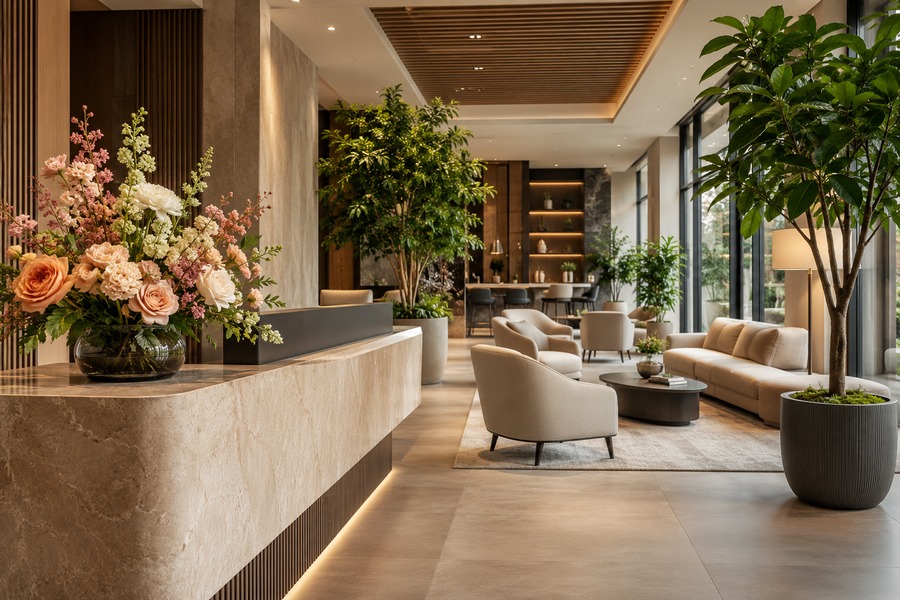
Business interiors in 2025 continue to move toward nature-inspired design, warmer materials, and greener visual experiences. Commercial office trend coverage highlights biophilic design, natural light, wood, stone, and greenery as important directions for modern workspaces. At the same time, demand for artificial flowers is supported by low-maintenance and long-lasting décor needs in both homes and commercial spaces.
What Is the Difference Between Artificial Flowers and Faux Plants?
Many buyers treat artificial flowers and faux plants as the same category. They are related, but they solve different commercial décor problems.
Artificial flowers usually refer to decorative blooms such as roses, orchids, hydrangeas, peonies, cherry blossoms, and floral arrangements. Faux plants usually refer to non-living greenery such as artificial trees, palms, ferns, moss walls, boxwood panels, hanging plants, and potted foliage.
Artificial flowers bring color and emotional detail
Artificial flowers are strong when a space needs softness, color, and a clear decorative focal point. A hotel reception desk may use white orchids. A restaurant may use low floral centerpieces. A retail store may use seasonal flower displays in the window. A wedding venue may use floral arches, flower walls, and table arrangements.
Flowers feel more expressive than plain greenery. They can signal romance, luxury, freshness, celebration, or seasonal mood. This makes them useful for businesses that want visual change throughout the year.
Faux plants build long-term green structure
Faux plants are better when a business needs stable greenery every day. A faux olive tree can soften a hotel lounge. A faux palm can add height to a restaurant patio. A moss wall can create a branded photo background. Boxwood panels can divide seating areas. Snake plants and faux ferns can warm up office corners.
Biophilic architecture is based on the human desire to connect with nature, and it often uses natural elements such as light, greenery, water, materials, and spatial qualities that remind people of nature. Faux plants support the visual side of this design direction when live plants are hard to maintain.
| Category | Best For | Common Commercial Use |
|---|---|---|
| Artificial flowers | Color, emotion, seasonal styling | Hotels, restaurants, retail, events |
| Faux plants | Greenery, structure, biophilic design | Offices, lobbies, patios, malls |
| Artificial flower walls | Photo moments and event backdrops | Weddings, salons, retail stores |
| Faux greenery panels | Privacy and brand features | Restaurants, rooftops, office dividers |
| Floral arrangements | Close-up decoration | Reception desks, tables, counters |
| Artificial trees | Long-term interior landscaping | Hotels, offices, showrooms |
The main difference is not only product type. It is business purpose. Artificial flowers decorate. Faux plants shape the space.
When Should Commercial Spaces Choose Artificial Flowers?
A plain business interior can feel too cold when it has no color. Artificial flowers solve that problem quickly when they are realistic and well styled.
Commercial spaces should choose artificial flowers when they need color, seasonal themes, reception desk styling, restaurant table décor, retail merchandising, event decoration, wedding setups, or hotel lobby arrangements. Flowers work best where customers notice close visual details.
Artificial flowers are strong for customer-facing areas
Artificial flowers perform well in areas where the customer experience matters immediately. A reception counter, checkout desk, restaurant table, salon station, hotel lobby table, or luxury showroom can feel more complete with a well-made floral arrangement.
Modern artificial flowers are also more accepted than before because quality has improved. Design coverage has noted that faux florals look more realistic now, with better texture, tone, and natural imperfections. This matters for commercial buyers because guests and customers often see flowers at close range.
They support seasonal and campaign décor
Artificial flowers are useful for businesses that need regular visual refreshes. A retail store can change spring cherry blossoms to summer sunflowers, fall hydrangeas, or winter white orchids. A hotel can update lobby flowers by season. A restaurant can refresh table arrangements without buying fresh flowers every week.
| Commercial Goal | Best Artificial Flower Choice | Why It Works |
|---|---|---|
| Luxury first impression | Orchids, magnolia, white roses | Clean and premium |
| Romantic event décor | Roses, peonies, hydrangeas | Soft and emotional |
| Seasonal retail display | Cherry blossoms, tulips, sunflowers | Easy visual refresh |
| Restaurant table styling | Low floral centerpieces | Adds warmth without blocking views |
| Wedding rental inventory | Arch flowers, flower panels, aisle pieces | Reusable and profitable |
| Salon or spa décor | Orchids, lavender, soft greenery | Calm and feminine |
Flowers are best when the design needs emotion
A faux plant can make a space greener, but artificial flowers can make it feel more styled. This is why flowers are useful for special moments. They work well for openings, product launches, hotel check-ins, wedding ceremonies, gift displays, and hospitality photo areas.
The risk is overuse. Too many flowers can make a commercial space feel busy or artificial. The better approach is to use flowers as focal points and support them with simple greenery, quality vases, and clean surfaces.
When Are Faux Plants Better for Business Interiors?
Some commercial spaces do not need more color. They need structure, calm, privacy, and a stable green look.
Faux plants are better for business interiors when the goal is long-term greenery, low maintenance, biophilic styling, space division, acoustic softness, corner filling, brand consistency, and year-round visual stability. They are ideal for offices, hotels, restaurants, malls, showrooms, and healthcare spaces.
Faux plants solve daily maintenance problems
Live plants need light, water, pruning, pest control, and staff attention. In many business spaces, those needs are hard to manage. Offices may have low-light corners. Hotels may have large lobbies with air-conditioning. Restaurants may need clean plant dividers without soil mess. Retail stores may need greenery that looks the same every day.
Faux plants solve these issues. They do not wilt, shed soil, or require watering. The artificial plants market was valued at USD 1.06 billion in 2024 and is expected to reach USD 1.49 billion by 2032, with growth linked to urbanization, smaller spaces, and vertical garden trends.
Faux plants are better for scale
A large office lobby may need tall trees, floor planters, or greenery walls. A few artificial flower arrangements may look too small. Faux plants can fill vertical and architectural space more effectively.
| Business Space | Best Faux Plant Choice | Design Purpose |
|---|---|---|
| Office reception | Olive tree, snake plant, moss wall | Calm professional mood |
| Hotel lobby | Palms, ficus, large planters | Premium green structure |
| Restaurant patio | Boxwood panels, bamboo screens | Privacy and atmosphere |
| Retail store | Greenery wall, hanging plants | Brand photo moment |
| Healthcare space | Simple potted greenery | Soft and clean feeling |
| Showroom | Tall trees and divider plants | Guides customer flow |
Faux plants support long-term ROI
Faux plants often work best as long-term décor assets. A realistic artificial tree can stay in place for years if cleaned and maintained. A greenery divider can help a restaurant organize seating. A moss wall can act as a branded backdrop for customer photos.
The key is quality. Cheap faux plants can fade, look glossy, or collect dust. Commercial buyers should choose matte leaves, realistic color variation, weighted planters, stable trunks, and easy-clean surfaces.
How Should B2B Buyers Choose the Best Option for Commercial Décor?
A smart buyer should not ask only, “Which looks better?” The better question is, “Which product solves the business problem?”
B2B buyers should choose between artificial flowers and faux plants by checking the décor goal, customer distance, maintenance plan, installation location, brand style, safety needs, and expected product lifespan. Flowers are stronger for visual moments. Plants are stronger for long-term interior structure.
Start with placement
Placement decides the best product. If the item sits on a reception counter, artificial flowers may work better. If the item fills a lobby corner, a faux tree may work better. If the item divides restaurant tables, boxwood panels or faux bamboo are stronger. If the item supports a seasonal campaign, artificial flowers are more flexible.
| Placement | Better Choice | Reason |
|---|---|---|
| Reception desk | Artificial flowers | Close-up detail and welcome feeling |
| Lobby corner | Faux plant | Height and structure |
| Retail window | Artificial flowers | Seasonal color and campaign styling |
| Restaurant divider | Faux plant | Privacy and long-term use |
| Wedding backdrop | Artificial flowers | Romantic visual impact |
| Office hallway | Faux plants | Calm low-maintenance greenery |
| Hotel table | Artificial flowers | Premium decorative detail |
| Rooftop lounge | Outdoor faux plants | Weather-ready structure |
Check quality before bulk buying
B2B buyers should inspect samples before ordering. For artificial flowers, check petal texture, color gradients, stem strength, flower-head attachment, and packaging. For faux plants, check leaf realism, trunk quality, base weight, UV resistance, fire-safety needs, and cleaning access.
Commercial design projects may also need safety review. Large artificial greenery installations in public spaces can require fire-retardant materials or code-aware product choices depending on the building and local rules. Buyers should ask suppliers for documentation when installing faux greenery in hotels, malls, offices, restaurants, or event venues.
Use both when the project needs depth
The best commercial décor often uses both. Faux plants create the green structure. Artificial flowers add color and seasonal emotion.
For example, a hotel lobby can use faux olive trees as permanent greenery and silk orchids on the reception counter. A restaurant patio can use boxwood dividers and small artificial flower arrangements on host stands. A retail store can use a greenery wall as a permanent backdrop and change artificial flowers for seasonal campaigns.
My insights: Artificial Flowers vs. Faux Plants-Best Choice for Commercial Décor in 2025
Many B2B buyers compare artificial flowers and faux plants as if one must be better. In commercial décor, the better choice depends on the job.
Artificial flowers are the best choice for decorative moments, seasonal color, close-up styling, events, and hospitality details. Faux plants are the best choice for long-term greenery, commercial interior structure, biophilic design, privacy, and low-maintenance spatial planning. In 2025, many businesses should use both.
The best decision is based on function
My main insight is simple: flowers create moments, while plants create environments. Artificial flowers are strongest when a business wants attention, emotion, celebration, or color. Faux plants are strongest when a business wants calm, structure, privacy, and consistent greenery.
A reception desk needs a beautiful moment. A hotel lounge needs an environment. A wedding arch needs flowers. A restaurant divider needs plants. A retail display may need both.
A practical B2B decision framework
| Business Question | Best Choice |
|---|---|
| Do we need color or seasonal change? | Artificial flowers |
| Do we need long-term greenery? | Faux plants |
| Will customers see it very close? | Premium artificial flowers or realistic faux plants |
| Do we need privacy or space division? | Faux plants |
| Do we need event impact? | Artificial flowers |
| Do we need low maintenance for years? | Faux plants |
| Do we need a branded photo spot? | Greenery wall with artificial flower accents |
| Do we need flexible campaign displays? | Artificial flowers with a faux greenery base |
The smartest commercial strategy is layered décor
For commercial interiors in 2025, the strongest strategy is not choosing one category. It is layering them well. A business can use faux plants as the permanent foundation, then use artificial flowers as changeable accents.
This approach improves ROI. The faux greenery stays in place. The flowers refresh the mood. The business does not need to rebuild the full display every season. A greenery wall can stay year-round, while flower colors change for spring, summer, holidays, weddings, or product launches.
The final choice should match the customer journey. Use flowers where customers pause, check in, dine, shop, or take photos. Use faux plants where the space needs height, softness, privacy, or a natural atmosphere. When both are chosen with quality and purpose, commercial décor feels polished, warm, and practical.
Conclusion
Artificial flowers are best for color and moments. Faux plants are best for structure and long-term greenery. Smart commercial décor in 2025 often uses both together.