Outdoor hotel plants must survive sun, wind, rain, guest traffic, cleaning, and daily brand scrutiny without becoming faded, unstable, dirty, or difficult to maintain.
For hospitality projects, the best outdoor artificial plants combine realistic UV-stabilized foliage, site-appropriate geometry, secure commercial planters, positive drainage, replaceable components, and documented weathering performance. Hotels should select products by zone—entrance, terrace, rooftop, pool deck, courtyard, or restaurant—and calculate lifecycle cost rather than choosing by appearance or unit price alone.
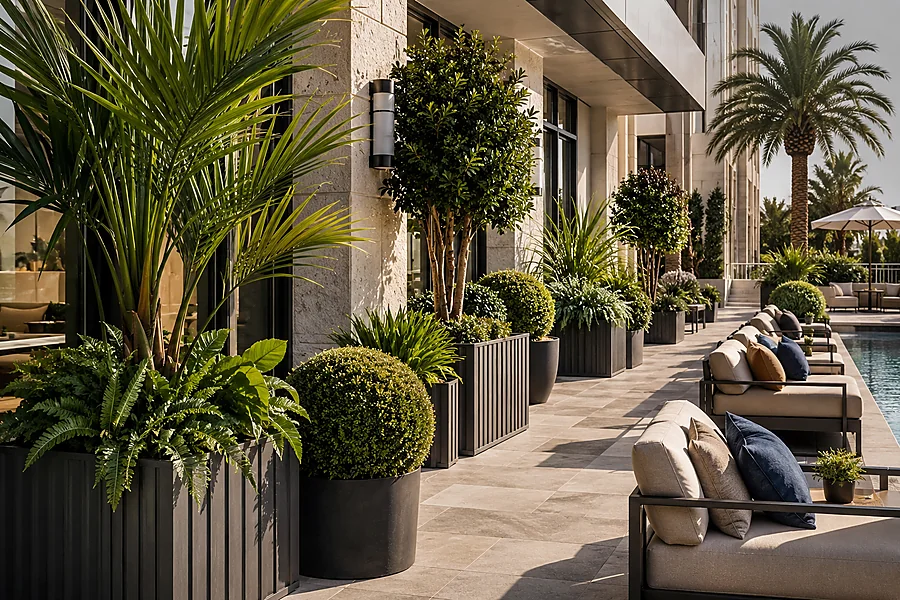
Outdoor greenery can frame hotel arrivals, divide dining terraces, create pool privacy, soften rooftops, and give courtyards a stronger resort identity. Yet outdoor exposure varies significantly by location. ASTM G154-23 and G155-25 both require defined exposure conditions and evaluation methods; neither provides a universal “UV test passed” result or automatic conversion from laboratory hours to years outdoors.
Which Outdoor Artificial Plants Are Best for Hotel Projects?
Hotel projects need several plant roles. A single artificial palm cannot solve entrance framing, privacy, rooftop wind, table styling, and poolside screening.
The strongest hotel plant program uses compact agave and grasses in exposed areas, boxwood or hedge panels for screening, olive and eucalyptus forms for upscale terraces, topiary for entrances, and palms only where scale and anchoring support them. Colored flowers should generally be modular so they can be replaced without rebuilding the complete display.
1. Artificial olive trees for premium terraces
Olive trees fit boutique hotels, Mediterranean restaurants, luxury courtyards, spas, and contemporary resort spaces.
Their open branch structure feels softer than formal topiary, while small leaves provide texture without completely blocking sightlines.
Best locations:
- Restaurant terraces
- Covered courtyards
- Hotel entrances
- Pool cabanas
- Outdoor lounge areas
For exposed locations, specify molded, UV-stabilized foliage rather than assuming an indoor artificial olive tree is suitable outdoors.
2. Compact agave and succulents for high exposure
Agave and succulent forms are among my strongest hotel recommendations because their geometry creates fewer installation problems.
Their benefits include:
- Low wind profile
- Broad cleanable leaves
- Strong architectural appearance
- Small footprint
- Good compatibility with modern planters
- Easy modular replacement
They work particularly well on sunny pool decks, desert resorts, coastal terraces, and rooftop seating areas.
3. Ornamental grasses for restaurant zoning
Long trough planters filled with artificial grasses can divide tables without constructing permanent walls.
This works for:
- Outdoor restaurants
- Rooftop bars
- Café terraces
- Pool lounges
- Arrival zones
Grasses provide movement and texture while keeping sightlines more open than tall hedges.
Choose products with strong blade attachment. Hundreds of thin blades create hundreds of possible failure points.
4. Boxwood topiary for entrances
Structured topiary provides a formal, repeatable appearance for:
- Main entrances
- Valet zones
- Event entrances
- Restaurant doors
- Spa entrances
Matched pairs create strong visual symmetry.
For windy sites, compact spheres or cones usually create fewer stability challenges than tall multi-ball topiaries.
5. Artificial hedge panels for privacy
Hotels often need privacy around:
- Pool decks
- Outdoor dining
- Service areas
- Rooftop lounges
- Event zones
- Parking-facing terraces
Artificial hedge systems can provide instant visual screening without irrigation or pruning.
Commercial outdoor products should use UV-qualified leaves, outdoor-compatible backing, secure connectors, and maintainable mounting systems.
One current commercial warranty example distinguishes between product types: qualifying UV commercial-grade green walls and hedges receive five-year coverage, while individual UV-rated artificial plants and trees receive shorter coverage. This illustrates why hospitality buyers must check the exact SKU rather than assuming one supplier warranty applies to every product.
6. Eucalyptus for neutral hospitality styling
Eucalyptus works well when the hotel wants greenery without a strongly tropical or formal identity.
Use it in:
- Long planters
- Restaurant dividers
- Spa terraces
- Wedding spaces
- Rooftop seating
Its neutral green-gray color can coordinate with stone, timber, concrete, and metal.
7. Palms for resorts—with stronger installation controls
Artificial palms create immediate resort character.
They also create more wind leverage.
Tall trunks and broad fronds mean that the planter, internal trunk restraint, ballast, and anchor system need to work together.
I would prioritize palms for:
- Sheltered pool courtyards
- Covered terraces
- Interior-exterior transition zones
- Large resort entrances with engineered planters
I would be cautious with lightweight palms on open rooftops or exposed coastal sites.
8. Modular flowering inserts
Artificial bougainvillea, lavender, geraniums, and other flowers add color to hotel exteriors.
However, flowers often make fading more visually obvious than green foliage.
My preferred system uses:
Permanent structural greenery + replaceable floral accents.
The hotel can then change campaign colors, replace faded flowers, or refresh seasons without discarding the complete planter.
Hotel plant selection matrix
| Hotel Zone | Recommended Plant Types | Main Buying Priority |
|---|---|---|
| Main entrance | Topiary, olive, narrow trees | Premium realism and stability |
| Restaurant terrace | Grasses, eucalyptus, hedge inserts | Privacy and cleanability |
| Pool deck | Agave, succulents, palms | UV, drainage, stability |
| Courtyard | Olive, palms, mixed planters | Realism and guest experience |
| Rooftop | Agave, grasses, compact hedges | Wind and anchoring |
| Spa terrace | Olive, eucalyptus, grasses | Calm neutral styling |
| Wedding terrace | Greenery base + floral modules | Flexible seasonal styling |
| Service screening | Hedge panels | Coverage and durability |
What Specifications Should Hotels Require for UV, Weather, and Wind Resistance?
“Outdoor quality” is not a measurable procurement requirement. The buyer needs to know what is protected, how it was tested, and what happens if it fails.
Hotel buyers should specify the exact materials, UV-stabilization method, pigment system, test standard, exposure cycle, color limits, structural requirements, cleaning method, and warranty. The finished plant—not merely the raw plastic—should represent the approved commercial performance standard.
Ask how UV protection is added
UV protection may be:
- Compounded into the polymer
- Added through stabilized pigments
- Applied as a factory coating
- Applied later as a spray
- Used in a combination system
Built-in protection can be especially valuable for molded outdoor foliage because it does not depend entirely on maintaining one exposed coating layer.
One current commercial supplier states that its higher-grade outdoor hedge and green-wall range incorporates UV inhibitors within the leaf material rather than relying solely on surface treatment. This is a supplier-specific example, but it illustrates the type of construction detail buyers should request.
Require meaningful weathering reports
ASTM G154-23 covers fluorescent UV exposure with controlled environmental conditions and states that the practice alone does not deliver a specific result. Reports should describe the actual operating conditions. ASTM also recommends controls and multiple replicates for comparative evaluation.
ASTM G155-25 uses filtered xenon-arc light, heat, and optional moisture. It also allows many exposure conditions that can produce substantially different results. It does not simulate localized effects such as saltwater exposure.
Therefore, a hotel buyer should request:
| Test Report Field | What to Check |
|---|---|
| Product identification | Exact plant SKU or component |
| Material | PE, PVC, PU, polyester, coating, etc. |
| Standard | Exact standard and edition |
| Light source | Fluorescent UV or xenon arc |
| Cycle | Light, moisture, spray or condensation |
| Temperature | Exposure conditions |
| Duration | Total test hours |
| Color result | Visual or instrumental change |
| Structural result | Cracking, brittleness, adhesion |
| Pass limit | Agreed acceptance criteria |
| Laboratory | Traceable report information |
Do not convert laboratory hours directly into hotel years
A claim such as:
1,000 hours = five years outdoors
should not be accepted without validated correlation to the exact product, test cycle, and intended climate.
ASTM’s standards are exposure practices. Their results depend on the selected conditions.
For hotel procurement, weathering reports are most useful when comparing competing formulations tested under the same conditions.
Use site exposure classes
A multi-property hotel group can create a simple classification system.
| Exposure Class | Example | Procurement Direction |
|---|---|---|
| H1 | Covered courtyard | Outdoor-rated commercial foliage |
| H2 | Morning or partial sun | Verified UV-resistant product |
| H3 | Long direct sun | Stronger UV package and warranty |
| H4 | Rooftop or coastal | UV + wind + corrosion review |
| H5 | Desert/reflected heat | UV + heat + surface-temperature review |
The EPA UV Index ranges from 1 to 11+ and varies with local conditions. It is designed for human sun-safety guidance, not product certification, but it can be one useful indicator when hotels document unusually strong solar exposure across locations.
Wind changes the product choice
Wind resistance is not only about planter weight.
A tall artificial palm can generate much greater overturning leverage than a compact artificial agave.
FEMA’s guidance for exposed rooftop equipment highlights anchors, hold-down connectors, and straps as methods for resisting lateral and uplift forces. While hotel planters are a different product category, the underlying engineering principle is relevant: exposed equipment should be positively restrained where wind could displace it.
Hotel teams should therefore document:
- Plant height
- Canopy width
- Planter footprint
- Complete installed weight
- Ballast position
- Anchor arrangement
- Rooftop or ground-level location
- Expected wind exposure
How Should Hotel Teams Design Planters, Anchoring, Drainage, and Guest-Safe Layouts?
A premium artificial tree can fail because its planter is narrow, its drainage is blocked, its trunk is held only by foam, or the complete unit intrudes into guest circulation.
Hotel planters should combine a wide stable footprint, low contained ballast, positive drainage, secure plant retention, substrate-appropriate anchoring where required, and sufficient guest circulation. Rooftop, façade, coastal, tall-tree, and public-facing installations deserve professional review rather than improvised weighting.
Choose commercial planter construction
Hotel exterior planters experience:
- Luggage impacts
- Cleaning equipment
- Furniture movement
- Guest contact
- Sun
- Rain
- Seasonal temperature changes
- Repeated housekeeping
Common commercial materials include:
- FRP
- GFRC
- Powder-coated metal
- Rotationally molded polymers
- Other engineered composites
Appearance matters, but so do wall strength, base reinforcement, anchor compatibility, weight, and repairability.
Put ballast low
The same weight has different stability value depending on where it is positioned.
Low ballast lowers the center of gravity.
Suitable options can include:
- Precast blocks
- Steel plates
- Sealed sandbags
- Manufacturer-designed weights
- Paver blocks
Avoid loose materials that can shift, block drainage, or spill during service.
Secure the artificial plant inside the planter
Anchoring the outer planter is not enough.
A tall artificial tree can still pull out if its trunk is inserted only into floral foam.
Commercial planter manufacturers offer internal tree tie-down points for large planters, showing the importance of restraining the plant separately from the outer container. Tournesol, for example, offers internal tie-downs and bottom reinforcement options for applications involving anchoring.
A hotel installation may therefore need:
- Outer planter restraint
- Low ballast
- Rigid internal frame
- Trunk or insert tie-down
- Decorative top dressing
Drain artificial planters too
Artificial plants do not require irrigation, but outdoor planters still receive rain, wash water, condensation, and debris.
Tournesol’s commercial planter guidance specifically notes that drainage planning helps prevent water and debris from collecting on non-permeable surfaces, and it offers drain holes and controlled drainage configurations for commercial planters.
Hotel drainage should avoid:
- Standing water
- Mosquito breeding
- Odor
- Corrosion
- Freeze damage
- Overflow across walking surfaces
- Water stains
- Drainage toward doorways
Rainwater should not be used as planned ballast.
Protect accessible routes
Planters are frequently used to guide guests, divide restaurants, and create privacy, but they must not reduce required circulation.
The U.S. Access Board states that protruding-object requirements apply to exterior as well as interior circulation paths, and objects must not reduce the required accessible-route clear width.
In U.S. projects, its guidance identifies a typical continuous accessible-route clear width of at least 36 inches, with certain permitted localized reductions. Local codes and project conditions still need to be reviewed.
Also keep planters clear of:
- Door swings
- Exit routes
- Fire equipment
- Passenger loading
- Valet circulation
- Pool access
- Service doors
- Drainage channels
- Sightlines
OSHA separately requires workplace exit routes to remain free and unobstructed.
Hotel planter installation matrix
| Installation | Primary Risk | Stronger Approach |
|---|---|---|
| Covered entrance | Guest contact | Stable wide planter |
| Restaurant terrace | Movement and crowding | Low planters with clear routes |
| Pool deck | Water and wind | Drainage + ballast |
| Rooftop lounge | Wind | Anchored compact planters |
| Coastal hotel | Wind + corrosion | Protected hardware + washability |
| Façade planter | Falling load | Engineered mounting system |
| Tall artificial tree | Overturning/pullout | Anchor + ballast + trunk restraint |
Purpose-built façade planter systems illustrate how seriously elevated installations should be treated. Tournesol’s commercial façade system uses structural mounting frames, façade-appropriate anchors, safety bolts, and integrated drainage, with engineering information available for projects.
How Can Hospitality Buyers Control Samples, Maintenance, Warranties, and Lifecycle Cost?
Artificial plants can reduce horticultural care, but hotels still need quality control and planned maintenance. A dusty, faded artificial tree can create a worse impression than an empty corner.
Hospitality buyers should approve physical samples, create an asset register, define cleaning methods, inspect exposed locations regularly, retain color references, stock replacement components, and compare lifecycle cost. Warranty terms should identify the exact SKU, covered exposure, fade definition, exclusions, remedy, and responsibility for freight and labor.
Approve samples at the actual hotel
Do not approve outdoor greenery only in a showroom.
Place the sample at the intended property and review:
- Morning sunlight
- Afternoon sunlight
- Hotel lighting at night
- Guest viewing distance
- Photography
- Wind movement
- Cleaning
- Planter proportions
Also test:
- Leaf attachment
- Branch bending
- Surface wiping
- Water response
- Odor
- Packaging recovery
- Color consistency
Use a retained sample
Keep one approved leaf, plant section, or complete small specimen indoors and away from sunlight.
Record:
- Supplier
- SKU
- Batch
- Purchase date
- Installation location
- Material
- UV claim
- Warranty
- Original photographs
The retained sample gives facilities teams a reference when deciding whether an exposed plant has faded excessively.
Create a maintenance schedule
| Frequency | Hotel Maintenance Action |
|---|---|
| Weekly | Remove litter and inspect guest-facing damage |
| Every 2–4 weeks | Dust or wipe exposed foliage |
| Monthly | Check fading, movement, drainage, and fasteners |
| After strong wind | Inspect planters, anchors, trunks, and panels |
| After heavy rain | Confirm free drainage |
| Quarterly | Formal condition review and photographs |
| Seasonally | Replace faded flower accents |
| Annually | Review supplier performance and lifecycle cost |
The frequency should increase for coastal, desert, rooftop, poolside, or heavily trafficked locations.
Make cleaning product-specific
Broad molded leaves usually clean faster than fine ferns or dense boxwood.
This matters when one hotel has hundreds of plants.
| Plant Type | Maintenance Burden |
|---|---|
| Agave | Low |
| Broad-leaf tropical plant | Low |
| Olive | Moderate |
| Eucalyptus | Moderate |
| Grasses | Moderate |
| Boxwood | Moderate–high |
| Fern | High |
| Dense flowering insert | High |
The most realistic product is not always the most operationally efficient.
Require useful warranty terms
A warranty should answer:
- Which SKU is covered?
- Which installation environment is permitted?
- What counts as excessive fading?
- Is cracking covered?
- Is foliage loss covered?
- Are full-sun locations permitted?
- Are coastal or rooftop locations excluded?
- Is the remedy replacement, refund, or credit?
- Is the remedy prorated?
- Who pays shipping?
- Is installation labor covered?
- What evidence must the hotel provide?
Current commercial warranties demonstrate why this matters: coverage can vary significantly between green-wall products, structural components, and individual plants.
Calculate lifecycle cost by hotel zone
Use:
Lifecycle cost = purchase + freight + installation + anchoring + cleaning + repairs + spare parts + replacement + removal
A cheaper artificial palm may need early replacement. A more expensive modular hedge may keep its structural base while only individual panels or flowers are replaced.
Example lifecycle comparison
| Option | Initial Cost | Maintenance | Replacement Risk | Best Use |
|---|---|---|---|---|
| Cheap indoor tree outdoors | Low | Moderate | Very high | Avoid |
| UV-rated compact plant | Moderate | Low | Lower | Exposed hotel zones |
| Premium artificial olive | Higher | Moderate | Moderate | Luxury terrace |
| Modular hedge system | Higher | Moderate | Replaceable sections | Privacy |
| Seasonal flower modules | Moderate | Higher | Easy targeted replacement | Brand refresh |
My insights: How Should Hotels Buy Outdoor Plants for Hospitality Projects in 2025
The best outdoor hotel plant is not the product with the most realistic leaves in a supplier showroom. Hotels operate complex public spaces, so the product must work visually, structurally, operationally, and financially.
For 2025 hospitality projects, I would buy outdoor artificial plants as complete systems: climate-matched foliage, verified UV performance, stable planters, low ballast, secure inserts, drainage, guest-safe placement, replaceable accents, maintenance access, and enforceable warranties. A hospitality project succeeds when greenery still looks intentional after months of sun, guests, cleaning, storms, and routine operations.
My seven-part hotel buying framework
| Step | Buyer Decision | Why It Matters |
|---|---|---|
| 1 | Define the hotel zone | Establishes exposure and visual role |
| 2 | Select plant geometry | Controls scale and wind risk |
| 3 | Verify materials and UV evidence | Reduces premature fading |
| 4 | Engineer planter and restraint | Controls movement and tipping |
| 5 | Protect guest circulation | Supports safe hotel operation |
| 6 | Plan maintenance and replacement | Protects appearance |
| 7 | Compare lifecycle cost | Supports better procurement |
Buy by zone, not by catalog
I would not standardize one artificial tree across an entire hotel.
Instead:
Entrance: structured topiary or olive trees.
Restaurant terrace: grasses, eucalyptus, and modular privacy planting.
Pool: compact agave, succulents, and carefully secured palms.
Rooftop: low, wide, wind-conscious greenery.
Wedding area: permanent greenery plus replaceable flower colors.
Service screening: modular commercial hedges.
This creates a coherent hotel landscape while matching each plant to its environment.
Make durable greenery permanent and color replaceable
My strongest hospitality design principle is:
Invest in the green structure; modularize the flowers.
Artificial grasses, hedges, eucalyptus, boxwood, and other neutral greenery can form the long-term design base.
Colored bougainvillea, hydrangea, lavender, or seasonal flowers can become replaceable modules.
This supports:
- Wedding themes
- Seasonal campaigns
- Holiday changes
- Hotel rebranding
- Local events
- Replacement after fading
without rebuilding complete planter systems.
Standardize the planter platform
Multi-property hotel groups can reduce operational complexity by standardizing several planter sizes.
For example:
| Platform | Typical Application |
|---|---|
| Small | Tables and balcony accents |
| Medium | Guestroom patios and entrances |
| Large | Olive trees and topiary |
| Linear | Restaurant and pool dividers |
| Extra-large anchored | Large trees and architectural features |
Standardization makes it easier to manage liners, ballast, anchors, spare parts, replacement plants, and property-wide visual consistency.
Treat warranties as part of the specification
A five-year headline is not enough.
The warranty should match the actual:
- Product
- Climate
- Sun exposure
- Installation
- Height
- Maintenance
- Property type
A rooftop hotel in a desert city and a covered courtyard hotel do not create the same exposure.
Keep the approval file
Before accepting a project, I would require one hotel procurement file containing:
- Approved product list
- Physical or retained samples
- Material specifications
- UV reports
- Warranty terms
- Planter drawings
- Anchor details
- Drainage design
- Installation photographs
- Maintenance method
- Spare-parts list
- Replacement triggers
This turns decorative greenery into a controlled hospitality asset rather than an untracked décor purchase.
Final hospitality buying rule
The best outdoor hotel plants do four jobs at once:
They improve the guest experience.
They survive the site.
They remain safe and maintainable.
They protect the hotel’s long-term décor budget.
That is the standard hospitality buyers should use in 2025.
Conclusion
Choose outdoor hotel plants by zone, UV evidence, geometry, planter stability, drainage, guest safety, maintenance, and lifecycle value—not appearance or price alone.