
A modern bathroom can feel clean but cold. Hard tiles, glass, and metal need a soft detail that brings warmth without adding clutter.
Faux succulent arrangements for modern bathrooms are a smart way to add greenery, texture, and spa-like calm without worrying about sunlight, drainage, humidity, or daily plant care. The best arrangements use realistic artificial succulents, simple planters, balanced scale, and clean placement on vanities, shelves, bath ledges, and niches.
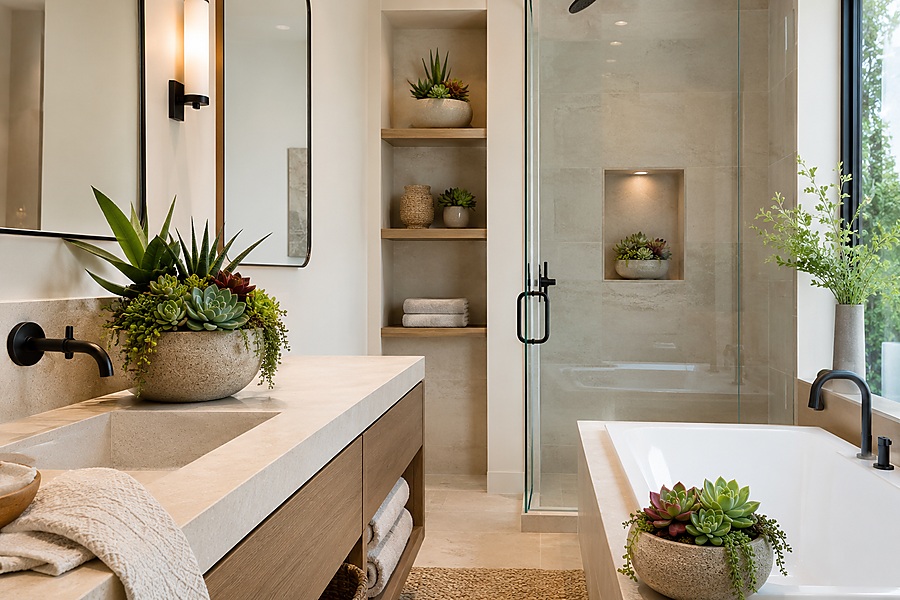
Bathrooms are becoming more personal and relaxing, not just functional. Current bathroom design coverage points toward spa-like spaces, natural textures, warm finishes, and biophilic details that bring a calm outdoor feeling inside. Faux succulents fit this trend because they give the look of greenery in bathrooms where real succulents may struggle with low light or too much moisture.
Why Choose Faux Succulents for a Bathroom?
Real succulents look beautiful, but bathrooms are not always their ideal home. Many bathrooms have low light, poor airflow, and frequent humidity from showers.
Faux succulents are a good bathroom choice because they keep the clean sculptural look of real succulents without needing bright light, dry soil, or careful watering. They work well in windowless bathrooms, guest bathrooms, powder rooms, rental homes, hotels, and commercial washrooms.
Real succulents often need drier conditions
Many real succulents need bright light, drainage, and soil that dries between watering. Iowa State University Extension notes that overwatering is one of the most common succulent problems and that wet conditions can lead to yellowing, mushy leaves, leaf drop, mold, and fungus gnats. This is why real succulents can become tricky in a bathroom, especially if the room has no window or stays damp after showers.
Faux succulents remove that risk. They do not stretch toward light. They do not rot. They do not need drainage holes. They do not attract fungus gnats. They also do not drop soil on a clean counter. That makes them useful for people who want a neat modern bathroom with greenery but do not want plant-care stress.
Faux succulents fit modern bathroom design
Succulents have strong shapes. Echeveria looks like a rosette. Aloe has clean pointed leaves. Jade plants look compact and sculptural. Agave-style succulents add bold form. These shapes work well with modern bathroom materials such as stone, tile, concrete, glass, matte black metal, brushed brass, and warm wood.
| Bathroom Challenge | Faux Succulent Solution | Best Placement |
|---|---|---|
| No natural light | Artificial plants do not need sunlight | Shelf, vanity, windowless powder room |
| High humidity | No root rot or soil mold | Bath ledge, shower-adjacent area |
| Small counter space | Compact arrangements add greenery | Tray or small ceramic pot |
| Clean modern style | Sculptural leaves feel minimal | Floating shelf or niche |
| Low maintenance | Only needs dusting and wiping | Guest bath or rental property |
The key is to choose faux succulents that look matte, varied, and slightly imperfect. A succulent that is too shiny or too plastic-looking will feel cheap beside premium bathroom finishes. A soft green, dusty sage, blue-green, or muted gray-green tone usually looks more natural.
What Faux Succulent Arrangements Work Best in Modern Bathrooms?
A single fake plant in the wrong pot can look random. A planned arrangement feels intentional and helps the bathroom look designed.
The best faux succulent arrangements for modern bathrooms include low vanity trays, small shelf clusters, shower niche accents, bathtub ledge planters, wall-mounted arrangements, and minimalist bowl gardens. Each style should match the bathroom size, color palette, and surface material.
1. Low vanity tray arrangement
A vanity tray is one of the easiest places to use faux succulents. Choose a small group of three to five artificial succulents in a shallow ceramic, stone, or concrete container. Place it beside hand soap, a candle, rolled towels, or a small perfume bottle.
This style works well because it keeps the counter organized. It also prevents the plant from looking like an afterthought. For modern bathrooms, use one simple planter instead of many tiny pots scattered across the vanity.
2. Floating shelf succulent cluster
Floating shelves often need styling that looks light but not empty. Faux succulents work well because they are compact and do not need watering near towels or wood shelving. Use one medium succulent pot with two smaller accent pieces. Add a folded towel, glass jar, or neutral ceramic object to complete the shelf.
3. Bathtub ledge planter
A bathtub ledge can look bare without decor. A long narrow planter filled with faux succulents can create a spa feeling without soil, water, or dropped leaves. This works best beside freestanding tubs, alcove tubs, and large soaking tubs.
4. Shower niche accent
A shower niche can hold more than shampoo. In a guest bathroom or styled display bathroom, a small faux succulent in a waterproof-look pot can soften the tile. This should stay simple. One small plant is enough. Avoid placing delicate fabric leaves where they will be soaked every day.
5. Minimalist succulent bowl garden
A bowl garden works well on a stool, side table, or large vanity. Use mixed artificial echeveria, sedum, aloe, and string of pearls. Choose a low bowl in stone, matte ceramic, or terrazzo. Keep the colors soft and natural.
| Arrangement Style | Best Bathroom Type | Design Mood |
|---|---|---|
| Vanity tray | Small modern bathroom | Clean and practical |
| Floating shelf cluster | Guest bath or powder room | Styled but light |
| Bathtub ledge planter | Spa bathroom | Calm and relaxing |
| Shower niche accent | Minimal bathroom | Fresh detail |
| Bowl garden | Large vanity or side table | Sculptural and premium |
| Wall-mounted succulents | Small bathroom | Space-saving greenery |
MyDomaine recommends faux plants or dried botanicals for bathrooms with absolutely no light, because they give a plant look without needing water or sunlight. This is exactly where faux succulent arrangements become useful. They bring visual freshness to spaces where real plants may fail.
How Do You Style Artificial Succulents So They Look Real?
Artificial succulents can look beautiful online but fake in person. The styling decides whether they blend into the bathroom or stand out in the wrong way.
To make artificial succulents look real, choose matte leaves, natural color variation, realistic soil covers, simple planters, and uneven placement. Avoid neon green colors, glossy plastic, perfect symmetry, and crowded arrangements that make the plants look manufactured.
Start with the right texture
Real succulents often have a soft powdery look, especially echeveria and many rosette forms. Their colors may include sage, blue-green, gray, pale purple, or dusty pink. A realistic faux succulent should copy that softness. It should not look wet or shiny.
A good faux succulent also has varied leaf sizes. The center leaves should be smaller. The outer leaves should be wider. Some leaves should curve slightly. A perfect plastic rosette with identical leaves often looks fake.
Modern artificial greenery is more accepted now because materials and styling have improved. Vogue recently reported that artificial florals are gaining more respect in design circles as higher-quality pieces look more realistic and less like old imitations.
Use better planters
The planter is almost as important as the plant. A realistic succulent in a cheap plastic pot will still look unfinished. Modern bathrooms usually look better with ceramic, stone, concrete, terrazzo, glass, wood, or matte metal containers.
| Bathroom Style | Best Planter | Best Faux Succulent Color |
|---|---|---|
| Minimal white bathroom | Matte white ceramic | Sage, gray-green, soft green |
| Warm wood bathroom | Stone or clay pot | Olive, dusty green, muted burgundy |
| Luxury marble bathroom | Brushed brass or stone bowl | Blue-green, ivory-green, pale purple |
| Industrial bathroom | Concrete or matte black pot | Deep green, gray, agave tones |
| Spa bathroom | Woven basket or natural ceramic | Soft green, aloe, trailing pearls |
Keep the arrangement slightly uneven
Real plants do not grow in perfect circles. When arranging faux succulents, vary the height and direction. Let one small trailing piece fall over the edge. Turn one rosette slightly to the side. Mix one upright aloe shape with lower echeveria forms. This makes the arrangement feel more organic.
Also avoid overfilling. A small bathroom can feel cluttered quickly. One strong arrangement is better than five small fake plants. Negative space is part of modern design. The greenery should soften the bathroom, not cover every surface.
How Do You Clean and Maintain Faux Succulents in Bathrooms?
Faux succulents do not need water, but they still need care. Dust, hairspray, soap mist, and humidity marks can make them look old.
Clean faux succulents in bathrooms by dusting them weekly, wiping leaves with a damp microfiber cloth, using a soft brush for tight spaces, and keeping them away from direct water spray. Choose wipeable materials and avoid fuzzy surfaces that trap dust.
Bathrooms create a different kind of buildup
A living room plant mostly collects dust. A bathroom plant may collect dust, moisture, soap residue, hair products, and towel lint. This is why faux succulents in bathrooms should be easy to clean. Broad leaves are easier to wipe than tiny textured pieces. Smooth planters are easier to maintain than rough baskets in damp zones.
If the faux succulent is near the sink, wipe it more often. If it is on a high shelf, dust it before it becomes obvious. A dusty artificial plant can make a clean bathroom feel neglected.
Simple cleaning routine
| Cleaning Need | Best Method | How Often |
|---|---|---|
| Light dust | Soft makeup brush or microfiber cloth | Weekly |
| Soap mist | Slightly damp cloth | Every 1–2 weeks |
| Tight leaf gaps | Small soft brush | Monthly |
| Hard-to-reach shelf | Cool hairdryer on low setting | Monthly |
| Planter surface | Damp cloth | Weekly |
| Deep reset | Remove and clean outside the bathroom | Seasonally |
Place them away from constant water
Most faux succulents can handle bathroom moisture, but they should not sit under daily direct water spray unless the material is clearly suitable for that use. Fabric leaves, glue points, and foam bases may break down faster when they stay wet. Use shower-adjacent styling carefully. A niche outside the spray zone is better than a niche directly under the shower head.
For hotels, rentals, and commercial bathrooms, choose artificial succulents with wipeable plastic or PE leaves and secured bases. These are easier for cleaning teams to maintain. For home bathrooms, softer real-touch materials may look better, but they should still be placed where they can stay dry.
My insights: How Should Faux Succulent Arrangements for Modern Bathrooms Be Designed
Many bathroom plants fail because people treat them like random decoration. A faux succulent arrangement works best when it is planned as part of the bathroom’s shape, color, and daily use.
The best faux succulent arrangements for modern bathrooms are clean, compact, realistic, and easy to maintain. They should add a spa-like natural feeling without blocking counters, collecting too much dust, or fighting the bathroom’s tile, wood, stone, and metal finishes.
The strongest design idea is “small greenery, strong placement”
My main insight is that bathroom greenery should be small but intentional. A bathroom has less visual space than a living room. Every object matters. A faux succulent arrangement should have a clear job. It may soften a sharp vanity. It may add texture to a floating shelf. It may warm up a marble bathroom. It may make a guest bathroom feel more finished.
This is why placement matters more than quantity. A single low succulent bowl on a vanity tray can look more expensive than six tiny pots spread around the room. A narrow planter beside the bathtub can create a spa mood without making the room feel busy. A small faux aloe in a shower niche can add life to plain tile, as long as it stays clean and dry enough.
A practical bathroom styling framework
| Design Question | Best Answer |
|---|---|
| Is the bathroom small? | Use one compact arrangement, not many pots |
| Is the bathroom very modern? | Choose simple planters and sculptural succulents |
| Is the bathroom warm and natural? | Use clay, stone, or woven textures |
| Is the space dark? | Use faux succulents instead of struggling real ones |
| Is the surface wet often? | Choose wipeable leaves and avoid fabric pieces |
| Does the plant look fake? | Change the pot, reduce shine, and vary placement |
Faux succulents work because they solve real bathroom problems
The best part of faux succulent decor is that it gives the look of plant life where real succulents may not be practical. Real succulents often need more light and drier soil than many bathrooms provide, while faux succulents keep the same sculptural style without the care issues. Iowa State University Extension’s succulent guidance warns that wet conditions and poor drainage can create common succulent problems, which supports using faux versions in difficult bathroom environments.
For modern bathrooms, the goal is not to trick everyone. The goal is to create a calm, clean, natural mood that fits the room. High-quality faux succulents can do that when they are chosen carefully, styled simply, and kept clean.
The best arrangement is usually the one that feels quiet. It does not shout. It does not look overly perfect. It does not crowd the sink. It simply gives the bathroom a soft green detail that makes the space feel more complete.
Conclusion
Faux succulent arrangements make modern bathrooms feel warmer, fresher, and more spa-like when they are realistic, compact, well-placed, and easy to clean.