Coastal salt, abrasive wind, reflected heat, and desert sun can quickly turn ordinary artificial plants faded, brittle, unstable, and expensive to replace.
The best outdoor artificial plants for coastal and desert sites are compact agave, yucca, succulents, grasses, boxwood, topiary, olive, eucalyptus, cypress, palms, lavender, and bougainvillea forms made from verified UV-stabilized polymers. Low profiles, corrosion-resistant hardware, secure anchoring, drainage, cleaning, and written warranties matter more than the plant name alone.
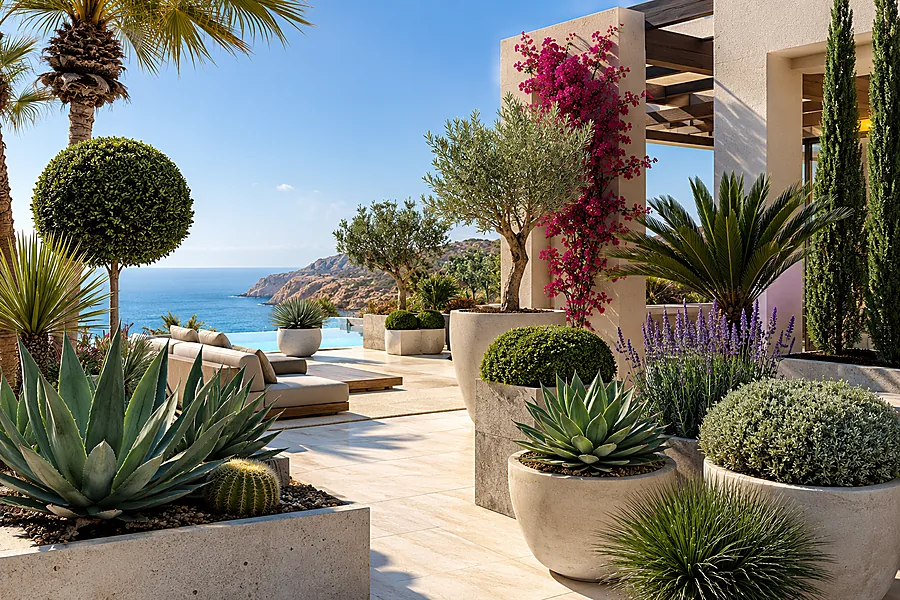
Coastal and desert sites create different combinations of stress. Salt spray can accelerate corrosion of exposed metal components, while strong solar exposure can affect pigments, polymers, coatings, and adhesives. The EPA records UV intensity on a 1–11+ scale, but buyers need product-specific weathering evidence rather than relying on climate labels alone.
Why Do Coastal and Desert Sites Destroy Ordinary Artificial Plants?
An artificial plant that performs well beneath a covered entrance may fail quickly beside the sea or on a west-facing desert rooftop.
Coastal sites combine UV exposure, salt, humidity, wind, moisture, and corrosion risk. Desert sites combine intense sunlight, high surface temperatures, dust, thermal cycling, and reflected heat. Ordinary indoor flowers and plants usually lack the polymer stabilization, pigments, construction, hardware, and installation system needed for these conditions.
Coastal sites attack more than foliage
Salt-containing air can settle on planters, frames, cables, screws, backing grids, and internal supports. When moisture remains on these components, corrosion can affect finishes, fasteners, and structural connections. NOAA coastal guidance notes that salt spray frequently contributes to the deterioration of building materials in coastal environments.
ASTM B117 creates a controlled salt-fog environment for obtaining relative corrosion-resistance information about metals and coated metals. It can help buyers compare planter hardware or coated frames, but it does not automatically predict an exact coastal service life.
| Coastal Risk | Possible Failure | Better Control |
|---|---|---|
| Salt deposition | Corroded screws and frames | Suitable stainless or protected hardware |
| Strong wind | Tipping and leaf detachment | Compact forms and engineered anchoring |
| Humidity and rain | Standing water and coating damage | Positive drainage |
| Blowing sand | Scratched or dull surfaces | Washable molded foliage |
| Direct UV | Fading and brittleness | Stabilized polymers and pigments |
| Salt residue | Cloudy or sticky appearance | Scheduled fresh-water cleaning |
A product can have UV-resistant leaves and still fail because its internal wire, planter bracket, or backing grid corrodes. Coastal procurement must cover the complete assembly.
Desert locations create extreme heat loads
Desert plants often sit beside glass, concrete, stone, metal façades, or dark paving. These surfaces can absorb and reflect solar energy toward the foliage. U.S. Department of Energy guidance notes that solar heating raises exterior surface temperatures in hot, dry conditions.
Heat can affect:
- Adhesive strength
- Stem shape
- Leaf flexibility
- Surface coatings
- Pigment stability
- Planter materials
- Internal foam
- Cable ties and connectors
The product’s air-temperature rating may not represent the actual temperature of a dark leaf, planter, or wall surface under direct sun.
Wind changes the best plant shape
Tall, dense trees create more wind leverage than compact succulents or low grasses. Palms may fit a coastal resort design, but their large fronds and elevated canopies require stronger bases and connections.
FEMA guidance for exterior equipment emphasizes securing exposed items against wind forces. By the same safety principle, commercial planters and large artificial trees should use attachments designed for their site rather than relying only on empty planter weight.
| Plant Form | Wind Exposure | Installation Direction |
|---|---|---|
| Low agave | Low | Weighted planter may be sufficient at sheltered sites |
| Compact grass | Low to moderate | Secure insert and planter |
| Dense hedge | Moderate | Fix panels and support frames |
| Narrow cypress | Moderate | Use low ballast and trunk restraint |
| Olive tree | Moderate to high | Anchor planter and secure trunk |
| Tall palm | High | Structural anchoring and reinforced trunk |
| Wide flowering tree | High | Avoid highly exposed locations |
The botanical name does not prove durability
A faux agave is not naturally sun-resistant because a living agave tolerates desert conditions. The artificial product survives only when its synthetic materials, pigments, coatings, adhesives, and connections are made for outdoor exposure.
That distinction applies to every category in this guide. Plant shape supports performance, but material engineering determines whether the plant can tolerate the site.
Which Outdoor Artificial Plants Are Best for Coastal and Desert Full Sun?
The strongest choices usually have molded leaves, compact geometry, simple cleaning surfaces, and replaceable components.
Agave, yucca, succulent clusters, ornamental grasses, boxwood panels, compact topiaries, olive trees, eucalyptus shrubs, narrow cypress, reinforced palms, lavender, and bougainvillea inserts offer the best design range. Every choice still requires verified outdoor materials, stable pigments, suitable hardware, secure installation, and realistic warranty terms.
1. Artificial agave
Agave is the strongest all-round shape for exposed sites. Its low profile reduces wind leverage, while broad molded leaves are easier to wipe than dense, delicate foliage.
It suits:
- Desert resorts
- Coastal restaurants
- Pool decks
- Rooftop lounges
- Retail entrances
- Modern office terraces
Choose rounded or flexible leaf tips for customer-facing spaces. Very rigid artificial leaves can create contact hazards.
Coastal score: 5/5
Desert score: 5/5
2. Faux yucca
Yucca offers more height than agave without the wide canopy of a palm. It creates a desert appearance while remaining visually narrow.
The internal trunk and leaf connections need heat resistance. The planter should also restrain the trunk because height increases leverage.
Coastal score: 4/5
Desert score: 5/5
3. Artificial aloe and succulent clusters
Succulent groups provide compact color and texture. They fit low planters, table-height troughs, hotel entrances, and exposed balcony displays.
Molded clusters also have fewer fine leaves that can detach or collect dust. Buyers should avoid highly glossy surfaces and lightweight foam-heavy construction.
Coastal score: 5/5
Desert score: 5/5
4. Outdoor ornamental grasses
Artificial grasses work well in long troughs and privacy dividers. Their low height can reduce overturning risk, although individual blades must be securely attached.
Grasses are useful for:
- Coastal boardwalks
- Restaurant boundaries
- Desert hotel paths
- Rooftop seating
- Poolside planters
The product should recover after wind movement and cleaning without permanent curling.
Coastal score: 4/5
Desert score: 5/5
5. UV-resistant boxwood panels and hedges
Boxwood provides dense coverage for screens, walls, rails, service areas, and branded photo zones. It is versatile, but its many small leaves create more connection points and collect salt or dust.
Buyers should check:
- Stabilized leaves
- Outdoor-rated backing grids
- Connector strength
- Frame corrosion resistance
- Access for cleaning
- Panel replacement availability
Some suppliers publish separate warranties for exterior green-wall panels and individual plant specimens because product form and exposure affect warranty conditions.
Coastal score: 4/5
Desert score: 4/5
6. Compact boxwood or podocarpus topiary
Low balls, cones, and short spirals frame entrances without creating the broad wind profile of a large tree.
Topiaries should have:
- Dense but flexible foliage
- A reinforced central stem
- Low internal ballast
- Drainage
- A concealed anchoring option
Large double-ball or tall spiral forms need more restraint than compact single-ball products.
Coastal score: 4/5
Desert score: 4/5
7. Artificial olive trees
Olive trees match coastal Mediterranean, luxury hospitality, restaurant, and desert-modern interiors. Their open branch structure creates less visual density than boxwood.
Small leaves may accumulate dust or salt, so branches must remain reachable for cleaning. A natural wood trunk can improve realism but may need separate environmental review.
Coastal score: 4/5
Desert score: 4/5
8. UV-resistant eucalyptus shrubs
Eucalyptus creates neutral greenery for cafés, wellness properties, hotels, and mixed commercial planters. Molded PE-style leaves can be easy to clean and replace.
Compact eucalyptus bushes generally suit exposed sites better than long, loosely wired garlands.
Coastal score: 4/5
Desert score: 4/5
9. Narrow artificial cypress or cedar
Cypress and cedar forms provide vertical structure without a wide canopy. They work well beside doors, columns, and walkways.
Dense foliage can still catch wind. The central trunk, planter, and internal frame should work as one secured system.
Coastal score: 4/5
Desert score: 4/5
10. Reinforced artificial palms
Palms create the strongest coastal resort identity, but they are not the lowest-risk option. Tall trunks and broad fronds increase wind exposure.
Use palms in:
- Sheltered courtyards
- Pool areas with engineered planters
- Covered terraces
- Interior-exterior transition spaces
- Sites with structural anchoring
Avoid installing lightweight decorative palms on open rooftops or exposed shorelines without a documented wind solution.
Coastal score: 3/5
Desert score: 3/5
11. UV-rated lavender
Lavender adds controlled flower color without the large heads of hydrangeas or peonies. Its smaller blossoms can suit restaurant tables, wellness spaces, balcony boxes, and low planters.
Purple pigments and small textured surfaces should be included in finished-product weathering and cleaning trials.
Coastal score: 3/5
Desert score: 4/5
12. Bougainvillea-style flowering inserts
Bougainvillea suits both coastal and desert architecture. It can create strong color on hotel walls, pergolas, restaurant façades, and large planters.
The colored sections are usually more visually sensitive than green structural foliage. A modular design allows faded flower stems to be replaced without discarding the entire installation.
Coastal score: 3/5
Desert score: 3/5
Full-sun selection matrix
The following scores are procurement judgments based on geometry, cleanability, installation difficulty, and likely exposure. They are not universal laboratory rankings.
| Artificial Plant | Coastal | Desert | Wind Profile | Cleaning |
|---|---|---|---|---|
| Agave | 5 | 5 | Low | Easy |
| Yucca | 4 | 5 | Moderate | Easy |
| Succulent cluster | 5 | 5 | Low | Easy |
| Ornamental grass | 4 | 5 | Low–moderate | Moderate |
| Boxwood panel | 4 | 4 | Moderate | Moderate |
| Compact topiary | 4 | 4 | Moderate | Moderate |
| Olive tree | 4 | 4 | Moderate | Moderate |
| Eucalyptus shrub | 4 | 4 | Moderate | Easy |
| Narrow cypress | 4 | 4 | Moderate | Moderate |
| Reinforced palm | 3 | 3 | High | Moderate |
| Lavender | 3 | 4 | Low | More difficult |
| Bougainvillea insert | 3 | 3 | Moderate | More difficult |
How Should Buyers Specify, Anchor, and Install Outdoor Artificial Plants?
Words such as “weatherproof” and “commercial grade” do not define a measurable product.
Buyers should specify the exact SKU, component materials, UV stabilization, pigments, adhesives, hardware, test method, exposure conditions, color limits, planter design, anchoring, drainage, cleaning method, and warranty. Coastal orders also need corrosion controls, while desert orders need heat and reflected-sun limits.
Build a climate-specific product specification
| Specification Field | Coastal Requirement | Desert Requirement |
|---|---|---|
| Foliage | UV-stabilized, washable polymer | UV- and heat-qualified polymer |
| Pigment | Weather-stable color system | Strong color and heat stability |
| Internal wire | Corrosion-resistant or protected | Heat-compatible coating |
| Fasteners | Suitable corrosion resistance | Heat and UV resistance |
| Adhesive | Moisture- and salt-aware | Heat- and UV-aware |
| Planter | Drainage and corrosion control | Heat-stable, light-colored where practical |
| Ballast | Contained and positioned low | Contained and positioned low |
| Anchor | Wind-appropriate | Wind-appropriate |
| Cleaning | Fresh-water salt removal | Dust-removal procedure |
| Warranty | Salt-air conditions stated | Heat and full-sun conditions stated |
Request complete weathering evidence
ASTM G154 covers operation of fluorescent UV weathering equipment. ASTM G155 covers filtered xenon-arc exposure intended to reproduce aspects of sunlight and moisture. Both allow different operating conditions, so a report must state the actual cycle and evaluation method.
A useful report should identify:
- Exact SKU or tested component
- Material and color
- Standard and edition
- Lamp and filter
- Irradiance
- Temperature
- Moisture or spray cycle
- Exposure duration
- Color-change result
- Cracking, chalking, brittleness, and attachment results
- Acceptance criteria
- Laboratory and report number
Do not accept an unsupported statement that a fixed number of laboratory hours equals a fixed number of outdoor years. The conditions in accelerated weathering and the real installation must be correlated before such a conversion is defensible.
Include metal and coated components
For coastal projects, polymer testing is not enough. Buyers should review:
- Trunk wires
- Stem wires
- Base plates
- Screws
- Washers
- Security cables
- Panel frames
- Anchor brackets
- Planter inserts
- Caster components
ASTM B117 can provide relative comparisons for metals and coated metals in a controlled salt-fog environment, but it should be combined with product design, material declarations, and site maintenance requirements.
Design a low center of gravity
Ballast should sit near the bottom of the planter. Heavy material placed high inside a false liner may add total weight without delivering the same resistance to overturning.
Suitable contained ballast can include:
- Precast blocks
- Steel base plates
- Sealed sandbags
- Manufacturer-designed weights
- Paver blocks
- Removable ballast modules
Rainwater should not be used as planned ballast. Its amount changes, and trapped water can create stains, corrosion, insects, odors, and unpredictable loads.
Secure the plant and planter separately
The planter may remain stable while the artificial tree pulls out. A complete installation has two mechanical systems:
- The planter connects securely to the site or has a verified stability solution.
- The trunk, stems, panels, or floral insert connect securely to the planter’s internal frame.
Foam can position stems, but it should not be the only retention method for a large commercial tree.
Reduce unnecessary heat
For desert installations:
- Increase distance from reflective glass.
- Avoid direct contact with dark metal façades.
- Use lighter planter finishes where design allows.
- Add pergolas, screens, or partial shade.
- Avoid enclosed spaces that trap heat.
- Keep adhesives and plastic parts away from exhaust outlets.
- Use replaceable inserts in the highest-exposure areas.
Shade does not replace UV stabilization. It reduces the total exposure received by the product.
How Can Teams Test and Maintain Artificial Plants in Extreme Climates?
A supplier certificate cannot show how every plant will perform at one specific rooftop, beach, pool, or desert entrance.
Teams should combine laboratory reports with site trials, retained control samples, scheduled photographs, cleaning records, attachment checks, planter inspections, and clear replacement triggers. Coastal plants need salt removal and hardware checks, while desert plants need dust removal, heat inspection, and color monitoring.
Run a three-sample trial
Before a large rollout, use three matching products.
| Sample | Location | Purpose |
|---|---|---|
| A | Full intended exposure | Tests the worst planned condition |
| B | Partial shade | Measures the value of exposure reduction |
| C | Indoor storage | Retains the original reference |
Record:
- Leaf and flower color
- Surface gloss
- Chalking
- Flexibility
- Cracking
- Adhesive condition
- Leaf retention
- Stem shape
- Odor
- Cleaning response
Take photographs using similar lighting, distance, orientation, and camera settings.
Use different maintenance schedules
| Task | Coastal Site | Desert Site |
|---|---|---|
| Visual condition check | Weekly or biweekly | Weekly or biweekly |
| Surface cleaning | Fresh-water wipe or approved rinse | Soft brush and damp wipe |
| Hardware inspection | Frequent corrosion check | Heat and loosening check |
| Drainage inspection | After rain and washing | After storms or cleaning |
| Planter stability | After strong wind | After wind and extreme heat |
| Color comparison | Monthly | Monthly |
| Floral accent replacement | As fading appears | As fading appears |
| Formal condition review | Quarterly | Quarterly |
Fresh-water cleaning can remove coastal salt deposits from suitable washable surfaces. Confirm the supplier’s approved method before rinsing fabric, flocked, coated, or real-touch components.
Define replacement triggers
Replace or escalate a plant when:
- Color differs clearly from the retained sample.
- Fading becomes patchy.
- Leaves become brittle.
- Cracks appear near attachments.
- Repeated foliage loss occurs.
- Hardware corrodes.
- The planter or insert moves.
- Cleaning no longer restores appearance.
- The plant no longer matches nearby units.
- Repair labor exceeds replacement value.
Protect warranty evidence
Some commercial suppliers publish warranties that distinguish between product categories and exposure tiers, including direct sun, salt air, and exposed elevations. Other suppliers advertise multi-year fade warranties for outdoor foliage used in places such as Arizona and Florida. These examples show why buyers must review coverage for the exact SKU and location rather than assuming every outdoor product receives identical protection.
Keep:
- Invoice and purchase order
- Exact SKU
- Batch information
- Approved sample photographs
- Test reports
- Installation date
- Site orientation
- Initial condition photographs
- Cleaning records
- Inspection history
- Damage photographs
- Correspondence with the supplier
Do not recoat, repaint, or modify a failing product before documenting the condition and reviewing the warranty.
My insights: Which Outdoor Artificial Plants Are Best for Coastal and Desert Full-Sun Sites?
Plant names make a useful design shortlist, but they do not answer the full performance question.
The best outdoor artificial plants for coastal and desert full-sun sites are compact, molded, cleanable products supported by component-level UV protection, stable pigments, corrosion-resistant hardware, low ballast, secure anchoring, drainage, maintenance access, and written warranty terms. Agave and succulents lead overall because their geometry creates fewer installation compromises.
My top four choices
Best overall: artificial agave
I rank agave first because it combines a low profile, broad cleanable leaves, strong visual impact, and low wind leverage. It works in both coastal-modern and desert-modern designs.
Best for low commercial planters: succulent clusters
Succulent clusters create dense coverage without tall trunks or broad canopies. They also allow modular replacement.
Best for long dividers: ornamental grasses
Grasses fill troughs efficiently and help define seating areas. Their attachment quality must be checked because they contain many individual blades.
Best for walls and privacy: boxwood panels
Boxwood remains the most flexible screening product. Its backing, connectors, frames, and cleaning access matter as much as its leaves.
Use trees only where their height is valuable
Olive trees, cypress, yucca, and palms provide scale, but every additional unit of height increases installation responsibility.
I recommend tall products only when the design benefit justifies:
- Stronger planters
- More ballast
- Structural connections
- Wind review
- Increased cleaning access
- More expensive removal
- Higher replacement labor
Build a climate-adjusted plant mix
| Design Layer | Coastal Mix | Desert Mix |
|---|---|---|
| Low structure | Agave and succulents | Agave, aloe, and succulents |
| Linear texture | Grasses | Grasses and yucca |
| Screening | Boxwood or eucalyptus hedge | Boxwood or narrow cypress |
| Feature tree | Reinforced palm or olive | Olive, yucca, or cypress |
| Flower color | Lavender or limited seasonal inserts | Bougainvillea or lavender |
| Replaceable layer | Flower stems and fine foliage | Flower stems and colored accents |
The durable green structure should remain in place. More vulnerable colored accents should be removable and replaceable.
Final buying rule
Do not buy a coastal palm because it looks tropical. Do not buy a desert agave because the living species tolerates heat.
Buy the complete artificial-plant system:
- Verified outdoor polymer
- Stable pigment
- Suitable coating
- Secure leaf construction
- Corrosion-aware hardware
- Stable planter
- Planned drainage
- Site-rated anchoring
- Practical cleaning access
- Product-specific warranty
That system—not the botanical label—is what helps an artificial plant survive brutal coastal or desert exposure.
Conclusion
Choose compact UV-qualified plants, corrosion-resistant hardware, secure planters, drainage, climate-specific cleaning, and clear warranties. Agave, succulents, grasses, and boxwood provide the strongest overall foundation.