
Retail displays change fast, but floral props often get crushed, lost, dusty, or thrown away after one campaign. That turns reusable décor into hidden waste.
Retailers should store and reuse artificial flowers in 2025 by cleaning them after each campaign, sorting them by season, color, size, and material, protecting stems from crushing, labeling every storage unit, tracking inventory, and planning displays around modular floral assets that can move across windows, pop-ups, shelves, events, and brand zones.
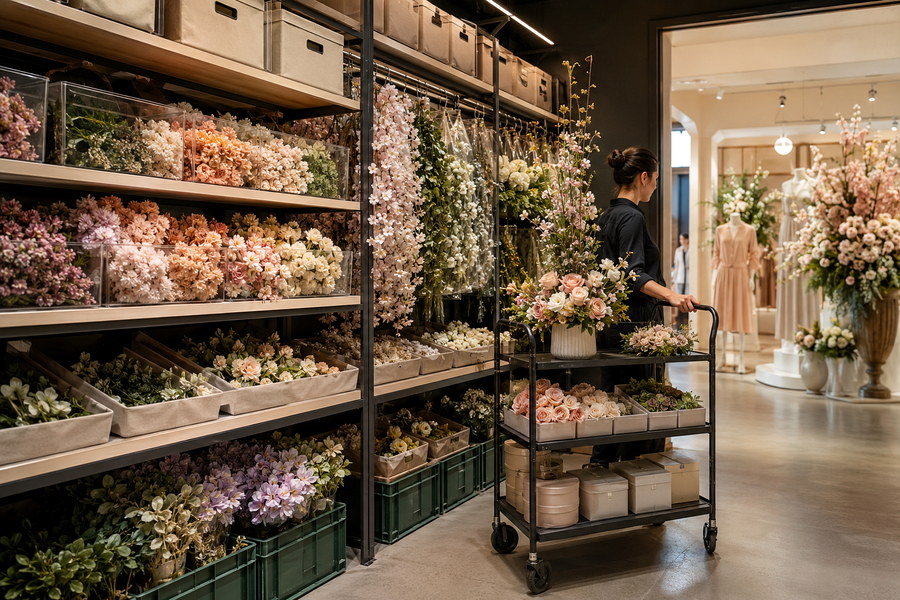
In retail, artificial flowers should not be treated as one-time decorations. They should be treated as visual merchandising assets. The EPA’s waste hierarchy places source reduction and reuse above recycling and disposal, which makes reuse a practical sustainability priority for display props, seasonal décor, and store materials.
Why Should Retailers Store and Reuse Artificial Flowers Instead of Rebuying Them?
Retail teams often buy new flowers for every holiday, launch, or campaign because it feels faster. But that habit creates higher costs, more storage confusion, and more avoidable waste.
Retailers should store and reuse artificial flowers because good faux florals can support many selling seasons when they are cleaned, protected, and organized well. Reuse lowers campaign costs, improves brand consistency, reduces last-minute purchasing, and helps visual teams build faster displays from known materials.
Reuse Turns Flowers Into Retail Assets
A single artificial flower bundle may look small, but a full retail floral program can include arches, wall panels, loose stems, garlands, hanging installations, window-box fillers, product-table accents, wreaths, and branded photo moments. If these items are not stored well, the store loses value after every campaign. Petals bend. Colors become mixed. Stems disappear. Teams waste time searching. Buyers order duplicates because no one knows what is already available.
A better system starts with a simple mindset: artificial flowers are part of the display inventory. They should be checked in, checked out, cleaned, labeled, and reused like fixtures, mannequins, risers, hangers, signage holders, and lighting accessories. This supports both cost control and sustainability because the store gets more use from the same materials.
| Retail problem | Storage and reuse solution | Business value |
|---|---|---|
| Seasonal décor waste | Save core flowers for repeat campaigns | Lower replacement cost |
| Inconsistent displays | Store flowers by campaign theme | Better brand control |
| Crushed stems | Use tall bins, racks, or sleeves | Longer product life |
| Last-minute buying | Keep an inventory list | Faster planning |
| Multi-store confusion | Label by store, season, and display zone | Easier rollout |
Retail Reuse Also Supports Brand Consistency
Brand consistency matters in retail because shoppers remember repeated colors, textures, and display styles. A beauty retailer may reuse white orchids, soft greenery, and clear acrylic risers across skincare launches. A fashion boutique may reuse oversized roses across Valentine’s Day, bridal, spring, and gifting stories. A jewelry store may reuse small cream blossoms and green accents for elegant product frames.
Shopify’s current window display guidance describes retail windows as tools that need design principles and measurement, not just decoration. It also points retailers toward tracking impact on foot traffic and sales. Stored floral assets make that measurement easier because teams can compare how the same props perform in different layouts, seasons, and product stories.
How Should Retail Teams Clean Artificial Flowers Before Storage?
Artificial flowers may look clean from a distance, but retail lighting, dust, fingerprints, fragrance mist, floor debris, and window exposure can make them dull after a campaign.
Retail teams should clean artificial flowers before storage by removing dust, wiping petals and leaves gently, checking for stains, drying all materials fully, repairing loose stems, and separating damaged pieces. Clean flowers store better, last longer, and look more realistic when reused.
Cleaning Should Happen Before the Flowers Enter Storage
The biggest mistake is packing artificial flowers directly after a campaign. Dust and dirt become harder to remove after weeks or months in storage. Fabric flowers may hold odor. Plastic flowers may collect sticky residue from store air, sprays, or nearby cosmetics. Outdoor or window-facing flowers may also carry pollen, moisture, or street dust.
A basic cleaning routine should start with a dry method. Use a microfiber cloth, soft brush, makeup brush, cool hair dryer, or gentle air blower to remove loose dust. For durable plastic flowers, teams can use a lightly damp cloth with mild soap and water. For delicate silk-like flowers, spot testing is safer before any wet cleaning. Homes & Gardens recommends matching the cleaning method to the plant material and using gentle tools such as microfiber cloths, makeup brushes, cool air, or diluted cleaning solutions only when appropriate.
| Flower type | Best cleaning method | What to avoid |
|---|---|---|
| Silk-like petals | Soft brush or dry cloth | Heavy soaking |
| Plastic stems | Damp cloth and mild soap | Harsh chemicals |
| Glitter flowers | Gentle air or dry dusting | Liquid cleaners |
| Large garlands | Vacuum with soft brush attachment | Strong suction |
| Outdoor flowers | Light rinse, then full drying | Packing while damp |
| Floral walls | Section-by-section dusting | Crushing panels flat |
Inspection Is Part of Cleaning
Cleaning is also the best time to inspect. Retail teams should remove broken stems, faded pieces, bent wires, loose petals, damaged foam bases, and cracked clips. This prevents weak pieces from returning to the sales floor. It also helps teams decide what to repair, what to donate, what to recycle if possible, and what to discard.
After cleaning, flowers should dry completely before storage. Moisture trapped inside dense floral bundles can cause odor, mildew on nearby materials, or damage to paper labels and cardboard boxes. A simple drying rack, rolling rack, or open table can help. Once the flowers are dry, teams can reshape petals, fluff leaves, and group pieces before packing.
What Is the Best Way to Organize Artificial Flowers for Retail Storage?
A flower room can become messy fast. If roses, greenery, wreaths, garlands, and floral wall panels are all stored together, the team wastes time and damages the inventory.
The best way to organize artificial flowers for retail storage is to sort them by season, color, flower type, display zone, campaign use, and fragility. Retailers should use clear bins, padded bags, garment bags, wreath bags, vertical stem storage, and labeled shelving to keep flowers visible and protected.
Build a System That Matches Retail Workflows
Retail storage should match how visual teams actually build displays. If the team creates campaigns by holiday, sort some items by season. If the brand works by color palette, sort core flowers by color. If the store runs many product launches, sort by display zone, such as window, entrance, feature table, checkout, and pop-up.
Balsam Hill recommends durable storage containers, padded storage bags, airtight plastic containers, large protective bags for oversized items, and wreath storage bags for floral wreaths. It also warns against overstuffing containers because delicate arrangements need space. This advice fits retail use because crushed petals and bent stems reduce the professional look of a display.
| Storage category | Best storage method | Retail note |
|---|---|---|
| Loose stems | Tall bins, buckets, or vertical racks | Sort by color and height |
| Garlands | Wide bins or hanging hooks | Avoid tight coils |
| Wreaths | Wreath bags or flat shelves | Keep shape protected |
| Floral panels | Upright rack or flat padded shelves | Avoid heavy stacking |
| Premium flowers | Padded bags or individual sleeves | Protect hero pieces |
| Seasonal bundles | Clear bins with labels | Add campaign photos |
| Oversized props | Cloth covers or large bags | Keep dust off surfaces |
Labels Make Reuse Possible
Labels are not a small detail. They are the difference between reuse and rebuying. Each bin or bag should show the season, color family, flower type, quantity, store location, and last-used campaign. A QR code can link to campaign photos or a shared inventory sheet. This helps new staff understand how the flowers were used before.
For multi-store retailers, the labeling system should be even clearer. A floral kit for “Spring Window 2025” can include stems, greenery, product risers, clips, wire, signage holders, and a photo guide. When the campaign ends, the same kit can return to storage as a complete set. This makes future reuse faster and reduces missing parts.
How Can Retailers Reuse Faux Flowers Across Seasonal Campaigns?
Many stores reuse flowers by simply placing them in a new vase. That works sometimes, but retail displays need stronger planning if the goal is sales and branding.
Retailers can reuse faux flowers across seasonal campaigns by building modular floral kits, choosing core neutral greenery, adding seasonal accent colors, changing lighting and signage, and designing displays that can move from windows to tables, pop-ups, events, fitting rooms, and checkout areas.
Design Flowers as Modular Campaign Tools
The best floral inventory has layers. Core greenery works all year. Neutral flowers work across luxury, bridal, beauty, wellness, and gifting campaigns. Brand-color flowers reinforce visual identity. Seasonal accent flowers create freshness without replacing the whole display.
For example, white roses and eucalyptus can support a spring skincare launch. Add red roses and gold ribbon, and the same base can become a Valentine’s Day display. Add soft pink peonies, and it can support Mother’s Day. Add white lights and metallic branches, and it can become a holiday gifting display.
| Core floral asset | Spring use | Summer use | Holiday use |
|---|---|---|---|
| White roses | Clean beauty display | Bridal capsule | Luxury gift table |
| Eucalyptus garland | Wellness shelf frame | Outdoor-inspired window | Neutral winter greenery |
| Pink peonies | Mother’s Day feature | Fashion launch | Romantic gift zone |
| Green wall panel | Photo spot | Pop-up backdrop | Brand event wall |
| Floral arch | Entrance moment | Product launch | Seasonal window frame |
Reuse Should Still Protect Product Focus
Retail floral displays should not become visual noise. Shopify’s visual merchandising guidance says stores can use focal points and natural traffic flow so customers see more products and displays. Artificial flowers should support that purpose. They should frame hero products, guide movement, and build emotion without hiding the merchandise.
A practical reuse plan can follow a three-step rule. First, choose the product story. Second, choose the reusable floral base. Third, add a small seasonal layer. This keeps displays fresh while protecting the original investment. It also makes campaign planning faster because the team starts from existing assets instead of a blank page.
My insights: How Should Retailers Store and Reuse Artificial Flowers in 2025
A retailer can buy beautiful artificial flowers and still waste money if there is no storage plan. Reuse only works when the system is simple enough for staff to follow.
Retailers should store and reuse artificial flowers in 2025 as a circular visual merchandising system. The best approach combines cleaning, sorting, labeling, protected storage, inventory tracking, modular design, and campaign planning so floral assets stay attractive, easy to find, and ready for repeated selling moments.
The Core Insight Is Operational, Not Decorative
The main question is not only “How do we store flowers?” The better question is “How do we keep floral displays useful across the full retail calendar?” Storage is not a back-room task. It is part of merchandising strategy.
A strong system helps stores reduce waste, save labor, and build better displays. It also helps visual teams move faster. When a campaign deadline is close, staff should not dig through mixed boxes of crushed stems. They should be able to pull a labeled bin, review a photo guide, clean or refresh a few pieces, and rebuild a display with confidence.
| 2025 retail need | Storage and reuse response | Result |
|---|---|---|
| Faster campaign changes | Pre-built floral kits | Shorter setup time |
| Lower display waste | Reuse core flowers | Fewer one-time props |
| Better brand identity | Repeat signature colors | Stronger recognition |
| Cleaner stockroom | Labeled bins and racks | Easier staff access |
| Better sales testing | Reuse and compare displays | Clearer performance learning |
| Multi-store consistency | Standardized kits | Smoother rollout |
The Best System Has Five Parts
First, clean every flower before storage. Second, sort by use, not just by flower type. Third, protect the shape with the right container. Fourth, label everything in plain language. Fifth, track every asset with a simple inventory sheet.
A small retailer can manage this with shelves, clear bins, hang tags, and photos. A larger retailer can use barcodes, QR codes, shared spreadsheets, and campaign kit numbers. The tool matters less than the habit. The habit is what protects the flowers and makes reuse easy.
Reuse Also Improves Sustainability Messaging
Customers are more aware of waste in retail environments. A store does not need to turn every display into a sustainability lecture, but it can make better choices behind the scenes. Reusing artificial flowers supports the broader reduce-and-reuse principle in waste management. It also helps the visual team avoid rushed purchasing and disposable styling.
The best reuse strategy is balanced. Retailers should keep high-quality core flowers for many campaigns, refresh damaged pieces when needed, and avoid storing items that no longer match the brand. A tidy floral library is more useful than a crowded storage room full of forgotten props.
Conclusion
Artificial flowers become more valuable when retailers clean, sort, protect, label, track, and reuse them as long-term visual merchandising assets instead of short-term decorations.