A large artificial tree can transform an empty commercial interior, but the wrong species, height, canopy, planter, or trunk can make an expensive space look poorly planned.
I choose large artificial trees by matching tree style, height, canopy spread, trunk character, planter scale, viewing distance, lighting, circulation, and maintenance requirements to the architecture. Olive and ficus trees suit refined interiors, palms create resort character, birch adds vertical structure, while custom trees work best in large atriums and signature spaces.
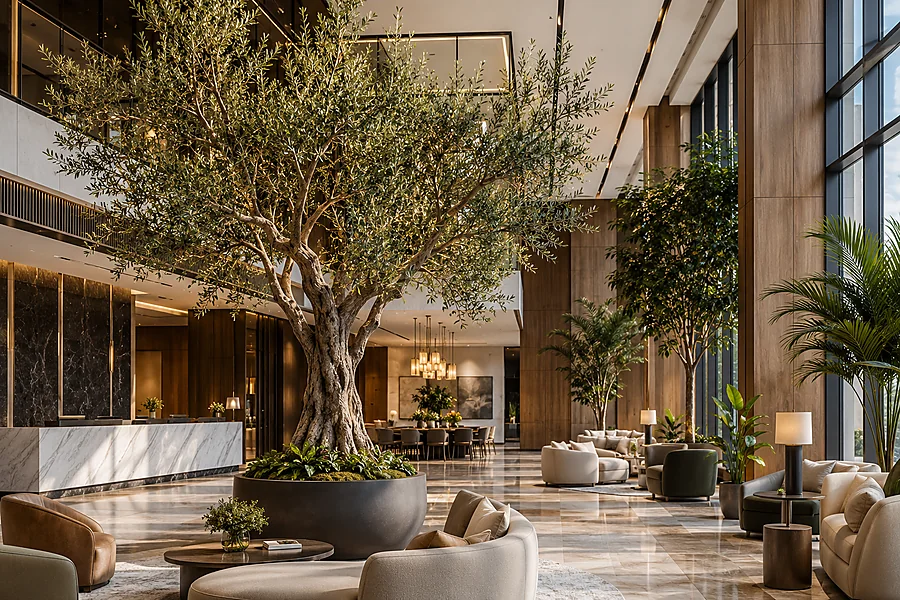
Large artificial trees work differently from ordinary decorative plants. Once a tree reaches lobby or atrium scale, its canopy can affect lighting, sightlines, ceiling clearance, seating, access routes, installation, and fire-code review. Commercial designers increasingly treat these trees as architectural features rather than accessories, especially in hotels, offices, restaurants, retail spaces, and mixed-use developments.
Which Large Artificial Tree Styles Work Best in Commercial Spaces?
A beautiful artificial tree in a catalog is not automatically right for every lobby. I first consider what visual role the tree needs to perform.
I select artificial tree style according to the atmosphere and architecture of the commercial space. Olive trees create relaxed luxury, ficus trees provide versatile fullness, palms support resort and hospitality concepts, birch adds vertical rhythm, and broad custom canopy trees create strong focal points in atriums, malls, restaurants, and large reception areas.
Artificial olive trees: refined and contemporary
Large artificial olive trees have become one of my strongest choices for modern hospitality and commercial interiors.
Their main strengths are:
- Fine, narrow leaves
- Open branching
- Soft Mediterranean character
- Natural compatibility with stone and timber
- Good visibility through the canopy
- Strong performance in neutral interior palettes
I would use a large olive tree in:
- Hotel lobbies
- Luxury restaurants
- Corporate reception areas
- Boutique retail
- Wellness spaces
- Residential sales galleries
A 3-meter-class olive tree can create significant presence without the heavy visual mass of very dense tropical foliage. Commercial examples now range from approximately 3 m statement pieces to much larger custom installations, showing how the form can scale from an ordinary lobby to an atrium.
Artificial ficus trees: the flexible commercial choice
Ficus is useful when I need a fuller canopy.
The tree works well in:
- Offices
- Shopping centers
- Waiting areas
- Restaurants
- Healthcare reception spaces
- Hotels
A ficus can visually soften hard architecture and provide more greenery at eye level than an open olive tree.
I pay close attention to leaf density. A cheap ficus with identical leaf positions quickly looks artificial under bright commercial lighting. Better trees use different branch directions, leaf sizes, and shades of green.
Artificial palms: best for hospitality identity
Palms communicate a clear visual message.
I use them where the design concept needs:
- Resort character
- Tropical styling
- Pool-club atmosphere
- Coastal hospitality
- Leisure or entertainment energy
Large palms suit resorts, restaurants, spas, themed retail, and entertainment venues.
However, palm fronds require substantial horizontal space. A palm that fits vertically may still interfere with pendant lights, signage, balcony edges, or walkways.
This makes canopy measurements just as important as height.
Birch-style trees: strong for vertical architecture
Artificial birch works differently from olive or ficus.
Instead of creating a dense central canopy, multiple pale trunks can create vertical rhythm.
I would consider birch for:
- Contemporary offices
- Scandinavian-style interiors
- Retail displays
- Restaurants
- High-ceiling event spaces
- Wellness interiors
Birch also works well in groups. Three or five narrow artificial trees can sometimes fill a tall area more elegantly than one oversized dense tree.
Banyan and broad-canopy trees: dramatic focal points
Large spreading trees are most useful when the project needs a true architectural centerpiece.
Commercial fabricators currently supply oversized artificial trees for atriums and large public spaces where canopy, trunk structure, and anchorage affect the surrounding architecture.
These trees work well in:
- Shopping malls
- Large resorts
- Food halls
- Airport lounges
- Atriums
- Entertainment venues
- Large corporate headquarters
A broad canopy can also help organize seating beneath the tree.
The project should be planned around the tree early rather than adding it after furniture, lighting, and mechanical services have already been fixed.
Style comparison
| Tree Style | Visual Character | Best Commercial Spaces | Main Design Risk |
|---|---|---|---|
| Olive | Refined, Mediterranean, soft | Hotels, restaurants, offices | Too small for large atriums |
| Ficus | Full, familiar, green | Offices, malls, reception | Excessive density |
| Palm | Tropical, dramatic | Resorts, spas, leisure venues | Wide frond clearance |
| Birch | Light, vertical, modern | Retail, office, wellness | Can look sparse alone |
| Maple | Seasonal, decorative | Retail and themed spaces | Strong style may limit reuse |
| Banyan | Sculptural, expansive | Atriums and malls | Large structural footprint |
| Custom tree | Brand-specific | Flagship commercial projects | Higher engineering and installation complexity |
How Do Buyers Choose the Right Artificial Tree Size and Scale?
Undersizing is one of the easiest ways to make an expensive artificial tree look cheap.
I size a commercial artificial tree by checking ceiling height, usable floor area, canopy diameter, viewing distance, surrounding furniture, lighting, and planter dimensions together. I do not select height alone. A well-scaled tree should occupy enough vertical volume to anchor the room while keeping clear space around circulation, lighting, signs, and services.
Measure the architectural envelope first
Before requesting quotations, I record:
- Floor-to-ceiling height
- Lowest ceiling feature
- Pendant-light positions
- Sprinklers and services
- Floor area available for the planter
- Maximum canopy diameter
- Main guest viewing distance
- Door and delivery dimensions
- Lift dimensions
- Installation access
Large commercial-tree specialists specifically emphasize ceiling height, canopy spread, structure, circulation, and installation access because oversize artificial trees become part of the architectural layout rather than movable décor.
Use height and canopy together
I use a practical starting matrix during concept development:
| Interior Condition | Starting Tree Direction |
|---|---|
| Standard commercial ceiling | 6–8 ft / 1.8–2.4 m decorative tree |
| 10–14 ft ceiling | 8–10 ft / 2.4–3 m statement tree |
| Double-height lobby | 10–16 ft / 3–5 m tree |
| Major atrium | Custom 15 ft+ tree |
| Long narrow reception | Narrow ficus, olive, birch |
| Wide open lobby | Broad olive, ficus, banyan, custom canopy |
These are design starting points, not building-code rules.
The final dimensions must come from the actual space.
Think about canopy footprint
I often see buyers focus on a 10-foot height while ignoring the fact that the foliage may spread 8 feet across.
That affects:
- Seating
- Lighting
- Wayfinding
- Security visibility
- Cleaning
- Nearby displays
- Guest circulation
A narrow olive or birch form works better when floor space is limited.
A broad ficus or banyan makes more sense when the room has a large open center.
Match the planter to the tree
A large tree in a tiny planter looks unstable even when the hidden base is structurally secure.
I look at the complete visual ratio:
Tree height + canopy + trunk diameter + planter width + surrounding furniture.
The planter can also become part of the architecture.
Useful commercial approaches include:
- Circular planter benches
- Large fiberglass pots
- Built-in rectangular planters
- Stone-look containers
- Custom millwork
- Concealed structural bases
A large planter can integrate seating around the tree and make the installation feel intentional rather than decorative.
Check delivery access before ordering
A beautiful 4-meter tree is useless when it cannot enter the building.
For large projects, I ask whether the tree ships:
- Fully assembled
- In trunk sections
- With removable branches
- With a separate canopy
- On a structural base
- As a site-assembled custom system
I also compare:
- Door width
- Loading dock
- Freight elevator
- Stair access
- Ceiling openings
- Installation equipment
Large commercial artificial trees are commonly designed as assembled systems with trunks, branches, canopy components, and bases because site logistics become important at this scale.
What Materials, Safety, and Installation Details Should Buyers Check?
Large artificial trees should not be evaluated only through photographs. Commercial projects need more technical information.
I check the trunk, branches, foliage, internal frame, base, fire documentation, installation method, and cleaning requirements before approving a large artificial tree. For public commercial interiors, I also verify applicable fire, egress, accessibility, and electrical requirements with the project team rather than assuming a decorative product is automatically compliant.
Inspect the trunk first
The trunk becomes more visible as the tree gets larger.
Common trunk systems include:
| Trunk Type | Main Advantage | Main Concern |
|---|---|---|
| Natural preserved wood | Strong realism | Variation, moisture, sourcing |
| Molded fiberglass | Custom shape and scale | Poor finishes can look artificial |
| Steel frame + sculpted skin | Strong for large custom trees | Requires professional fabrication |
| Molded polymer | Lightweight | May lack close-up realism |
| Mixed natural/synthetic | Balances realism and engineering | More complex specification |
For luxury spaces, I prefer irregular trunks with natural taper, texture, branching, and color variation.
Perfectly cylindrical trunks usually look artificial.
Inspect foliage under real lighting
Commercial lighting exposes quality problems.
I look for:
- Multiple leaf tones
- Matte finish
- Natural leaf orientation
- Mixed branch lengths
- Botanical proportions
- Hidden connections
- No visible glue
- No repeated plastic patterns
A tree that looks realistic in a dim warehouse may appear shiny under daylight or strong lobby lighting.
I therefore approve samples in the actual project lighting whenever possible.
Require fire-performance documentation
Artificial decorative vegetation can be subject to fire-code requirements.
The 2024 International Fire Code requires artificial decorative vegetation covered by its provisions to meet the appropriate flame-propagation criteria of NFPA 701 or an alternative NFPA 289 heat-release test, with compliance documented appropriately. The 2025 California Fire Code includes the same basic artificial-vegetation requirement.
Current NFPA development materials also specifically define artificial decorative vegetation and address testing under NFPA 701.
I therefore ask for:
- Exact tested product or material
- Test standard
- Test method
- Laboratory
- Report number
- Construction covered by the report
- Treatment method
- Restrictions
- Confirmation that production matches the tested construction
I do not treat “fire retardant” as enough information.
Local codes, occupancy, sprinkler conditions, and authority requirements still determine what is acceptable for a particular project.
Protect circulation and exits
A tree is not well designed when guests have to walk around its branches.
The U.S. Access Board notes that protruding-object requirements apply to circulation paths in both interior and exterior spaces, while objects cannot reduce the required width of accessible routes.
OSHA also requires workplace exit routes to remain free and unobstructed.
I therefore check:
- Canopy projection
- Planter footprint
- Branch height
- Exit visibility
- Door swing
- Wayfinding signs
- Queue lines
- Furniture movement
- Cleaning equipment access
Secure the complete tree
Large trees may need:
- Structural base plates
- Concealed steel frames
- Bolted planters
- Internal ballast
- Tree tie-downs
- Custom floor connections
The exact solution depends on tree height, canopy, base geometry, public access, and whether the tree is permanent or movable.
For very large custom trees, I treat the installation like architectural fabrication rather than ordinary plant styling.
How Can Businesses Compare Quality, Maintenance, and Lifecycle Cost?
The purchase price is only the first cost of a large commercial tree.
I compare large artificial trees by delivered quality, installation, shaping, cleaning access, repairability, spare parts, storage, expected service conditions, and replacement cost. A cheaper tree can become more expensive when the canopy deforms, branches detach, the trunk looks unrealistic, or specialist labor is repeatedly needed for maintenance.
Create a commercial-quality scorecard
| Quality Area | Suggested Weight |
|---|---|
| Overall realism | 25% |
| Scale and architectural fit | 20% |
| Trunk and structural quality | 15% |
| Foliage consistency | 15% |
| Fire/safety documentation | 10% |
| Installation system | 5% |
| Maintenance access | 5% |
| Packaging and replacement parts | 5% |
I would approve quality before comparing final price.
Plan cleaning access before installation
Large trees collect dust.
The bigger the canopy, the more important access becomes.
A 12-foot tree may require:
- Extension tools
- Mobile access equipment
- Scheduled maintenance
- Removable branches
- Specialist cleaning
A very dense ficus may take longer to clean than an open olive tree.
That operational difference matters in hotels, offices, restaurants, and retail environments.
Ask for spare foliage
For a large custom installation, I request spare:
- Leaves
- Branches
- Connection hardware
- Touch-up materials
- Trunk finish
- Mounting components
Replacing one damaged branch is much cheaper than replacing the complete tree.
Calculate lifecycle cost
I use:
Lifecycle cost = tree + planter + freight + installation + structural work + cleaning + repair + replacement
For a very large tree, installation and access can become significant parts of the budget.
That means a supplier offering:
- Modular branches
- Clear installation drawings
- Replacement foliage
- Stable color batches
- Technical support
may create better long-term value than the supplier with the lowest factory quotation.
My insights: How Should Buyers Choose the Right Style of Large Artificial Trees for Commercial Spaces
I do not start with the question, “Which artificial tree looks best?” I start with the role that the commercial space needs the tree to perform.
I choose the right large artificial tree style by matching botanical form to architecture, scale to ceiling volume, canopy to circulation, materials to viewing distance, and construction to commercial safety and maintenance needs. Olive, ficus, palm, birch, and custom trees each solve different spatial problems, so style should follow function rather than trend alone.
I use five design roles
| Design Role | Tree Direction |
|---|---|
| Elegant focal point | Mature olive |
| Full green volume | Ficus |
| Resort identity | Palm |
| Vertical architectural rhythm | Birch |
| Major atrium centerpiece | Banyan or custom tree |
This approach keeps the selection process simple.
I match tree personality to brand personality
An artificial tree communicates style immediately.
An olive tree suggests calm, refined Mediterranean design.
A palm suggests leisure and tropical hospitality.
Birch feels lighter and more contemporary.
A broad banyan or custom sculptural tree feels dramatic and experiential.
A dense ficus communicates familiar greenery without dominating a brand concept.
The tree should reinforce the interior story already created by lighting, flooring, furniture, art, and architecture.
I avoid undersizing statement spaces
My strongest practical insight is that buyers often spend too much on a tree that is still too small.
A 7-foot artificial olive may look impressive in a product photo.
Place it in a 25-foot atrium, and it can look like ordinary furniture.
Commercial specialists similarly identify scale and structure as central selection issues for large artificial trees.
When the architecture is large, the tree should be specified as part of the architecture.
I choose open canopies where operations matter
Dense foliage looks impressive, but open branching often works better in busy commercial spaces.
An open canopy can:
- Preserve sightlines
- Reduce visual clutter
- Make lighting integration easier
- Improve cleaning access
- Reveal a premium trunk
- Feel more natural
That is one reason I frequently favor mature olive forms for hotels and premium offices.
I use custom trees only when the architecture deserves them
Custom artificial trees make sense when the project has:
- Double- or triple-height space
- A major central atrium
- Integrated seating
- Special lighting
- Brand storytelling
- Unusual tree dimensions
- Permanent architectural installation
For ordinary meeting rooms or smaller reception areas, a standard premium tree is normally easier to purchase, install, replace, and maintain.
My final buyer checklist
Before I approve a large commercial artificial tree, I confirm:
- Finished tree height.
- Maximum canopy width.
- Trunk diameter and finish.
- Tree style and botanical character.
- Ceiling and lighting clearance.
- Planter dimensions.
- Base and anchoring method.
- Delivery route.
- Assembly process.
- Foliage materials.
- Fire documentation where required.
- Circulation and exit clearance.
- Cleaning access.
- Replacement branches and foliage.
- Warranty and corrective-action terms.
The best large artificial tree does not simply fill empty space.
It should create scale, support the interior identity, remain safe, look realistic from the normal viewing distance, and stay practical for the people who operate the building every day.
Conclusion
Choose large artificial trees by architectural scale, tree style, canopy, realism, planter design, safety, access, installation, and maintenance—not by height or appearance alone.