
Outdoor artificial plants can look fresh on day one, then fade, tip, crack, or collect dust if buyers choose the wrong products.
Outdoor UV artificial plants should be UV-resistant, weather-ready, realistic, easy to clean, and installed with stable planters or secure attachment points. In 2025, buyers should check materials, UV claims, wind exposure, drainage, fire rules, exit clearance, packaging, samples, and long-term maintenance before bulk ordering.
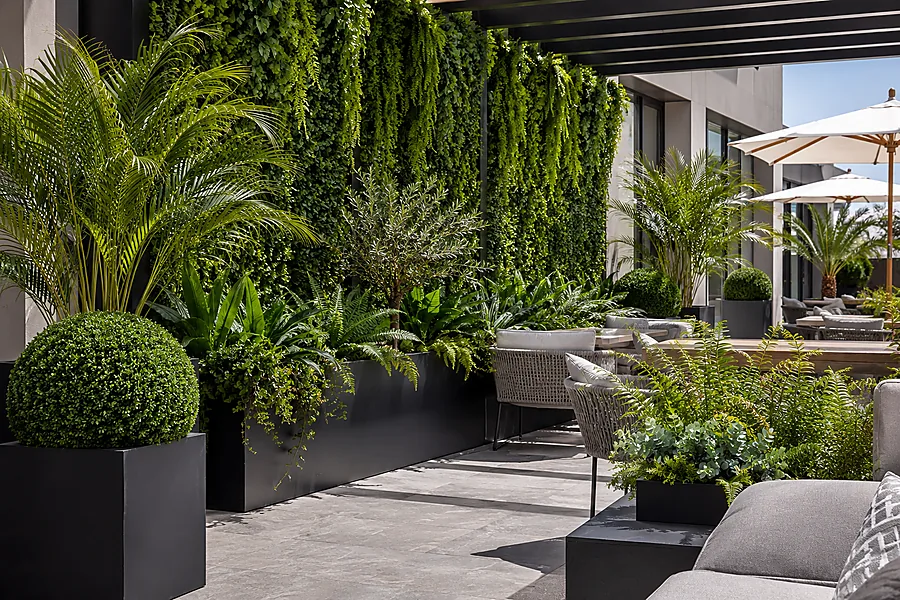
Artificial plants and flowers are growing as homes and businesses choose low-maintenance décor. For commercial spaces, outdoor UV greenery is now a practical long-term display investment.
What Are Outdoor UV Artificial Plants?
Many buyers assume any fake plant can go outside. That mistake often leads to faded leaves, weak stems, loose panels, and poor customer-facing displays.
Outdoor UV artificial plants are faux plants made or treated to slow sun fading, discoloration, cracking, and outdoor material damage. They usually use UV-resistant plastics, PE, PVC, treated polyblend materials, weather-safe coatings, or fade-resistant pigments for exterior use.
UV resistance slows damage, but does not stop time
UV-resistant does not mean fade-proof forever. It means the plant is designed to perform better outdoors than a standard indoor artificial plant. Full sun, heat, rain, wind, dust, salt air, and pollution can still shorten the product’s life.
The Spruce notes that many faux plants are not designed for outdoor conditions and recommends outdoor-safe, UV-resistant, weatherproof materials such as polyethylene, polyblend plastics, or PVC for exterior placement. This is why outdoor buyers should always check product labels and material details before comparing price.
| Label Term | What It Usually Means | Buyer Caution |
|---|---|---|
| UV-resistant | Designed to slow fading from sunlight | Not fade-proof forever |
| UV-protected | Treated or made with UV protection | Ask if coating or built-in material |
| Outdoor-safe | Intended for exterior use | Still check wind and weather exposure |
| Weatherproof | Better resistance to rain and temperature change | Does not mean damage-proof |
| Fade-resistant | Color is designed to last longer | Still needs cleaning and rotation |
Outdoor UV plants are built for difficult spaces
Outdoor UV artificial plants are useful in places where live plants are hard to maintain. These include sunny storefronts, shaded hotel entrances, windy rooftops, restaurant patios, apartment balconies, retail window boxes, pool areas, and event venues.
Live plants need water, pruning, soil care, light control, pest control, and replacement. UV artificial plants reduce these needs. But they still need proper installation. A realistic plant in an unstable pot is not a weather-safe solution.
Which Outdoor UV Artificial Plants Work Best in 2025?
The best outdoor UV plant depends on sun exposure, wind, customer traffic, design style, and cleaning needs.
The best outdoor UV artificial plants in 2025 include boxwood panels, artificial hedges, topiary trees, faux palms, olive trees, eucalyptus, ferns, lavender, geraniums, hydrangeas, hanging baskets, agave, yucca, and mixed greenery planter inserts.
1. UV boxwood panels
Boxwood panels are one of the most useful outdoor products. They work for storefront walls, privacy screens, balcony railings, hotel terraces, mall photo zones, and event backdrops. They create a clean green surface and can be combined with signs, flowers, logos, and lighting.
Boxwood panels should be dense, flexible, UV-resistant, and easy to clean. For commercial installs, buyers should also check panel connection strength, backing material, flame documentation when needed, and whether the panels can be removed for cleaning.
2. Artificial topiary trees
Topiary trees are excellent for entrances. A pair of cone, ball, square, or spiral topiaries can make a hotel, boutique, restaurant, office, salon, or villa entrance look polished.
The main risk is stability. Topiaries can be top-heavy, especially in wind. Use weighted planters, internal anchors, gravel, sandbags, or concealed fixing systems.
3. Faux palms
Faux palms suit resorts, pool decks, rooftop lounges, beach clubs, restaurant patios, and hotel courtyards. They add height and a relaxed outdoor feeling.
Choose palms with reinforced trunks, flexible fronds, matte leaves, and heavy bases. Tall palms should never be placed in lightweight decorative pots without support.
4. Olive trees and eucalyptus
Olive trees and eucalyptus work well for modern outdoor design. They suit cafés, spas, apartments, hotels, offices, and shaded terraces. They look softer than boxwood and more premium than basic plastic shrubs.
These plants are best in partial shade, covered terraces, pergolas, and lounge areas where close-up realism matters.
5. Flowering planter inserts
Outdoor displays often need color. UV-rated lavender, geraniums, hydrangeas, bougainvillea-style stems, and mixed floral inserts can brighten planters without watering. Southern Living has highlighted outdoor artificial plants and flowers such as hydrangeas, geraniums, hanging baskets, topiaries, cedar trees, and Boston ferns as low-maintenance outdoor options.
| Plant Type | Best Outdoor Use | Main Buyer Priority |
|---|---|---|
| Boxwood panels | Walls, screens, photo zones | UV rating and panel density |
| Topiary trees | Entrances, doors, walkways | Stability and shape retention |
| Faux palms | Hotels, resorts, patios | Base weight and frond strength |
| Olive trees | Cafés, terraces, luxury retail | Realism and planter style |
| Eucalyptus | Restaurants, spas, balconies | Natural texture and easy cleaning |
| Lavender | Wellness, balconies, cafés | Color stability |
| Geraniums | Window boxes, storefronts | Bright curb appeal |
| Hanging baskets | Porches, patios, retail fronts | Hook strength and UV material |
| Agave or yucca | Hot, dry-style outdoor areas | Sculptural durability |
How Should Buyers Plan Weather-Safe Artificial Plant Installs?
A weather-safe install is not only about the plant. It is about the planter, anchor, placement, clearance, drainage, fire requirements, and maintenance access.
Buyers should plan weather-safe artificial plant installs by checking UV material, exposure level, wind risk, planter weight, drainage, attachment strength, fire safety, exit clearance, sprinkler clearance, and cleaning access. Commercial installs should be approved by property managers when required.
Start with exposure mapping
Before buying, map the space. Look at sun direction, peak heat, wind channels, foot traffic, drainage, cleaning routes, door swings, signs, cameras, vents, lighting, and emergency exits. The same product may perform well under an awning but poorly in full afternoon sun.
| Site Condition | Buying Decision |
|---|---|
| Full sun | Use strong UV-rated PE, PVC, or treated plastic |
| Partial shade | Use premium realistic foliage and lighter flowers |
| Windy rooftop | Use compact plants, weighted pots, and anchors |
| Rain exposure | Use weather-safe materials and drainage-ready planters |
| High traffic | Use sturdy stems and tamper-resistant placement |
| Luxury entrance | Use premium pots and realistic, matte foliage |
| Restaurant patio | Use wipeable leaves and low-allergen, no-soil décor |
Secure the base first
Many outdoor artificial plant problems start at the base. A beautiful plant that tips over is not commercial-ready. Use heavy planters, internal weights, gravel, sandbags, concrete-look pots, hidden brackets, or anchor-ready bases.
For wall panels, use strong clips or approved fasteners. For hanging baskets, confirm hook strength and ceiling or beam capacity. For balconies, avoid loose pieces that can fall or blow away.
Keep exits and safety systems clear
Commercial displays should never block exit routes, exit doors, emergency signs, sprinklers, alarms, cameras, lighting, or access panels. OSHA states that exit routes must be free and unobstructed, and exit route doors must not be obscured by decorations or signs.
Fire requirements also matter. The 2025 California Fire Code states that artificial decorative vegetation must meet NFPA 701 flame propagation performance criteria. NFPA 701 covers flame propagation testing for textiles and films, and related listings note that claimed durability to cleaning or weathering can require testing after applicable exposure procedures.
| Install Safety Check | What to Confirm |
|---|---|
| Exit routes | No planters, panels, or vines block egress |
| Doors | Door swings and visibility remain clear |
| Fire rating | Ask for flame documentation when required |
| Sprinklers | Keep clear space around sprinkler heads |
| Wind | Use weighted bases and secure panels |
| Drainage | Avoid trapped water inside planters |
| Lighting | Do not cover fixtures or create heat buildup |
| Maintenance | Staff can clean and inspect without dismantling everything |
Use modular installation
A modular install is easier to maintain. Use a strong UV greenery base, then add replaceable flowers or seasonal accents. If red geraniums fade faster than boxwood, replace only the flowers. If one planter gets more sun, refresh that planter first.
This approach works well for hotels, retailers, restaurants, event venues, apartment communities, and shopping centers.
How Can Businesses Maintain Outdoor UV Artificial Plants Long Term?
Outdoor UV artificial plants reduce daily care, but they still need cleaning, rotation, inspection, and planned replacement.
Businesses can maintain outdoor UV artificial plants by dusting leaves, wiping dirt, rotating planters, checking anchors, applying UV protectant when suitable, replacing faded accents, and storing seasonal pieces in clean, labeled boxes.
Clean before the plants look old
Dust can make UV-resistant plants look faded even when the color is still strong. Road dirt, pollen, rain marks, sand, and pollution can sit on leaves and panels.
Use a microfiber cloth for broad leaves. Use a soft brush for boxwood, ferns, and topiary surfaces. Outdoor-safe plastic foliage may handle a light rinse, but it should dry fully before storage or UV spray.
Use UV spray as extra support
Clear UV protectant spray can help slow fading on artificial flowers, silk stems, dried flowers, and some decorative pieces. Krylon’s Ultra UV Floral Protectant is described as a clear indoor/outdoor spray that helps protect silk and dried flowers from fading, dirt, moisture, discoloration, and UV light rays.
Spray should support outdoor-grade materials, not replace them. Clean first, dry fully, test a hidden area, and apply thin coats according to the label.
| Maintenance Timing | Task | Purpose |
|---|---|---|
| Weekly | Visual check | Remove debris and spot loose parts |
| Every 2–4 weeks | Dust or wipe | Keep foliage fresh-looking |
| Monthly | Rotate planters | Reduce one-sided fading |
| After wind or storms | Inspect bases and panels | Prevent tipping or falling |
| Seasonally | Replace faded accents | Refresh without full replacement |
| After campaigns | Clean and store | Protect reusable inventory |
Store seasonal greenery correctly
Do not crush large blooms, palms, or garlands into tight cartons. Clean first. Dry fully. Reshape leaves. Coil garlands loosely. Label boxes by product type, color, location, and condition.
Good storage turns artificial plants into reusable assets. Poor storage creates bent stems, crushed leaves, tangled vines, and wasted labor.
My insights: Outdoor UV Artificial Plants-Proven 2025 Buyer’s Guide for Weather-Safe Installs
Many buyers ask, “Which outdoor UV artificial plants last the longest?” That question is useful, but it is incomplete.
The best outdoor UV artificial plants in 2025 are not only UV-resistant. They are selected, installed, secured, cleaned, and maintained as part of a weather-safe system. Strong results come from matching material, exposure, planter stability, safety clearance, and replacement planning.
The best install is a system
My main insight is that outdoor UV success has five parts: product, placement, planter, protection, and process.
| System Part | What It Means |
|---|---|
| Product | UV-resistant, outdoor-safe, realistic materials |
| Placement | Right plant for sun, shade, wind, and traffic |
| Planter | Weighted, stable, drainage-ready base |
| Protection | Shade, UV spray, secure fittings, fire checks |
| Process | Cleaning, rotation, inspection, and replacement |
A buyer who only chooses a pretty plant may still have problems. A buyer who plans the whole system gets better long-term value.
B2B buyers should ask better questions
Do not ask only, “Is this outdoor?” Ask:
| Buyer Question | Strong Supplier Answer |
|---|---|
| What material is used? | PE, PVC, treated plastic, or UV-stabilized blend |
| Is UV protection built in or sprayed? | Clear explanation of protection method |
| Can it handle full sun? | Honest guidance by exposure level |
| Is the base stable? | Weighted or anchor-ready planter options |
| Is fire documentation available? | NFPA 701 or relevant documentation when needed |
| Can I order samples? | Yes, before bulk production |
| Can I reorder later? | Stable SKU and color records |
| How is it packed? | Cartons protect leaves, stems, panels, and pots |
Weather-safe installs protect profit
For retailers, faded plants weaken curb appeal. For hotels, unstable planters hurt luxury perception. For restaurants, dusty leaves look unhygienic. For event companies, weak greenery increases replacement cost. For property managers, blocked exits or loose panels create risk.
Outdoor UV artificial plants work best when buyers treat them as commercial display assets. They need specifications, testing, installation rules, and maintenance schedules.
The strongest 2025 strategy
Start with UV-resistant outdoor-safe materials. Test samples. Choose plants by exposure level. Use weighted planters. Keep exits clear. Ask for fire documentation when required. Clean regularly. Rotate planters. Replace faded accents early. Store seasonal pieces correctly.
This strategy helps outdoor artificial plants stay realistic, safe, and profitable across commercial weather conditions.
Conclusion
Outdoor UV artificial plants perform best when buyers choose UV-rated materials, secure weather-safe installs, protect safety clearances, clean regularly, and refresh faded accents early.