
Choosing between artificial and preserved wedding flowers becomes difficult when both promise lasting beauty, stable styling, and fewer fresh-flower timing problems.
Artificial flowers are manufactured and offer stronger durability, color consistency, advance preparation, and reuse. Preserved flowers are real botanicals treated to retain a fresh-looking form, giving more natural texture but greater sensitivity to humidity, sunlight, crushing, and outdoor exposure. The better choice depends on venue, handling, budget, realism, and post-wedding plans.
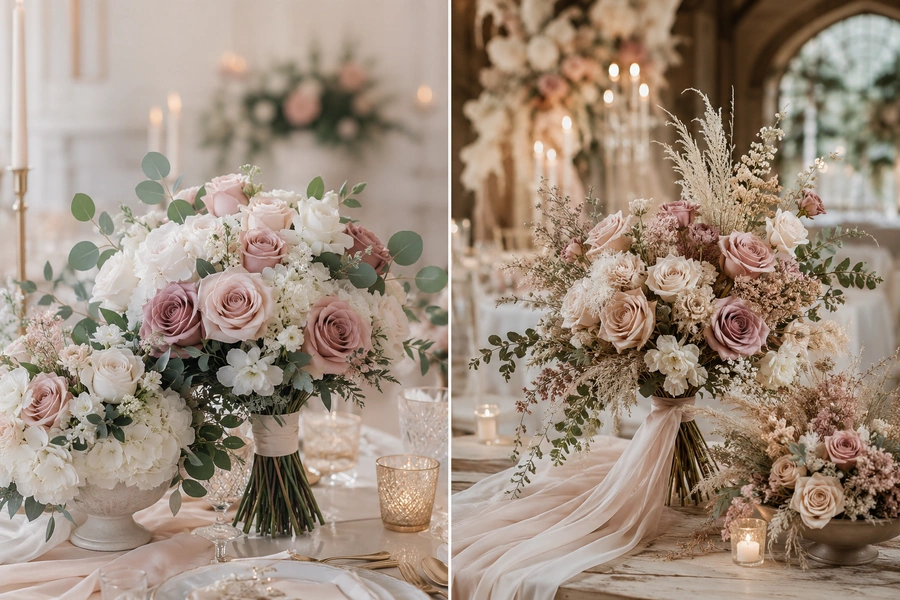
Preserved flowers are natural botanicals treated to retain their appearance, while dried flowers lose moisture. Both support 2025 wedding trends but differ in transport, installation, durability, storage, and handling requirements.
What Is the Difference Between Artificial and Preserved Wedding Flowers?
The two options may look similar in photographs, but their materials, structure, care requirements, and expected uses are fundamentally different.
Artificial wedding flowers are manufactured reproductions made from materials such as polyester, PE, PU, PVC, wire, foam, and adhesives. Preserved flowers are genuine botanical products treated after harvesting. Artificial flowers offer greater physical durability, while preserved flowers retain more of the natural texture, shape, and variation of real flowers.
Artificial flowers are manufactured products
Artificial wedding flowers can reproduce almost any flower type, including:
- Roses
- Peonies
- Hydrangeas
- Orchids
- Tulips
- Ranunculus
- Dahlias
- Eucalyptus
- Ferns
- Olive foliage
Their construction may combine fabric petals, molded leaves, wired stems, coatings, plastic centers, and adhesives.
High-quality artificial flowers often include slight variations in color, flexible stems, dimensional petals, matte foliage, and small irregularities. These details reduce the uniform plastic appearance associated with cheaper products. Current event-design guidance recommends looking for natural tones, texture, flexible stems, and subtle imperfections when evaluating faux flowers.
Preserved flowers remain natural botanical material
Preserved products begin as living flowers or plants. Commercial preservation methods can replace the plant’s sap and water with a stabilizing solution so the botanical material maintains a fresh-looking appearance without normal watering.
Common preserved wedding materials include:
- Preserved roses
- Preserved hydrangeas
- Preserved eucalyptus
- Preserved ruscus
- Preserved moss
- Preserved ferns
- Preserved palm leaves
They may be combined with dried grasses, seed heads, bunny tails, pampas grass, or dried flowers.
Preserved and dried flowers are different
These categories frequently overlap in wedding descriptions, but buyers should separate them.
| Product | Basic Construction | Typical Appearance |
|---|---|---|
| Artificial flower | Fully manufactured | Can imitate fresh flowers closely |
| Preserved flower | Real flower treated for longevity | Soft, natural and fresh-looking |
| Dried flower | Real flower with moisture removed | Crisp, muted and textured |
| Pressed flower | Flattened natural flower | Flat decorative keepsake |
| Hybrid arrangement | Combination of materials | Flexible texture and performance |
A preserved rose may remain soft and dimensional. An air-dried rose normally becomes firmer, more fragile, and slightly smaller.
The Knot notes that dried and preserved flowers are often used for bohemian, rustic, beach, cottage-inspired, and keepsake-focused weddings.
The main difference is natural material versus manufactured control
I reduce the comparison to one simple distinction:
Preserved flowers retain natural botanical character. Artificial flowers provide manufactured consistency.
That difference affects almost every later decision, including color, transport, weather, storage, repair, customization, and reuse.
Which Option Looks Better and Lasts Longer?
Neither category is automatically more realistic. Product quality, flower species, viewing distance, lighting, and arrangement skill all influence the final result.
Preserved flowers usually provide stronger natural texture because they are genuine botanicals. Premium artificial flowers can provide more consistent shape, color, and structure, especially for large installations. Artificial flowers generally tolerate repeated handling better, while preserved flowers can remain attractive for extended periods when protected from sunlight, humidity, water, and crushing.
Preserved flowers lead in natural variation
Because preserved flowers were once living plants, they retain characteristics that are difficult to manufacture perfectly:
- Natural petal edges
- Botanical asymmetry
- Organic veins
- Slight color variation
- Natural stem structure
- Authentic surface texture
These qualities are valuable in bridal bouquets and intimate table arrangements because guests may see them closely.
However, natural variation can also create purchasing challenges. Two preserved roses may differ slightly in shape or color. That variation can look beautiful, but it may be less suitable when a buyer needs hundreds of nearly identical arrangements.
Artificial flowers lead in consistency
Artificial flowers provide stronger control over:
- Flower-head diameter
- Stem length
- Color family
- Petal count
- Leaf placement
- Finished arrangement size
- Repeat-order specifications
This is useful for wedding planners, rental companies, hotels, wholesalers, and multi-day events.
One artificial bouquet design can be reproduced for the bride, bridesmaids, ceremony, reception, and later photo sessions without depending on natural variation.
Longevity depends on how the flowers are used
Artificial flowers generally tolerate:
- Repeated setup
- Transport
- Storage
- Stem bending
- Arrangement changes
- Multi-day use
Preserved flowers need gentler handling.
One major preserved-flower producer advises that its products should remain indoors, receive no water, avoid prolonged direct sunlight, avoid crushing, and avoid humidity above 80%. Buyers should verify the instructions for their specific supplier because preservation systems can differ.
Comparison by performance
| Performance Factor | Artificial Flowers | Preserved Flowers |
|---|---|---|
| Natural botanical texture | Good–excellent | Excellent |
| Color consistency | Excellent | Moderate–good |
| Repeated handling | Excellent | Limited |
| Long-term reuse | Excellent | Moderate |
| Humidity tolerance | Product-dependent | Often sensitive |
| Outdoor suitability | Outdoor-rated options available | Usually poor |
| Advance preparation | Excellent | Good with careful storage |
| Repairability | Individual parts can be replaced | More difficult |
| Keepsake value | High | Very high for natural-material buyers |
Viewing distance changes the answer
For a bridal bouquet viewed closely, preserved roses can deliver convincing natural detail.
For a large ceremony arch viewed from several meters away, premium artificial flowers may create stronger structural volume and tolerate assembly better.
I therefore do not apply one quality level across the complete wedding.
I use the most natural material where guests inspect the flowers closely and the most durable material where scale, transport, and installation matter more.
Which Flowers Work Best for Bouquets, Centerpieces, Arches, and Outdoor Weddings?
Wedding flowers perform different jobs. A bouquet must survive close viewing and photography, while an arch must survive transport, installation, gravity, and possibly wind.
Preserved flowers work best for bridal bouquets, boutonnieres, intimate centerpieces, keepsakes, and textured indoor styling. Artificial flowers work best for arches, flower walls, hanging installations, aisle arrangements, large centerpieces, outdoor décor, and reusable rental inventories. Hybrid designs often provide the strongest balance of realism and durability.
Bridal bouquets
The bridal bouquet receives close attention and carries emotional value.
Preserved flowers are a strong choice when the couple wants:
- Genuine botanical material
- Natural texture
- A keepsake after the wedding
- A bohemian or romantic style
- Neutral, autumnal, or earthy colors
The Knot highlights the ability to save preserved and dried wedding flowers as keepsakes or reuse them as home décor.
Artificial bouquets are stronger when the couple needs:
- Exact color matching
- Flowers unavailable in the wedding season
- Early preparation
- Destination transport
- Greater resistance to handling
- Matching duplicate bouquets
Premium artificial bouquets can also be carried during pre-wedding photography without affecting their wedding-day appearance.
Boutonnieres and corsages
Preserved materials can look elegant in small personal flowers, but fragile stems or petals may be damaged by hugs, clothing contact, heat, or handling.
Artificial boutonnieres often provide better strength because wired stems and secured flower heads can maintain their position.
I would test the complete item on actual clothing before approval.
Table centerpieces
Both options work well for reception tables.
| Table Requirement | Better Starting Option |
|---|---|
| Close natural detail | Preserved |
| Identical tables | Artificial |
| Rustic or bohemian texture | Preserved/dried |
| Bright custom colors | Artificial |
| Multi-day reception | Artificial |
| Keepsake arrangements | Preserved |
| Rental collection | Artificial |
| Mixed residential styling | Hybrid |
The residential-style centerpiece trend identified for 2025 can work especially well with preserved flowers, lamps, plants, rocks, candles, and decorative vessels.
Ceremony arches and backdrops
Artificial flowers are normally more practical for large structures.
They can be:
- Attached in advance
- Wired securely
- Transported in modules
- Reshaped
- Reused
- Combined with artificial greenery
- Repaired with replacement flower heads
Preserved flowers can add natural detail, but using them across a complete large arch increases the risk of crushing and breakage.
My preferred hybrid arch uses:
Artificial structural greenery + artificial volume flowers + limited preserved hero accents
Hanging installations
Overhead installations require additional attention to weight, attachment, installation access, and venue approval.
Artificial foliage is normally more suitable because it can withstand mechanical fixing and repeated transport.
Preserved materials may work in sheltered indoor installations when they are protected and installed carefully.
The 2025 movement toward artistic, curved, asymmetric, and unexpected floral installations makes modular construction especially valuable.
Outdoor weddings
Artificial flowers are the stronger starting option for most outdoor installations.
However, not every artificial flower is designed for sun, rain, or wind. Buyers should still distinguish indoor decorative products from outdoor-rated products.
Preserved flowers are usually better kept indoors or under tightly controlled sheltered conditions. Supplier care guidance commonly warns against prolonged sunlight, high humidity, water, folding, and crushing.
For an outdoor ceremony, I would use:
- Artificial arch flowers
- Artificial aisle arrangements
- Artificial flower-wall sections
- Weighted or secured structures
- Preserved flowers only in protected personal pieces where appropriate
How Should Couples Compare Cost, Care, Transport, and Sustainability?
The flower price is only one part of the wedding budget. Design labor, shipping, setup, storage, damage, cleaning, and post-wedding plans can change which option offers better value.
Couples should compare artificial and preserved flowers using completed arrangement cost, installation labor, transport, storage, reuse, keepsake plans, venue conditions, and disposal. Artificial flowers often offer better value through repeated use, while preserved flowers provide natural material and keepsake appeal. Neither option is automatically cheaper or more sustainable in every wedding.
Compare completed floral costs
A 2025 Brides cost guide reported an average U.S. wedding-flower spend of about $2,200, with many couples spending between $500 and $3,500. It also noted that arrangement size, flower type, season, labor, delivery, and location can change the final price substantially.
Artificial and preserved quotations should include:
| Cost | Artificial | Preserved |
|---|---|---|
| Product | Manufactured flowers | Treated natural flowers |
| Design labor | Required | Required |
| Delivery | Normal or dimensional freight | Protective delivery |
| Installation | Moderate for large structures | Careful handling required |
| Storage | Space required | Dry protected storage |
| Repairs | Replaceable components | Limited repair options |
| Reuse | Strong potential | Possible but more fragile |
| Keepsake use | Strong | Strong natural appeal |
| Post-wedding resale | Possible | More limited |
Artificial flowers may cost more initially
Premium faux flowers can have a high starting price.
Their value improves when they are:
- Reused
- Rented
- Resold
- Repurposed as home décor
- Used for several wedding events
- Added to a professional inventory
Current design guidance notes that faux flowers can cost more upfront but may provide savings when used repeatedly.
Preserved flowers require controlled care
Preserved flowers do not need ordinary watering, but they are not maintenance-free.
Care may include:
- Avoiding direct sunlight
- Avoiding high humidity
- Keeping them indoors
- Preventing petal compression
- Removing dust gently
- Using protective storage
- Limiting repeated handling
These conditions make preserved flowers easier to manage as keepsakes than as frequently rented event inventory.
Transport risk differs
Artificial flowers can normally be compressed moderately and reshaped, depending on their construction.
Preserved flowers require more protective space because crushed petals may not recover.
For destination weddings, I compare:
- Suitcase or carton dimensions
- Customs requirements
- Local delivery
- Temperature and humidity
- Setup labor
- Replacement options
- Whether the bouquet travels as hand luggage
Avoid simple sustainability claims
Neither artificial nor preserved flowers should automatically be described as the sustainable winner.
Artificial flowers may use plastic, fabric, coatings, wire, packaging, and international freight.
Preserved flowers begin as natural botanicals but also require growing, processing, treatment, packaging, and transport.
The Associated Press reported growing interest in local, dried, reused, and seasonal wedding flowers, while also noting that environmental claims about imported plastic artificial flowers should not be accepted without evidence.
I evaluate environmental impact through:
- Product origin
- Manufacturing or treatment process
- Transportation
- Number of uses
- Packaging
- Repairability
- Disposal
- Local sourcing
- Compostability where verified
My practical budget strategy
I would allocate flower materials by function:
Preserved flowers: bridal bouquet, keepsake arrangement, close-viewing details.
Artificial flowers: ceremony structure, backdrop, large table volume, hanging installation, rental pieces.
Fresh or local botanicals: fragrance, seasonal accents, meaningful local flowers.
This approach places each material where its strengths create the most value.
My insights: Which Is Better for a 2025 Wedding—Artificial or Preserved Flowers
The best choice is rarely one material across every wedding zone. Couples need different levels of realism, strength, scale, and emotional meaning throughout the day.
For most 2025 weddings, I recommend a hybrid strategy. I would use preserved flowers for the bridal bouquet, keepsakes, and close-viewing details, while using high-quality artificial flowers for arches, walls, hanging installations, outdoor décor, and reusable volume. This combination balances natural texture, predictable color, installation strength, and post-wedding value.
My five-part decision model
| Decision | Choose Artificial When | Choose Preserved When |
|---|---|---|
| Viewing distance | Medium or far | Close |
| Installation size | Large | Small–medium |
| Handling | Frequent | Gentle |
| Environment | Outdoor or unpredictable | Controlled indoor |
| Post-wedding goal | Reuse, rental or resale | Natural keepsake |
Artificial flowers win on operational control
I select artificial flowers when the wedding requires:
- Exact colors
- Early preparation
- Long installation windows
- Complex structures
- Outdoor exposure
- Multiple uses
- Reliable replacement pieces
They are especially useful for event planners who need consistent products across several bookings.
Preserved flowers win on natural character
I select preserved flowers when the wedding requires:
- Natural petal variation
- Real botanical texture
- Romantic keepsake value
- Muted or earthy palettes
- Indoor styling
- Limited handling
Their strongest value comes from being genuine botanical material that remains visually useful beyond a typical fresh-flower event window.
2025 trends support mixing materials
The major 2025 floral directions included:
- Asymmetry
- Movement
- Single-flower designs
- Bold colors
- Potted vignettes
- Artistic installations
- Unexpected placement
Artificial flowers can provide structural freedom and unusual color.
Preserved flowers can provide texture and natural irregularity.
Combining them allows designers to use the strengths of both.
Match realism to guest distance
My strongest cost-control rule is:
Use natural detail where guests can inspect it and durable volume where they experience the overall design.
A preserved bridal bouquet may be photographed from centimeters away.
An artificial flower arch may be viewed from several meters away.
The two products do not need the same construction or budget priority.
Design the keepsake before the wedding
Couples often think about saving flowers only after the event.
I would decide earlier whether the bouquet will become:
- A complete displayed bouquet
- A shadow-box arrangement
- A framed pressed design
- A vase arrangement
- A collection of individual flowers
The Knot identifies air-drying, pressing, silica-gel preservation, resin, and professional preservation among common post-wedding bouquet options.
A bouquet designed as a keepsake from the beginning will normally be easier to preserve and display successfully.
My final recommendation
I would choose:
100% artificial for destination weddings, outdoor installations, rental inventories, complex arches, strong custom colors, and multi-day use.
100% preserved for intimate indoor weddings, natural bohemian styling, small arrangements, and keepsake-led design.
Hybrid for most medium and large weddings that need natural detail close to guests and reliable decorative volume throughout the venue.
The ultimate choice should not come from a material label.
It should come from the venue, design, weather, logistics, viewing distance, budget, and what the couple wants to keep after the wedding.
Conclusion
Artificial flowers win on durability and reuse; preserved flowers win on natural texture. The best 2025 wedding choice matches venue, handling, budget, and keepsake goals.