
An attractive fake flower planter can become a safety problem when it tips, fills with rainwater, blocks access, or disappears from a storefront.
The seven best-practice fixes for a fake flower planter are choosing stable geometry, installing site-rated anchors, adding contained ballast, securing the floral insert, creating positive drainage, using layered anti-theft protection, and maintaining safe clearances. Commercial installations should be designed for local wind, surface, traffic, and property requirements.
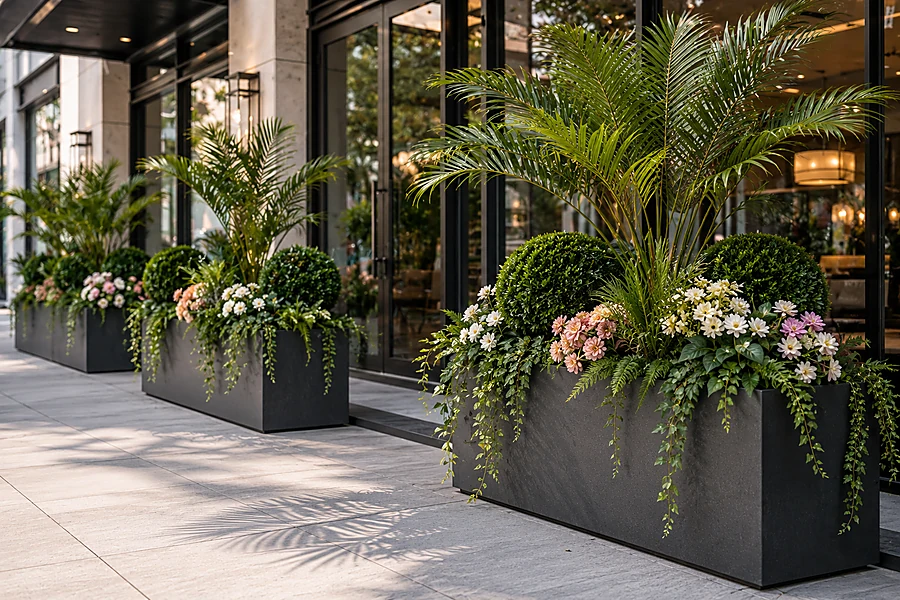
Large commercial planters shape walkways, entrances, privacy, and outdoor displays. Their safety depends on size, foliage height, weight, anchors, surfaces, drainage, traffic, and proper wind-resistant installation for reliable long-term performance.
Why Do Fake Flower Planters Fail Outdoors?
Fake flower planters do not need irrigation or growing soil, but they still face wind, rain, heat, vandalism, customer contact, cleaning equipment, and delivery damage.
Outdoor fake flower planters usually fail because they are too tall for their base, use loose or high-positioned ballast, lack mechanical anchoring, trap rainwater, hold poorly secured stems, or remain easy to lift and remove. Poor placement can also obstruct doors, exits, signs, and emergency equipment.
Height creates leverage
A tall palm, flowering tree, or dense artificial hedge creates a larger surface for wind to push against. The planter may feel heavy when lifted vertically but still overturn when force acts near the top.
The risk increases when the planter has:
- A narrow footprint
- Lightweight fiberglass or plastic construction
- Tall, dense foliage
- Large flower heads
- A raised false bottom
- Ballast placed near the top
- Wheels or slippery feet
- Placement near wind tunnels or building corners
A strong design keeps the center of gravity low. It also matches planter width and base geometry to the foliage’s projected area rather than choosing the smallest pot that hides the artificial stem.
Rainwater changes the load
An unplanned planter can collect water after rain or cleaning. This creates inconsistent weight and may cause odors, insects, staining, corrosion, freeze damage, or water release when the planter is moved.
Commercial planter guidance recommends planning drainage so water and debris do not collect on non-permeable surfaces. Manufacturers commonly provide drain-hole configurations or drainage fittings for exterior installations.
Rainwater should not be treated as dependable ballast. Its volume changes with weather, and uncontrolled water can move inside the planter.
Decorative inserts can separate from the planter
The planter may remain upright while the artificial tree or flower arrangement pulls out. This happens when stems are pushed only into light foam, loose gravel, or decorative moss.
Commercial installations need two levels of security:
- The planter must remain stable.
- The artificial floral insert must remain connected to the planter or internal frame.
Poor placement creates operational risk
Planters should not reduce required access or obstruct emergency routes. OSHA requires workplace exit routes to remain free and unobstructed. Fire-service guidance also identifies fixed planters or furniture blocking fire-department connections as a coordination problem.
| Common Failure | Likely Cause | Business Effect |
|---|---|---|
| Planter overturns | Narrow base, high center of gravity | Injury and property risk |
| Artificial tree pulls out | Stem held only by foam | Damaged display |
| Water pools inside | No outlet or blocked drain | Added weight, stains, insects |
| Planter moves across paving | No anchor or low friction | Blocked walkway |
| Flowers disappear | Entire insert lifts out | Replacement expense |
| Planter is stolen | Lightweight, unsecured unit | Inventory and brand loss |
| Door or exit is restricted | Poor location planning | Safety and compliance issue |
What Are the Seven Best-Practice Planter Fixes for 2025?
No single bag of sand or security cable solves every problem. Reliable installations use several controls together.
The seven fixes are stable planter selection, substrate-approved anchoring, low contained ballast, mechanically secured floral inserts, planned drainage, layered anti-theft protection, and documented placement and inspection. Each method should match the installation site.
Fix 1: Choose stable planter geometry
Begin with a planter that has a wide base, strong bottom, and enough internal space for both ballast and floral mechanics.
A tall narrow planter may suit a sheltered lobby entrance. It may be unsuitable for a rooftop, coastal walkway, or exposed restaurant terrace. Square and rectangular planters often provide a larger footprint, while rounded planters may reduce sharp corners in busy customer areas.
| Installation | Better Planter Direction |
|---|---|
| Exposed rooftop | Low, wide, compact planter |
| Hotel doorway | Weighted pair with controlled height |
| Retail walkway | Long rectangular trough |
| Restaurant divider | Wide planter with secured hedge insert |
| Covered entrance | Taller planter with hidden ballast |
| Temporary event | Modular base with approved removable weights |
The planter material must also tolerate the environment. Check impact resistance, UV performance, corrosion risk, cracking, base thickness, and whether the manufacturer permits drilling or anchoring.
Fix 2: Use a site-rated anchor
Mechanical anchoring is the strongest option when the planter must remain permanently in one location.
Possible systems include:
- Base plates fixed to concrete
- Concealed brackets
- Stainless-steel anchor bolts
- Ground anchors
- Wall or railing brackets
- Structural cables
- Manufacturer-designed anchor kits
The correct method depends on whether the surface is concrete, masonry, timber decking, rooftop membrane, pavers, or raised flooring. Anchors should not be installed blindly through waterproofing, utility lines, post-tensioned slabs, or protected architectural surfaces.
FEMA guidance reflects the broader safety principle that exposed equipment and accessories should be anchored for expected wind forces. For high-risk, rooftop, or public installations, the property team or qualified professional should determine the connection method.
Fix 3: Put contained ballast low in the planter
Ballast increases total weight, but its location matters. Heavy material placed at the bottom creates more stability than the same weight positioned near the top.
Useful contained ballast options include:
- Precast concrete blocks
- Sealed sandbags
- Steel plates
- Manufacturer-supplied weight plates
- Paver blocks
- Removable commercial ballast modules
Avoid loose sand or stones when they may shift, spill through drainage holes, block outlets, or make future maintenance difficult. Keep ballast mechanically contained and separate from decorative top dressing.
Do not copy a universal ballast weight from another project. Required weight depends on planter shape, foliage height, wind exposure, anchoring, surface friction, and site rules.
Fix 4: Secure the floral insert internally
Foam helps position stems, but foam alone should not be treated as a commercial anti-pullout system.
Use a rigid internal framework such as:
- Timber or recycled-plastic crossbars
- Metal grids
- Wire baskets
- Bolted stem sleeves
- Cable-tied internal frames
- Replaceable liner modules
- Steel base plates for large trunks
Secure the main trunk or stem cluster to the frame. Then use foam, moss, bark, or decorative stones only for shaping and appearance.
| Insert Type | Better Retention Method |
|---|---|
| Tall artificial tree | Trunk sleeve attached to base plate |
| Hedge panel | Internal rail and multiple ties |
| Flowering planter insert | Removable rigid liner with locking points |
| Mixed floral display | Wire grid over structural foam |
| Seasonal arrangement | Lockable drop-in cassette |
| Trailing greenery | Main stems secured before top dressing |
A removable liner is useful for hotels, retailers, and seasonal displays because staff can change the flowers without moving the anchored outer planter.
Fix 5: Build positive drainage
Fake plants do not need watering, but outdoor planters still need rainwater management.
A practical drainage system may include:
- Drain holes at the planter’s lowest points.
- Screened outlets to stop leaves and decorative filler from blocking them.
- Stand-offs or feet that keep holes open.
- A sloped internal base.
- Drain tubing where water must be directed away.
- Accessible cleanout points.
Commercial planter manufacturers note that drainage planning prevents water and debris from collecting on hard surfaces, and some offer factory-installed drainage holes or fittings.
Do not allow drainage water to create slip hazards, stain building finishes, flow across accessible routes, or discharge toward doorways. For indoor or semi-enclosed installations, use a sealed liner and controlled collection system instead of uncontrolled floor drainage.
Fix 6: Add layered anti-theft protection
Anti-theft works best when the display is difficult to lift, difficult to separate, identifiable, and visible.
Use several layers:
- Anchor the planter to the substrate.
- Connect the liner to the planter.
- Secure the main stem to the internal frame.
- Use tamper-resistant fasteners.
- Add a concealed steel cable.
- Mark the planter and insert with asset numbers.
- Maintain purchase photographs and serial records.
- Position valuable displays in visible, illuminated areas.
- Include the installation within existing CCTV coverage where lawful.
General police security guidance favors securing valuable movable property to a sturdy fixed point or immovable anchor. Applying that principle to commercial planters means the cable, bracket, or bolt must attach to structure—not merely another lightweight decorative object.
Security measures should not create exposed loops, sharp fasteners, or trip hazards.
Fix 7: Protect clearances and inspect routinely
A stable planter can become unsafe when moved by staff, contractors, wind, or customers. Mark the approved location and include planters in facilities inspections.
Check that each planter remains clear of:
- Exit doors and exit routes
- Fire-department connections
- Fire hydrants
- Sprinklers and alarms
- Accessible travel paths
- Vehicle sightlines
- Loading zones
- Utility access panels
- Door swings
- Floor drains
OSHA requires exit routes to remain unobstructed, while fire-service guidance specifically warns that fixed planters can interfere with emergency connections.
How Should Buyers Select Anchors, Ballast, and Drainage Systems?
Supplier descriptions such as “heavy planter,” “windproof,” or “commercial grade” are not complete specifications.
Buyers should select planter safety components by documenting planter dimensions, artificial foliage height, total weight, exposure, surface type, anchor compatibility, ballast location, drainage route, maintenance access, and removal requirements. Samples or prototypes should be tested at the planned site.
Use a site assessment form
| Site Question | Why It Matters |
|---|---|
| Is the location full sun or shaded? | Affects material aging |
| Is it exposed to wind? | Affects overturning risk |
| What is the substrate? | Controls anchor selection |
| Can the surface be drilled? | May limit permanent fixing |
| Is waterproofing present? | Prevents damaging the building envelope |
| Where will rainwater drain? | Controls staining and slip risk |
| Must the planter move seasonally? | Influences removable anchoring |
| Is the area open to the public? | Raises tampering and safety concerns |
| Are exits or fire connections nearby? | Requires protected clearance |
| Can staff access the internal liner? | Affects inspection and repair |
Ask suppliers for complete specifications
A strong planter supplier should provide:
- Empty planter weight
- Dimensions and base footprint
- Material and wall thickness
- Maximum recommended filled weight
- Drain-hole options
- Anchor-ready details
- Caster ratings, when fitted
- Recommended lifting method
- Indoor or outdoor rating
- Warranty exclusions
- Replacement parts
Tournesol, for example, notes that commercial planter drainage should be planned for the installation surface and that optional casters must be selected for the total filled weight. This illustrates why buyers must calculate the complete installed system rather than relying on the empty planter specification.
Build and test one prototype
Before ordering dozens of planters, create one finished unit using the actual:
- Planter
- Artificial flowers or tree
- Internal liner
- Ballast
- Anchor system
- Drainage components
- Decorative top dressing
Test normal cleaning, pulling on the foliage, moving nearby furniture, rain exposure, drainage, and authorized removal. Photograph the approved construction for installers.
Use a responsibility matrix
| Task | Supplier | Installer | Property Team |
|---|---|---|---|
| Confirm planter dimensions | ✓ | ✓ | |
| Provide anchor details | ✓ | ✓ | |
| Approve substrate penetration | ✓ | ||
| Install ballast | ✓ | ||
| Secure floral insert | ✓ | ✓ | |
| Confirm drainage route | ✓ | ✓ | |
| Maintain emergency clearances | ✓ | ✓ | |
| Inspect after severe weather | ✓ | ||
| Process theft or damage records | ✓ |
How Can Businesses Prevent Theft and Maintain Fake Flower Planters?
Anti-theft hardware is only one part of the solution. Good visibility, controlled access, documentation, and maintenance are also important.
Businesses can reduce fake flower planter theft by combining concealed anchors, secure liners, tamper-resistant hardware, asset identification, visible placement, lighting, and inspection. Maintenance teams should also check stability, drainage, foliage attachment, corrosion, and clearances after wind, rain, cleaning, or relocation.
Make theft slower and more visible
The goal is not to promise that theft is impossible. The goal is to increase the time, tools, effort, and visibility needed to remove the display.
Public-realm guidance emphasizes designing spaces to reduce opportunities for crime while keeping them welcoming rather than intimidating. Good lighting and visibility support this approach.
Avoid creating hidden spaces behind oversized planters. A planter used as a divider should not block staff sightlines or create a concealed area near doors, payment points, or loading spaces.
Separate replaceable and permanent parts
A useful commercial design has three layers:
| Layer | Recommended Treatment |
|---|---|
| Outer planter | Anchored or heavily ballasted |
| Inner liner | Locked, bolted, or cable-secured |
| Flower insert | Mechanically fixed but replaceable by staff |
This lets authorized staff replace faded flowers without removing the structural planter. It also makes opportunistic theft more difficult because the flower insert cannot simply be lifted out.
Use a maintenance schedule
| Timing | Inspection Task |
|---|---|
| Weekly | Check movement, missing flowers, debris, and blocked drains |
| Monthly | Inspect anchors, fasteners, ballast, liners, and labels |
| After strong wind | Check tilt, loosened stems, movement, and surface damage |
| After heavy rain | Confirm free drainage and remove standing water |
| After cleaning | Confirm planter has not been pushed into a walkway |
| Seasonally | Replace faded foliage and inspect corrosion |
| After relocation | Reapprove placement, stability, and clearances |
Record incidents and recurring defects
Track:
- Theft attempts
- Missing stems
- Loose fasteners
- Planter movement
- Blocked drains
- Standing water
- Trip complaints
- Cart or vehicle contact
- Wind-related damage
- Time needed for repairs
These records help buyers decide whether to increase ballast, change the foliage profile, strengthen anchoring, relocate the planter, or upgrade anti-theft components.
My insights: Fake Flower Planter 2025-7 Proven, Best-Practice Fixes for Anchors, Ballast, Drainage & Anti-Theft
Many buyers ask how much sand to put inside a fake flower planter. That question addresses only one part of the risk.
The strongest fake flower planter system in 2025 combines stable geometry, engineered anchoring, low contained ballast, secured floral inserts, positive drainage, layered anti-theft protection, and documented safety inspections. A planter should be treated as installed commercial equipment, not as a lightweight decorative pot.
The seven fixes must work together
My core insight is that each fix controls a different failure:
| Fix | Main Failure Controlled |
|---|---|
| Stable geometry | Overturning |
| Site-rated anchor | Sliding and lifting |
| Low contained ballast | High center of gravity |
| Secured floral insert | Stem or tree removal |
| Positive drainage | Standing water |
| Layered anti-theft | Unauthorized removal |
| Clearance and inspection | Operational and emergency obstruction |
A heavy planter can still tip when its base is narrow. An anchored planter can still lose its flower insert. A secure planter can still trap water. A theft-resistant planter can still create a blocked exit.
Buy the complete installed system
A B2B purchase order should identify:
- Outer planter dimensions and material
- Artificial foliage dimensions and weight
- Internal support frame
- Ballast type and location
- Anchor design
- Drainage configuration
- Anti-theft hardware
- Decorative top dressing
- Installation location
- Inspection and maintenance instructions
This prevents the planter supplier, artificial plant supplier, installer, and property manager from assuming another party will solve stability or drainage.
Avoid universal “windproof” claims
Planter stability is site-specific. A display that works under a covered shopping arcade may not work on a coastal terrace or high-rise rooftop.
Buyers should ask what conditions support the supplier’s claim. Useful evidence includes planter dimensions, total installed weight, anchor drawings, test conditions, wind assumptions, and written installation restrictions.
The safest installation remains serviceable
Permanent safety does not mean sealing everything forever. Staff should still be able to:
- Clear drains
- Inspect anchors
- Replace damaged flowers
- Reach internal fasteners
- Remove the planter with authorization
- Clean underneath when required
- Check asset labels
- Document maintenance
The best fake flower planter is therefore stable and secure, but also modular and maintainable. This approach protects customers, staff, inventory, property finishes, and long-term display value.
Conclusion
Fix fake flower planters with stable geometry, approved anchors, low contained ballast, secured inserts, positive drainage, anti-theft layers, clear placement, and documented inspections.