Brutal sunlight can turn ordinary artificial plants pale, brittle, and visibly fake. Choosing indoor-only greenery for an exposed space often leads to early replacement.
The strongest UV-resistant artificial plants for intense sun include boxwood panels, topiaries, palms, olive trees, cedar trees, eucalyptus, agave, yucca, ferns, ornamental grasses, lavender, and flowering planter inserts. Buyers should still verify outdoor materials, testing, installation limits, warranties, and maintenance because UV-resistant does not mean permanently fade-proof.
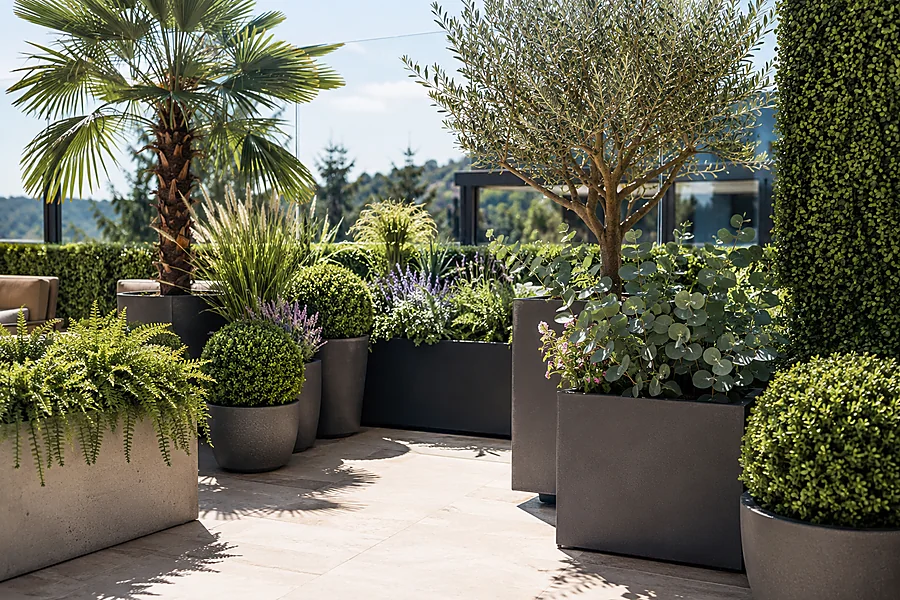
Outdoor faux plants should be labeled for exterior use and made from weather-resistant materials such as polyethylene, PVC, or suitable plastic blends. Most standard indoor artificial plants are not designed for prolonged outdoor exposure and may fade rapidly in direct sunlight.
What Makes an Artificial Plant Suitable for Brutal Outdoor Sun?
A plant can look realistic in a catalog while performing poorly on a sunny storefront, rooftop, pool deck, or hotel entrance.
A sun-ready artificial plant needs UV-stabilized materials, stable pigments, strong stems, secure leaves, weather-resistant construction, easy-clean surfaces, and installation hardware suited to wind and heat. Buyers should request product-specific evidence rather than trusting a general “outdoor” label.
UV protection should be part of the product
UV protection can be incorporated into the plastic during manufacturing or applied as a surface coating. Built-in stabilization is generally harder to remove through cleaning and weather exposure, while a surface treatment may wear gradually.
Buyers should ask whether protection applies to every component. A tree may have UV-treated leaves but untreated flowers, glue, stems, backing grids, or connectors. The finished product should be evaluated, not only a raw plastic sample.
| Product Feature | Strong Outdoor Specification | Warning Sign |
|---|---|---|
| Material | UV-stabilized PE, PVC, or outdoor polymer | Unidentified fabric or plastic |
| Color | Stable pigments with natural variation | Bright, flat, undocumented color |
| Leaves | Matte, flexible, securely attached | Thin, glossy, easily detached |
| Stems | Reinforced and shapeable | Brittle or weak joints |
| Base | Weighted or anchor-ready | Lightweight nursery pot |
| Documentation | SKU-specific test or warranty | Generic marketing statement |
| Cleaning | Wipeable or lightly washable | Surface becomes sticky or shiny |
One commercial supplier describes selected outdoor faux plants as using PE with inherent UV stabilization, with certain products tested to ASTM G154 and warranty support offered for qualifying orders. This is an example of the level of detail buyers can request, although every claim should be checked against the exact ordered SKU.
Laboratory hours are not outdoor years
ASTM G154 uses fluorescent UV lamps, heat, and moisture cycles to expose materials to accelerated weathering conditions. The standard provides operating procedures, but it does not create one universal pass result or automatically convert a test duration into a fixed number of outdoor years.
A claim such as “1,000 hours equals five years outside” needs validated correlation for the exact material, climate, test cycle, and failure criteria. Actual performance changes with sun intensity, temperature, moisture, pollution, orientation, and maintenance.
UV-resistant does not mean indestructible
All exterior synthetic materials age. Full afternoon sun usually creates more stress than filtered light beneath an awning. Reflective glass, dark walls, paved surfaces, salt air, and extreme heat can also increase exposure.
A stronger buying decision considers the complete environment:
| Outdoor Condition | Main Risk | Better Product Direction |
|---|---|---|
| Full direct sun | Fading and brittleness | Built-in UV-stabilized foliage |
| High reflected heat | Warping and joint failure | Thick, heat-tolerant plastic components |
| Windy rooftop | Tipping and stem damage | Compact foliage and weighted planters |
| Coastal location | Salt and hardware corrosion | Outdoor polymers and corrosion-resistant fittings |
| Dusty roadside | Dull surfaces | Broad, easy-clean leaves |
| High customer traffic | Contact and tampering | Reinforced stems and secured bases |
Which 12 UV-Resistant Artificial Plants Are the Strongest Choices?
The best plant type depends on the design goal. Structured hedges create privacy, trees provide height, and flowering inserts add seasonal color.
The 2025 power list includes 12 flexible artificial plant categories that work across hospitality, retail, restaurants, offices, residential properties, events, and public-facing outdoor installations when manufactured and installed for exterior use.
1. UV-resistant boxwood hedge panels
Boxwood panels provide fast, consistent coverage for walls, railings, privacy screens, restaurant boundaries, and branded photo zones. Their dense surface hides plain structures and can support signs or replaceable floral accents.
Choose panels with strong backing grids, secure leaf attachment, realistic two-tone color, and documented UV protection. Commercial-grade green-wall suppliers commonly separate UV-rated exterior products from indoor-only ranges and may offer longer warranties on qualifying panels.
2. Boxwood topiary trees
Ball, cone, and spiral topiaries frame hotel doors, retail entrances, restaurants, offices, and residential developments. Their controlled shape suits formal architecture and repeat installations across multiple locations.
Topiaries need weighted planters because their dense upper foliage can create wind leverage. Confirm that the trunk, internal frame, foliage, and outer pot are designed as one stable system.
3. Artificial palm trees
Faux palms create height and a relaxed resort atmosphere. They work well around hotel terraces, pools, beach clubs, restaurants, rooftop lounges, and lifestyle stores.
Select palms with flexible fronds, reinforced trunks, matte color, and wide or weighted bases. Avoid placing very tall, dense palms in exposed wind without professional anchoring.
4. Faux olive trees
Artificial olive trees suit cafés, boutique hotels, Mediterranean restaurants, apartment terraces, spas, and luxury retail. Their small leaves and open branching create a softer, less formal appearance than boxwood.
Olive trees work especially well in covered or partly shaded spaces where customers can appreciate their detailed branches and natural color variation.
5. Artificial cedar or cypress trees
Cedar and cypress-style trees provide narrow vertical greenery for entrances, walkways, building corners, and privacy layouts. Their compact shape is easier to position than a wide palm.
Outdoor shopping coverage in 2025 included artificial cedar trees among low-maintenance porch and patio options, alongside topiaries, hanging baskets, ferns, hydrangeas, and geraniums.
6. UV-resistant eucalyptus
Eucalyptus provides neutral greenery for restaurant patios, hotels, spas, wedding venues, and modern commercial displays. It works as a potted plant, garland, planter filler, or mixed arrangement component.
Choose matte leaves and reinforced wired stems. Eucalyptus is particularly useful as a reusable base that can accept replaceable seasonal flowers.
7. Artificial agave
Agave has a compact, architectural form that suits hot-climate designs, modern buildings, resort landscapes, and minimalist planters. Its broad leaves are easier to wipe than highly detailed foliage.
The plant’s low profile also reduces wind exposure compared with tall trees. Buyers should still inspect leaf tips for sharp or rigid edges in customer-facing areas.
8. Faux yucca
Yucca adds height without the wide canopy of a palm. It works for patios, office entrances, retail centers, hotels, and desert-inspired settings.
A good artificial yucca should have reinforced trunks, securely attached blades, a natural leaf gradient, and a planter that prevents tipping. It can be combined with agave and ornamental grasses for a layered dry-climate display.
9. Boston fern or outdoor hanging fern
Artificial ferns soften covered patios, hanging baskets, restaurant terraces, balconies, and shaded entrances. Their trailing shape helps break the hard lines of walls, rails, and commercial planters.
Because ferns contain many small leaves, they collect dust more quickly than broad-leaf plants. Buyers should prioritize washable, flexible foliage and easily accessible hanging systems.
10. Artificial ornamental grasses
Faux grasses provide movement and texture for long trough planters, privacy dividers, rooftop seating, walkways, and office terraces. Compact grass inserts can also be mixed with flowers or shrubs.
Choose products with secure blade attachment and enough variation to prevent a repeated plastic pattern. Their low profile makes them useful in windy locations when the planter is stable.
11. UV-resistant lavender
Artificial lavender adds controlled purple color to cafés, wellness spaces, residential balconies, hotel terraces, and retail planters. It is useful where buyers want flowering detail without heavy flower heads.
Lavender should have varied stem heights and muted tones. Very bright purple flowers often appear less realistic and may show fading more clearly.
12. UV-rated flowering planter inserts
Geraniums, hydrangeas, petunias, bougainvillea-style stems, and mixed hanging baskets add high-impact color to storefronts, window boxes, patios, and seasonal displays. These products were repeatedly featured in 2025 outdoor faux-plant selections because they deliver curb appeal with less routine plant care.
| Power-List Pick | Best Location | Main Advantage |
|---|---|---|
| Boxwood panel | Walls and privacy screens | Complete green coverage |
| Topiary tree | Entrances | Formal structure |
| Faux palm | Hotels and rooftop lounges | Height and resort style |
| Olive tree | Cafés and luxury terraces | Soft realism |
| Cedar or cypress | Doorways and pathways | Narrow vertical form |
| Eucalyptus | Restaurants and mixed planters | Flexible neutral greenery |
| Agave | Sunny modern spaces | Low architectural shape |
| Yucca | Hotels and commercial patios | Vertical desert style |
| Boston fern | Covered patios and baskets | Trailing softness |
| Ornamental grass | Troughs and dividers | Texture and movement |
| Lavender | Wellness and retail planters | Controlled color |
| Flowering inserts | Storefronts and window boxes | Strong curb appeal |
How Should Buyers Match Artificial Plants to Outdoor Conditions?
A top-performing plant in partial shade may fail in a full-sun rooftop installation. Site conditions should guide the selection before color or price.
Buyers should match artificial plants to sunlight, reflected heat, wind, rain, dust, customer traffic, planter weight, viewing distance, and maintenance access. The most realistic product is not the best choice when it cannot be cleaned, secured, or replaced efficiently.
Match plant type to exposure
| Site Condition | Strongest Options | Installation Priority |
|---|---|---|
| Full sun | Boxwood, topiary, agave, yucca, grasses | Documented UV stabilization |
| Partial shade | Olive trees, eucalyptus, palms, ferns | Close-up realism |
| Windy rooftop | Low grasses, agave, compact hedges | Heavy or anchored planters |
| Dusty entrance | Palms, agave, broad-leaf greenery | Easy cleaning |
| Covered restaurant patio | Olive, eucalyptus, ferns, lavender | Low maintenance and soft styling |
| Retail storefront | Topiary, boxwood, flowering inserts | Visibility and replaceable color |
| Luxury hotel | Palms, olive trees, topiary | Premium pots and scale |
Use fewer, stronger pieces
A pair of premium topiaries can create a better entrance than many small, weak plants. A single well-installed boxwood wall can provide more impact than scattered vines. A large olive tree in a properly scaled planter can anchor an entire seating area.
Commercial buyers should plan the visual hierarchy:
- Structure: boxwood, topiary, cedar, palm, or yucca
- Texture: eucalyptus, fern, grass, or olive foliage
- Color: lavender, geranium, hydrangea, or mixed floral inserts
This three-layer system makes displays easier to refresh. The structural greenery can stay in place while seasonal accent stems are replaced.
Plan the planter with the plant
A UV-resistant tree can still fail when its planter tips or traps rainwater. Buyers should confirm:
| Planter Check | Why It Matters |
|---|---|
| Base width | Controls overturning risk |
| Ballast location | Low weight improves stability |
| Drainage | Prevents standing water |
| Internal frame | Secures trunks and stems |
| Anchor options | Protects exposed installations |
| Surface finish | Supports the desired commercial style |
| Maintenance access | Allows repairs and cleaning |
For public spaces, planters should not block doors, exits, emergency equipment, accessible routes, or customer sightlines.
How Can Businesses Test and Maintain UV-Resistant Artificial Plants?
A supplier label should be the start of product evaluation, not the end. Samples, records, and routine maintenance protect long-term appearance.
Businesses should test outdoor artificial plants through product-specific documentation, sample exposure, color comparisons, bend tests, attachment checks, cleaning trials, and planter-stability reviews. Maintenance should include dusting, rotation, inspection, early replacement, and seasonal storage.
Request useful test evidence
Ask for the full report or specification, not only a certificate cover page. The document should identify:
- The exact tested SKU or material
- Test method and standard edition
- Exposure duration and cycle
- Lamp or light source
- Heat and moisture conditions
- Color-change criteria
- Structural observations
- Laboratory and report number
- Final result and product limitations
ASTM G154 is useful for accelerated comparison, but it needs defined exposure and evaluation conditions. Buyers should not compare results from different test cycles as though they are automatically equal.
Run a site sample trial
Place one sample in the planned installation, one in partial shade, and one indoors as a control. Photograph all three under similar lighting.
| Monthly Check | What to Record |
|---|---|
| Color | Fading, yellowing, or uneven tone |
| Surface | Chalkiness, stickiness, or cracking |
| Leaves | Detachment, curling, or brittleness |
| Stems | Warping and joint failure |
| Cleaning | Response to approved wiping |
| Base | Movement, water collection, or tipping |
| Photography | Visible difference in customer-facing images |
A site test cannot replace laboratory testing, but it helps buyers determine whether a product suits their exact sunlight, heat, wind, and maintenance conditions.
Maintain the display before it looks tired
| Timing | Maintenance Task |
|---|---|
| Weekly | Remove debris and check loose parts |
| Every 2–4 weeks | Wipe or brush dust from foliage |
| Monthly | Rotate movable planters |
| After storms | Inspect anchors, bases, stems, and panels |
| Seasonally | Replace faded accent flowers |
| After campaigns | Clean, reshape, label, and store reusable items |
UV-protected products may have different warranties. One published commercial warranty covers qualifying green-wall products for five years against excessive fading, cracking, and failure, while individual plants and trees receive different coverage. Indoor-only products are excluded.
This shows why buyers should check the exact SKU, warranty duration, installation conditions, exclusions, remedy, freight responsibility, and whether coverage is prorated.
My insights: Which 12 UV-Resistant Artificial Plants Are the Strongest 2025 Choices for Brutal Sun
Many buyers search for one plant that will remain perfect forever. No artificial plant can honestly promise unlimited performance under every outdoor condition.
The strongest 2025 choices are the plants that combine suitable geometry, documented UV materials, realistic construction, secure installation, easy maintenance, and replaceable components. Boxwood, topiary, palms, olive trees, cedar, eucalyptus, agave, yucca, ferns, grasses, lavender, and flowering inserts cover most commercial outdoor needs.
The power list is a system, not only 12 plant names
My main insight is that plant type alone does not determine outdoor success. A UV-rated boxwood panel may perform well, while an indoor-only boxwood panel may fade rapidly. A compact artificial agave may remain stable, while an unsecured tall palm may become a wind hazard.
Buyers should judge each product through six controls:
| Control | Buyer Requirement |
|---|---|
| Material | Outdoor-safe and UV-stabilized |
| Evidence | Test information for the actual SKU |
| Exposure | Matched to sun, heat, wind, and moisture |
| Installation | Weighted, secured, and drainage-aware |
| Maintenance | Cleanable, inspectable, and replaceable |
| Warranty | Clear coverage, exclusions, and remedy |
Choose by role
Use boxwood panels and topiaries for structure. Use palms, olive trees, cedar, and yucca for height. Use eucalyptus, ferns, and grasses for texture. Use lavender and mixed flowering inserts for color. Use agave where low, sculptural greenery is safer than a tall tree.
This method creates modular displays. Buyers can retain the expensive structural components and replace only the accents that fade or become damaged.
Strong warranties need precise terms
A “five-year UV warranty” has limited value when it does not identify covered SKUs, acceptable fading, installation conditions, or remedies. Buyers should request written terms covering excessive color change, cracking, brittleness, foliage loss, and structural failure.
They should also confirm exclusions for extreme weather, incorrect installation, reflected heat, chemical cleaning, coastal exposure, and unauthorized product modification.
The strongest 2025 buying rule
Do not buy “UV resistance” as a marketing phrase. Buy a complete outdoor-performance system.
The product should match the exposure. The planter should hold it securely. The supplier should provide evidence. The maintenance team should keep it clean. The warranty should explain what happens when performance falls below the agreed standard.
That is how these 12 UV-resistant artificial plants can deliver dependable visual value under brutal sun.
Conclusion
Choose UV-resistant artificial plants by material, exposure, testing, stability, maintenance, and warranty—not appearance alone. The right system keeps outdoor greenery realistic for longer.