
Silk flowers and faux plants may look similar online, but choosing the wrong product can create problems with realism, weather resistance, cleaning, packing, and durability.
The five biggest differences between silk flowers and faux plants are product scope, materials, realism, outdoor durability, and commercial use. Silk flowers usually focus on soft flowering stems and arrangements, while faux plants cover a broader category of artificial trees, foliage, grasses, succulents, hedges, and flowers made from fabric or molded polymers.
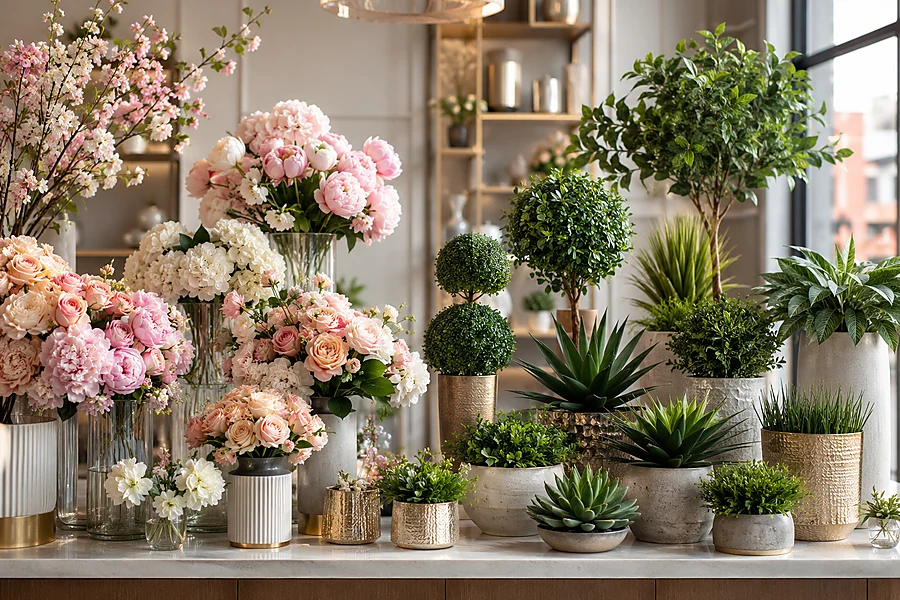
The name “silk flower” can also be misleading. Modern artificial flowers may use polyester, rayon, PE, PU, PVC, coatings, wire, and adhesives rather than natural silk. In the U.S., the FTC specifically lists flowers made of fabric among products not covered by Textile Act labeling requirements, so professional buyers should request actual material specifications instead of relying on the word “silk.”
What Exactly Are Silk Flowers and Faux Plants?
“Silk flower” describes a narrower product style, while “faux plant” is a much broader commercial category. Confusing the terms can lead buyers to compare products designed for completely different applications.
Silk flowers are artificial floral products that usually emphasize soft petals, realistic colors, and decorative arrangements. Faux plants include almost every manufactured botanical imitation, including flowers, trees, palms, shrubs, grasses, succulents, hanging greenery, hedges, and green-wall panels. A silk flower can therefore be a faux botanical, but not every faux plant is a silk flower.
Silk flowers are mainly floral products
Typical silk-flower categories include:
- Roses
- Peonies
- Hydrangeas
- Orchids
- Tulips
- Ranunculus
- Poppies
- Dahlias
- Magnolia flowers
- Wedding bouquets
- Floral garlands
- Flower-wall accents
The main visual goal is normally petal realism. Buyers pay attention to layering, edge shape, color gradients, flower centers, stem flexibility, and how the bloom appears in photographs.
Despite the name, modern “silk-style” flowers often use synthetic fabric. Wayfair’s material guide distinguishes genuine silk from faux-silk products made from synthetic materials such as rayon or polyester, and also identifies polyester as a common material for artificial flowers.
Faux plants cover a wider category
Faux plants can include flowers, but they also include non-flowering botanical products.
| Faux Plant Category | Typical Products |
|---|---|
| Artificial trees | Olive, ficus, maple, magnolia |
| Palms | Areca, kentia, fan palm |
| Greenery | Eucalyptus, monstera, fern |
| Succulents | Agave, aloe, echeveria |
| Grasses | Pampas-style foliage, ornamental grasses |
| Topiary | Boxwood balls, cones, spirals |
| Hedges | Boxwood and privacy screens |
| Green walls | Mixed foliage and boxwood panels |
| Hanging plants | Ivy, pothos, fern |
| Flowers | Roses, orchids, peonies, hydrangeas |
This wider product range explains why faux-plant manufacturers frequently rely more heavily on molded PE, PVC, PU, polymer blends, metal frames, plastic trunks, and structural bases.
What Are the Five Biggest Differences Between Silk Flowers and Faux Plants?
The buyer should compare complete products rather than treating every artificial botanical as the same thing.
The five most important differences are scope, material construction, type of realism, environmental durability, and commercial handling. Silk flowers usually perform best where soft floral detail matters. Molded faux plants often perform better where structural foliage, repeated cleaning, outdoor exposure, or large permanent installations are required.
Difference 1: Product scope
This is the simplest difference.
Silk flowers are primarily flowers. Faux plants are an entire botanical category.
A wedding wholesaler may buy 5,000 silk-style rose stems. A hotel project may buy artificial olive trees, orchids, palms, grass inserts, and wall panels under one faux-plant program.
| Buyer Need | Better Starting Category |
|---|---|
| Bridal bouquet | Silk-style flowers |
| Wedding centerpiece | Silk flowers or real-touch flowers |
| Hotel lobby tree | Faux plant |
| Privacy hedge | Faux plant |
| Artificial green wall | Faux plant |
| Outdoor planter greenery | Faux plant |
| Flower arch | Silk flowers plus faux greenery |
| Restaurant table orchid | Silk-style or real-touch flower |
For mixed installations, buyers often need both categories.
Difference 2: Material construction
Silk flowers usually depend on thin, flexible petals. Faux foliage often needs stronger molded components.
Common silk-flower construction may include:
- Polyester fabric petals
- Printed fabric
- PU or latex-style coatings
- Molded plastic centers
- PE leaves
- Metal stem wire
- Adhesive
- Plastic stem coverings
Common faux-plant construction may include:
- PE leaves
- PVC leaves
- PU real-touch surfaces
- Polyester foliage
- Metal branches
- Fiberglass trunks
- Natural wood trunks
- Plastic backing grids
- Structural metal frames
The important buyer lesson is simple:
Do not purchase based on the word “silk,” “plastic,” or “faux.” Request a component-by-component material specification.
The FTC’s textile guidance is especially relevant here because fabric flowers are specifically excluded from the Textile Act’s normal labeling requirements. Buyers cannot assume the decorative product will automatically provide the same fiber-content information expected from covered clothing or household textiles.
Difference 3: The type of realism
Silk flowers usually win when the buyer needs soft layered petals. Faux plants can win when shape, structure, leaf texture, and botanical scale matter more.
Architectural Digest recommends fabric artificial flowers when realism is the priority, while noting that good plastic products can also be convincing. It also recommends individual stems because they give the buyer more control over arrangement realism.
Silk flowers are strongest for:
- Petal layering
- Wedding photography
- Bouquets
- Romantic arrangements
- Soft flower movement
- Detailed color gradients
- Large flower heads
Molded faux plants are strongest for:
- Leaf veins
- Structured shapes
- Succulents
- Palm fronds
- Boxwood
- Grasses
- Large trees
- Commercial hedges
A high-quality molded PE agave can look more convincing than a fabric version because a real agave naturally has firm, structured leaves.
Likewise, a premium polyester peony can look better than a thick molded-plastic peony because real peonies have thin layered petals.
The best material depends on what natural characteristic the manufacturer is trying to reproduce.
Difference 4: Outdoor durability
This is one of the most important differences for commercial buyers.
Ordinary fabric silk flowers are generally intended for indoor or sheltered decoration. Sunlight, rain, moisture, wind, and repeated outdoor cleaning can damage delicate petals and dyes.
For exposed exterior environments, buyers should look for products specifically designed for outdoor use.
Current outdoor guidance recommends UV-resistant, weatherproof faux plants made from materials such as PE, PVC, or suitable polymer blends rather than assuming ordinary indoor artificial plants can tolerate continuous exterior exposure.
Outdoor faux plants featured in 2025 buying coverage included UV-resistant hydrangeas, topiary trees, geraniums, cedar trees, ferns, and other products designed for porches and patios.
| Environment | Silk Flowers | Outdoor Faux Plants |
|---|---|---|
| Indoor wedding | Excellent | Excellent as greenery |
| Hotel lobby | Excellent | Excellent |
| Retail window | Excellent | Excellent |
| Covered restaurant | Good | Excellent |
| Outdoor full sun | Usually weak unless specifically rated | Better when UV-rated |
| Rooftop | Limited | Suitable products available |
| Coastal terrace | High-risk without special specification | Better with verified materials |
| Outdoor hedge | Not practical | Strong use case |
UV claims still need evidence
“Plastic” does not automatically mean UV-resistant.
Buyers should request finished-product weathering information. ASTM G155-25 uses controlled xenon-arc light, heat, and optional moisture to evaluate weathering effects, but ASTM explicitly states that the practice by itself does not produce a specific pass result and allows exposure conditions that can generate significantly different outcomes.
Therefore, ask:
- Which SKU was tested?
- What material was tested?
- Was the finished plant tested?
- Which test cycle was used?
- How long was exposure?
- How was fading measured?
- Was cracking evaluated?
- What acceptance limit was used?
- What does the warranty cover?
Difference 5: Commercial handling and maintenance
Silk flowers and faux plants also behave differently after purchase.
Silk-style blooms may need careful reshaping after tight carton packing. Large flower heads can crease. Fabric petals can collect dust and may not tolerate aggressive washing.
Molded foliage is often easier to wipe and may recover better from normal commercial handling. However, large faux plants create different problems, including bulky cartons, planter stability, branch assembly, and storage space.
| Commercial Issue | Silk Flowers | Faux Plants |
|---|---|---|
| Shipping volume | Usually low–moderate | Can be high for trees |
| Petal crushing | Major concern | Usually lower |
| Branch bending | Moderate | Major for trees |
| Cleaning | Gentle cleaning | Often easier to wipe |
| Storage | Flower heads need protection | Trees need more space |
| Installation | Usually simple | May require planters or anchors |
| Replacement | Individual stems easy to replace | Modules/branches may be needed |
| Color assortment | Very broad | Usually more greenery-focused |
For wedding and event companies, silk flowers are easy to separate into reusable bouquets, garlands, centerpieces, and arch arrangements.
For hotels, offices, shopping centers, and restaurants, faux plants often behave more like long-term decorative assets.
Which Option Is Better for Weddings, Hotels, Homes, and Outdoor Décor?
There is no single winner. The better choice depends on whether the buyer needs floral softness or structural greenery.
Silk flowers are usually better for weddings, bouquets, indoor arrangements, seasonal flowers, and close-up styling. Faux plants are usually better for trees, foliage, commercial planters, green walls, privacy screens, and exterior greenery. The strongest hotel and event installations often combine both categories.
Weddings and events
I would prioritize silk-style or real-touch flowers when guests will view products closely.
Good options include:
- Roses
- Peonies
- Orchids
- Hydrangeas
- Ranunculus
- Tulips
Then I would add molded faux foliage for structure:
- Eucalyptus
- Ferns
- Olive branches
- Ivy
- Boxwood
- Grasses
This hybrid construction gives designers softness and structure without forcing one material to perform every role.
Hotels and restaurants
Hotels can use silk flowers for reception desks and restaurant tables while using faux trees and greenery for larger architectural zones.
For example:
| Hotel Area | Better Product |
|---|---|
| Reception desk | Silk-style orchids |
| Guestroom | Small faux plant or flowers |
| Lobby corner | Artificial olive tree |
| Restaurant divider | Faux grass or hedge |
| Green wall | Molded faux foliage |
| Ballroom event | Silk flower installation |
| Outdoor entrance | UV-rated faux greenery |
Homes and retail interiors
For shelves, coffee tables, dining spaces, and decorative vases, silk flowers provide flexible color.
Faux trees work better when the room needs height and architectural scale.
A practical combination might use one artificial olive tree in a corner and a small seasonal flower arrangement on the dining table.
Outdoor projects
For permanent outdoor use, I would normally begin with outdoor-specific faux plants rather than traditional silk flowers.
Good categories include:
- Agave
- Yucca
- Boxwood
- Eucalyptus
- Grasses
- Topiary
- Palms
- Artificial hedges
Colored flowers can be added as replaceable seasonal modules.
This approach keeps the long-life greenery in place while allowing more vulnerable flower accents to be replaced individually.
How Should Buyers Choose High-Quality Silk Flowers and Faux Plants?
Catalog images hide many defects. Buyers should physically test samples before approving wholesale orders.
Buyers should compare silk flowers and faux plants by material accuracy, botanical realism, color, construction, cleaning performance, packaging recovery, UV requirements, safety documentation, and reorder consistency. The best product is the one designed for its actual environment—not simply the product described as “premium,” “silk,” or “realistic.”
Use a quality checklist
For silk flowers, inspect:
- Petal material.
- Petal edges.
- Color gradients.
- Flower-center detail.
- Flower-head attachment.
- Visible glue.
- Stem flexibility.
- Fabric fraying.
- Packaging recovery.
- Photography under real lighting.
For faux plants, inspect:
- Leaf material.
- Matte versus glossy finish.
- Botanical leaf shape.
- Branch placement.
- Trunk realism.
- Leaf attachment.
- Stem strength.
- Planter stability.
- Cleaning response.
- UV documentation for outdoor products.
Request samples for the actual application
A showroom sample can look excellent but fail after packing, cleaning, or sun exposure.
Test samples in the intended environment.
| Sample Test | Why It Matters |
|---|---|
| Daylight | Reveals unnatural shine |
| Warm hotel lighting | Shows unwanted yellow tones |
| Camera test | Reveals flat colors and construction |
| Bend test | Checks stems and branches |
| Shake test | Finds weak attachments |
| Cleaning test | Checks color transfer and coatings |
| Repacking test | Measures recovery |
| Outdoor test | Provides real-site comparison |
Compare lifecycle cost
A premium silk flower may cost more than a basic fabric flower but require fewer replacements.
A larger commercial faux tree may cost more upfront but remain in service longer than several cheap alternatives.
Calculate:
Total cost = purchase + shipping + installation + reshaping + cleaning + repairs + storage + replacement
This matters especially for:
- Hotels
- Event rental businesses
- Wedding suppliers
- Restaurants
- Retail chains
- Property managers
- Artificial flower wholesalers
The lowest unit price is rarely enough information.
My insights: What Are the 5 Best Differences Between Silk Flowers and Faux Plants Every Buyer Must Know
Many buyers treat “silk flower” and “faux plant” as competing products. I think that is the wrong way to compare them.
The five differences buyers should remember are scope, materials, realism, outdoor performance, and commercial handling. Silk flowers specialize in soft floral detail. Faux plants provide a broader material and product system for greenery, trees, walls, and permanent installations. The strongest projects often combine both instead of choosing only one.
My five-difference buyer matrix
| Difference | Silk Flowers | Faux Plants | Buyer Priority |
|---|---|---|---|
| 1. Scope | Primarily floral | Entire artificial botanical category | Match product to project |
| 2. Material | Often fabric/polyester-based | PE, PVC, PU, fabric and hybrid | Request true specification |
| 3. Realism | Strong petal softness | Strong foliage structure | Consider viewing distance |
| 4. Outdoor use | Usually indoor/sheltered | Outdoor-rated versions widely available | Verify UV evidence |
| 5. Operations | Easy modular floral replacement | Better for permanent greenery | Calculate lifecycle cost |
The biggest mistake is buying by name
“Silk flower” does not guarantee actual silk.
“Faux plant” does not mean plastic-only.
“Real touch” does not guarantee UV resistance.
“Outdoor” does not tell the buyer how long a product will maintain acceptable color.
“Premium” does not define construction quality.
The buyer should convert every marketing label into a specification.
Instead of asking:
Is this a high-quality silk flower?
Ask:
What are the petal, leaf, stem, coating, wire, and adhesive materials, and what quality controls apply to bulk production?
Instead of asking:
Is this faux tree outdoor-safe?
Ask:
Which components are UV-stabilized, what weathering method was used, what changes were measured, and what does the written warranty cover?
Use silk flowers for emotion and faux plants for structure
This is my simplest sourcing rule.
Silk flowers create floral emotion. Faux plants create botanical structure.
Use silk-style roses and peonies for weddings, tables, romantic displays, and seasonal color.
Use artificial olive trees, palms, boxwood, eucalyptus, grasses, and hedges when the project needs height, volume, screening, or permanent greenery.
Then combine them where both qualities matter.
A wedding arch can use durable faux greenery as its structural layer and silk flowers as replaceable focal accents.
A hotel lobby can use a permanent faux olive tree and seasonal silk-flower arrangements.
A restaurant terrace can use UV-rated greenery with removable floral inserts.
This hybrid model improves flexibility because buyers do not force fragile flowers into high-risk applications or use hard molded foliage where soft petals would look more realistic.
Final buyer rule
Do not ask whether silk flowers or faux plants are universally better.
Ask:
Which product reproduces the natural characteristic I need, survives the installation environment, ships safely, cleans efficiently, and remains consistent across repeat orders?
That question leads to better sourcing decisions than any product label.
Conclusion
Silk flowers lead in soft floral realism, while faux plants lead in botanical range and durability. Smart buyers choose by materials, environment, use, and lifecycle cost.