
Fresh flowers are beautiful, but wilting, maintenance, seasonal limits, and replacement costs can make them difficult for long-term décor and commercial projects.
Faux flowers mean artificial flowers made to copy natural blooms. They can be the best choice when buyers need reusable, low-maintenance, allergy-conscious, season-independent décor. Fresh flowers remain better when natural fragrance, organic movement, local seasonality, and genuine botanical character are the main priorities.
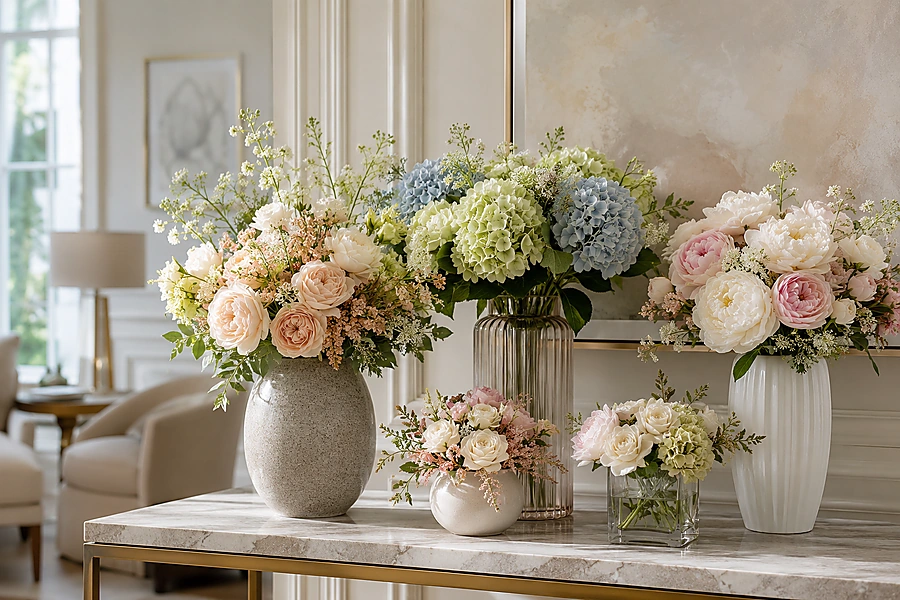
Modern faux flowers are no longer limited to shiny plastic petals. Better designs now use layered fabric, molded polymers, realistic color variation, flexible stems, and natural-touch surfaces. Vogue reports that artificial floral designs have become more realistic and luxurious, helping them gain wider acceptance in homes and events.
What Does Faux Flowers Mean?
The word “faux” can make a product sound more luxurious than “fake,” but both terms describe something created to imitate the real item.
Faux flowers are decorative flowers made by people rather than grown naturally. “Faux” comes from the French word for false or fake. In modern décor, the term usually refers to higher-quality artificial flowers designed to imitate the color, texture, shape, and movement of fresh blooms.
Faux, fake, silk, and artificial flowers
The terms are often used interchangeably, but they can create different expectations.
Merriam-Webster defines “faux” as artificial or imitation, while Oxford describes artificial products as things made to copy something natural rather than being natural themselves.
| Term | Common Meaning | Typical Buyer Expectation |
|---|---|---|
| Faux flowers | Artificial flowers with a décor-focused description | Stylish or realistic appearance |
| Fake flowers | General everyday term | Any non-natural flower |
| Artificial flowers | Formal product category | Man-made floral products |
| Silk flowers | Fabric-petal artificial flowers | Soft, layered petals |
| Real-touch flowers | Artificial flowers with a natural-feeling surface | Premium tactile realism |
| Preserved flowers | Real flowers treated to extend their life | Natural material with limited maintenance |
| Dried flowers | Natural flowers dried after harvesting | Organic texture and muted color |
Are faux flowers always made from silk?
No. “Silk flowers” originally referred more closely to textile-based flowers, but most products sold under that name today use polyester or other synthetic fabrics. Modern artificial flowers may also contain polyethylene, PVC, polyurethane, latex-style coatings, metal wire, foam, glue, paint, and molded plastic.
This matters because material affects how the flower looks and performs.
| Material | Common Use | Main Strength |
|---|---|---|
| Polyester fabric | Roses, peonies, hydrangeas | Soft layered petals |
| Polyethylene | Leaves, greenery, outdoor plants | Durability and easy cleaning |
| Polyurethane | Real-touch petals | Natural surface feel |
| PVC | Pine, leaves, structured components | Shape retention |
| Latex-style coating | Orchids and premium flowers | Flexible realistic texture |
| Metal wire | Stems and branches | Allows natural shaping |
A buyer should not assume that “faux,” “silk,” or “real touch” guarantees quality. These descriptions do not confirm material grade, UV resistance, color stability, secure construction, or commercial durability.
Why has the meaning changed?
“Fake flowers” once suggested stiff plastic blooms and unrealistic colors. The modern term “faux florals” often describes a more design-led product category. Current high-quality options can include natural color gradients, detailed veins, irregular petal shapes, wired stems, and realistic bloom stages.
Design coverage in 2025 and 2026 reflects this change. Vogue noted that improved materials and lifelike variation have made people more open to artificial florals, while Veranda reported that realistic faux greenery now appears across homes, restaurants, and high-end event venues.
What Are the Main Advantages and Disadvantages of Artificial Flowers?
Artificial flowers solve several problems, but they also create trade-offs. Their value depends on where, how often, and how long they will be used.
The main advantages of artificial flowers are longevity, reusability, predictable appearance, seasonal availability, and low routine care. Their disadvantages include no natural fragrance, possible plastic waste, dust accumulation, fading, storage needs, and the risk of looking unrealistic when quality or styling is poor.
Advantages of faux flowers
1. They do not wilt
Artificial flowers maintain their basic form without water. This is helpful for hotel lobbies, retail windows, wedding rentals, office receptions, restaurants, model homes, and long-running events.
2. They can be prepared early
Fresh floral installations often depend on tight delivery and setup schedules. Artificial arrangements can be designed, photographed, labeled, packed, and approved before the installation day.
3. They are reusable
A wedding arch, table garland, flower wall, or reception arrangement can be reused when its materials and construction are durable. Reuse is especially valuable for event rental businesses and hospitality groups.
4. They offer year-round availability
Peonies, tulips, hydrangeas, orchids, and other flowers can be used regardless of local growing season. Buyers can also repeat an approved color palette across multiple venues or branches.
5. They need less routine care
Faux flowers do not require watering, trimming, refrigeration, or removal of wilted petals. They still need dusting, reshaping, repairs, and suitable storage.
| Advantage | Home Benefit | B2B Benefit |
|---|---|---|
| Long display life | Less frequent replacement | Stable customer-facing décor |
| No watering | Easier daily care | Lower routine staff workload |
| Early preparation | Stress-free event setup | Better production scheduling |
| Reusability | Seasonal restyling | Rental and inventory value |
| Consistent colors | Coordinated interiors | Repeatable brand presentation |
| Year-round products | Any flower in any season | Predictable sourcing |
Disadvantages of faux flowers
1. Low-quality products can look obvious
Glossy leaves, flat colors, repeated petal shapes, exposed glue, and stiff stems weaken realism. Artificial flowers viewed at close range need better materials and more careful styling.
2. They collect dust
Faux flowers do not decay, but they still become dirty. Hotel, restaurant, retail, and outdoor installations need scheduled cleaning.
3. Outdoor products can fade
Indoor artificial flowers may discolor or become brittle in direct sunlight. Exterior buyers need products specifically rated for UV and weather exposure.
4. Storage can damage them
Large peonies, hydrangeas, garlands, and flower panels can be crushed in tight cartons. Reusable products need clean, dry, clearly labeled storage.
5. They have no natural scent
Fragrance is part of the experience of fresh roses, lavender, jasmine, lilies, and garden flowers. Artificial flowers reproduce appearance, not the complete sensory experience.
6. Sustainability is not automatic
Many artificial flowers contain plastic, coatings, wire, adhesives, and mixed materials that are difficult to recycle. Fresh cut flowers also have environmental impacts from cultivation, heating, irrigation, chemicals, refrigeration, packaging, transport, and waste. A review of cut-flower life-cycle studies found that environmental impacts can occur across production, post-harvest handling, transportation, consumer use, and disposal.
Artificial flowers should therefore not be called environmentally superior without evidence. The Associated Press reported that artificial products are sometimes promoted as sustainable alternatives, but experts caution that plastic content, manufacturing, importing, and actual reuse must be considered.
When Are Faux Flowers Better Than Fresh Flowers?
The best choice depends on the project. Faux flowers perform well when consistency, preparation, reuse, and low maintenance matter more than natural fragrance and organic change.
Faux flowers are usually better for reusable events, long-term displays, low-light interiors, early installations, seasonal consistency, and allergy-conscious spaces. Fresh flowers are usually better for intimate gifts, fragrance-led experiences, local seasonal designs, and occasions where natural beauty is more important than reuse.
Choose faux flowers for long-term commercial décor
Hotels, retailers, restaurants, offices, malls, spas, apartments, and property managers often need décor that looks ready every day. Artificial arrangements can remain in place while staff handle routine dusting and inspection.
Suitable commercial uses include:
- Hotel lobby statement arrangements
- Reception-desk orchids
- Restaurant table centerpieces
- Retail window garlands
- Shopping-center flower walls
- Office reception greenery
- Model-home arrangements
- Event rental bouquets
- Reusable wedding arches
- Seasonal storefront planters
Choose faux flowers for complex event logistics
Artificial flowers can be useful when arrangements must be assembled early, transported long distances, installed in warm conditions, or reused at several events.
An event business may create one floral collection containing:
| Floral Product | Reuse Opportunity |
|---|---|
| Bridal bouquet | Styled shoots and rental packages |
| Bridesmaid bouquets | Multiple wedding orders |
| Ceremony arch | Weddings, launches, and photo zones |
| Table garlands | Banquets and corporate events |
| Flower wall | Retail, weddings, and brand activations |
| Staircase swag | Hotels and holiday installations |
Faux flowers also make design revisions easier. Stems can be removed, bent, recolored through accents, or combined with new greenery without rebuilding the full installation.
Choose fresh flowers for natural sensory value
Fresh flowers provide fragrance, softness, natural movement, and unique variation. They also connect an event to a season, location, grower, or cultural tradition.
Fresh flowers may be the stronger choice for:
- Personal gifts
- Locally grown wedding flowers
- Fragrance-focused dining experiences
- Seasonal garden celebrations
- Botanical exhibitions
- Small intimate tables
- Compostable floral programs
- Designs where natural aging is part of the experience
Consider a hybrid arrangement
The decision does not need to be completely artificial or completely fresh. A hybrid design can use durable faux flowers for volume and structure, then add fresh seasonal flowers, branches, herbs, or greenery.
Homes & Gardens has highlighted mixed arrangements that combine fresh and artificial blooms to improve realism and extend display life.
| Project Need | Better Choice |
|---|---|
| One-day fragrance-led dinner | Fresh |
| Multi-week hotel lobby display | Faux |
| Reusable wedding-rental arch | Faux |
| Locally grown seasonal ceremony | Fresh |
| Large installation with limited setup time | Faux or hybrid |
| Premium centerpiece viewed closely | Fresh, PU faux, or hybrid |
| Outdoor full-sun planter | UV-rated faux |
| Sustainability-focused project | Compare the full lifecycle |
How Can Buyers Choose Artificial Flowers That Look Realistic?
The best faux flowers imitate natural variation rather than perfect symmetry. Product selection and styling both affect the result.
Choose realistic artificial flowers by checking petal texture, color gradients, matte leaves, flexible wired stems, secure flower heads, natural scale, mixed bloom stages, and performance under real lighting. Samples should be opened, shaped, photographed, cleaned, packed, and tested before bulk ordering.
Check texture and color
Real flowers rarely have one flat color. A rose may be darker in the center. A hydrangea may include green, cream, blue, or pink variations. An orchid may have spots, veins, or a different-colored throat.
Choose products with:
- Soft color transitions
- Slight petal variation
- Matte rather than glossy leaves
- Natural flower-head dimensions
- Clean edges
- Hidden glue points
- Realistic centers
- Flexible stems
Test the sample under several conditions
A flower may look realistic in a supplier’s studio and too shiny under hotel lighting. Review samples in daylight, warm indoor light, cool retail lighting, and camera flash.
| Sample Test | What to Check |
|---|---|
| Daylight test | Color and material realism |
| Warm-light test | Yellowing or unwanted shine |
| Photography test | Flat colors and visible construction |
| Touch test | Petal texture and flexibility |
| Bend test | Stem strength and shaping |
| Shake test | Loose heads and leaves |
| Cleaning test | Color transfer and surface damage |
| Packaging test | Recovery after compression |
Style flowers like living blooms
Even premium flowers can look fake when every stem is straight and every bloom sits at the same height.
For a more natural result:
- Bend stems gently.
- Rotate flower heads in different directions.
- Mix open flowers with buds.
- Vary the stem heights.
- Add realistic greenery.
- Leave controlled negative space.
- Use a properly scaled vase.
- Hide foam and mechanics.
- Keep petals clean.
Real flowers have irregularity. Controlled imperfection helps faux flowers look more convincing.
Match quality to viewing distance
A flower wall viewed from several meters away may prioritize fullness, color, and installation strength. A bridal bouquet requires close-up petal realism. A hotel reception orchid must look good when guests stand beside it.
| Viewing Situation | Main Quality Priority |
|---|---|
| Bridal bouquet | Petal texture and natural color |
| Hotel reception | Close-up realism and easy cleaning |
| Retail window | Strong silhouette and visible color |
| Ceiling installation | Low weight and secure construction |
| Flower wall | Density and repeatable panel coverage |
| Outdoor planter | UV resistance and cleanability |
| Event rental | Durability and reshaping |
My insights: Faux Flowers Meaning—Are Artificial Flowers the Best Choice
The meaning of faux flowers is simple: they are artificial versions of natural flowers. Deciding whether they are the best choice requires a more complete answer.
Artificial flowers are the best choice when their strengths match the project. They deliver consistency, longevity, early preparation, reuse, and low routine care. They are not automatically better than fresh flowers, more sustainable, or more luxurious. Product quality, use frequency, styling, storage, and end-of-life planning determine their real value.
The best choice is based on performance
My main insight is that buyers should stop asking whether artificial flowers are universally better. They should ask what the flowers need to accomplish.
| Decision Question | Faux Advantage | Fresh Advantage |
|---|---|---|
| How long must the display last? | Weeks, months, or repeated use | Short natural display |
| Is fragrance important? | No fragrance | Natural scent |
| Must installation happen early? | Easy to prepare in advance | Requires tighter timing |
| Will flowers be reused? | Strong reuse potential | Limited reuse |
| Is the design seasonal? | Any bloom at any time | Authentic seasonal connection |
| Is maintenance limited? | No watering or wilting | Needs ongoing care |
| Is close-up realism essential? | Requires premium quality | Naturally realistic |
| Is sustainability the priority? | Depends on long reuse | Depends on growing and supply chain |
Artificial flowers work best as managed assets
For businesses, faux flowers should be treated as reusable inventory. Each arrangement needs a product code, use case, cleaning routine, storage method, and replacement plan.
A hotel can rotate lobby arrangements. An event rental company can reuse arch flowers. A retailer can store seasonal garlands. A restaurant can refresh only damaged stems. These practices improve the economic case for artificial flowers.
Purchasing products for one short display and discarding them removes much of their reuse advantage.
Fresh flowers and faux flowers serve different emotional roles
Fresh flowers communicate freshness, season, fragrance, and natural change. Faux flowers communicate consistency, control, permanence, and preparation.
Neither is always superior. Their emotional effect depends on the setting. Fresh locally grown flowers may be ideal for an intimate ceremony. Realistic artificial flowers may be better for a large ceiling installation that must be prepared days earlier and remain unchanged.
The strongest decision rule
Choose faux flowers when the project needs:
- Long display life
- Repeated use
- Predictable colors
- Early preparation
- Low routine care
- Hard-to-source seasonal blooms
- Large installations
- Low-light placement
- Easy replacement modules
Choose fresh flowers when the project needs:
- Natural fragrance
- Local seasonality
- Organic movement
- A one-time personal gesture
- Compostable natural materials
- Authentic botanical character
Choose a hybrid design when both structure and natural sensory value matter.
That is the most accurate answer to whether artificial flowers are the best choice: they are best when the project benefits from what artificial flowers do better.
Conclusion
Faux flowers mean artificial blooms. They are best for reusable, consistent, low-maintenance décor, while fresh flowers remain stronger for fragrance, seasonality, and natural character.