
Outdoor artificial flowers can fade, crack, and lose realism quickly when buyers use indoor products, poor placement, or weak maintenance under intense sunlight.
Protect artificial flowers outdoors by choosing UV-resistant materials, confirming weathering evidence, applying a compatible UV protectant, adding shade, rotating displays, reducing reflected heat, cleaning regularly, replacing vulnerable accents, and storing seasonal arrangements indoors. These nine methods slow fading, protect construction, and extend the display’s useful commercial life.
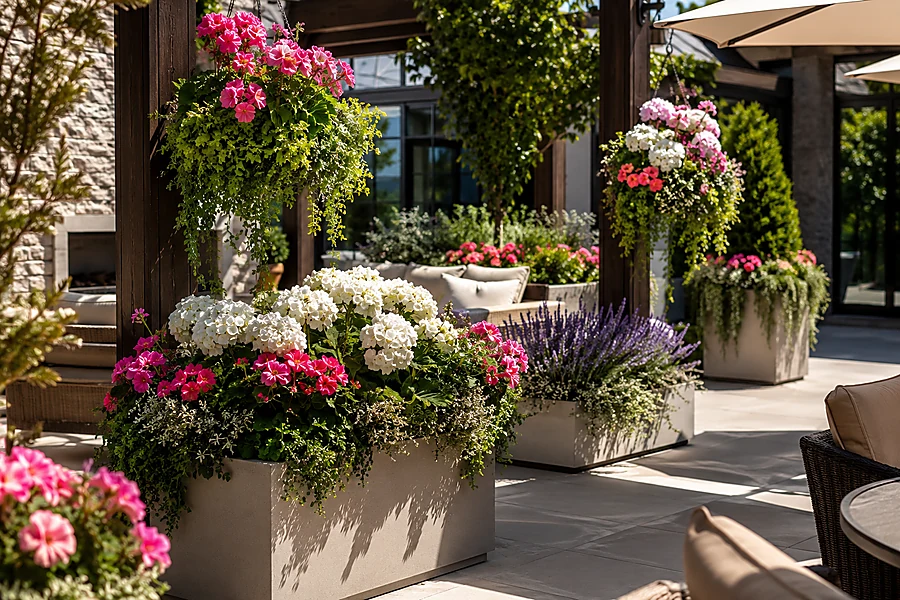
Most artificial flowers are not automatically suitable for long-term exterior use. Outdoor products should be clearly rated for UV and weather exposure and commonly use materials such as PE, PVC, or suitable plastic blends rather than delicate indoor-only fabrics.
Why Do Artificial Flowers Fade Outdoors?
Artificial flowers do not wilt like fresh blooms, but their pigments, polymers, coatings, fabrics, adhesives, and internal connections still age outdoors.
Artificial flowers fade because UV radiation and heat gradually affect pigments and synthetic materials. Rain, moisture, dust, cleaning, reflected heat, and wind can accelerate visible deterioration. The rate depends on the flower’s formulation, color, construction, placement, and maintenance.
UV exposure affects more than color
Fading is usually the first visible problem, but prolonged exposure may also create chalky surfaces, brittle leaves, stiff petals, cracked stems, weakened coatings, or loose flower heads.
A red flower may become pale pink. Dark greenery may become yellow-green. Purple flowers may develop a gray tone. Surface coatings may lose their matte finish and start to look glossy or uneven.
| Outdoor damage | What buyers may notice | Commercial effect |
|---|---|---|
| Pigment fading | Pale or uneven petals | Display looks old |
| Surface chalking | Powdery plastic finish | Reduced realism |
| Brittleness | Cracking leaves or stems | Higher replacement rate |
| Coating failure | Sticky or peeling surfaces | Dust buildup |
| Adhesive weakening | Loose petals or flower heads | Repair and safety concerns |
| Uneven exposure | One side fades faster | Inconsistent presentation |
“Artificial” does not mean “outdoor-ready”
Many artificial flowers are designed for indoor weddings, home arrangements, showrooms, or short-term events. These products may have soft fabric petals and realistic colors, but they may degrade quickly when placed in continuous direct sunlight.
Outdoor guidance recommends selecting products specifically marked UV-resistant, weatherproof, fade-resistant, or outdoor-safe. Suitable exterior products commonly use molded PE, PVC, or related plastic blends that tolerate moisture and cleaning better than delicate indoor fabrics.
Exposure changes by location
A covered hotel doorway does not create the same stress as a west-facing storefront. Flowers near dark paving, reflective glass, metal walls, or light-colored stone may receive strong direct and reflected heat.
The UV Index uses a scale from 1 to 11+, with higher values representing stronger UV intensity. Although the index is designed for human sun-safety guidance, it is also a useful reminder that sunlight intensity varies by location, season, weather, and time of day.
| Location | Likely exposure level | Better approach |
|---|---|---|
| Covered entrance | Low to moderate | Outdoor-rated flowers and routine cleaning |
| Morning-sun balcony | Moderate | UV materials and rotation |
| West-facing storefront | High | Strong UV specification and shade |
| Rooftop terrace | High | UV products, secure planters, regular inspection |
| Reflective glass wall | High heat exposure | Increase distance and use shade |
| Seasonal event | Short-term | Protect, inspect, then store indoors |
What Are the 9 Proven Ways to Protect Artificial Flowers Outdoors?
No single spray makes artificial flowers permanently fade-proof. Better results come from several layers of protection.
The nine most effective methods combine product selection, exposure control, surface protection, cleaning, modular design, and storage. Buyers should begin before ordering, not after fading has already appeared.
1. Buy flowers specifically rated for outdoor use
The first and most important step is choosing the correct product. Look for terms such as:
- UV-resistant
- UV-stabilized
- UV-protected
- Outdoor-safe
- Weather-resistant
- Fade-resistant
Ask whether UV protection is built into the material or applied only as a surface treatment. Built-in stabilizers become part of the polymer, while surface coatings can gradually wear through handling and cleaning.
The product description should cover the exact ordered SKU. A supplier’s outdoor boxwood panel does not prove that its silk rose, hydrangea, or poinsettia is also outdoor-rated.
2. Request product-specific weathering evidence
A supplier may say that a flower was “UV tested,” but buyers should ask how it was tested.
ASTM G154 is a recognized practice for exposing materials to fluorescent UV light under controlled conditions. It is an exposure method rather than an automatic lifespan guarantee, so buyers should request the test cycle, duration, specimen description, evaluation method, and acceptance criteria.
A useful report should identify:
| Report detail | Why it matters |
|---|---|
| Tested SKU or material | Confirms relevance to the order |
| Test standard | Identifies the method |
| Exposure cycle | Shows UV, heat, and moisture conditions |
| Test duration | Allows meaningful comparison |
| Color result | Shows measured or visible fading |
| Structural result | Shows cracking, brittleness, or failure |
| Laboratory name | Supports traceability |
| Acceptance criteria | Explains what “passed” means |
Do not automatically convert laboratory hours into outdoor years. Actual service life depends on climate, orientation, product construction, and maintenance.
3. Apply a compatible UV floral protectant
A clear UV protectant can add another layer of defense, especially for silk-style or dried-look flowers used in sheltered outdoor displays.
Krylon’s Ultra UV Floral Protectant is described as a clear, non-yellowing indoor/outdoor spray that helps protect silk and dried flowers from UV rays, fading, dirt, moisture, and discoloration.
Use protectant correctly:
- Dust and clean the flowers.
- Let every surface dry fully.
- Test one hidden petal.
- Check for darkening, stiffness, gloss, or color change.
- Apply light, even coats.
- Follow the manufacturer’s drying and safety instructions.
- Reinspect the finish before installation.
Spray outside or in a properly ventilated area and follow the product’s safety instructions. Krylon advises avoiding skin and eye contact and using suitable ventilation during application.
A UV spray should support an outdoor-rated product. It should not be treated as a reliable way to convert a weak indoor flower into a permanent full-sun product.
4. Add shade wherever possible
Shade reduces the amount of direct sunlight reaching petals and foliage. Even UV-resistant artificial flowers generally benefit from partial protection.
Useful shade sources include:
- Storefront awnings
- Covered porches
- Pergolas
- Patio umbrellas
- Balcony overhangs
- Shade sails
- Covered hotel entrances
- Recessed window boxes
Patio design guidance commonly uses umbrellas, awnings, pergolas, and shade sails to reduce direct sunlight and make exterior spaces more usable.
Place the most color-sensitive flowers—red, purple, blue, blush, and dark green—away from the strongest afternoon exposure when the design allows it.
5. Rotate planters and arrangements
Outdoor displays often fade unevenly because one side constantly faces the sun. Rotating movable planters helps distribute exposure more evenly.
A simple commercial schedule may include:
| Display type | Rotation approach |
|---|---|
| Small window box | Turn or rearrange monthly |
| Freestanding planter | Rotate approximately one-quarter turn |
| Hanging basket | Change hook orientation |
| Hotel entrance pair | Exchange left and right positions |
| Modular floral insert | Rotate the inner cassette |
| Fixed wall installation | Swap removable accent sections |
Rotation does not stop fading. It helps prevent one side from becoming visibly older than the rest.
Photograph the original arrangement before installation. Monthly comparison photographs make uneven fading easier to detect.
6. Reduce reflected heat and concentrated sunlight
Direct UV light is not the only concern. Reflected sunlight and heat from surrounding surfaces can increase material stress.
Common high-exposure locations include:
- Beside reflective glass
- Against dark metal walls
- Over black paving
- Near mirrored building panels
- Inside enclosed glass balconies
- Near heat-producing exterior equipment
Move arrangements away from hot surfaces when possible. Use a planter stand, wall spacer, canopy, screen, or lighter-colored backing to reduce concentrated heat.
Do not place artificial flowers close to high-temperature light fixtures, heaters, exhaust outlets, or surfaces that become extremely hot. Heat may soften glue, deform plastic, or change coatings even when the petals themselves resist UV light.
7. Clean dust, pollen, and pollution regularly
Dust can make artificial flowers look faded before major pigment loss occurs. Outdoor arrangements near roads, construction, beaches, restaurants, or open entrances may need frequent cleaning.
Use the gentlest suitable method:
| Flower material | Safer cleaning method |
|---|---|
| Outdoor plastic flowers | Microfiber cloth or light rinse |
| PE/PVC foliage | Damp wipe or soft brush |
| Fabric petals | Dry brush or careful spot cleaning |
| Real-touch petals | Lightly damp cloth after testing |
| Boxwood panels | Soft brush or low-pressure rinse if rated |
| Glittered flowers | Dry dusting only |
Clean before adding a new layer of UV protectant. Spraying over dust can seal dirt into the finish and create an uneven appearance.
Allow washed products to dry fully. Trapped moisture can affect foam, wire, adhesive, liners, cartons, and storage areas.
8. Build modular displays with replaceable accents
Some flower colors and materials fade faster than others. A modular arrangement allows buyers to replace the vulnerable parts without discarding the entire display.
Use UV-resistant greenery as the structural base. Then add removable flowering accents such as geraniums, hydrangeas, lavender, roses, or seasonal blooms.
| Display layer | Product role | Replacement strategy |
|---|---|---|
| Structural base | Boxwood, eucalyptus, grasses | Keep for long-term use |
| Mid-layer texture | Ferns, olive leaves, filler foliage | Replace only when worn |
| Color accents | Roses, geraniums, lavender | Keep spare stems available |
| Seasonal accents | Holiday or campaign flowers | Remove and store after use |
| Branded details | Signs, ribbons, color inserts | Update by campaign |
This method is especially useful for retail chains, hotels, restaurants, property managers, and event rental businesses. It lowers replacement costs and keeps customer-facing displays consistent.
9. Store seasonal flowers indoors
Continuous exposure is unnecessary when flowers are only needed for a seasonal promotion, wedding, holiday, or summer patio program.
At the end of the display period:
- Clean the flowers.
- Let them dry fully.
- Inspect petals, stems, glue, and color.
- Replace damaged pieces.
- Reshape the arrangement.
- Wrap delicate flower heads loosely.
- Store in a cool, dry, dark space.
- Label cartons by SKU, color, location, and condition.
Avoid crushing hydrangeas, peonies, roses, and large poinsettias into tight cartons. Garlands should be coiled loosely. White flowers should be separated from strongly dyed products when color transfer is possible.
How Should Buyers Test UV-Resistant Artificial Flowers?
The phrase “UV-resistant” should be supported by evidence. Buyers can reduce risk by combining documentation, sample testing, and clear purchase specifications.
Buyers should test artificial flowers through supplier reports, side-by-side outdoor samples, color records, bend tests, cleaning trials, attachment checks, and packaging recovery. The test should cover the finished flower, not only the raw plastic used to make one component.
Run a three-sample exposure trial
Use three matching samples:
- Sample A: full planned exposure
- Sample B: partial shade
- Sample C: indoor control
Photograph all three under similar lighting before testing. Record monthly changes.
| Inspection point | What to examine |
|---|---|
| Petal color | Fading, yellowing, or uneven tone |
| Leaf surface | Chalking, gloss, or stickiness |
| Flexibility | Brittleness or permanent bending |
| Flower head | Looseness or adhesive failure |
| Stem | Cracking or exposed wire |
| Cleaning response | Color transfer or coating damage |
| Camera appearance | Visible changes in marketing photos |
| Odor | Chemical or degraded smell |
A practical sample trial does not replace formal weathering testing. It shows whether the product works in the buyer’s actual environment.
Test all materials in the finished product
An artificial flower may contain polyester petals, PE leaves, PVC components, glue, wire, paint, and surface coatings. Each part may age differently.
Ask whether testing covered:
- Petals
- Leaves
- Stems
- Printed details
- Flower centers
- Adhesive connections
- Garland backing
- Wall-panel grid
- Installation clips
- Planter components
A supplier may test the green leaves but not the red flower petals. Buyers should not assume one material report covers the complete arrangement.
Put UV requirements in the purchase order
A stronger purchase specification includes:
| Purchase-order requirement | Example |
|---|---|
| Product | Exact SKU and approved sample |
| Environment | Full sun, partial shade, or sheltered exterior |
| Material | PE, PVC, polyester, PU, or specified blend |
| UV method | Built-in stabilizer or surface coating |
| Evidence | Test report and supplier declaration |
| Color limit | Agreed visual or measured tolerance |
| Structural requirement | No cracking, excessive brittleness, or leaf loss |
| Warranty | Duration, remedy, and exclusions |
| Packaging | Anti-crush method and carton orientation |
| Spare stock | Replacement flowers or modules |
This converts “UV-resistant” from a marketing phrase into a measurable buying requirement.
How Can Businesses Maintain Outdoor Artificial Flowers Long Term?
Low maintenance does not mean no maintenance. A simple inspection plan protects visual quality and helps identify failure before customers notice it.
Businesses should maintain outdoor artificial flowers with scheduled cleaning, rotation, fastening checks, drainage inspections, color comparisons, coating reviews, and planned replacement. Maintenance records also support warranty claims and future supplier decisions.
Use a commercial care schedule
| Timing | Maintenance task |
|---|---|
| Weekly | Remove debris and inspect obvious damage |
| Every 2–4 weeks | Dust, brush, or wipe flowers |
| Monthly | Rotate movable planters and compare colors |
| After strong wind | Check stems, hooks, ties, and planter stability |
| After heavy rain | Confirm drainage and full drying |
| Seasonally | Replace faded accents and inspect coatings |
| After removal | Clean, repair, label, and store |
Protect planter stability and drainage
Sun protection will not help if the arrangement tips in wind or stands in trapped rainwater. Use weighted planters, secure floral inserts, functioning drainage, and attachment methods appropriate for the site.
Outdoor faux-plant guidance also warns that wind and rain can dislodge artificial plants. It recommends using them in controlled locations such as pots, paved areas, and patios rather than placing them loosely among live garden beds.
Check that planters do not block doors, accessible paths, exit signs, drainage channels, or service access.
Keep warranty evidence
A warranty claim may require the invoice, SKU, batch information, installation photographs, maintenance records, and current damage photographs.
Keep:
- Approved sample images
- Supplier specification sheet
- Weathering-test report
- UV treatment details
- Purchase order
- Warranty document
- Installation date and location
- Monthly photographs
- Cleaning records
- Damage and replacement history
A warranty is only useful when it covers the exact SKU and exposure. Buyers should check whether it covers fading, cracking, brittleness, leaf loss, or structural failure—and whether replacement freight and installation labor are excluded.
My insights: How Can You Beat the Sun and Protect Artificial Flowers Outdoors
Many buyers search for one coating that prevents fading forever. The stronger answer is a complete protection system.
Artificial flowers survive outdoors longer when buyers combine nine controls: outdoor-rated materials, test evidence, UV protectant, shade, rotation, reduced reflected heat, regular cleaning, replaceable accents, and indoor storage. Product quality starts the process, but placement and maintenance determine how well the flowers keep their appearance.
UV protection begins before the purchase
The most important decision happens before installation. Indoor flowers placed in brutal sun are difficult to rescue. A clear coating may slow fading, but it cannot fully correct unsuitable pigments, weak glue, delicate fabric, or poor construction.
The best order of action is:
| Stage | Best action |
|---|---|
| Product selection | Choose verified outdoor-rated flowers |
| Supplier approval | Review test details and warranty |
| Sample stage | Test full sun, shade, and indoor controls |
| Pre-installation | Clean, coat if suitable, and secure |
| Display period | Shade, rotate, and inspect |
| Maintenance | Replace faded accents early |
| Off-season | Clean and store indoors |
The best displays are designed for replacement
Permanent outdoor displays should not depend on every flower lasting at the same rate. Dark reds, purples, blues, and delicate fabrics may age differently from molded greenery.
A better system keeps durable foliage as the foundation and treats colored flowers as replaceable modules. Hotels can refresh entrance planters. Retailers can change campaign colors. Restaurants can update patio flowers. Event rental companies can replace damaged accents without rebuilding the complete arrangement.
Evidence is stronger than “fade-proof” language
Terms such as “never fades,” “sun-proof,” and “permanent outdoor flower” should be treated carefully. Outdoor performance depends on product formulation, climate, direct exposure, heat, reflected light, moisture, installation, and care.
Buyers should ask:
- Which exact SKU was tested?
- What material was tested?
- Which method and cycle were used?
- What color change was accepted?
- Were petals, leaves, glue, and stems included?
- What environment does the warranty allow?
- What remedy applies if fading becomes excessive?
The strongest commercial rule
Buy the right flower first. Reduce exposure second. Maintain the display third.
This sequence protects appearance, labor, customer impressions, and replacement budgets. It also gives B2B buyers clearer evidence when comparing suppliers or making a warranty claim.
Artificial flowers will still age outdoors, but these nine methods can slow that process and keep the display realistic for much longer than an unplanned indoor arrangement placed in direct sun.
Conclusion
Beat the sun with outdoor-rated flowers, UV protection, shade, rotation, cleaning, heat control, modular replacements, testing, and proper off-season storage.