
Fake flowers become tacky when glossy petals, rigid stems, loud colors, visible mechanics, and dusty leaves make the arrangement feel manufactured rather than botanical.
Fake flowers can look gorgeous and expensive when they use realistic textures, restrained colors, natural stem movement, varied bloom stages, and a correctly proportioned vase. The most convincing arrangements avoid perfect symmetry, hide plastic construction, leave negative space, suit their surroundings, and remain consistently clean.
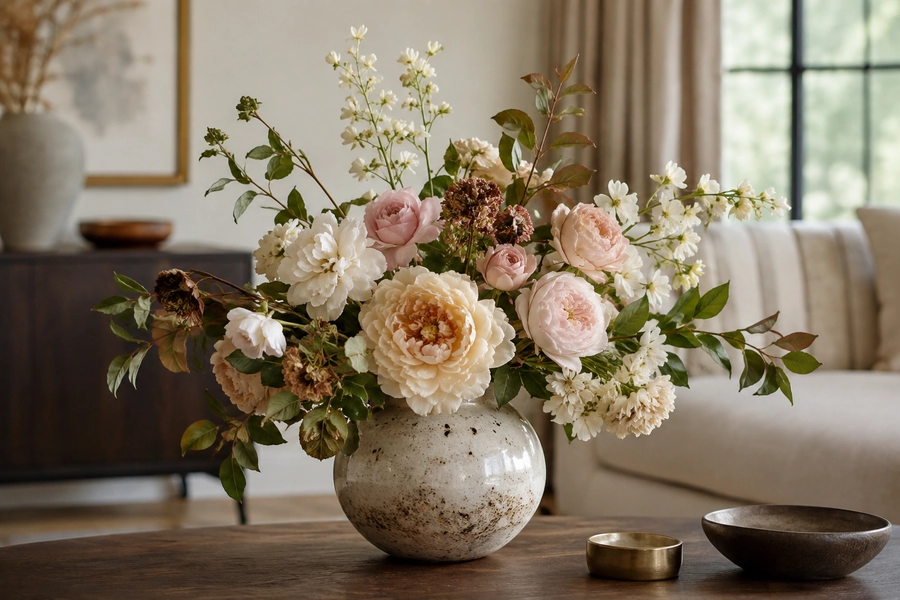
Modern artificial flowers are not automatically elegant or cheap-looking. The final impression depends on the quality of the stems and how carefully they are selected, reshaped, arranged, displayed, and maintained.
Are Fake Flowers Considered Tacky?
Opinions remain divided. Some designers reject obviously artificial flowers, while others accept carefully made faux botanicals in locations where fresh arrangements are impractical.
Fake flowers look tacky when their artificial qualities become the main visual feature. They look gorgeous when viewers notice the shape, color, vessel, and composition before noticing the material. One restrained, convincing arrangement usually appears more sophisticated than several crowded displays of low-quality flowers.
Recent design commentary illustrates this division. Some designers argue that poorly made or excessively used faux plants cheapen a room, while others accept one or two high-quality examples when they are styled carefully.
Better Homes & Gardens reported that modern faux flowers have improved substantially and can be effective when they feature dimensional petals, natural asymmetry, subtle color variation, and flexible stems. Its event-design expert preferred one well-made arrangement over numerous plastic-looking alternatives.
What Makes Fake Flowers Look Tacky?
| Tacky Signal | Why It Fails | Expensive-Looking Correction |
|---|---|---|
| Strong plastic shine | Reveals the manufactured surface | Choose matte or naturally soft reflection |
| Flat single-tone petals | Removes natural depth | Use layered, related shades |
| Every flower fully open | Looks frozen and repetitive | Add buds and partially open blooms |
| Perfectly straight stems | Ignores natural growth | Add gradual curves |
| Identical flower angles | Creates a catalog-like pattern | Turn blooms in several directions |
| Overcrowded vase | Hides shape and movement | Remove stems and leave negative space |
| Visible glue or wire | Exposes construction | Conceal, rotate, trim, or replace |
| Oversized bouquet | Makes the vase appear unstable | Improve proportion |
| Bright mixed colors | Feels decorative rather than botanical | Limit the palette |
| Dusty petals | Makes colors look gray and neglected | Clean on a schedule |
| Too many faux displays | Creates repetition throughout the room | Use fewer, stronger focal arrangements |
The difference between tacky and gorgeous is rarely one flower. It is the accumulation of visible decisions.
What Are the 11 Rules That Keep Fake Flowers Looking Expensive?
An expensive-looking arrangement does not require the largest bouquet or the greatest number of flower types. It requires control.
The 11 rules are to invest in visible stems, choose natural materials and colors, mix bloom stages, reshape every flower, vary height and direction, simplify the palette, use the right vase, hide all mechanics, leave negative space, match the arrangement to its location, and maintain it before dust becomes visible.
Rule 1: Spend More on the Stems People Will Inspect
Not every flower in an arrangement needs the same level of detail.
Use the highest-quality flowers at eye level, around the front, and in positions viewed from less than a meter away. Less detailed stems can provide background volume when their centers, seams, and plastic components remain hidden.
Close-view flowers need convincing:
- Petal edges
- Flower centers
- Veins
- Calyxes
- Leaves
- Stem transitions
- Surface texture
A rose on a reception desk is examined more closely than a hydrangea installed three meters above a wedding arch.
Better Homes & Gardens recommends prioritizing quality over quantity and specifically highlights natural tones, dimensional petals, subtle imperfections, varied greens, and flexible stems as indicators of stronger faux flowers.
Use a Viewing-Distance Budget
| Viewing Zone | Typical Location | Required Detail |
|---|---|---|
| Close view | Dining table, desk, counter | Highest |
| Medium view | Console, mantel, lobby seating | High |
| Long view | Arch, stage, high shelf | Moderate |
| Background | Photo wall, upper installation | Overall silhouette matters most |
This allows the buyer to control cost without placing weak flowers where their construction is obvious.
One premium orchid may create a stronger impression than a mixed bouquet containing twenty inexpensive stems.
Rule 2: Match the Material to the Real Flower
A flower looks artificial when its material behaves differently from the living version.
Choose soft fabric for naturally delicate layered blooms, real-touch finishes for smooth or waxy petals, and molded materials for firm foliage, berries, succulents, and structured flower centers. The finish should imitate the natural flower rather than advertise the manufacturing process.
Material Guide
| Flower Type | Suitable Faux Material |
|---|---|
| Rose | Soft polyester or silk-touch fabric |
| Peony | Layered matte fabric |
| Ranunculus | Fine layered polyester |
| Tulip | Real-touch or softly coated material |
| Orchid | Real-touch petals with detailed centers |
| Calla lily | Smooth flexible coating |
| Magnolia | Substantial fabric or real-touch petals |
| Hydrangea | Fine fabric with flexible branching |
| Eucalyptus | Matte molded plastic |
| Succulent | Detailed molded PE or similar material |
A smooth coating can suit a tulip because fresh tulips naturally have softly waxed petals. The same coating may make a poppy or garden rose look synthetic.
House Beautiful and Better Homes & Gardens both emphasize natural texture, organic form, and controlled reflection rather than excessive gloss.
Reject the Wrong Kind of Shine
Some living leaves naturally reflect light. A rubber plant, magnolia leaf, or orchid leaf may have a soft sheen.
The problem is uniform shine across every petal and leaf. Strong, even reflection makes the surface read as molded plastic.
Evaluate flowers under:
- Daylight
- Warm lamps
- Cool LED lighting
- Camera flash
- The actual venue lighting
Balsam Hill’s buyer guidance recommends reviewing artificial flowers under different lighting because unsuitable shine and color may become more obvious as conditions change.
Rule 3: Use Natural, Layered Colors
Cheap-looking arrangements often contain colors that are too saturated, too evenly printed, or unrelated to one another.
Select flowers with several nearby tones inside each bloom. Favor ivory, cream, blush, dusty pink, muted burgundy, soft yellow, faded blue, and botanical greens. Strong colors can work, but they require more realistic texture and should normally appear as controlled accents.
A believable blush rose may contain:
- Warm ivory near the center
- Pale peach through the middle
- Dusty pink on the outer petals
- Slight green or brown near the calyx
- One or two darker edges
A flat pink rose has less depth and may look inexpensive even when its shape is accurate.
Use a Controlled Palette
For most expensive-looking arrangements, I use:
- One dominant flower color
- One lighter or darker supporting shade
- One neutral
- One or two greenery tones
Example:
- Warm white peonies
- Pale blush garden roses
- Champagne ranunculus
- Gray-green eucalyptus
- Deeper olive foliage
Color variation should exist within the palette, not compete against it.
Rule 4: Mix Buds, Opening Flowers, and Mature Blooms
A vase in which every flower is fully open looks manufactured because every stem appears to be at the same stage of life.
Combine closed buds, partially open flowers, medium blooms, and a limited number of fully open focal flowers. Place mature blooms near the visual center and use smaller buds to extend the arrangement’s outer lines.
Balsam Hill describes realistic faux arrangements as reproducing flowers at several stages of bloom. Better Homes & Gardens also recommends slight natural variation instead of perfectly uniform artificial stems.
Example Rose Recipe
| Bloom Stage | Quantity | Placement |
|---|---|---|
| Fully open garden rose | 3 | Main focal area |
| Medium rose | 5 | Around focal blooms |
| Small rose | 3 | Mid and outer layers |
| Rosebud | 3 | Upper and side edges |
The exact count changes with the vase, but the principle remains consistent.
Different bloom stages produce depth without requiring more flower varieties.
Rule 5: Reshape Every Stem Before Arranging
Flowers compressed for shipping rarely look convincing immediately after unpacking.
Open every flower and leaf individually. Separate compressed petals, rotate repeated leaves, adjust flower heads, and bend wired stems into broad natural curves. Follow the growth pattern of the real flower rather than forcing every stem into the same round bouquet shape.
Afloral advises reshaping faux flowers after shipping, curving stems slightly, separating petals and leaves, and creating an organic form based on how the living flower grows.
Reshaping Sequence
- Hold the stem below the flower head.
- Open lower leaves first.
- Rotate identical leaves in different directions.
- Separate compressed side branches.
- Open the outer petals.
- Adjust the flower center carefully.
- Form one broad stem curve.
- Review the flower from the side and back.
Different flowers require different movement.
| Flower | Natural-Looking Shape |
|---|---|
| Tulip | Curved and slightly leaning |
| Rose | Mostly upright with a gentle bend |
| Peony | Soft bend beneath the heavy bloom |
| Orchid | Long architectural curve |
| Poppy | Fine irregular movement |
| Delphinium | Vertical with small side variation |
| Wisteria | Trailing downward line |
| Hydrangea | Irregular rounded cluster |
Do not create sharp angles unless the actual botanical form supports them.
Rule 6: Vary Height, Direction, and Depth
An arrangement looks inexpensive when all flower heads create one flat upper line.
Position flowers at several heights and depths. Turn some blooms forward, some sideways, and a few toward the back. Place selected flowers close to the vase opening and allow lighter stems to rise above the main group.
A recent florist styling guide highlighted varied heights, wispy extensions, and a shape designed for the arrangement’s actual viewing position. A display against a wall can prioritize the front, while a table centerpiece requires balanced interest from every direction.
Build in Three Dimensions
I divide the arrangement into:
- Low flowers
- Central focal flowers
- High movement stems
- Front-facing flowers
- Side-facing flowers
- Rear support flowers
One bloom may sit near the vase rim. Another may lean outward. A third may rise above the main group.
Avoid Perfect Mirroring
Symmetry can look elegant in formal arrangements, but every detail should not be duplicated.
A pair of matching hotel-lobby arrangements can share:
- Height
- Color
- General silhouette
- Vessel
They do not need identical flower angles and branch positions.
Controlled variation makes a pair feel professionally composed rather than factory assembled.
Rule 7: Use Fewer Flower Types and More Repetition
A bouquet does not look expensive merely because it contains many varieties.
Limit most arrangements to one primary flower, one supporting flower, and one foliage family. Repeating a few excellent stems creates stronger visual identity than mixing numerous unrelated flowers, colors, textures, berries, branches, and decorative accessories.
Afloral’s rule-of-three styling approach demonstrates that a small number of stems can create an elegant composition when they follow natural growth patterns and use a complementary vessel.
Three-Stem Design
A minimalist arrangement may use:
- One magnolia branch
- One smaller blossom branch
- One foliage stem
Medium Arrangement
A fuller arrangement may use:
- Garden roses
- Ranunculus
- Eucalyptus
Large Arrangement
A large lobby or event design may use:
- Hydrangeas for volume
- Roses for focal detail
- Delphiniums for height
- One coordinated greenery family
The number of physical stems can be high. The number of competing botanical ideas should remain controlled.
Rule 8: Choose a Vase That Looks More Valuable Than the Flowers
A poor container can make strong flowers appear cheap. A carefully selected vessel can elevate moderate stems.
Use matte ceramic, stoneware, textured glass, aged metal, or other substantial vessels. Match the vase opening and height to the arrangement. Opaque containers are especially useful because they hide molded stems, exposed wire, foam, and identical cut ends.
Afloral recommends natural-looking vessels and notes that artisan ceramic and other organic materials help faux botanicals feel integrated into a room.
Vase Selection Guide
| Arrangement | Strong Vessel Choice |
|---|---|
| Single orchid | Low ceramic bowl |
| Tulips | Narrow glass or simple pitcher |
| Garden roses | Medium stoneware vase |
| Peonies | Low bowl or compote |
| Magnolia branches | Tall heavy ceramic |
| Minimal calla lilies | Narrow sculptural vessel |
| Hydrangeas | Wide stable vase |
| Wildflower stems | Informal handmade jug |
Check the Proportion
The vase should appear capable of supporting the arrangement.
A tall, dense bouquet in a narrow lightweight vase looks unstable. Very short flowers in a deep vase look buried.
Proportion depends on flower weight and shape, but the vase commonly occupies a meaningful part of the complete visual height rather than appearing as a tiny base beneath an oversized canopy.
Avoid Generic Plastic Pots
A convincing artificial orchid can still look tacky when displayed in a small shiny nursery pot.
Place the original container inside a larger decorative vessel and finish the surface with:
- Bark
- Fixed moss
- River stones
- Artificial soil
- A fitted insert
Rule 9: Hide Every Piece of Construction
Visible mechanics are among the strongest signals that an arrangement is artificial.
Conceal foam, wire, cable ties, plastic stem ends, glue, labels, grids, and support stakes. Use opaque vessels, foliage, fitted top dressings, and discreet internal holders. Inspect the arrangement from the side and back as well as the main viewing position.
Remove Manufacturing Clues
Before arranging, inspect for:
- Loose threads
- Clear glue strings
- Mold seams
- Plastic tags
- Bent calyxes
- Exposed metal
- Crushed petal edges
- Obvious identical cuts
- Excess artificial pollen
- Packaging ties
Trim loose material carefully. Turn minor defects toward the back. Replace highly visible defective focal blooms.
Use Hidden Mechanics
Useful internal holders include:
- Floral frogs
- Chicken wire
- Reusable grids
- Dry floral foam
- Stem sleeves
- Tape grids
- Inner vases
The holder should control the arrangement without becoming visible.
In a clear vase, artificial stems can be disguised with a smaller concealed inner vessel, carefully positioned foliage, compatible artificial water, stones, or a controlled bundled-stem treatment.
Rule 10: Leave Negative Space
Crowding is one of the fastest ways to make fake flowers look decorative and inexpensive.
Leave visible openings between flower groups. Negative space reveals individual stem lines, creates depth, and allows premium blooms to remain identifiable. When an arrangement looks heavy, remove stems before buying more flowers or adding extra filler.
Modern styling commentary continues to favor organic flow, sculptural arrangements, and intentional empty space rather than dense artificial symmetry.
When to Remove Flowers
Remove one or more stems when:
- Every flower touches another bloom
- The vase disappears beneath the arrangement
- The design has no visible stem lines
- The outer edge forms a perfect circle
- The arrangement blocks conversation
- The focal flowers lose their identity
- The design appears equally dense everywhere
A luxury arrangement often looks relaxed rather than maximally full.
Use Greenery Selectively
Greenery should create:
- Movement
- Connection
- Height
- Direction
- A natural outer line
It should not fill every empty area.
One loose eucalyptus branch can contribute more realism than five short filler bushes packed around the vase rim.
Rule 11: Place and Maintain Faux Flowers Like Valuable Décor
A gorgeous arrangement can become tacky when it sits in the wrong room, remains unchanged for years, or collects visible dust.
Place artificial flowers where their scale, species, and vessel make sense. Use fewer displays, rotate them seasonally, and clean them before dust dulls their color. Keep arrangements away from harsh heat or sunlight unless the exact product is designed for that exposure.
Balsam Hill positions modern artificial flowers as stylish, practical décor but emphasizes choosing products suited to their location and caring for them appropriately.
Good Locations
- Entry console
- Dining table
- Kitchen island
- Reception desk
- Bedroom dresser
- Hotel lobby table
- Retail counter
- Covered event installation
- Guest-room side table
Questionable Locations
- Beside visible fresh flowers of much higher quality
- In every room of the house
- Directly beneath harsh spotlights
- Beside a heat source
- In strong outdoor sun when not exterior-rated
- Above food-preparation surfaces
- Where dusting is difficult
- In a vessel too small for the arrangement
Create a Cleaning Routine
| Location | Suggested Inspection |
|---|---|
| Dining table | Weekly |
| Kitchen | Weekly |
| Reception desk | Weekly |
| Living room | Every one to two weeks |
| Bedroom | Every two to four weeks |
| Elevated arrangement | Monthly, with safe access |
| Event inventory | Before and after every use |
Use the care instructions for the exact product. Routine dry dusting is generally safer than frequent washing because materials, coatings, dyes, glue, and decorative centers may respond differently to moisture.
Are Expensive Fake Flowers Always Better?
Price can reflect better materials, hand finishing, more detailed centers, custom pigments, secure construction, packaging, or brand positioning. It can also reflect marketing.
Expensive fake flowers are not automatically realistic. Evaluate the finished stem under the intended lighting and viewing distance. A convincing product should have believable color, suitable texture, a detailed center, natural movement, secure construction, and enough flexibility to recover after packing.
The 10-Point Quality Test
- Does the petal contain more than one tone?
- Does the surface reflect light naturally?
- Is the flower center detailed?
- Does the calyx look correctly scaled?
- Can the stem hold a gradual curve?
- Are the leaves varied in direction and size?
- Are repeated molds immediately visible?
- Is glue hidden?
- Can the flower recover after compression?
- Does it remain convincing from the side and back?
Balsam Hill’s comparison guidance notes that artificial flowers can often be identified through uniform texture, visible plastic or fabric construction, lack of scent, and unnatural touch. The goal should therefore be visual credibility in context—not a claim that no observer can ever identify the product.
Which Fake Flowers Look Most Expensive?
Flowers with layered petals, sculptural shapes, or naturally smooth surfaces often translate successfully into artificial materials.
The most reliable expensive-looking choices include real-touch tulips, orchids, garden roses, peonies, ranunculus, calla lilies, magnolias, hydrangeas, hellebores, and flowering branches. Their success still depends on color, construction, shaping, scale, and placement.
Reliable Choices
| Flower | Why It Works |
|---|---|
| Tulip | Naturally smooth, curved form |
| Orchid | Sculptural shape and substantial petals |
| Garden rose | Layered petals conceal construction |
| Peony | Large soft volume |
| Ranunculus | Compact detailed layers |
| Calla lily | Clean minimalist silhouette |
| Magnolia | Strong petals and architectural branch |
| Hydrangea | Many small blooms create volume |
| Hellebore | Muted botanical colors |
| Cherry blossom | Branch shape carries the composition |
Flowers with very thin translucent petals can also look excellent, but they require stronger manufacturing and careful storage.
Can Cheap Fake Flowers Be Made to Look Expensive?
Styling can improve moderate flowers, but it cannot completely hide strong gloss, incorrect proportions, weak centers, or obvious fabric construction.
Make affordable fake flowers look more expensive by removing the weakest stems, simplifying the palette, reshaping every branch, turning poor centers away, shortening or bending uniform stems, and placing the arrangement in a substantial opaque vase. Use fewer flowers rather than displaying every stem in the package.
The Editing Method
Begin with the full bundle, then remove:
- The brightest flower
- The most visibly plastic bloom
- Repeated identical filler
- Excess greenery
- Damaged petals
- Flowers with exposed glue
- Stems that cannot hold their position
Next:
- Open the remaining flowers.
- Create three or more heights.
- Turn flowers in several directions.
- Cluster related colors.
- Add one natural-looking foliage type.
- Move the arrangement into a better vessel.
- Leave one clear area of negative space.
A smaller edited arrangement often looks more valuable than the original complete bundle.
My Insights: Are Fake Flowers Tacky or Gorgeous-Which 11 Rules Keep Them Looking Expensive
Fake flowers are not inherently tacky or gorgeous. They become one or the other through a combination of material quality, styling discipline, environmental fit, and maintenance.
The 11 rules keep artificial flowers looking expensive by removing manufactured clues. Quality visible stems establish credibility; natural colors and mixed bloom stages add depth; reshaping and varied heights create movement; restrained palettes and negative space control the design; strong vessels, hidden mechanics, suitable placement, and regular cleaning complete the effect.
My central insight is that expensive-looking faux flowers are edited, not merely arranged.
The 11-Rule Summary
| Rule | Expensive-Looking Result |
|---|---|
| 1. Prioritize visible quality | Strong close-up realism |
| 2. Match material to flower | Believable texture |
| 3. Use layered colors | Natural depth |
| 4. Mix bloom stages | Botanical variation |
| 5. Reshape every stem | Organic movement |
| 6. Vary height and direction | Three-dimensional composition |
| 7. Limit flower varieties | Visual confidence |
| 8. Select a substantial vase | Better proportion and finish |
| 9. Hide construction | No obvious artificial clues |
| 10. Leave negative space | Lighter, more deliberate styling |
| 11. Place and maintain carefully | Long-term polish |
Tacky Usually Means Too Much
The most common problems are excessive:
- Shine
- Color
- Symmetry
- Density
- Variety
- Decoration
- Repetition
- Dust
The most effective correction is often subtraction.
Remove a color, flower type, filler, ribbon, or decorative accessory before purchasing another premium stem.
Gorgeous Usually Means Controlled
A gorgeous artificial arrangement normally has:
- One clear visual idea
- A limited palette
- Believable stem movement
- Several bloom stages
- Correct scale
- A suitable vessel
- Hidden construction
- Clean surfaces
- Enough empty space
The arrangement looks complete without looking overworked.
My Most Reliable Expensive-Looking Formula
For a medium table arrangement, I use:
- One matte ceramic vase
- Three premium focal flowers
- Five supporting blooms
- Several buds
- One foliage family
- Three height levels
- Two or three flower directions
- One visible opening through the arrangement
- A hidden reusable grid
- No visible glue, wire, or dust
Example:
- Three ivory peonies
- Five blush garden roses
- Three small ranunculus stems
- Two rosebuds
- Olive foliage
- A warm stoneware bowl
I arrange the flowers, photograph the result, and then remove one stem. The final edit frequently improves the composition.
Where Faux Flowers Work Best
Artificial flowers are especially effective when:
- The location has insufficient light for living plants
- A display must be prepared in advance
- The arrangement needs to remain consistent
- Allergies are a concern
- A rare seasonal flower is required throughout the year
- The décor will be reused
- Regular fresh-flower replacement is impractical
Better Homes & Gardens’ event expert identified dark or low-light locations and arrangements prepared well in advance as practical situations for faux flowers.
Where Fresh Flowers May Be Stronger
Fresh flowers may be preferable when:
- Scent is important
- The flowers are being given as an emotional gift
- Natural aging is part of the experience
- The event celebrates seasonality
- Guests will handle the flowers closely
- Suitable local flowers are readily available
Artificial and fresh flowers do not need to compete in every situation. Each format can be selected for the role it performs best.
The Final Tacky-or-Gorgeous Test
Before displaying a faux arrangement, ask:
- Is the material suitable for the flower?
- Are the colors found in nature?
- Do the stems move naturally?
- Are bloom stages varied?
- Does the vase support the arrangement visually?
- Can I see glue, wire, foam, or labels?
- Is the design too symmetrical?
- Is there enough negative space?
- Does the arrangement suit the room?
- Is it completely clean?
- Would removing one stem improve it?
When the arrangement passes these questions, its artificial construction becomes secondary. The flowers function as deliberate interior design rather than an inexpensive substitute for something fresh.
Conclusion
Fake flowers look gorgeous—not tacky—when quality, color, movement, proportion, restraint, hidden mechanics, and maintenance work together. Use fewer convincing stems and style every one deliberately.