Artificial flowers can fade, crack, loosen, or blow from planters when buyers mistake a vague “UV protected” label for a complete outdoor specification.
UV-safe artificial flowers should be selected by exact product, exposure zone, test evidence, material, color, and installation method. Protect outdoor displays with shade, controlled orientation, secure planters, drainage, compatible coatings, gentle cleaning, seasonal rotation, fire review, and documented replacement thresholds. No artificial flower remains permanently weatherproof.
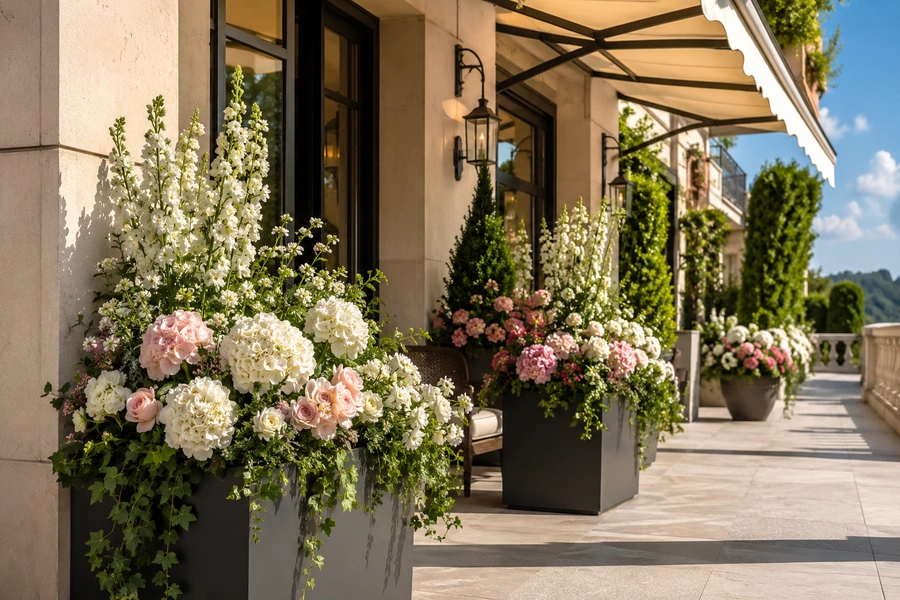
Patios, balconies, and storefronts expose faux flowers to different combinations of sunlight, reflected radiation, heat, rain, dust, wind, handling, and public-safety requirements. A product suitable beneath a deep hotel canopy may fail quickly in an uncovered west-facing window box.
What Does UV Safe Mean for Artificial Flowers?
“UV safe” is not a standardized promise of unlimited outdoor life.
For artificial flowers, UV safe should mean that the exact product is intended for the stated outdoor exposure and has relevant evidence showing improved resistance to ultraviolet weathering. The claim should identify the tested material, color, exposure method, duration, result, maintenance requirements, and limits of use.
ISO 4892-3:2024 specifies laboratory methods for exposing plastic specimens to fluorescent ultraviolet radiation, heat, and water to simulate important aspects of weathering under global or window-glass-filtered solar radiation. ASTM G154-23 provides procedures for operating fluorescent UV exposure equipment for plastics, while ASTM D4329 gives plastic-specific procedures and evaluation conditions. These are comparison and exposure methods—not automatic guarantees of a fixed number of outdoor years.
UV Terms Buyers Commonly See
| Supplier Term | What It May Mean | What the Buyer Must Confirm |
|---|---|---|
| UV treated | An additive or coating was applied | Which material, amount, and test |
| UV resistant | Improved resistance compared with untreated material | Test result and acceptance limit |
| Outdoor safe | Intended for some exterior use | Full sun, partial sun, or covered use |
| Indoor/outdoor | Suitable for both environments | Exposure and seasonal limits |
| Weather resistant | Designed for several weather factors | Whether UV, rain, heat, and wind are all covered |
| Fade resistant | Color change is slowed | Which colors and for how long |
| UV proof | Usually an overstatement | Request evidence and limitations |
A label becomes meaningful only when it is linked to the exact flower, color, batch, and installation conditions.
Are UV-Treated Artificial Flowers Completely Fade-Proof?
No pigment, plastic, fabric, adhesive, or surface coating should be assumed to remain unchanged indefinitely outdoors.
UV treatment can slow color loss and material deterioration, but exposure continues accumulating. Direct sunlight, reflected radiation, heat, moisture, cleaning, abrasion, orientation, pigment chemistry, and installation duration all influence the final result. “Resistant” should never be interpreted as “immune.”
ISO weathering methods expose materials to combinations of UV radiation, heat, and water because outdoor deterioration is not caused by ultraviolet energy alone. ASTM guidance also stresses that accelerated exposure results require careful interpretation and must be connected to defined material properties and test conditions.
Outdoor Failure Is More Than Fading
| Failure | Possible Cause |
|---|---|
| Pale upper petals | Direct solar exposure |
| Uneven color | Fixed orientation or reflected light |
| Yellow white flowers | Pigment, coating, or environmental aging |
| Chalky leaves | Surface weathering |
| Brittle foliage | Polymer aging |
| Sticky petals | Heat or coating deterioration |
| Loose flower heads | Adhesive or mechanical failure |
| Exposed wire | Cracked stem coating |
| Warped leaves | Heat accumulation |
| Rust marks | Moisture reaching internal metal |
| Detached planter | Wind or weak fixing |
A flower can retain acceptable color while becoming structurally unsafe. Outdoor inspections must therefore evaluate the complete product.
What Are the 11 Rules for UV-Safe Artificial Flower Displays?
The strongest outdoor plan controls exposure before relying on coatings and replacement.
The 11 rules are to specify the exact outdoor rating, verify test evidence, evaluate the complete assembly, map direct and reflected sunlight, use physical shade, choose forgiving colors and materials, secure every display against wind, manage water and heat, use compatible UV protectants, clean and rotate systematically, and maintain fire, access, and replacement controls.
Rule 1: Match the Exact Product to the Exposure Zone
“Outdoor” covers too many different conditions to function as a complete specification.
Classify each flower location as covered shade, bright indirect exposure, partial sun, full sun, window-adjacent, or high-reflection exposure. Approve the product for that specific zone and confirm whether the supplier permits year-round use or only limited seasonal display.
Balsam Hill advises choosing products explicitly marked outdoor safe and still recommends reducing direct sunlight and extreme-weather exposure. Its product-care guidance limits some outdoor-safe collections to approximately three months of exterior display annually, demonstrating that outdoor claims can include product-specific usage limits.
Exposure-Zone Matrix
| Zone | Typical Location | Main Risk |
|---|---|---|
| Covered shade | Deep porch, recessed storefront | Dust and indirect weather |
| Bright indirect | North-facing balcony | Scattered UV and wind |
| Morning sun | East-facing patio | Moderate daily exposure |
| Afternoon sun | West-facing balcony | Strong heat and radiation |
| Full sun | Open planter or roof terrace | Maximum accumulated exposure |
| Window-adjacent | Store display behind glazing | Heat and filtered radiation |
| Reflective | Beside glass, water, white walls, or paving | Secondary exposure |
| Coastal | Balcony near salt air | Residue, wind, and corrosion |
| Urban roadside | Storefront near traffic | Dust and pollution residue |
Do not approve one universal SKU for every area simply because the botanical design is identical.
Questions for the Supplier
Ask:
- Is this exact SKU approved for full sun?
- Is the rating limited to covered outdoor use?
- Is the UV protection integral or surface-applied?
- Are the fabric petals included in the claim?
- Are the stem covering and adhesives outdoor compatible?
- Is there a recommended maximum display period?
- Which cleaning method is approved?
- Does the warranty exclude high-sun locations?
- Are replacement flowers available?
- Does adding another coating affect the warranty?
Rule 2: Verify the UV Test—Not Just the Marketing Label
A supplier may have tested a raw plastic sample that does not represent the finished flower.
Request the test standard, edition, specimen, exact color, exposure cycle, duration, laboratory, measured result, and acceptance criterion. Confirm that the petals, leaves, stems, pigments, coatings, and adhesives used in production are represented by the submitted evidence.
ISO 4892-3:2024 covers fluorescent UV exposure of plastics to radiation, heat, and water. ASTM G154-23 covers the exposure apparatus, and ASTM D4329 provides procedures for plastics intended for outdoor use. A report should therefore explain both how the material was exposed and how change was evaluated.
UV Evidence Checklist
| Required Detail | Why It Matters |
|---|---|
| Standard and edition | Identifies the method |
| Lamp type and cycle | Defines the exposure |
| Test temperature | Heat affects materials |
| Moisture or condensation cycle | Represents weather interaction |
| Specimen description | Shows what was tested |
| Exact pigment or color | Colors may perform differently |
| Exposure duration | Allows comparison |
| Color-change method | Quantifies fading |
| Gloss, cracking, or brittleness review | Detects non-color failures |
| Laboratory | Supports traceability |
| Production relationship | Links evidence to the order |
| Acceptance limit | Defines pass or failure |
Do Not Convert Test Hours Directly Into Outdoor Years
An accelerated exposure result does not automatically predict a universal service life.
The relationship between laboratory exposure and a real patio depends on:
- Solar intensity
- Climate
- Orientation
- Shade
- Temperature
- Moisture
- Pigment
- Polymer
- Surface coating
- Maintenance
- Acceptable color change
Use accelerated testing to compare defined samples under the same conditions unless the supplier provides a defensible outdoor correlation for the exact material and location.
Rule 3: Test the Complete Flower Assembly
A UV-stabilized leaf does not protect an untested flower center or glue joint.
Evaluate the finished artificial flower—not only a resin sample. Inspect petals, leaves, flower centers, calyxes, wires, stem coatings, adhesives, foam, backing grids, ribbons, and planter inserts after realistic exposure. The weakest component determines whether the complete display remains usable.
Complete-Assembly Trial
Expose several production-representative samples in the intended location and record:
- Initial color
- Gloss
- Texture
- Petal shape
- Stem flexibility
- Flower-head angle
- Adhesive condition
- Leaf attachment
- Odor
- Surface residue
- Wire exposure
Reinspect at fixed intervals under the same lighting and camera position.
High-Risk Mixed Materials
Use additional caution with:
- Fabric petals on molded plastic stems
- Real-touch coatings
- Foam flower centers
- Paper-wrapped wire
- Loose glitter
- Artificial pollen
- Flocking
- Natural moss
- Untreated ribbon
- Hot-melt glue
Outdoor performance claims should state whether these components are included.
Rule 4: Map Direct Sun and Reflected UV
A shaded planter can still receive substantial exposure from its surroundings.
Observe the display area in the morning, at midday, and in the afternoon. Record direct sun, seasonal shadow changes, reflected light, hot glazing, pale walls, water, metal cladding, and bright paving. Orient delicate flowers away from the strongest combined exposure.
EPA guidance notes that bright surfaces such as water, sand, and snow can reflect UV and increase exposure. Although that guidance concerns human sun safety, the same physical principle helps buyers identify reflected radiation around pools, waterfront patios, light-colored paving, and glazed storefronts.
High-Reflection Outdoor Locations
- Poolside patios
- Waterfront balconies
- White stone terraces
- Pale concrete courtyards
- Glass storefronts
- Mirrored façades
- Stainless-steel surroundings
- Bright artificial turf
- Light-colored parapet walls
Create a Display Exposure Map
Record:
| Field | Example |
|---|---|
| Location | West storefront planter |
| Direct sun | 2:00–6:00 p.m. |
| Reflected source | Glass façade opposite |
| Surface temperature concern | Dark metal planter |
| Wind exposure | Street-corner gusts |
| Rain exposure | Partial |
| Cleaning access | Weekly |
| Rotation possibility | Inner planter rotates |
| Selected product | Full-sun outdoor-rated geranium |
| Inspection interval | Every two weeks |
Without this map, fading often appears “unexpected” even though the exposure was predictable.
Rule 5: Use Physical Shade Before Adding More Coating
Reducing radiation at the source protects more components than a surface spray can reach.
Place faux flowers beneath a canopy, balcony overhang, pergola, awning, entrance recess, umbrella, or architectural screen where possible. Confirm that the shade protects the display during the strongest exposure period rather than only in the morning or one season.
Balsam Hill recommends displaying outdoor-safe flowers beneath structures such as canopies, archways, or pergolas to reduce fading and dirt accumulation.
Patio Shade Options
- Pergola
- Retractable awning
- Umbrella
- Roof overhang
- Covered dining area
- Trellis screen
- Recessed wall planter
Balcony Shade Options
- Upper-floor slab
- UV-managing exterior screen
- Side panel
- Retractable canopy
- Deep planter position behind the parapet
Storefront Shade Options
- Entrance recess
- Window canopy
- Projecting sign structure
- Interior setback behind glazing
- Sidewall niche
Do Not Create a Heat Trap
A transparent cover or enclosed glass box may reduce rain while increasing internal temperature.
Maintain ventilation around:
- Adhesives
- Real-touch coatings
- Foam
- Dark plastic
- Artificial soil
- Electrical lighting
Shade should reduce the total environmental load rather than exchange UV exposure for extreme heat.
Rule 6: Choose Materials and Colors That Age Gracefully
Outdoor success depends on both chemical resistance and how visible small changes become.
Favor molded foliage, matte or botanically appropriate finishes, layered green tones, replaceable flower modules, and colors containing natural variation. Large expanses of one bright color show uneven fading more clearly than arrangements containing several related botanical shades.
Practical Outdoor Starting Choices
| Stronger Starting Category | Buyer Check |
|---|---|
| Boxwood | Color variation and panel repetition |
| Agave | Brittleness and projecting tips |
| Yucca | Leaf attachment |
| Snake plant | Printed pattern and warping |
| Grasses | Shedding and strand discoloration |
| Small-leaf shrubs | Adhesive and stem stability |
| Bougainvillea-style clusters | Flower pigment and attachment |
| Geraniums | Petal color and grouped replacement |
| Ferns | Dust burden and fine-leaf brittleness |
| Structured orchids | Center detail and coating |
More Demanding Flowers
These may still be suitable when supported by exact product evidence:
- White peonies
- Fine poppies
- Pale hydrangeas
- Velvet flowers
- Flocked foliage
- Real-touch roses
- Dark purple blossoms
- Glittered products
White flowers can reveal yellowing, dust, and pollution quickly. Deep red, blue, and purple products may show pigment changes sharply when one side receives more sun than another.
Use Modular Color
Instead of building one permanently glued flower wall, specify:
- Replaceable flower clusters
- Numbered panels
- Detachable hanging baskets
- Removable planter inserts
- Spare stems from the same batch
A modular design turns uneven fading into a controlled repair rather than complete disposal.
Rule 7: Secure Every Planter, Basket, and Stem Against Wind
UV performance is irrelevant if the display becomes a falling or airborne object.
Anchor the planter, secure the inner insert, lock stems into a stable mechanic, and use rated hardware for hanging baskets and wall displays. Review wind forecasts and remove or secure vulnerable decorations before high-wind conditions.
The National Weather Service advises securing loose outdoor items when wind watches or advisories are issued and warns that high winds can turn unsecured objects into dangerous debris.
Wind-Safety Checklist
- Heavy or fixed planter
- Stable center of gravity
- Inner pot restrained
- Flowers secured below the visible surface
- No loose stones
- No exposed wire
- No projecting branch into circulation
- Hanging hardware rated for the total load
- Secondary safety cable where required
- Wall fixings matched to the substrate
- Removal plan for severe weather
Patio Displays
Keep planters clear of:
- Door swings
- Server routes
- Umbrella mechanisms
- Heaters
- Table edges
- Emergency paths
Balcony Displays
Do not balance unsecured boxes or pots on parapets.
Confirm:
- Building rules
- Weight limits
- Drainage route
- Wind exposure
- Fastener approval
- Whether objects could fall onto lower levels
Storefront Displays
Keep flowers outside:
- Accessible routes
- Door clearances
- Queue areas
- Delivery paths
- Emergency exits
- Sign sightlines
A low stable planter usually creates less risk than a narrow container holding a top-heavy floral canopy.
Rule 8: Manage Rain, Drainage, Heat, and Internal Corrosion
Outdoor-safe flowers may tolerate moisture while the planter traps it around internal materials.
Provide drainage where water can enter, keep exposed wire and paper-wrapped stems away from standing water, and allow the display to dry after rain or cleaning. Avoid placing artificial flowers against hot glass, dark metal, exhaust outlets, heaters, or surfaces that soften adhesives and coatings.
Drainage Controls
Use:
- Drain holes
- Raised internal inserts
- Removable top dressing
- Nonabsorbent ballast
- Water paths away from doors
- Accessible inspection points
Avoid sealing a planter in a way that creates a hidden water reservoir.
Inspect After Rain
Check for:
- Water inside flower heads
- Damp artificial moss
- Rust staining
- Loose glue
- Heavy saturated packaging
- Shifted ballast
- Blocked drainage
- Planter movement
Heat Controls
Increase separation from:
- West-facing glass
- Black metal
- Barbecue equipment
- Patio heaters
- HVAC exhausts
- Roof membranes
- Enclosed display boxes
Visible color is only one acceptance criterion. Sticky petals, softened glue, drooping heads, or warped leaves are also reasons to remove a component.
Rule 9: Apply UV Protectant Only After Compatibility Testing
A topical UV product may supplement protection, but it cannot convert every indoor flower into a fully outdoor-rated assembly.
Use only a protectant approved for the exact artificial flower materials. Clean and dry the product first, test a spare stem, apply thin even coats, and document the product, batch, curing conditions, and reapplication schedule. Stop if the coating changes color, gloss, flexibility, adhesion, odor, or dust attraction.
Afloral recommends UV protectant for selected outdoor artificial flowers and advises additional treatment for some products in high-sun locations. This is manufacturer-specific guidance, not proof that one spray is suitable for every brand or material.
Patch-Test Criteria
Inspect the cured sample for:
- Darkening
- Yellowing
- White residue
- Added gloss
- Sticky texture
- Stiff fabric
- Cracked coating
- Softened adhesive
- Odor
- Dust attraction
- Color transfer
Avoid Improvised Coatings
Do not automatically use:
- Hairspray
- Furniture polish
- Automotive clear coat
- Craft varnish
- Silicone lubricant
- General-purpose waterproofing spray
- Leaf shine
- Unknown aerosol sealant
These products may change appearance, flexibility, cleanability, flammability, or project documentation.
Reapplication Is Product-Specific
Do not copy another brand’s six-month or annual schedule without checking:
- Product instructions
- Exposure
- Rain
- Cleaning frequency
- Surface abrasion
- Existing coating condition
- Fire-review requirements
More coating is not necessarily more protection.
Rule 10: Clean, Rotate, and Remove Displays on a Schedule
Dust and residue can make flowers appear faded before the pigment has actually changed.
Brush away loose particles, wipe stable broad surfaces with approved materials, and clean before adding any new protectant. Rotate freestanding displays to balance one-sided exposure, and remove vulnerable flowers during the harshest season, major storms, or extended property closures.
Balsam Hill recommends weekly or biweekly dusting for artificial flowers depending on location and conditions. It also advises keeping outdoor-safe flowers protected from direct sunlight and severe weather.
Cleaning Sequence
- Photograph the display.
- Inspect brittle or loose components.
- Remove dry dust with a soft brush.
- Work from the top downward.
- Wipe suitable broad leaves with microfiber.
- Use water only when the manufacturer permits it.
- Allow the display to dry completely.
- Inspect the coating and connections.
- Apply compatible protectant if due.
- Restore the approved orientation.
Starting Inspection Schedule
| Exposure | Suggested Starting Check |
|---|---|
| Deep covered patio | Every two to four weeks |
| Busy restaurant patio | Weekly |
| Full-sun balcony | Weekly |
| High-wind balcony | Before and after wind events |
| Storefront entrance | Weekly |
| Window display | Weekly for heat and fading |
| Seasonal hanging basket | Every one to two weeks |
| Coastal location | Weekly for salt residue |
Adjust the schedule according to observed change rather than following a universal calendar.
Rotation Method
For freestanding planters:
- Mark the original front
- Photograph the shape
- Rotate the inner insert
- Recheck stability
- Keep branches out of circulation
- Record the date
Rotation balances exposure but does not eliminate it.
Rule 11: Control Fire, Access, Inspection, and Replacement
Outdoor flowers near storefront entrances, covered patios, public balconies, heaters, or event structures may fall under project safety requirements.
Keep artificial flowers away from open flames, heaters, exits, electrical equipment, and safety systems. Request product-specific fire documentation where required, inspect all fixings and materials, and establish measurable replacement criteria for fading, brittleness, loosening, and structural damage.
NFPA guidance states that combustible artificial decorative vegetation in covered applications may need to meet flame-propagation criteria and that open flames should not be used on or near combustible artificial vegetation. Exact requirements depend on the applicable code, jurisdiction, occupancy, and installation.
Fire-Document Checklist
Request:
- Exact product identification
- Material covered
- Test method
- Laboratory
- Report number
- Test date
- Result
- Specimen mounting
- Treatment method
- Retreatment requirements
- Modification restrictions
A report for green plastic foliage may not cover:
- Fabric flowers
- Foam
- Moss
- Ribbon
- Adhesive
- Backing mesh
- Cable ties
- Applied UV coating
Replacement Criteria
Remove or repair a flower when it shows:
- Significant color change
- Uneven fading that affects the design
- Brittleness
- Cracking
- Sticky surfaces
- Loose flower heads
- Exposed metal
- Failed fixings
- Unstable planter movement
- Persistent odor
- Damage that remains visible at the intended viewing distance
Do not wait for complete failure.
Which Artificial Flowers Are Best for Patios?
Patios require a balance of realism, cleanability, wind control, and service access.
Good patio starting choices include outdoor-rated geraniums, bougainvillea, boxwood, structured orchids, agave, grasses, magnolia foliage, and selected roses. Use low, stable planters near dining areas and reserve tall arrangements for protected positions outside primary service routes.
Patio Formula
Use:
- One weighted planter
- One outdoor-rated greenery base
- Two or three replaceable flower modules
- A removable top-dressing insert
- One orientation mark
- A weather-removal plan
Strong Patio Locations
- Covered entrance
- Pergola column
- Recessed dining corner
- Host-stand background
- Protected wall planter
Weak Patio Locations
- Beside an open flame
- Beneath a heater
- At the edge of a server route
- In an uncovered lightweight vase
- Where sprinkler water accumulates
- Directly against hot glazing
Which Artificial Flowers Are Best for Balconies?
Balconies demand stronger wind and falling-object controls than ordinary ground-level patios.
Use compact outdoor-rated flowers inside secured planter boxes or fixed containers. Choose lower profiles, flexible branches, and removable inserts. Avoid top-heavy trees, unsecured hanging baskets, loose stones, and flowers extending beyond the balcony edge.
Balcony Starting Choices
- Geraniums
- Pansies
- Small boxwood
- Compact bougainvillea
- Low grasses
- Trailing UV-rated foliage
- Short hydrangea modules where exposure permits
Balcony Safety Questions
- Is the planter fixed?
- Could any component fall?
- Does drainage affect lower balconies?
- Are building-management approvals required?
- What wind direction dominates?
- Can the flowers be removed quickly?
- Are loose inserts secured?
- Does the display project beyond the parapet?
The best balcony design is often lower and more restrained than the product photograph suggests.
Which Artificial Flowers Are Best for Storefronts?
Storefront flowers must remain visually strong from a distance without blocking entrances, products, signs, or customer movement.
Use outdoor-rated flower modules with clear color contrast, stable containers, and replaceable components. Place the highest-quality flowers at normal viewing height and use more durable foliage in exposed upper or outer zones. Review sunlight through glazing as well as direct exterior exposure.
Storefront Layouts
| Layout | Best Use |
|---|---|
| Pair of low entrance planters | Formal arrival |
| One asymmetrical statement planter | Boutique storefront |
| Modular window boxes | Seasonal color |
| Wall-mounted flower panel | Photography or branding |
| Hanging baskets | Covered façade |
| Recessed niche arrangement | High weather protection |
| Interior display behind glass | Protected but heat-sensitive |
Storefront Maintenance Priorities
- Dust and roadside residue
- Door clearance
- Customer contact
- Window heat
- Reflection
- Sign visibility
- Security
- Fire and access requirements
- Evening-light gloss
Test the flowers under both daylight and storefront lighting.
How Should Commercial Buyers Compare UV-Safe Products?
A product comparison should include evidence, maintenance, repairability, and full installed cost.
Outdoor Product Scorecard
| Category | Buyer Question |
|---|---|
| Exact outdoor rating | Full sun, partial sun, or covered? |
| UV evidence | Which standard and result? |
| Tested specimen | Finished flower or raw material? |
| Heat performance | Do petals, glue, and stems remain stable? |
| Moisture | Can water enter or become trapped? |
| Wind | Can the complete display be secured? |
| Cleaning | Which methods are permitted? |
| Coating | Integral, topical, or both? |
| Fire evidence | Does documentation cover the assembly? |
| Replacement parts | Can flowers or panels be changed individually? |
| Warranty | What exposure is excluded? |
| Storage | Can seasonal components be protected? |
| Landed cost | What is the installed cost per display cycle? |
Approve Physical Samples
Review at least several production-representative units for:
- Color consistency
- Leaf variation
- Flower-center quality
- Surface gloss
- Stem flexibility
- Packaging recovery
- Attachment strength
- Odor
- Cleaning response
- Coating compatibility
One perfect showroom sample is not enough for a large storefront rollout.
What Are the Biggest Outdoor Faux-Flower Mistakes?
| Mistake | Likely Result | Better Rule |
|---|---|---|
| Assuming plastic means outdoor safe | Rapid deterioration | Verify the exact SKU |
| Accepting “UV proof” | Unrealistic expectations | Request evidence and limits |
| Testing only one green leaf | Flower colors fail differently | Test every visible material |
| Ignoring reflected light | Unexpected one-sided fading | Map the full environment |
| Depending only on spray | Hidden components remain vulnerable | Reduce exposure first |
| Using lightweight planters | Wind movement or tipping | Anchor and ballast |
| Blocking drainage | Standing water and corrosion | Provide inspection access |
| Placing flowers near heaters | Warping and glue failure | Control heat |
| Coating dirty leaves | Trapped residue | Clean and dry first |
| Never rotating | Uneven color change | Rotate removable modules |
| Ignoring fire documentation | Approval problems | Verify the complete assembly |
| Waiting for total failure | Safety and brand damage | Set replacement thresholds |
Outdoor Display Maintenance SOP
| Step | Action | Acceptance Requirement |
|---|---|---|
| 1 | Confirm product and exposure rating | Suitable exact SKU |
| 2 | Photograph approved appearance | Reference created |
| 3 | Inspect planter and fixings | Stable and secure |
| 4 | Check petals and leaves | No major fading or brittleness |
| 5 | Brush away loose residue | No visible dust |
| 6 | Clean approved surfaces | No coating damage |
| 7 | Check drainage | No trapped water |
| 8 | Rotate removable insert | Stable orientation |
| 9 | Reapply approved protectant if due | Fully cured and documented |
| 10 | Review wind and weather plan | Removal procedure ready |
| 11 | Check fire and access clearances | No obstruction |
| 12 | Replace failed modules | Display matches standard |
My Insights: UV Safe Artificial Flowers—Which 11 Outdoor Display Rules Work for Patios, Balconies and Storefronts
The strongest UV-safe display is not the product with the boldest fade-proof claim. It is the installation that combines suitable materials, verified evidence, reduced exposure, secure mechanics, maintainable design, and planned replacement.
The 11 rules work by treating UV resistance as one part of outdoor performance. Buyers must also control heat, reflection, wind, rain, drainage, dust, coatings, fire requirements, public access, and component aging. Patios favor stable service-friendly planters, balconies require strict wind security, and storefronts require high visual impact without blocking circulation.
The 11-Rule Summary
| Rule | Main Risk Controlled |
|---|---|
| 1. Match product to exposure | Incorrect outdoor specification |
| 2. Verify UV evidence | Unsupported marketing claims |
| 3. Test complete assembly | Hidden component failure |
| 4. Map sun and reflection | Uneven exposure |
| 5. Add physical shade | Excess accumulated radiation |
| 6. Select durable materials and colors | Visible premature aging |
| 7. Secure against wind | Falling and airborne displays |
| 8. Control water and heat | Corrosion, warping, and glue failure |
| 9. Test UV protectant | Coating incompatibility |
| 10. Clean and rotate | Dust and one-sided fading |
| 11. Manage fire and replacement | Safety and end-of-life failure |
The Most Important UV Rule
Verify the exact product.
The outdoor rating of one artificial rose does not automatically apply to:
- Another color
- Another factory
- Another petal fabric
- Another adhesive
- Another stem
- Another production batch
The approved specification should identify the product code and visible materials.
The Most Important Placement Rule
Reduce direct and reflected exposure before relying on topical chemicals.
A canopy can protect:
- Petals
- Leaves
- Adhesive
- Wire coating
- Stems
- Top dressing
- Planter surfaces
A spray may not reach or protect all these components equally.
The Most Important Balcony Rule
Secure everything.
The display should remain safe when:
- Wind changes direction
- Soil or ballast shifts
- Flowers become wet
- The planter is bumped
- Maintenance staff remove an insert
- A storm arrives unexpectedly
A beautiful unsecured balcony arrangement is not commercially acceptable.
The Most Important Patio Rule
Preserve service and guest movement.
Flowers should not interfere with:
- Chairs
- Servers
- Umbrellas
- Heaters
- Doors
- Table use
- Emergency routes
Use compact, heavy planters and removable flower modules.
The Most Important Storefront Rule
Design for two viewing distances.
From the street, the display needs:
- Shape
- Color
- Scale
- Contrast
At the entrance, it needs:
- Realistic surfaces
- Clean petals
- Hidden mechanics
- Safe clearance
- Secure installation
A flower wall that works in a distant photograph may look repetitive or dusty beside the door.
The Most Important Maintenance Rule
Retain an unexposed reference.
Store one protected flower, leaf, or panel from the approved batch in a dark, dry location. Compare installed components against it under consistent lighting.
Without a reference, gradual fading becomes difficult to detect because staff become accustomed to the changing color.
The Most Important Replacement Rule
Replace modules before the complete display fails.
Plan for:
- Spare flowers
- Spare greenery
- Spare hanging-basket inserts
- Matching panels
- Batch records
- Numbered installation positions
- Approved disposal or repurposing routes
A modular display costs less to repair and creates less waste than one permanently assembled unit.
My Preferred Outdoor Specification Sequence
I use this order:
- Define the patio, balcony, or storefront location.
- Map direct sun, reflection, heat, wind, and rain.
- Select an exact outdoor-rated product.
- Review UV and material evidence.
- Approve physical samples.
- Run a site-exposure trial.
- Design shade and drainage.
- Engineer stable fixings and ballast.
- Test the cleaning and coating system.
- Confirm fire and circulation requirements.
- Photograph and label the approved installation.
- Establish rotation and severe-weather procedures.
- Retain spare modules and an unexposed reference.
- Record the reason for every replacement.
My Final UV-Safe Rule
Do not buy “UV-safe artificial flowers” as though they were one universal material class.
Buy a documented product for a measured exposure zone, install it inside a safe and maintainable system, and accept that every outdoor decorative material eventually needs inspection, rotation, repair, or replacement.
Conclusion
Specify the exact outdoor rating, reduce sun and reflection, secure every display, control water and heat, clean regularly, and replace fading or brittle modules before failure.