
Artificial plants can lose color, realism, and structural strength long before expected when purchasing, placement, cleaning, and inspection decisions are not controlled.
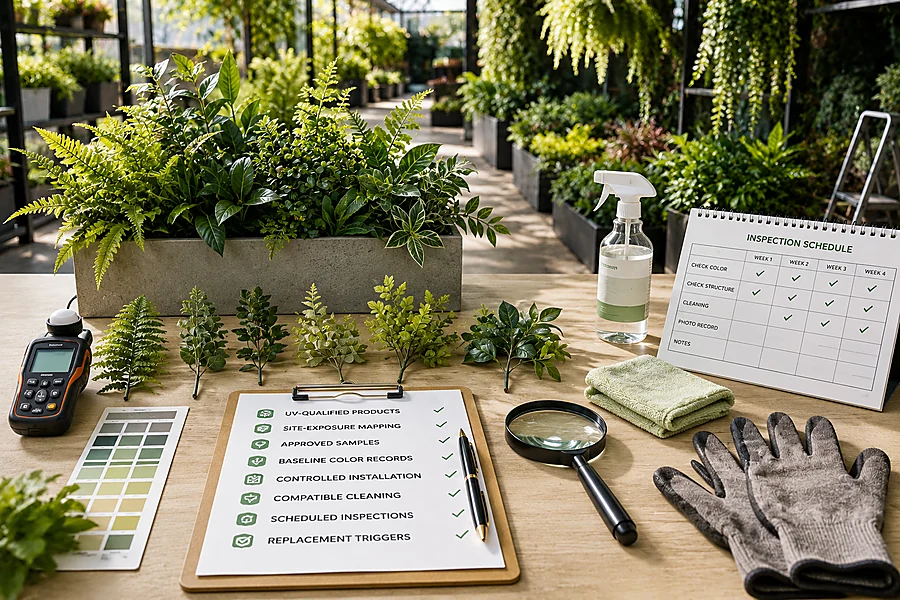
A proven anti-fade SOP starts with UV-qualified products, site-exposure mapping, approved samples, baseline color records, controlled installation, compatible cleaning, scheduled inspections, and clear replacement triggers. It cannot make synthetic foliage permanent, but it can slow avoidable deterioration, protect warranty rights, and reduce unplanned replacement costs.
Accelerated weathering can support product comparisons, but it does not automatically predict a fixed outdoor lifespan. ASTM G154 covers fluorescent UV-lamp apparatus, while ASTM G155 covers filtered xenon-arc exposure. Both require defined conditions and evaluation methods rather than producing a universal pass result by themselves.
Why Do Artificial Plants Fade Outdoors?
Fading is often blamed only on sunlight. In practice, product formulation, heat, moisture, orientation, reflected light, cleaning chemicals, and installation conditions can all influence deterioration.
Artificial plants fade when sunlight and environmental exposure change their pigments, polymers, coatings, adhesives, or printed surfaces. Visible color loss may be followed by chalking, cracking, brittleness, loose foliage, or surface changes. The rate varies by material, color, location, construction, and maintenance.
Fading is a complete-product problem
An artificial plant may contain several materials:
| Component | Possible Material | Potential Failure |
|---|---|---|
| Leaves | PE, PVC, polyester, or coated fabric | Fading, chalking, curling |
| Flowers | Polyester, PU, foam, or molded plastic | Discoloration, stiffness, peeling |
| Stems | Molded polymer and internal wire | Cracking, warping, exposed wire |
| Trunk | Plastic, fiberglass, wood, or composite | Splitting or coating failure |
| Adhesive | Hot-melt or other bonding system | Loose leaves and flower heads |
| Surface finish | Paint, print, flocking, or clear coating | Transfer, yellowing, or loss of texture |
| Backing grid | PE, PVC, or another polymer | Brittleness and connector failure |
A leaf material may pass a laboratory exposure while the flower coating or adhesive fails earlier. Buyers should therefore request evidence for the finished SKU or for every critical component.
Exposure is not equal across one property
A covered doorway may receive limited direct sunlight. A west-facing storefront can experience long afternoon exposure. A rooftop can combine sunlight, heat, wind, and reflected radiation.
The EPA UV Index forecasts ultraviolet intensity on a scale from 1 to 11+. It was created for human sun-safety decisions, not artificial-plant qualification, but facilities teams can record it as one site-exposure indicator alongside orientation, shade hours, temperature, and reflected heat.
| Site Condition | Relative Fade Risk | Main Control |
|---|---|---|
| Indoor area away from windows | Low | Dust control |
| Covered exterior entrance | Low to moderate | Outdoor-rated product |
| Morning-sun balcony | Moderate | Rotation and inspection |
| West-facing storefront | High | Shade and strong UV specification |
| Rooftop terrace | High | UV-qualified product and secure installation |
| Reflective-glass location | Potentially high | Increase distance or add screening |
| Seasonal display | Controllable | Remove and store after use |
This table is a risk-screening tool, not a service-life guarantee.
Laboratory hours are not outdoor years
Q-Lab explains that there is no universal “magic number” that converts accelerated weathering hours into years outside. Correlation changes with latitude, altitude, orientation, weather, specimen temperature, test cycle, material, and light source. Accelerated results are most defensible when used to compare materials under the same controlled conditions.
A supplier claim such as “1,000 hours equals five outdoor years” should be supported by product-specific correlation data. Without that evidence, the test is better used to rank one formulation against another.
What Should an Anti-Fade SOP Include Before Installation?
Maintenance cannot fully correct an unsuitable product. The strongest anti-fade process begins before the purchase order is approved.
A pre-installation anti-fade SOP should define the use environment, product specification, test evidence, approved sample, color baseline, warranty, installation limits, cleaning method, and responsible team. No shipment should be released until these controls are documented.
Step 1: Classify the exposure
Assign every installation to an exposure class.
| Exposure Class | Typical Location | Required Buying Direction |
|---|---|---|
| A | Indoor, no direct sunlight | Standard commercial artificial plants |
| B | Bright indoor or sheltered exterior | Color-stable products with documented limits |
| C | Partial outdoor sun | UV-rated finished products |
| D | Long direct-sun exposure | Higher-performance UV-stabilized products |
| E | Extreme heat, rooftop, coastal, or reflective site | Product-specific testing, warranty, and site trial |
The classification should appear in the RFQ, sample request, purchase order, installation plan, and asset register.
Step 2: Approve the exact product specification
Avoid descriptions such as “UV-proof palm” or “outdoor-quality hedge.” A useful specification identifies:
| Specification Field | Required Information |
|---|---|
| Product | Exact SKU and revision |
| Application | Indoor, sheltered exterior, or direct sun |
| Leaf and flower materials | Actual polymer, fabric, or coating |
| UV protection | Built into material, surface-applied, or both |
| Tested item | Raw material, component, or finished product |
| Test method | Standard, edition, and exposure cycle |
| Evaluation | Color, cracking, brittleness, adhesion, and strength |
| Approved sample | Signed physical reference |
| Warranty | Covered defect, duration, exclusions, and remedy |
| Cleaning | Approved products and procedure |
ASTM G155 states that its xenon-arc practice does not deliver a specific result alone. It must be combined with defined exposure conditions and a method for evaluating property changes. It also warns against comparing different apparatus results unless reproducibility has been established for the material.
Step 3: Create a retained control sample
Keep one approved sample away from direct light and normal cleaning. It becomes the comparison reference for installed products.
The control file should include:
- SKU and batch number.
- Installation location.
- Supplier and order number.
- Date received and installed.
- Standard photographs.
- Leaf and flower color references.
- Initial flexibility and attachment condition.
- Test reports and warranty.
- Approved cleaning method.
- Inspection and replacement limits.
Photographs should use the same background, distance, camera settings, and lighting whenever possible.
Step 4: Record a measurable color baseline
Visual assessment is essential, but larger commercial programs may also use instrumental color measurements. ISO/CIE 11664-6:2022 defines the CIEDE2000 color-difference formula, which expresses the relative magnitude of color differences more closely than a basic coordinate-distance comparison.
The buyer and supplier should agree on:
- Measurement location on the leaf or petal
- Instrument geometry and settings
- Lighting and observer conditions
- Number of readings
- Sample orientation
- Permitted variation
- Visual acceptance alongside instrument readings
There is no universal ΔE00 limit for every artificial plant. Surface texture, gloss, translucency, pattern, and viewing distance all influence whether a measured difference is commercially visible.
Step 5: Review warranty terms before purchase
Warranty length alone does not define protection. One commercial supplier, for example, publishes different terms for commercial green-wall panels and individual UV-rated plant specimens. Its warranty also distinguishes excessive fading from normal aging and excludes certain installation, extreme-weather, heat, labor, and consequential costs.
A buyer should confirm:
| Warranty Question | Required Answer |
|---|---|
| Which SKUs are covered? | Exact product list |
| What is fading? | Visual or measurable definition |
| When does coverage start? | Purchase, shipment, or installation date |
| Which environments qualify? | Full sun, partial shade, or sheltered use |
| What is excluded? | Heat, storms, misuse, chemicals, or installation |
| What is the remedy? | Repair, replacement, refund, or credit |
| Is coverage prorated? | Calculation method |
| Who pays freight and labor? | Buyer or supplier |
| What evidence is required? | Invoice, photos, batch, and maintenance records |
| How quickly must a claim be filed? | Written deadline |
How Should Teams Inspect, Clean, and Protect Artificial Plants?
Artificial plants need less care than live plants, but “low maintenance” should not become “no inspection.”
Maintenance teams should use an exposure-based schedule, approved cleaning tools, consistent photographs, color comparisons, attachment checks, and documented corrective actions. UV sprays should be treated as compatible supplementary coatings, not as permanent protection or substitutes for outdoor-rated materials.
Use a risk-based inspection schedule
The following schedule is a practical starting point. It should be adjusted after teams observe actual site performance.
| Exposure | Visual Check | Cleaning | Formal Condition Review |
|---|---|---|---|
| Indoor | Monthly | Every 1–3 months | Twice yearly |
| Sheltered exterior | Every 2–4 weeks | Monthly | Quarterly |
| Partial sun | Every 2 weeks | Every 2–4 weeks | Quarterly |
| Full sun | Weekly or biweekly | As contamination requires | Monthly |
| Extreme site | Weekly | Site-specific | Monthly plus seasonal review |
A formal condition review should compare the installation with the retained sample and previous photographs.
Follow a standard inspection sequence
Inspect from a fixed direction and complete the same steps each time.
| Inspection Point | Acceptable Condition | Escalation Sign |
|---|---|---|
| Color | Minor, even aging | Strong mismatch or patchy fading |
| Leaf surface | Matte and clean | Chalking, gloss change, or stickiness |
| Flexibility | Leaves bend normally | Brittle or cracking parts |
| Attachments | Leaves and flowers remain secure | Repeated detachment |
| Stems | Stable and shapeable | Warping or exposed wire |
| Coating | Even and transparent | Yellowing, peeling, or transfer |
| Planter | Stable with working drainage | Movement or standing water |
| Hardware | Secure and corrosion-free | Loose or damaged fittings |
| Appearance | Consistent from customer view | Clearly tired or unrealistic display |
Clean with the least aggressive method
Begin with dry dusting or a soft microfiber cloth. Use water or mild cleaning products only when the supplier permits them. Test every new method on a hidden area.
Avoid applying an unapproved solvent, strong alkaline cleaner, abrasive pad, or high-pressure stream. These may alter coatings, remove printed gradients, weaken glue, or change gloss.
The maintenance record should identify:
- Cleaner name and dilution
- Cleaning tool
- Test area
- Date
- Staff member
- Observed color transfer
- Surface changes
- Drying time
- Corrective action
Use protectant sprays carefully
A compatible clear coating may add supplementary protection. Krylon’s Ultra UV Floral Protectant, for example, is marketed for silk and dried flowers and is described as a clear, non-yellowing indoor/outdoor finish that helps protect against UV light, fading, dirt, moisture, and discoloration.
That description does not prove compatibility with every PE, PVC, PU, polyester, adhesive, paint, or flocked surface. Before full application:
- Clean and dry the product.
- Test a concealed area.
- Check color, gloss, flexibility, and touch.
- Follow the coating manufacturer’s instructions.
- Apply thin, even coats.
- Record the product, batch, date, and applicator.
- Inspect the finish after curing.
- Reapply only according to documented need and instructions.
Do not spray over dust, moisture, peeling coatings, or an active warranty defect before documenting the condition.
Reduce exposure through installation controls
Maintenance works better when the installation reduces unnecessary stress.
| Installation Control | Anti-Fade Benefit |
|---|---|
| Awning or overhang | Reduces direct exposure |
| Distance from reflective glass | Reduces concentrated light and heat |
| Rotatable planter | Helps balance one-sided exposure |
| Modular floral insert | Allows targeted replacement |
| Stable, drained planter | Prevents movement and standing water |
| Seasonal removal | Avoids unnecessary annual exposure |
| Spare accent stems | Enables low-cost visual refresh |
| Location code and orientation mark | Supports consistent inspections |
Rotation should not be used to hide a warranty failure. Photograph the plant before and after moving it.
When Should Artificial Plants Be Recoated, Relocated, Claimed, or Replaced?
Teams often delay action until a display looks unacceptable. By that point, evidence may be weak and damage may be irreversible.
Use written intervention triggers. Recoat only when the existing surface is compatible and stable. Relocate plants when the site exceeds their approved exposure. File warranty claims when covered fading or cracking appears. Replace products when deterioration affects realism, strength, safety, or brand presentation.
Use an action ladder
| Condition | Recommended Action |
|---|---|
| Dust without color change | Clean |
| Slight one-sided change | Document and consider rotation |
| Higher-than-planned exposure | Add shade or relocate |
| Stable surface with declining protection | Evaluate compatible recoating |
| Localized faded accents | Replace modular flowers or leaves |
| Excessive covered fading | Begin warranty claim |
| Cracking or brittleness | Isolate and assess immediately |
| Repeated leaf detachment | Repair or replace |
| Unsafe structure | Remove from service |
| Broad mismatch across a branded site | Plan controlled replacement |
Do not coat over an unresolved failure
Recoating may make diagnosis more difficult. Before applying any product to a faded or cracking plant:
- Photograph the condition.
- Record the installation and batch.
- Compare it with the control sample.
- Review warranty terms.
- Notify the supplier when required.
- Preserve a damaged specimen.
- Obtain written approval before modification when a claim is possible.
Published warranty terms may require the original invoice, clear photographs, and rapid notice after discovering a problem. Remedies may also be selected or prorated by the supplier.
Create objective replacement triggers
A commercial plant should be replaced when one or more agreed thresholds are reached.
| Trigger Type | Example |
|---|---|
| Visual | Obvious mismatch from normal customer distance |
| Color | Agreed color-difference limit exceeded |
| Structural | Cracking, exposed wire, or brittle stems |
| Attachment | Repeated leaf or flower-head loss |
| Maintenance | Cleaning no longer restores appearance |
| Operational | Repair time exceeds replacement value |
| Brand | Display no longer matches other locations |
| Warranty | Approved replacement or credit is issued |
| Safety | Product or planter cannot remain securely installed |
Replacement criteria should be defined before installation so teams do not rely entirely on individual opinions.
My insights: How Does a Proven Anti-Fade SOP Stop Costly Fading Now
Many anti-fade guides begin with cleaning or spray application. That begins too late. The most expensive fading problems are often created during product selection and site planning.
A proven anti-fade SOP stops costly fading by treating artificial plants as controlled commercial assets. It connects exposure classification, product evidence, baseline records, installation, cleaning, inspections, warranty triggers, and replacement planning. The SOP cannot stop all aging, but it prevents avoidable failures and makes every intervention faster and more defensible.
The SOP should have seven control gates
| Control Gate | Required Decision |
|---|---|
| 1. Site | What exposure will the plant receive? |
| 2. Product | Is the exact SKU qualified for that exposure? |
| 3. Evidence | Are the test conditions and results complete? |
| 4. Baseline | Is there a retained sample and color record? |
| 5. Installation | Can shade, rotation, stability, and drainage be improved? |
| 6. Maintenance | Who will inspect, clean, photograph, and escalate? |
| 7. Intervention | When will the plant be recoated, claimed, or replaced? |
A product should not advance to the next gate when required evidence is missing.
The most useful data is comparative
My central insight is that buyers should use weathering data to compare suppliers and formulations rather than demanding an unsupported lifespan conversion.
ASTM apparatus practices require defined exposure and evaluation conditions, and Q-Lab explains why one laboratory-hour conversion cannot represent every material, site, or climate.
A better supplier comparison uses the same:
- Product type
- Color
- Test cycle
- Exposure duration
- Measurement method
- Failure criteria
- Control material
- Number of specimens
This provides a defensible relative ranking.
Cost control requires early intervention
The financial loss from fading includes more than replacement units. It can include inspection labor, removal, installation, freight, closed areas, inconsistent branch presentation, customer complaints, and lost warranty evidence.
Track total cost by SKU:
| Cost Category | Record |
|---|---|
| Purchase | Unit and landed cost |
| Installation | Labor, hardware, and access equipment |
| Maintenance | Cleaning and inspection hours |
| Repair | Replacement leaves, flowers, and coatings |
| Failure | Claims, credits, and discarded inventory |
| Replacement | Product, freight, removal, and reinstallation |
| Downtime | Temporary visual or operational disruption |
The lowest-priced artificial plant may become the most expensive option when it fades early in a high-access installation.
Final anti-fade rule
Specify before buying, document before installing, inspect before fading becomes severe, and claim before modifying the failed product.
This order protects color, safety, commercial appearance, and warranty rights. It also turns maintenance records into better sourcing decisions for the next project.
Conclusion
Stop costly fading with qualified products, exposure controls, retained samples, measured inspections, compatible cleaning, clear warranty evidence, and timely replacement triggers.