Artificial plants marketed as “UV protected” can still fade because the protection method, pigment, polymer, dosage, and testing may be unsuitable for the installation.
No UV inhibitor permanently stops fading. The strongest method is a factory-compounded stabilization system inside the polymer, normally combining a low-migration HALS, a compatible UV absorber, antioxidants, and weather-stable pigments. For thin PE or PP foliage, HALS is usually the most important component. Factory coatings and aftermarket sprays should provide supplementary protection, not replace a stabilized substrate.
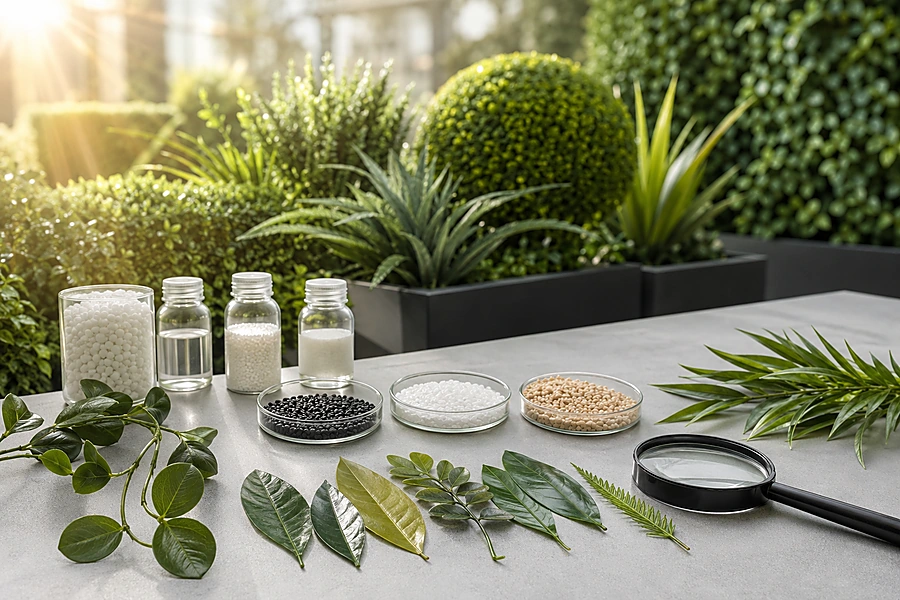
Sunlight can break polymer bonds and start oxidation that eventually causes color change, chalking, brittleness, cracking, and loss of physical properties. HALS and UV absorbers interrupt different parts of that process, which is why properly formulated combinations generally outperform a single generic additive.
What UV-Inhibitor Methods Are Used in Artificial Plants?
“UV inhibitor” is often used as a broad marketing term. It can describe an additive mixed into plastic, a protective pigment, a factory coating, or a clear spray applied after production.
The main UV-protection methods are HALS, UV absorbers, screening pigments, antioxidants, compounded masterbatches, factory-applied coatings, and aftermarket sprays. They do not offer equal protection because they act through different mechanisms and may protect only certain product components.
1. Bulk-compounded UV masterbatch
A UV masterbatch contains concentrated stabilizing additives carried in a compatible resin. The manufacturer mixes it into PE, PP, PVC, or another polymer before molding the artificial leaves or stems.
This method distributes protection through the molded component rather than placing it only on the exposed surface. Ampacet describes UV stabilizer masterbatches as additives used to protect plastic products from sunlight and long-term thermal degradation. Its product guides include HALS-based systems intended to preserve polymer properties.
Bulk compounding is usually the strongest starting point for:
- Artificial boxwood panels
- Molded eucalyptus leaves
- PE grasses
- Olive foliage
- Outdoor topiaries
- Artificial palms
- Plastic planter inserts
- Structural stems and backing grids
The term “masterbatch,” however, does not reveal the additive type, concentration, dispersion quality, or finished-product performance. Buyers still need test evidence for the exact formulation and SKU.
2. Hindered amine light stabilizers
Hindered amine light stabilizers, commonly called HALS, do not primarily work by absorbing UV radiation. They interrupt polymer photo-oxidation by scavenging damaging radicals.
BASF describes HALS as highly efficient stabilizers, particularly for polyolefins. Their stabilization cycle allows them to be regenerated rather than immediately consumed, and they can be effective at relatively low concentrations. BASF also identifies HALS as particularly effective in high-surface-area products such as films and fibers.
This characteristic is important for artificial plants because many leaves are:
- Thin
- Highly exposed
- Molded with large surface areas
- Frequently handled or cleaned
- Installed where both sunlight and heat are present
For thin PE and PP foliage, a suitable low-migration HALS is often the most valuable individual stabilizer.
3. UV absorbers
UV absorbers intercept harmful UV radiation and convert the absorbed energy into less damaging heat. They act more like sunscreen for the polymer.
BASF states that UV absorbers competitively absorb UV radiation and dissipate it as thermal energy. They can protect molded plastics, films, fibers, coatings, and adhesives, but the correct additive and concentration must be selected through formulation trials.
UV absorbers can be valuable for:
- Thick molded leaves
- Clear or translucent coatings
- PU surfaces
- Printed petals
- Adhesives
- Clear protective finishes
- Components where color and clarity matter
Their effectiveness depends partly on how far light travels through the protected layer. This makes them less complete as a standalone solution for extremely thin surfaces or exposed coating edges.
4. UV-screening pigments
Some pigments physically absorb, reflect, or screen radiation while creating the product’s visible color.
Carbon black can provide powerful UV protection in suitable black polymer products because it absorbs a broad range of UV wavelengths. Ampacet describes well-dispersed carbon black as an economical way to protect polyolefins from sunlight. This performance is useful scientifically, although black pigment is unsuitable for most realistic green leaves and colorful flowers.
Weathering-grade white pigments can also support durability. Ampacet reports stronger weatherability when suitable white masterbatch is combined with HALS, illustrating that pigment and stabilizer systems can work together.
For artificial plants, buyers need pigments selected for outdoor color stability rather than only an additive labeled “UV inhibitor.”
5. Antioxidants
Antioxidants are not complete UV inhibitors by themselves. They help control oxidation during processing and service, supporting the broader stabilization package.
Commercial stabilizer systems may combine UV absorbers, HALS, and antioxidants to reduce yellowing, cracking, and degradation caused by sunlight and heat.
An antioxidant-only formulation should not be accepted as proof of outdoor fade resistance.
6. Factory-applied UV coatings
A factory coating can add a protective surface layer to petals, leaves, printed details, or finished plants. Strong exterior coatings may combine UV absorbers and HALS.
BASF’s coatings guidance explains that UV absorbers filter harmful radiation, while HALS protect the coating surface by interrupting photo-oxidation. It also describes synergistic performance when both types are used together.
Factory coating can be useful when:
- A component cannot be stabilized during molding
- Printed color needs surface protection
- Fabric petals require a protective finish
- A premium appearance must be preserved
- Several materials meet in one finished flower
Its weakness is dependence on adhesion, thickness, coverage, flexibility, and abrasion resistance. Edges, joints, undersides, and areas damaged during shaping may receive less protection.
7. Aftermarket UV sprays
Clear sprays can provide an additional protective finish. Some commercial clear coatings are marketed as UV-resistant and suitable for exterior plastic surfaces.
However, an aftermarket spray should be treated as a maintenance layer. It may:
- Miss concealed surfaces
- Change gloss or texture
- Stiffen fabric petals
- React with paint or adhesive
- Wear during cleaning
- Peel from flexible leaves
- Require future reapplication
Test the spray on a concealed part before applying it to the complete display.
Method comparison
| Protection Method | Main Action | Best Role | Main Limitation |
|---|---|---|---|
| Bulk-compounded HALS | Interrupts radical degradation | Thin PE and PP foliage | Must match polymer and exposure |
| UV absorber | Absorbs UV and releases heat | Molded parts and coatings | Less complete at very thin surfaces |
| Weather-stable pigment | Screens radiation and retains color | Colored molded components | Performance varies by pigment |
| Antioxidant | Controls oxidation | Supporting additive | Not sufficient alone |
| Factory UVA/HALS coating | Protects surface and color layer | PU, fabric, printing, mixed materials | Can wear or lose adhesion |
| Aftermarket clear spray | Adds temporary surface protection | Maintenance and sheltered displays | Coverage and compatibility vary |
| Shade or exposure control | Reduces received radiation | Every installation | Does not improve the material itself |
Why Do HALS and UV Absorbers Work Differently?
Artificial plants do not fade through one simple reaction. Sunlight can affect the pigment, polymer, coating, adhesive, and printed details through related but different processes.
UV absorbers reduce the radiation entering a material. HALS interrupt the damaging oxidation cycle after radicals form. Because these mechanisms are complementary, a compatible HALS-and-absorber combination normally provides broader protection than either technology used alone.
UV absorbers act first
A UV absorber intercepts incoming radiation before it damages the polymer or underlying color layer.
This makes absorbers particularly useful in:
- Clear coatings
- Transparent or translucent materials
- Thicker molded parts
- Adhesives
- Printed surfaces
- Products where the original appearance must remain visible
However, BASF notes that UV absorbers alone may provide insufficient protection at the coating surface where effective film thickness becomes extremely low.
HALS control the degradation cycle
HALS work after damaging radicals begin to develop. They interrupt photo-oxidation and can continue participating through a regenerative stabilization cycle.
Their surface effectiveness and strong performance in polyolefins explain why they are often the central additive for molded PE or PP artificial foliage.
A high-molecular-weight or oligomeric HALS may also provide lower migration and volatility than a poorly selected small molecule. Both BASF and Clariant offer stabilizers specifically described as having low migration tendencies or strong migration resistance.
The strongest system combines mechanisms
BASF reports that combining a UV absorber with HALS can create synergistic performance. The correct concentration must still be established through laboratory trials for the selected resin and application.
A strong outdoor formulation may therefore contain:
- A HALS matched to the polymer.
- A compatible UV absorber.
- Processing and long-term antioxidants.
- Weather-stable pigments.
- Suitable polymer resin.
- Controlled additive dispersion.
- UV-stable adhesives and printed coatings.
Which method actually wins?
| Rank | Method | Practical Verdict |
|---|---|---|
| 1 | Bulk-compounded HALS-led package with UV absorber and stable pigments | Best overall system for molded outdoor foliage |
| 2 | Stabilized substrate plus factory UVA/HALS coating | Strong for mixed-material or premium products |
| 3 | Factory coating over an unstabilized substrate | Useful, but substrate failure remains possible |
| 4 | Single UV absorber in the polymer | Better than no protection, but incomplete |
| 5 | Aftermarket UV spray only | Supplementary and maintenance-dependent |
| 6 | Unverified “UV-resistant” claim | Highest sourcing risk |
This ranking is an engineering synthesis based on published stabilizer mechanisms, migration considerations, coating behavior, and weathering guidance. It is not a universal laboratory ranking of every artificial-plant formulation.
Which UV Protection Works Best for PE, PVC, PU, and Silk-Touch Plants?
A finished artificial plant may contain several materials. One stabilizer system cannot automatically protect every component.
PE and PP foliage usually benefits most from a HALS-led compounded package. PVC needs a formulation specifically validated for its stabilizers and pigments. PU and silk-touch surfaces usually need compatible material stabilization plus a tested factory coating. Every critical component must be evaluated separately.
PE and PP foliage
PE and PP are common choices for molded leaves, grasses, backing grids, stems, and artificial hedges.
For these products, specify:
- HALS mixed into the polymer
- Low-migration stabilizer
- Compatible UV absorber where required
- Weather-stable color masterbatch
- Antioxidant support
- Uniform additive dispersion
- Finished-product weathering test
BASF identifies HALS as the most effective additive class for stabilizing polyolefins against light degradation.
Best method: bulk-compounded, HALS-led stabilization.
PVC components
PVC may be used for pine needles, economical leaves, stems, garlands, and structural components. Its outdoor performance depends on the complete compound, including pigments, stabilizers, plasticizers, and processing conditions.
Clariant lists certain oligomeric HALS products as suitable for multiple materials, including PVC, but the exact formulation must be validated because compatibility and performance differ by application.
Best method: polymer-specific stabilizer and pigment system confirmed by finished-component testing.
PU and real-touch flowers
PU surfaces are often selected for realistic petals and soft-touch leaves. The exposed surface may be thin, flexible, and frequently handled.
A combined UVA-and-HALS coating can protect both the coating and underlying color more effectively than a UV absorber alone. The coating must remain flexible and must not become sticky, yellow, glossy, or brittle after weathering and cleaning. The need for combined stabilization is supported by coating-additive guidance, although performance must be proven for the actual PU formulation.
Best method: stabilized PU formulation plus a compatible factory-applied UVA/HALS surface system.
Silk-touch and polyester flowers
“Silk-touch” is a commercial description rather than one precise material. It may describe polyester fabric, coated fabric, flocking, printing, or a multilayer petal.
A plastic masterbatch used in a PE leaf does not protect a fabric petal. Fabric flowers require product-specific controls for:
- Fiber color
- Printed gradients
- Surface coating
- Edge treatment
- Adhesive
- Water exposure
- Cleaning
- UV exposure
Best method: weather-stable fiber or pigment combined with a flexible factory coating, followed by testing of the complete petal and flower assembly.
Full-sun placement should not be approved based only on a spray treatment.
Hybrid artificial plants
A realistic artificial olive tree might contain:
| Component | Possible Best Protection |
|---|---|
| PE leaves | Compounded HALS and pigment system |
| Printed leaf details | Factory UVA/HALS coating |
| Plastic branches | Polymer stabilizer package |
| Adhesive | UV- and heat-qualified formulation |
| Trunk coating | Exterior-grade finish |
| Decorative flowers | Component-specific coating |
| Planter | Weather-resistant resin and pigment |
This is why buyers should request a component map rather than one general statement saying “the plant has UV protection.”
How Can Buyers Verify Artificial-Plant Anti-Fade Claims?
A test certificate is useful only when it identifies the actual product, exposure conditions, measurements, and acceptance criteria.
Buyers should verify anti-fade claims with finished-product reports, control samples, measured color change, structural evaluations, outdoor trials, and written warranty terms. A test duration without the lamp, cycle, temperature, moisture, specimen, and pass criteria does not prove commercial performance.
Request a complete technical file
| Required Detail | Why It Matters |
|---|---|
| Exact SKU | Links testing to the purchased item |
| Polymer and pigment | Identifies the tested formulation |
| Stabilizer type | Distinguishes HALS, absorber, coating, or blend |
| Stabilizer location | Shows whether protection is internal or surface-only |
| Test standard and edition | Defines the procedure |
| Lamp and filter | Identifies the radiation spectrum |
| Irradiance | Shows exposure intensity |
| Temperature | Reveals heat conditions |
| Moisture cycle | Shows condensation or spray exposure |
| Test duration | Supports comparison |
| Color measurement | Quantifies fading |
| Structural evaluation | Records cracking and brittleness |
| Acceptance criteria | Explains what “passed” means |
| Laboratory details | Supports traceability |
Use suitable weathering methods
ASTM G154 provides operating procedures for fluorescent UV weathering devices. ASTM D4329 provides plastics-specific procedures using UV, moisture, and heat and recommends multiple specimens for meaningful evaluation.
ASTM G155 uses filtered xenon-arc light, heat, and optional moisture. It allows a wide range of exposure conditions that can produce significantly different results, so the report must state the selected conditions.
Neither method creates a universal conversion between laboratory hours and outdoor years. Q-Lab states that no single “magic number” can convert accelerated-weathering hours into a fixed outdoor lifespan because correlation changes with material, climate, orientation, temperature, moisture, and spectrum.
Measure color and physical condition
Color should be compared visually under controlled lighting and, where appropriate, instrumentally.
ISO/CIE 11664-6:2022 defines the CIEDE2000 formula for expressing the relative magnitude of perceived color differences. Buyers may use ΔE00 measurements as part of a color-retention specification, but the acceptable limit must be agreed for the product, texture, color, and viewing distance.
Do not evaluate color alone. Record:
- Fading
- Yellowing
- Chalking
- Gloss change
- Cracking
- Brittleness
- Leaf detachment
- Stem warping
- Adhesive failure
- Surface stickiness
Test the finished assembly
A supplier may submit a report for green PE resin while the purchased artificial plant also contains untreated flowers, paint, adhesive, and PVC connectors.
The strongest test plan evaluates:
- Individual high-risk materials.
- Finished leaves or petals.
- Complete artificial plant.
- Product after cleaning.
- Product after packaging and reshaping.
- Outdoor control samples at the intended site.
Use three physical samples
Install three matching samples:
| Sample | Location | Purpose |
|---|---|---|
| A | Full intended exposure | Tests the actual environment |
| B | Partial shade | Shows the value of exposure reduction |
| C | Dark indoor storage | Provides a control reference |
Photograph the samples before exposure and at scheduled intervals using consistent lighting, distance, orientation, and camera settings.
Strengthen the purchase order
A useful specification may state:
The leaves must use a factory-compounded, low-migration HALS-led stabilization system with compatible pigments. Bulk production must match the approved sample and meet the agreed color, cracking, brittleness, adhesion, and foliage-retention criteria after the specified weathering cycle.
Also include:
- Covered SKU
- Intended exposure
- Test method
- Minimum test duration
- Required measurements
- Acceptable color change
- Structural failure limits
- Warranty duration
- Exclusions
- Remedy
- Claim evidence
- Replacement freight responsibility
My insights: Which UV-Inhibitor Method Actually Stops Fading in Artificial Plants
The phrase “stops fading” creates the wrong expectation. Every organic polymer, pigment, coating, and adhesive can age under sufficient outdoor exposure.
No UV-inhibitor method stops artificial-plant fading permanently. The strongest practical solution is a component-specific system led by bulk-compounded HALS, supported by compatible UV absorbers, antioxidants, and weather-stable pigments. Factory coatings can protect sensitive surfaces, while sprays, shade, cleaning, and rotation extend—not create—outdoor durability.
The winning formula has five layers
| Layer | Required Control |
|---|---|
| 1. Polymer | Outdoor-suitable resin |
| 2. Stabilizer | Low-migration HALS plus compatible UV absorber |
| 3. Color | Weather-stable pigment system |
| 4. Surface | Factory coating where the component requires it |
| 5. Evidence | Finished-product testing and warranty |
My central insight is that the method must be inside the material before it is added on top of the material.
A surface coating protects only while it remains complete and attached. A bulk stabilizer remains distributed through the molded component. This does not make the product permanent, but it reduces reliance on one vulnerable outer film.
HALS is the winner—but not alone
For thin PE and PP artificial foliage, HALS is the strongest individual inhibitor because it controls photo-oxidative degradation efficiently at the polymer surface and in high-surface-area applications.
However, HALS alone cannot guarantee color retention when:
- The pigment is unstable
- The adhesive fails
- A flower coating yellows
- An untreated component fades
- The additive migrates
- The dosage is insufficient
- The product receives excessive heat
- Production differs from the tested formulation
The commercial winner is therefore a HALS-led stabilization package, not a single additive name.
Buyer decision matrix
| Supplier Claim | Buyer Decision |
|---|---|
| “Contains UV inhibitor” | Insufficient—request additive type and test |
| “UV spray applied” | Supplementary protection only |
| “UV absorber added” | Ask whether HALS is also included |
| “HALS masterbatch used” | Strong starting point; verify dosage and finished SKU |
| “HALS plus UVA and stable pigments” | Preferred formulation direction |
| “ASTM tested” | Request exact cycle, specimen, result, and criteria |
| “1,000 hours equals five years” | Request validated product-specific correlation |
| “Fade-proof forever” | Treat as an unsupported claim |
Final sourcing rule
Buyers should ask one direct question:
Is the UV protection compounded into every critical molded component, supported by a compatible pigment system, supplemented where necessary by a factory coating, and verified on the finished product?
When the answer is documented, the product has a defensible anti-fade system.
When the answer is only “UV treated,” the buyer has a marketing claim—not a reliable performance specification.
Conclusion
No inhibitor stops fading forever. A tested, HALS-led compounded system with compatible absorbers, pigments, coatings, installation controls, and warranty terms provides the strongest protection.