Outdoor fake plants can look perfect on day one and dull only weeks later. Sun, rain, heat, wind, and weak construction quickly expose a poor choice.
The best fake plants for outdoors in 2025 are made for exterior use, include UV protection throughout the material, and use durable polyethylene or weather-resistant plastic parts. Artificial boxwood, agave, grasses, ferns, topiaries, and dense-leaf shrubs usually last better than delicate fabric flowers in exposed outdoor spaces.
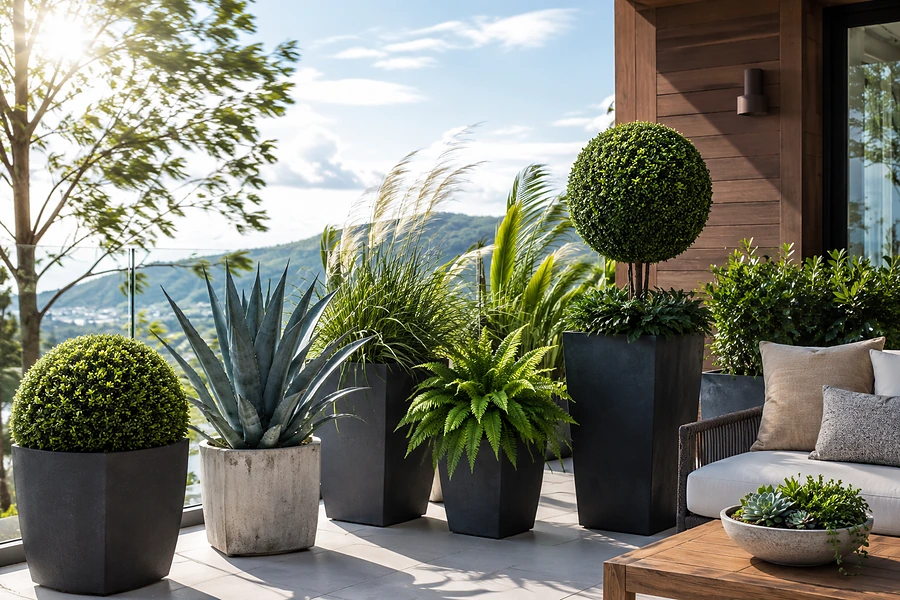
I do not judge an outdoor artificial plant by realism alone. I also check its material, UV treatment, stem construction, drainage, color, installation method, warranty, and intended exposure. These details tell me more than a simple “weatherproof” label.
What Makes a Fake Plant Suitable for Outdoor Use?
Many artificial plants look strong because they are made of plastic. That does not mean they can remain outside without fading, cracking, or losing leaves.
A fake plant is suitable for outdoor use when its leaves, stems, pigments, coatings, adhesives, and internal supports are designed for sunlight, moisture, heat, and wind. The product should be clearly labeled for exterior use and should include specific information about UV resistance, weather testing, placement limits, or warranty coverage.
The whole plant needs protection. A manufacturer may use UV-resistant leaves but attach them with an adhesive that softens in heat. Another product may use strong stems but weak pigments that fade in direct sunlight. I therefore evaluate the full construction rather than one material claim.
UV Resistance Is More Than a Marketing Label
Sunlight can start a process called photodegradation in plastic materials. The material may first lose color. It may then become dry, brittle, cracked, or weak. Temperature, rain, contaminants, and moisture can speed up weather-related damage. Light stabilizers and UV absorbers are added to polymers to reduce this degradation, but the type and amount of protection must match the intended application.
There are two common ways to protect artificial plants:
| UV Protection Method | How It Works | Main Limitation |
|---|---|---|
| UV additives in the material | Stabilizers are mixed into the polymer before molding | Quality depends on the formula and additive level |
| Surface UV coating | A protective layer is sprayed or applied after production | Coverage may wear, crack, or miss hidden surfaces |
| Combined protection | Stabilized material receives an added surface treatment | Usually increases cost |
| No verified protection | Product relies on basic plastic and pigments | Often fades quickly outdoors |
I prefer protection built into the material because scratches and cleaning do not remove it as easily as a surface-only treatment. A combined system can offer more protection, but the supplier should still provide meaningful test information.
Weatherproof Does Not Mean Indestructible
A weatherproof artificial plant should tolerate normal outdoor moisture and temperature changes. It does not mean the product can survive every climate or location.
A covered porch in a mild climate creates far less stress than an uncovered rooftop in Arizona, a coastal balcony with salt air, or a restaurant entrance exposed to daily heat and cleaning. The same fake plant can last for years in shade and fail within one season under intense direct sun.
I check these conditions before selecting a product:
- Hours of direct sunlight each day
- Highest summer temperature
- Winter freezing conditions
- Rain and drainage
- Wind speed and exposure
- Salt air or pool chemicals
- Cleaning frequency
- Length of the required display period
- Distance from which people will see the plant
Artificial plants intended only for indoor use may fade very quickly when placed outside. Horticulture guidance reported by The Spruce warns that many indoor fake plants can look poor after only a few weeks of outdoor sun exposure. Outdoor-safe products should use UV-resistant and weatherproof materials such as PE, PVC, or suitable plastic blends.
Which Fake Outdoor Plants Last the Longest?
A plant with thin petals and hundreds of small connection points has more ways to fail than a solid molded leaf. Plant type matters as much as material.
The longest-lasting fake outdoor plants are usually dense artificial boxwood, molded agave, grasses, conifers, topiaries, hedges, and broad-leaf tropical plants made from UV-stabilized PE or durable plastic blends. Their simple forms, thicker leaves, strong stems, and fewer delicate parts help them resist fading, tearing, and wind damage.
I generally choose plants that already have firm, waxy, or structured leaves in nature. Artificial versions of these plants can use thicker materials without looking unrealistic.
Artificial Boxwood and Hedge Panels
Artificial boxwood is one of the safest choices for outdoor walls, railings, partitions, and privacy screens. Its small leaves create a dense visual surface, so minor color differences are less visible from a distance.
Good boxwood panels should have:
- UV protection in the leaves
- Matte rather than glossy surfaces
- Several shades of green
- Strong grid backing
- Secure leaf connections
- Enough density to hide the support wall
- Fire-performance documentation when required for a commercial project
I avoid very cheap hedge panels with one bright green color. Bright yellow-green pigments often look artificial even before they fade. A mix of medium, dark, and muted greens usually ages more naturally.
Faux Agave, Yucca, and Succulents
Artificial agave and other architectural plants often perform well because their leaves are thick, simple, and firmly attached. They also need fewer individual parts than a flowering bush.
A molded agave can tolerate wiping and light rain better than a fabric flower. It also maintains its shape in a planter. I still inspect the leaf tips because thin points can bend during shipping or become brittle after long exposure.
Large faux agave plants work well in:
| Location | Why They Work |
|---|---|
| Hotel entrances | Strong shape and low visual maintenance |
| Pool areas | Tropical appearance without soil or watering |
| Rooftop terraces | Structured leaves handle open spaces well |
| Restaurant patios | Easy to wipe and rearrange |
| Commercial planters | Consistent size and year-round appearance |
Artificial Grasses and Ferns
Outdoor artificial grasses are useful in window boxes, balcony planters, and narrow containers. Their many blades create movement and hide small imperfections. They also mix easily with real plants.
Faux ferns can work in covered or partly shaded areas. I am more cautious in strong sun because many fern products use thin leaves with many small attachment points. Each small leaflet can fade, detach, or collect dirt.
For exposed locations, I choose grasses with molded blades and flexible stems. For covered porches, I can use softer ferns because they receive less sunlight and weather stress.
Topiaries, Cedar Trees, and Conifers
Artificial topiary balls, cedar trees, cypress spirals, and pine-style plants are common choices for entrances. Their dense foliage hides internal frames and offers a formal shape throughout the year.
The most important issue is stability. A tall fake topiary can become a wind hazard even when its leaves are durable. I use a heavy exterior planter, secure the base, and add drainage. Decorative stones or fixed internal supports can prevent the plant from tipping.
Outdoor Plants Ranked by Typical Durability
| Artificial Plant Type | Outdoor Durability Potential | Main Risk |
|---|---|---|
| Boxwood hedge | High | Grid or leaf connections may weaken |
| Molded agave | High | Tips may bend or crack |
| Artificial grass | High | Blades may flatten |
| Cedar or cypress topiary | Medium to high | Wind pressure and fading |
| Broad-leaf tropical plant | Medium | Large leaves can catch wind |
| Fern | Medium | Small leaflets can detach |
| Flowering shrub | Medium to low | Petals and colors fade unevenly |
| Silk-touch flowers | Low in full exposure | Fabric fading and fraying |
Material quality can change this ranking. A well-tested outdoor flower may outlast a cheap artificial hedge. The table is a starting point, not a guarantee.
Why Do Artificial Plants Fade in the Sun?
Color loss is the most visible problem, but it is usually only one part of a wider material failure.
Artificial plants fade because UV radiation breaks down pigments and polymer chains. Heat, moisture, oxygen, pollution, and repeated temperature changes can increase the damage. Indoor-grade fabrics, weak dyes, bright colors, surface-only treatments, and thin plastic parts usually show fading faster than UV-stabilized outdoor materials.
The process is not equal across the whole plant. Leaves facing the sun may fade while shaded leaves keep their original color. Red flowers may lose color before green foliage. One side of a topiary can become pale while the other side remains dark.
What Fades First?
I usually see early damage in these areas:
- Red, pink, purple, and bright blue flowers
- Pale green leaf tips
- Thin fabric petals
- Exposed stems and plastic joints
- Leaves facing south or west
- Parts near reflective walls or windows
- Surface coatings that were applied unevenly
Bright colors make changes easier to see. A dark green plant may also fade, but the change can look more natural than a pink flower turning white.
Artificial flowers are often more difficult to maintain outdoors than green plants. Their petals are thinner, their colors are stronger, and their construction includes more small pieces. A UV-resistant label can slow fading, but it does not make the color permanent.
Material Failure Beyond Color Loss
A faded plant may still be structurally usable. A brittle plant is a more serious problem.
UV exposure can reduce flexibility and strength. Leaves may crack when cleaned. Stems may split. Small connection points may fail. Adhesives can weaken, and metal wires may rust when water reaches an unprotected section.
Accelerated weathering equipment can expose materials to controlled cycles of UV light, heat, condensation, and water spray. These tests help evaluate changes caused by sunlight and moisture, but the test conditions and pass criteria must be stated clearly.
I do not accept a claim such as “tested for 1,000 hours” without more detail. The number alone does not explain:
- Which test method was used
- Which lamp or light source was used
- Whether water or condensation was included
- What temperature was used
- Which plant components were tested
- How color change was measured
- Whether cracking or strength was checked
- What result counted as a pass
A leaf sample can pass a UV test while the finished plant still fails at its joints. Complete-product testing gives more useful information for outdoor artificial plants.
Which Colors Hide Fading Better?
Muted and mixed colors usually age better visually than bright single colors. Natural plants already include color variation. A product with several greens can therefore lose a small amount of color without looking obviously damaged.
I favor:
- Olive green
- Sage green
- Dark forest green
- Mixed green and brown stems
- Dusty red
- Cream
- Muted yellow
- Soft terracotta
I am more careful with neon green, strong purple, bright red, and deep blue. These colors can look attractive in online photographs but may reveal uneven fading quickly in direct sunlight.
How Long Do UV-Resistant Artificial Plants Last Outside?
Buyers often want one clear number. Outdoor lifespan cannot be predicted from the words “UV resistant” alone.
UV-resistant artificial plants may remain presentable from several months to several years. Their actual lifespan depends on UV exposure, climate, material formula, pigment quality, construction, maintenance, and the buyer’s standard for acceptable fading. A written outdoor warranty is more useful than an unsupported lifespan claim.
Online claims vary widely. Some outdoor decorations are recommended for only limited seasonal exposure, while some commercial artificial greenery sellers advertise resistance lasting five years or longer. These claims are not directly comparable because the products, climates, tests, and definitions of failure differ.
Why Lifespan Claims Vary
A product may be called successful as long as it does not crack. Another company may count a visible color change as failure. A residential customer may accept some fading, while a luxury hotel may replace plants as soon as the green looks slightly uneven.
Location also changes the result:
| Exposure Level | Example Location | Expected Stress |
|---|---|---|
| Low | Covered porch with no direct sun | Dust and mild humidity |
| Moderate | Balcony with morning sun | Limited UV and rain |
| High | Open patio with afternoon sun | Strong UV, heat, and rain |
| Very high | Rooftop, desert, coastal frontage | UV, heat, wind, salt, and large temperature changes |
I avoid promising a fixed number of years unless the product has a warranty written for the same type of installation.
What a Useful Outdoor Warranty Should State
A good warranty should explain:
- Which product or stock-keeping unit is covered
- Whether full sun is allowed
- Which climate limits apply
- The warranty period
- The acceptable level of fading
- Whether cracking and leaf loss are included
- Required installation and maintenance
- Excluded conditions
- Replacement or refund terms
- Whether labor and installation costs are covered
A general company promise is not enough. The specific artificial plant must be included.
How I Extend the Life of Outdoor Faux Plants
Correct placement can add useful life without changing the product.
I use these simple steps:
- Place plants under partial cover when possible.
- Rotate planters to reduce one-sided fading.
- Remove dust with a soft cloth or gentle water flow.
- Avoid harsh cleaners unless the supplier approves them.
- Keep drainage holes open.
- Secure tall plants against wind.
- Inspect leaf joints after storms.
- Move seasonal displays indoors during extreme weather.
- Replace individual faded stems before replacing a full installation.
- Record installation dates and take reference photographs.
I do not apply a random UV spray without checking compatibility. Some sprays can change the sheen, make leaves sticky, soften printed colors, or create uneven patches. A small hidden test area is safer.
What Should You Buy for a Porch, Patio, Balcony, or Garden?
The best outdoor fake plant is not the most expensive one. It is the product that matches the exposure, viewing distance, and maintenance plan.
For covered porches, buyers can use realistic ferns, olive trees, and flowering arrangements with moderate outdoor protection. For open patios and balconies, UV-stabilized boxwood, grasses, agave, cypress, and molded tropical foliage are safer. For full-sun commercial spaces, buyers should choose tested product lines with written fade coverage.
I start with the location and then choose the plant.
Best Fake Plants for a Covered Porch
A covered porch gives me the most design freedom. I can use:
- Artificial Boston ferns
- Faux olive trees
- Artificial eucalyptus
- Hanging greenery
- Mixed-leaf arrangements
- Silk-touch flowers with outdoor labeling
- Small topiaries
- Trailing vines
These products receive less rain and UV exposure. I can focus more on realism and less on heavy structural protection.
I still avoid indoor-only flowers near the edge of the porch. Low-angle morning or afternoon sunlight can reach farther under a roof than expected.
Best Fake Plants for an Open Patio
An open patio needs stronger materials. I prefer:
- PE artificial grasses
- Molded agave
- Artificial boxwood balls
- UV-resistant cedar trees
- Dense tropical foliage
- Outdoor topiaries
- Mixed green shrubs
I use large, stable planters. I also leave drainage space because rainwater can collect around internal stems and metal supports.
Best Fake Plants for a Sunny Balcony
A balcony combines sunlight and wind. Large leaves can act like sails, so the plant must be secured.
Compact grasses, boxwood, low shrubs, and agave forms work better than tall fiddle-leaf figs or wide palms. I attach the plant base inside the planter and use enough weight to prevent tipping.
I also check building rules. A falling artificial plant can cause property damage or injury even when it is lightweight.
Best Fake Plants for Commercial Exteriors
Hotels, restaurants, shopping centers, offices, and event venues need consistent appearance and predictable replacement costs.
For commercial work, I focus on:
- Third-party weathering reports
- Fire-performance requirements
- Batch color consistency
- Replaceable stems or panels
- Strong installation systems
- Written warranties
- Cleaning instructions
- Spare inventory
- Material declarations
- Packaging that protects leaf shape
Commercial buyers should compare total cost rather than unit price. A cheap hedge that needs replacement every season can cost more than a tested system that lasts several display cycles.
Outdoor Fake Plant Buying Checklist
| Question | What I Want to See |
|---|---|
| Is it designed for outdoor use? | A clear exterior-use statement |
| How is it UV protected? | Additives in the material or a defined treatment |
| Has it been tested? | Method, duration, conditions, and result |
| Is fading covered? | Written product-specific warranty |
| What is it made from? | PE, PVC, polyester, or a defined blend |
| Can it handle rain? | Drainage and corrosion-resistant construction |
| Can it handle wind? | Strong frame and installation guidance |
| Is the color realistic? | Matte finish and several natural tones |
| Can damaged parts be replaced? | Spare stems, leaves, or panels |
| How should it be cleaned? | Clear maintenance instructions |
My Insights: Best Fake Plants for Outdoors in 2025—What Lasts, What Fades, What Should You Buy
The biggest buying mistake is searching for a fake plant that will “never fade.” Every exterior material changes when exposure is strong enough.
The best fake plants for outdoors in 2025 are not simply labeled UV resistant. They use outdoor-grade material throughout the plant, have realistic exposure limits, stable construction, natural colors, and test or warranty support. Buyers should choose dense molded greenery for full exposure and reserve delicate fabric flowers for protected locations.
My main insight is that outdoor performance should be treated as a complete system. Material, pigment, UV stabilizer, adhesive, stem, frame, planter, drainage, and installation all work together.
What Lasts
The strongest choices usually share these features:
- Thick molded leaves
- UV protection mixed into the polymer
- Muted or multi-tone colors
- Few delicate connection points
- Flexible but strong stems
- Protected metal supports
- Stable planters
- Replaceable components
- Clear outdoor-use documentation
Artificial boxwood, grasses, agave, topiary, cedar, and structured tropical plants often meet these conditions. They can also look convincing without using thin fabric.
What Fades
The highest-risk products usually include:
- Indoor silk flowers used outside
- Thin polyester petals
- Bright single-color leaves
- Glossy plastic foliage
- Surface-only protection with no test details
- Weak glue at leaf joints
- Exposed wire
- Unstable planters
- Products with no outdoor warranty
- Listings that promise “no fading” in every climate
A product can still be useful when it has one of these features, but I would place it under cover or use it for a short seasonal display.
What I Would Buy
For a covered porch, I would buy a realistic fern, olive tree, or mixed arrangement with basic outdoor protection.
For an open residential patio, I would buy UV-stabilized grasses, agave, boxwood, or a compact topiary.
For a sunny balcony, I would buy a low, wind-stable plant with molded leaves and a heavy planter.
For a hotel or restaurant exterior, I would buy commercial artificial greenery with product-specific testing, replaceable parts, and written warranty terms.
For a temporary wedding or seasonal display, I could use silk-touch flowers because long-term outdoor life is less important. I would still protect them from rain and strong afternoon sun.
The best buying decision is not based on one material or one product photograph. I look for the right plant form, verified outdoor construction, natural color, stable installation, and honest limits. That combination creates a display that stays attractive longer and costs less to replace.
Conclusion
Choose UV-stabilized molded greenery for exposed spaces, use delicate flowers under cover, verify outdoor claims, and match every fake plant to its actual sun, rain, and wind conditions.