
Faux flowers can look flat when they are placed straight from the box. The problem is not the flower. It is the arranging method.
To arrange faux flowers like a professional florist, choose realistic stems, shape every bloom, start with a strong vase, build a greenery base, place focal flowers first, add fillers for softness, and vary height, depth, and direction. A professional faux arrangement should look intentional, natural, balanced, and easy to maintain.
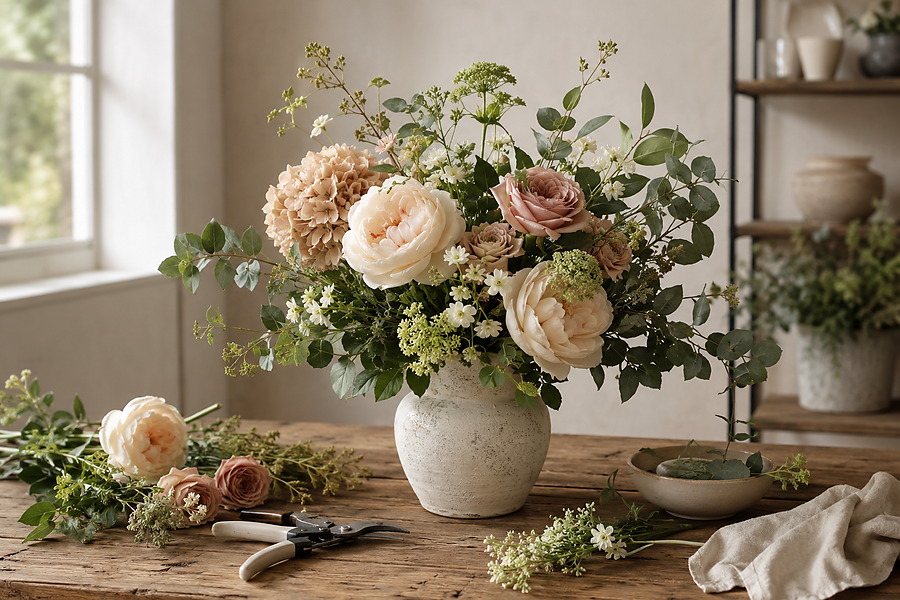
The best faux flower arrangements do not look perfect. They look alive. I want every stem to have a reason. I want the bouquet to feel soft, layered, and calm. That result comes from a clear process, not guesswork.
What tools do you need to arrange faux flowers?
Many people start with flowers only, then struggle when the bouquet falls apart. A professional look starts with the right tools and a stable base.
You need wire cutters, floral tape, floral foam or a floral frog, a sturdy vase, moss or stones, and realistic faux stems. These tools help you cut, bend, secure, lift, hide, and shape the arrangement so it holds a natural form.
The most important tool is not expensive. It is control. Faux stems often include wire inside, so normal scissors may not cut them well. A strong wire cutter protects your hands and gives a cleaner cut. Floral tape helps group stems. Floral foam helps hold the shape in a low bowl or wide container. A floral frog can also support stems when you want a reusable or more refined base.
Build a stable base first
Professional florists think about structure before beauty. A vase must support the arrangement. A tall, narrow vase works well for long stems. A low ceramic bowl works well for lush centerpieces. A wide glass vase may need foam, tape grids, or inner support. Balsam Hill recommends choosing a sturdy container, trimming stems to the desired height, layering different sizes and shapes, and bending stems for a lifelike look.
| Tool | Why It Matters | Best Use |
|---|---|---|
| Wire cutters | Cut thick faux stems cleanly | Roses, peonies, orchids, branches |
| Floral tape | Groups and secures stems | Bouquets and hand-tied designs |
| Floral foam | Holds stems in place | Bowls, boxes, wide vases |
| Floral frog | Supports stems without foam | Ceramic bowls and modern vessels |
| Moss or stones | Hides the artificial base | Clear or open containers |
| Steamer or warm hand shaping | Softens crushed petals | Silk and fabric flowers |
| Sturdy vase | Balances visual weight | Tall or heavy arrangements |
I also prepare the flowers before I arrange them. I open the petals. I separate leaves. I bend stems gently. I remove dust, loose threads, and visible glue marks. The Faux Flower Company advises opening out faux flowers and foliage before arranging because packaged stems often need shaping to look realistic.
This step matters because faux flowers hold their shape. That is both a strength and a weakness. If I leave a stem stiff, it will stay stiff. If I shape it well, it will keep that soft professional curve. I also measure the flowers against the vase before cutting. It is easy to cut too short. It is better to trim little by little.
How do you make fake flower arrangements look real?
A faux flower arrangement looks fake when the flowers are too shiny, too even, too crowded, or too bright. Realism comes from texture and restraint.
To make fake flower arrangements look real, use matte petals, natural color tones, bendable stems, uneven heights, and soft negative space. Real flowers have movement, shadow, and small imperfections, so faux flowers should not be arranged in a perfect round block.
The first choice is quality. Better Homes & Gardens notes that realistic faux flowers often have tone and texture, petals with dimension, slight imperfections, color variation, and stems that are not too stiff. These details matter because a viewer notices plastic shine very quickly.
Use natural imperfection
Real flowers do not all face forward. Some blooms lean. Some petals open more than others. Some leaves hide behind the flower head. I copy that pattern when I arrange faux stems. I place some stems higher. I push some deeper. I let a few leaves move outward. I turn one or two flowers slightly away from the viewer.
| Fake-Looking Problem | Professional Fix |
|---|---|
| Every bloom faces forward | Turn some stems sideways |
| All flowers sit at one height | Create low, middle, and high layers |
| Petals look too perfect | Open, bend, and soften the petals |
| Colors look too bright | Use muted ivory, blush, sage, taupe, or wine |
| Arrangement looks crowded | Remove stems and add breathing room |
| Vase looks cheap | Use ceramic, stone, glass, or basket texture |
Color is also important. A professional faux flower arrangement usually starts with a simple palette. Homes & Gardens highlights color palette, vessel choice, foliage base, balance, height, depth, and texture as key steps in professional arranging. For faux flowers, I like to keep the palette even tighter. Ivory with sage. Blush with taupe. White orchids with soft green. Mocha roses with dried-look grass.
The vase also changes the result. A beautiful faux arrangement can look cheap in a thin plastic container. I prefer matte ceramic, stone, glass, wood, or woven baskets. These materials give the flowers a more natural setting. If the vase is clear, I hide the stems with realistic water resin, moss, river stones, or a clean inner liner.
I also avoid overfilling. Many beginners add more stems because they think more flowers look more expensive. That is not always true. Luxury floral design often uses space. A few strong focal blooms can look better than a vase packed with random stems. The goal is not volume alone. The goal is shape, rhythm, and balance.
What is the basic rule for arranging faux flowers?
A professional arrangement needs order. Without a simple rule, the bouquet can become messy, heavy, or uneven.
The basic rule for arranging faux flowers is to work from structure to softness: start with greenery, add focal flowers, place textural flowers, then finish with fillers and movement stems. A simple 3-5-8 stem ratio can help beginners create balance.
The 3-5-8 rule is useful because it gives structure without making the arrangement feel stiff. Real Simple explains that the rule uses 3 focal flowers, 5 textural flowers, and 8 filler flowers for a balanced mid-sized bouquet. ([Real Simple][4]) I do not treat this as a strict law. I treat it as a starting point.
The 3-5-8 method for faux flowers
| Stem Type | Number | Role in the Arrangement | Faux Flower Examples |
|---|---|---|---|
| Focal flowers | 3 | Create the main visual story | Peonies, roses, orchids, hydrangeas |
| Textural flowers | 5 | Add structure and depth | Ranunculus, dahlias, anemones, berries |
| Filler flowers | 8 | Fill gaps and soften edges | Baby’s breath, waxflower, lavender, small leaves |
When I build the arrangement, I start with greenery. Greenery gives the design a skeleton. Eucalyptus, ruscus, olive branches, fern, and trailing vines can create width and direction. Then I add the focal flowers. These should not all sit in the same line. One can be higher. One can sit lower near the rim. One can lean slightly forward.
After that, I add textural stems. These stems connect the focal flowers. They make the arrangement feel full without looking heavy. Then I add fillers. Fillers should not hide the main blooms. They should soften the gaps and create a natural edge.
Real Simple also explains that stems can be crossed at about a 45-degree angle and rotated as more stems are added. This is very helpful for hand-tied faux bouquets. The spiral shape helps the bouquet sit evenly. It also keeps the stems from pointing straight up like a bundle.
For vase arrangements, I use the same idea but adapt it to the container. I insert the first stems at gentle angles. Bloomist recommends starting with substantial blooms at different heights and gentle angles to avoid a rigid artificial look. This advice is especially useful for faux flowers because artificial stems can look too vertical if they are not shaped.
The final rule is simple: turn the arrangement often. A professional florist does not design from one side only unless the arrangement will sit against a wall. I rotate the vase and check the silhouette from several angles. I adjust gaps. I lower heavy blooms. I bend leaves outward. I stop before the arrangement becomes too perfect.
How do you arrange faux flowers in a vase professionally?
A vase arrangement looks professional when the flowers fit the container, the height feels balanced, and the stems look naturally placed.
To arrange faux flowers in a vase professionally, choose a vessel that matches the flower scale, create support inside the vase, place stems at angles, vary the heights, hide the base, and finish by shaping the bouquet from every side.
The vase should decide the arrangement style. A narrow-neck vase holds tall stems well. A wide vase needs more structure. A low bowl works for centerpieces. A footed compote feels elegant for weddings. A ceramic pitcher can create a casual garden look. The container is not just a holder. It is part of the design.
A step-by-step vase method
| Step | What I Do | Why It Works |
|---|---|---|
| 1. Choose the vase | Match height, opening, and weight | The design feels balanced |
| 2. Add support | Use foam, frog, tape grid, or inner cup | Stems stay in place |
| 3. Add greenery | Build width and direction | The design gets structure |
| 4. Add focal blooms | Place them at varied heights | The eye has a clear path |
| 5. Add texture | Fill middle spaces | The bouquet gains depth |
| 6. Add fillers | Soften gaps and edges | The shape feels natural |
| 7. Hide the base | Use moss, stones, or leaves | The faux mechanics disappear |
| 8. Shape and rotate | Bend stems and check every angle | The final result looks professional |
Height is one of the easiest ways to improve a faux arrangement. If every bloom sits at the same level, the result looks flat. I like to create three levels. The tallest level gives movement. The middle level gives fullness. The lowest level connects the flowers to the vase. This makes the arrangement feel more natural.
I also think about depth. Some flowers should come forward. Some should sit back. This creates shadow and dimension. A flat front-facing bouquet can look artificial, especially in product photos or event displays. A deeper bouquet photographs better and feels more expensive.
Odd-number grouping also helps. Bless’er House uses a triangular placement method and notes that odd-number clusters work well in faux floral arrangements. I use this often with roses, peonies, or hydrangeas. Three large flowers can form a soft triangle. Five smaller stems can fill around them. This makes the arrangement feel planned but not stiff.
For modern interiors and events, I also use the 2025 quiet luxury direction. TrustFloral describes quiet luxury in artificial floral trends through simplicity, refined aesthetics, natural textures, monochrome palettes, and single-stem focus. This means I do not always need a large mixed bouquet. Sometimes one orchid stem in a sculptural vase looks more professional than a crowded centerpiece.
My insights: How can you arrange faux flowers like a professional florist
Professional faux flower arranging is not about copying fresh flowers exactly. It is about using the strengths of faux stems while hiding the parts that feel artificial.
You can arrange faux flowers like a professional florist by treating them as a designed floral system. Choose realistic stems, shape them by hand, build a clear structure, use a balanced color palette, vary height and depth, hide the mechanics, and finish with natural movement.
The biggest advantage of faux flowers is time. I can prepare them before an event. I can test colors with table linens. I can build a wedding centerpiece days earlier. I can reuse the same design for photo shoots, retail displays, hotel décor, or seasonal home styling. Better Homes & Gardens notes that faux florals are helpful for long-lasting arrangements, allergy sufferers, out-of-season flowers, and pieces styled well in advance.
My professional faux flower formula
| Design Step | What It Means | Why It Matters |
|---|---|---|
| Realism | Choose matte, flexible, color-varied stems | The arrangement starts with trust |
| Structure | Use greenery, vase support, and focal points | The bouquet holds its shape |
| Layering | Combine focal, texture, and filler stems | The design gains depth |
| Movement | Bend stems and change flower direction | The flowers feel alive |
| Restraint | Use fewer colors and avoid overcrowding | The final look feels refined |
| Finishing | Hide bases and clean every petal | The mechanics disappear |
My strongest view is that faux flowers should not be treated as a cheap shortcut. They should be treated as permanent botanicals. A professional florist does not just place flowers in a vase. A florist creates rhythm. A florist controls proportion. A florist edits. That same thinking works for faux flowers.
I always start by asking one question: what should this arrangement do? A wedding bouquet should feel romantic and hand-held. A dining centerpiece should stay low enough for conversation. A hotel lobby arrangement should have height and presence. A retail display should look clean from a distance and detailed up close. A home arrangement should feel natural with the room.
Then I choose the flowers based on that job. For a soft wedding look, I may use peonies, roses, ranunculus, and eucalyptus. For modern luxury, I may use orchids, calla lilies, hydrangeas, and olive branches. For a natural home arrangement, I may use tulips, ferns, and small seasonal fillers. Each choice should support the design mood.
The final step is editing. I remove anything that feels too shiny, too crowded, or too perfect. I turn a few blooms away. I bend one branch lower. I create a little space near the focal flower. I cover the base. I clean the petals. This is where a faux arrangement starts to look professional.
Conclusion
To arrange faux flowers like a professional florist, focus on realistic stems, strong structure, soft movement, balanced color, hidden mechanics, and careful final editing.