
Many people use the words artificial plant, fake plant, faux plant, and silk plant as if they mean the same thing. They are close, but the definition matters.
An artificial plant is a man-made imitation of a natural plant, designed to copy the appearance of living greenery, flowers, trees, succulents, vines, or foliage. Unlike a real plant, it does not grow, photosynthesize, need soil, require water, or stay alive. It is mainly used for decoration, display, events, retail styling, and low-maintenance interior or exterior design.
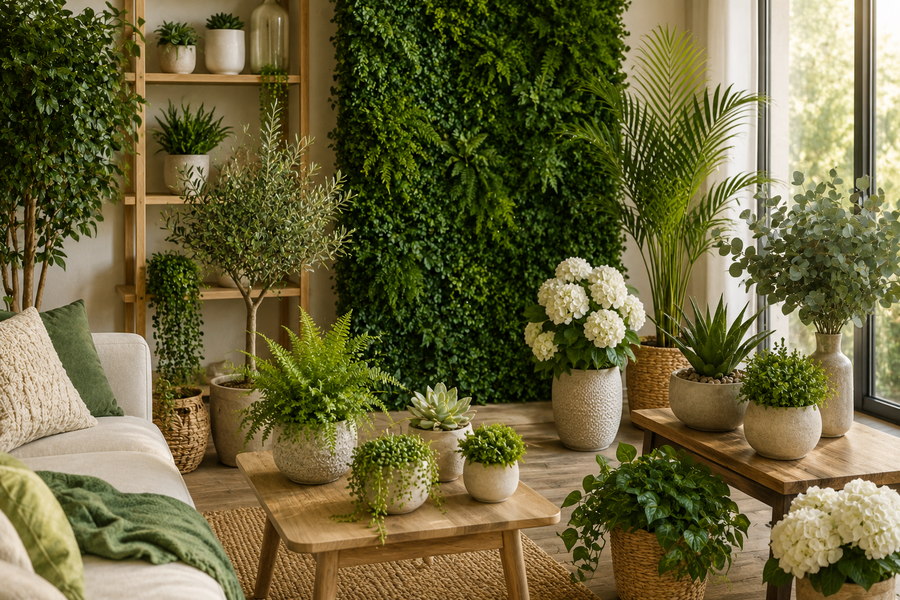
The word “artificial” means made by people, often as a copy of something natural, and Merriam-Webster defines it as made or produced by humans, especially to seem like something natural. A real plant, by contrast, is a living organism in the kingdom Plantae, usually multicellular and photosynthetic.
What does “artificial plant” mean in simple words?
The simplest definition is this: an artificial plant is a non-living plant replica made to look like a real plant.
In simple words, an artificial plant is a fake or faux plant made from materials such as plastic, polyester, silk-like fabric, latex, PE, PVC, wire, foam, or real-touch polymers. It is shaped, colored, and assembled to resemble natural leaves, stems, flowers, branches, vines, or trees for decorative use.
Artificial means man-made, not naturally grown
An artificial plant is not grown from seed. It does not have roots that absorb water. It does not convert sunlight into energy. It does not change through natural growth cycles.
Instead, it is manufactured. Designers study natural plants and recreate their shapes, colors, textures, and movement using synthetic or crafted materials.
Artificial plants are commonly described as imitations of natural plants used for residential or commercial decoration, and they can range from mass-produced plastic pieces to highly detailed botanical replicas.
Simple definition table
| Term | Meaning |
|---|---|
| Artificial plant | A man-made replica of a real plant |
| Faux plant | A stylish term for artificial plant |
| Fake plant | A casual term for artificial plant |
| Silk plant | A fabric-based artificial plant, often not made from real silk today |
| Real-touch plant | A faux plant made with softer, more realistic materials |
| Artificial greenery | Faux leaves, stems, vines, garlands, panels, or foliage |
| Artificial flower | A man-made flower replica, often part of the artificial plant category |
Is an artificial plant a real plant?
An artificial plant looks like a plant, but it is not biologically a plant.
An artificial plant is not a real plant because it is not alive. It does not have living cells, roots, photosynthesis, reproduction, growth, or natural metabolism. It is a decorative object that imitates the visual form of a real plant.
Real plants are living organisms
A living plant belongs to the biological kingdom Plantae. Most plants use photosynthesis to convert light energy, water, and carbon dioxide into chemical energy.
An artificial plant may look green, leafy, or floral, but it does not perform those biological functions.
The difference is function, not only appearance
A realistic faux olive tree may look like a real olive tree from across the room. A faux succulent may look natural on a shelf. But appearance does not make it alive.
The key difference is function. Real plants grow. Artificial plants imitate growth.
Real plant vs artificial plant
| Feature | Real Plant | Artificial Plant |
|---|---|---|
| Alive | Yes | No |
| Needs water | Yes | No |
| Needs sunlight | Usually yes | No |
| Photosynthesizes | Yes | No |
| Grows over time | Yes | No |
| Can wilt or die | Yes | No |
| Requires maintenance | Yes | Low maintenance |
| Main purpose | Living organism, décor, ecology, food, oxygen cycle | Decoration, display, styling, event use |
| Material | Living cells and tissues | Plastic, fabric, latex, wire, foam, polymers, or mixed materials |
What are artificial plants made of?
Artificial plants can be made from many materials. The material affects realism, durability, cost, and where the plant can be used.
Artificial plants are commonly made from plastic, polyester fabric, silk-like textiles, latex, PE, PVC, wire, foam, paper, real-touch polymers, and sometimes natural decorative materials such as preserved moss or wood bases. Higher-quality artificial plants usually have matte leaves, varied colors, bendable stems, and realistic surfaces.
Common materials
Plastic is often used for leaves, stems, outdoor greenery, and affordable products. Polyester or silk-like fabric is often used for flowers and softer leaves. Latex and real-touch polymers can create more realistic petals and leaves. Wire gives stems flexibility. Foam or plastic bases hold the plant structure in place.
Modern artificial plant products may include polyester, plastic, silk, latex, and high-grade fabrics, especially in commercial and residential décor categories.
“Silk plant” does not always mean real silk
Many products called silk plants are not made from actual silk. In modern décor language, “silk plant” often means a soft fabric-based artificial plant or flower. Buyers should check the material details instead of relying only on the marketing name.
Material guide
| Material | Common Use | Best For |
|---|---|---|
| Plastic | Leaves, stems, outdoor greenery | Affordable plants, durable décor |
| Polyester fabric | Flowers, soft leaves | Bouquets, floral arrangements |
| Latex | Realistic petals and leaves | Premium faux flowers |
| PE or PVC | Outdoor-safe greenery, molded leaves | Garlands, panels, weather-aware décor |
| Wire | Stem support | Bendable stems and branches |
| Foam | Base structure | Potted plants and arrangements |
| Real-touch polymers | Soft realistic surfaces | High-end faux plants and flowers |
| Moss or pebbles | Base covering | Making pots look more natural |
Why do people use artificial plants?
People use artificial plants because they want greenery without the care requirements of living plants.
People use artificial plants because they are low-maintenance, long-lasting, reusable, allergy-friendly for many spaces, and suitable for low-light areas. They are popular in homes, offices, hotels, restaurants, retail stores, weddings, events, balconies, bathrooms, photo backdrops, and commercial displays.
Low maintenance is the biggest reason
Artificial plants do not need watering, pruning, fertilizer, drainage, pest control, or sunlight. This makes them useful for busy homes, rental apartments, dark rooms, offices, restaurants, and event venues.
Nearly Natural describes indoor artificial plants as useful for spaces such as offices, bathrooms, shelves, and areas where real plants may struggle because they do not require sunlight or water.
Artificial plants solve design problems
A real plant may not survive in a windowless bathroom, dark office, high-traffic retail display, or wedding backdrop that must be built days before the event. Artificial plants solve those design problems by providing greenery where living plants are impractical.
Common uses
| Space | How Artificial Plants Are Used |
|---|---|
| Home | Living rooms, bathrooms, shelves, bedrooms, kitchens |
| Office | Reception areas, desks, meeting rooms, green walls |
| Events | Wedding arches, centerpieces, flower walls, garlands |
| Retail | Product displays, photo areas, seasonal installations |
| Hotels | Lobby plants, restaurant tables, corridor styling |
| Outdoor areas | UV-resistant porch plants, balcony greenery, patio pots |
| Photography | Backdrops, styled shoots, brand displays |
| Commercial interiors | Low-maintenance greenery for high-traffic spaces |
Are faux plants, fake plants, and artificial plants the same?
In everyday use, yes. These words usually refer to the same category, but they carry slightly different tones.
Faux plants, fake plants, and artificial plants all describe man-made plant replicas. “Artificial plant” is the clearest formal term. “Faux plant” sounds more stylish and design-friendly. “Fake plant” is more casual. “Silk plant” usually refers to fabric-based artificial greenery or flowers.
The word “faux” sounds more premium
In home décor, “faux” often sounds softer than “fake.” A product listing may say faux olive tree, faux eucalyptus stems, faux succulents, or faux greenery wall because the word feels more design-focused.
“Artificial plant” is better for definitions, wholesale categories, product catalogs, SEO pages, and formal descriptions.
Term comparison
| Term | Best Use |
|---|---|
| Artificial plant | Formal definition, product category, B2B catalog |
| Faux plant | Interior design, lifestyle content, premium décor |
| Fake plant | Casual speech, comparison with real plants |
| Silk plant | Fabric-style plant or floral product |
| Artificial greenery | Leaves, vines, stems, garlands, panels |
| Botanical replica | Premium or museum-style plant imitation |
What makes a good artificial plant?
A good artificial plant looks believable in the place where it is used.
A good artificial plant has realistic color, matte texture, natural shape, varied leaf sizes, bendable stems, hidden bases, and a planter that matches the room. The best artificial plants do not look perfectly symmetrical. They copy the small imperfections of real plants.
Realism comes from details
High-quality faux plants often use muted colors, flexible stems, and imperfect shapes. Epicurious notes that faux foliage tends to look better when it is pliable, muted in color, and placed where greenery would make sense.
House Beautiful also recommends styling tricks such as trimming stems to varied lengths, bending them slightly, adding water for faux stems in clear vases when appropriate, and hiding visible bases with moss.
The base is often the giveaway
Many artificial plants fail because the leaves look fine, but the base looks fake. Visible foam, glue, plastic stems, or empty pots make the plant look cheaper.
Cover the base with moss, pebbles, sand, bark, gravel, or a better planter.
Quality checklist
| Quality Detail | What to Look For |
|---|---|
| Leaf color | Mixed greens, not one flat neon tone |
| Texture | Matte or soft-touch, not shiny plastic |
| Stem | Bendable and realistic |
| Shape | Slightly uneven, not perfectly symmetrical |
| Base | Hidden with moss, stones, or soil topper |
| Planter | Ceramic, concrete, terracotta, stone, basket, or wood |
| Placement | Somewhere a real plant could plausibly sit |
| Maintenance | Easy to dust and reshape |
What are the main types of artificial plants?
Artificial plants are a large product category. They include more than potted green plants.
The main types of artificial plants include faux potted plants, artificial trees, faux succulents, hanging plants, artificial flowers, greenery stems, garlands, vines, wreaths, flower walls, greenery panels, outdoor-safe plants, and seasonal botanical decorations.
Product category guide
| Type | Examples | Best Use |
|---|---|---|
| Faux potted plants | Ferns, pothos, snake plants, monstera | Homes and offices |
| Artificial trees | Olive trees, fiddle leaf figs, palms | Corners and large rooms |
| Faux succulents | Echeveria, aloe, agave, sedum | Tables, shelves, bathrooms |
| Hanging plants | String of pearls, ivy, trailing pothos | Shelves, baskets, walls |
| Artificial flowers | Roses, peonies, orchids, hydrangeas | Bouquets, centerpieces, events |
| Greenery stems | Eucalyptus, olive, fern, ruscus | Vases and arrangements |
| Garlands and vines | Ivy, eucalyptus, wisteria | Mantels, arches, tables |
| Greenery walls | Boxwood, fern, mixed panels | Backdrops and commercial spaces |
| Outdoor-safe plants | UV-resistant plants and flowers | Patios, balconies, porches |
Not all artificial plants are used the same way
A faux succulent belongs on a table or shelf. A faux olive tree belongs in a corner. A greenery wall belongs behind a photo area or feature space. A garland belongs along a mantel, staircase, arch, or table.
Good styling starts by matching the artificial plant type to the design problem.
My insights: What is the definition of an artificial plant
The best definition should be simple enough for beginners and precise enough for buyers, decorators, and product catalogs.
An artificial plant is a non-living, man-made replica of a natural plant, created to imitate the look of real leaves, stems, flowers, vines, trees, or greenery. It is used mainly for decoration and display, offering the visual effect of plants without biological growth, watering, sunlight, or regular plant care.
Artificial plants are visual substitutes, not biological plants
An artificial plant can copy the shape of a living plant, but it cannot copy the life process. It does not photosynthesize, grow, reproduce, or respond to seasons.
That is why the definition should include both ideas: it looks like a plant, but it is not alive.
The category includes more than “fake houseplants”
Artificial plants include potted plants, trees, stems, flowers, succulents, vines, garlands, green walls, and outdoor-safe greenery. This broader definition is important for buyers and suppliers because the product category covers home décor, weddings, events, retail displays, and commercial interiors.
The purpose is low-maintenance greenery
Artificial plants are designed to bring natural style into places where real plants may be difficult, costly, temporary, or impractical. That includes low-light rooms, busy homes, rental properties, event venues, offices, restaurants, and photo backdrops.
Final definition table
| Question | Clear Answer |
|---|---|
| What is an artificial plant? | A man-made imitation of a natural plant |
| Is it alive? | No |
| Does it need water or sunlight? | No |
| What is it made from? | Plastic, fabric, latex, wire, foam, polymers, or mixed materials |
| What is it used for? | Decoration, events, displays, interiors, outdoor styling |
| Is “faux plant” the same? | Usually yes |
| Is “silk plant” always real silk? | No, it often means fabric-style artificial plant |
| What makes one look real? | Matte leaves, varied shape, hidden base, good placement |
The most useful definition is this: an artificial plant is a decorative, man-made plant replica created to provide the look of greenery without the care needs of a living plant.
Conclusion
An artificial plant is a non-living imitation of a real plant, made for decoration, display, and low-maintenance greenery. It looks botanical, but it does not grow, photosynthesize, or need care like a living plant.