
How to Make Wedding Bouquets with Silk Flowers: 9 Professional Steps
A wedding bouquet can look beautiful online but disappointing in person. Poor flower quality, weak structure, and wrong proportions can quickly make the whole design feel cheap.
I make a silk flower wedding bouquet by choosing realistic flowers, preparing flexible stems, building focal layers, adding fillers and greenery, securing the structure, and wrapping the handle. For commercial orders, I also standardize colors, sizes, materials, and packaging so every bouquet stays consistent.
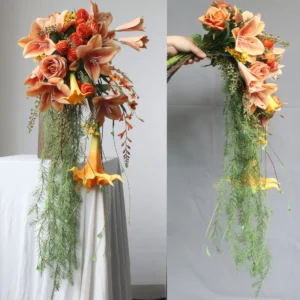
Applicable scenario: This image works for bridal bouquet catalogs, wedding rental websites, event planning portfolios, wholesale artificial flower pages, and wedding décor marketing.
I have made artificial wedding flowers for planners, rental businesses, retailers, and event companies for many years. I have learned that a good silk flower wedding bouquet is not only about choosing pretty flowers. The structure, flower scale, color balance, stem quality, packing method, and repeatability all matter.
This becomes even more important when I produce bouquets for a business instead of one bride. A wedding company may need one bridal bouquet, six bridesmaid bouquets, matching centerpieces, aisle flowers, and larger installations. Every piece must look like part of the same collection.
For more flower ideas before starting, I recommend reading my guide to the best artificial flowers for wedding bouquets.
What Materials Are Needed for a Silk Flower Wedding Bouquet?
I never start a bouquet with flowers alone. If I prepare the wrong tools or use weak stems, even expensive artificial flowers can become difficult to arrange.
For a professional silk flower wedding bouquet, I prepare focal flowers, secondary flowers, fillers, greenery, floral tape, wire, cutters, ribbon, pins, glue, and protective packaging. I also prepare a clear color and size reference before I start production.
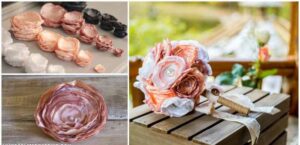
Applicable scenario: This image works for bouquet workshops, wedding florist training, artificial flower factories, wholesale catalogs, and DIY wedding flower guides.
Step 1: I Define the Bouquet Before I Select the Flowers
I first decide what the bouquet needs to achieve.
I ask myself several simple questions.
Is it a bridal bouquet or bridesmaid bouquet?
Will it be round, loose, cascading, garden-style, or modern?
Will the bouquet be photographed from very close range?
Does it need to match an arch, centerpiece, or aisle flower collection?
I also decide the approximate diameter and height.
This planning sounds basic, but it prevents many problems later. I have seen buyers select beautiful individual flowers and still struggle to make them work together. The flowers may all have large heads. The bouquet then becomes too heavy and dense. Another buyer may choose too many small fillers. The bouquet then lacks a clear focal point.
One Australian wedding rental client gave me a very clear design direction. She wanted a modern garden look with a European winery feeling. Her main palette was ivory, white, and soft green. White orchids were also important to the look.
Her project included more than one floral piece. She needed floral columns, centerpieces, welcome flowers, bar flowers, a bridal bouquet, and bridesmaid bouquets.
I could not treat the bouquet as a separate product. I had to think about the complete wedding collection first.
That experience is why I always create the design language before arranging the first silk flower wedding bouquet.
Step 2: I Prepare the Right Flowers and Tools
My basic material list normally includes:
- Silk roses
- Silk peonies
- Artificial hydrangeas
- Artificial orchids
- Ranunculus or smaller secondary flowers
- Baby’s breath or other fine fillers
- Eucalyptus
- Ferns or other soft greenery
- Flexible wired stems
- Green floral tape
- Floral wire
- Strong wire cutters
- Scissors
- Ribbon
- Decorative pins
- Hot glue when needed
- Protective sleeves or bouquet boxes
I pay close attention to stem flexibility.
A flower can look realistic at the head but still be difficult to use if the stem is too stiff. I prefer stems that I can bend slightly. This lets me control flower direction and create more natural movement.
I also test the flower heads before bulk production. I check whether petals fall off easily. I check whether the leaves are firmly attached. I check whether colors change between batches.
For B2B projects, these checks are just as important as appearance.
I explain more about supplier quality control in my artificial flowers supplier checklist.
How to Choose Artificial Flowers for Different Wedding Styles?
I never choose wedding flowers only because one stem looks attractive. The bouquet must match the venue, dress, wedding theme, photography style, and other floral decorations.[1]
I choose artificial flowers by matching flower shape, color, texture, and greenery to the wedding style. I use soft roses and peonies for romantic weddings, orchids for modern designs, and loose greenery and mixed blooms for garden-style bouquets.
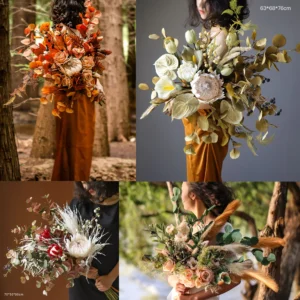
Applicable scenario: This image works for wedding planners comparing romantic, garden, modern, luxury, rustic, and editorial artificial flower styles.
Step 3: I Choose the Main Flowers First
The focal flowers control the character of a silk flower wedding bouquet.
For a romantic wedding, I often start with roses and peonies.
For a modern wedding, I may use orchids, calla lilies, or larger clean-shaped flowers.
For a garden-style wedding, I prefer a mix of roses, peonies, ranunculus, hydrangeas, and softer flowers with different opening stages.
For an editorial wedding, I may use fewer flower varieties but stronger shapes.
I also avoid choosing every flower at the same size.
I want one or two flowers to attract the eye first. Other flowers should support them.
The Australian wedding rental project taught me this clearly. The client wanted white orchids because they helped create the modern and slightly whimsical feeling she wanted. I did not fill every arrangement with orchids. I used them as important visual accents.
I applied the same thinking to the bouquet.
If every flower is special, no flower feels special.
I prefer to create a clear visual order.[2]
Buyers who are still deciding between varieties can also use my guide to choosing artificial flowers for weddings.
Step 4: I Match Fillers and Greenery to the Wedding Style
I treat greenery as part of the design, not as cheap material used to fill space.
For classic weddings, I use greenery carefully.
For garden weddings, I allow more leaves to move outside the bouquet shape.
For minimalist weddings, I may use very little greenery.
For rustic weddings, I may use eucalyptus, fern shapes, small berries, or softer wild-looking fillers.
I also watch the color temperature.
A cool green leaf may look wrong beside warm cream flowers. A bright plastic green can also make premium flowers look cheaper.
I prefer muted greens, dusty greens, grey-green eucalyptus tones, and several different leaf sizes.
I learned this during sampling for the same Australian client. We adjusted the amount of greenery more than once. A small change in green volume changed the whole mood of the design.
This is important for commercial buyers.
I often tell clients not to approve only the flower color.
I ask them to approve the total flower-to-greenery ratio.
That small decision makes repeat orders much easier.
For general inspiration, I also review industry styling references such as The Knot’s guide to artificial wedding flowers and Brides’ guide to silk flower arrangements.
How to Arrange the Main Flowers, Fillers, and Greenery?
I do not push every stem into one tight bunch. That method usually creates a flat artificial look with all flowers facing forward.
I arrange a silk flower wedding bouquet from the center outward. I place the focal flowers first, add secondary blooms at different heights, introduce fillers between gaps, and finish with greenery that creates movement around the outer shape.
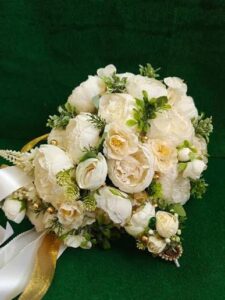
Applicable scenario: This image works for bouquet production training, wedding florist tutorials, factory assembly guides, and artificial flower styling content.
Step 5: I Shape Every Stem Before Building the Bouquet
Artificial flowers usually arrive packed closely together.
I never use them directly from the carton.
I open the petals carefully.
I separate leaves.
I bend wired stems.
I turn flower heads in slightly different directions.
I also look at the flower from the side.
This matters because wedding photos are not taken only from the front.
A bride may hold the bouquet low. A photographer may shoot from the side. Guests may see the bouquet from behind during the ceremony.
I want the silk flower wedding bouquet to look complete from every useful angle.
When I prepared samples for my Australian wedding rental client, we spent time adjusting the direction of flowers rather than simply adding more flowers. This gave the pieces a softer look without making them much heavier.
This is one reason I tell buyers that fullness does not always mean more stems.
Good positioning can create fullness.
Poor positioning can waste materials.
Step 6: I Build the Bouquet Around the Focal Flowers
I normally begin with three to five important blooms.
I hold them loosely in one hand.
I then add secondary flowers around the focal area.
I rotate the bouquet as I work.
I do not add every stem from the same direction.
I also change stem height.
Some flowers sit slightly higher. Some flowers sit deeper inside the bouquet. Some smaller flowers sit near the outside.
This creates depth.
I then add fillers between larger flowers.
I use fillers to connect different areas instead of covering every open space.
A little negative space can make the bouquet look more natural.
I have seen commercial buyers ask for very dense bouquets because they believe more stems always create more value. I understand the idea, but I normally show two samples when this happens.
One sample is tightly packed.
The other has controlled spacing and different flower heights.
The second design often looks more expensive in photographs even when it uses a similar number of stems.
My guide on how to arrange faux flowers explains the same idea in more detail.
Step 7: I Check the Bouquet From Every Angle
I stop before securing the stems.
I place the bouquet on a table.
I hold it at waist level.
I look at it from the front, sides, top, and back.
I check whether one flower is too dominant.
I check whether a large gap is visible.
I check whether too much greenery is concentrated on one side.
I also check the handle position.
A beautiful top section can still feel uncomfortable if the stems create a handle that is too wide.
For rental companies, I also think about repeated handling.
The bride, photographer, assistant, stylist, and rental team may all handle the same bouquet.
The structure needs to survive that use.
During my client projects, I often send photos or short videos before final production. A buyer can then see the scale and balance before I repeat the design across a larger order.
This approval step saves much more time than correcting finished bouquets later.
How to Secure and Wrap a Silk Flower Wedding Bouquet?
I never rely on ribbon alone to hold the bouquet together. The internal structure must already be stable before I add the decorative finish.
I secure a silk flower wedding bouquet by binding the stems firmly with floral tape or wire, trimming the handle evenly, covering the binding area, and wrapping the handle with ribbon. I then secure the ribbon and complete a final strength check.
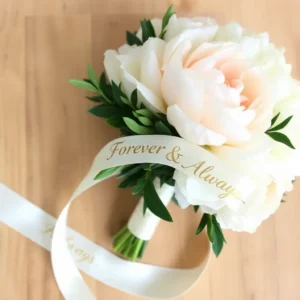
Applicable scenario: This image works for bouquet finishing instructions, bridal florist training, production SOPs, artificial flower workshops, and wholesale bouquet manufacturing.
Step 8: I Secure the Bouquet Structure
When I am happy with the arrangement, I hold the stems tightly without changing the flower positions.
I normally bind the stems close to the point where they naturally cross.
I use floral tape first for many designs.
I may add floral wire for heavier bouquets.
I make several secure turns around the stems.
I then test the bouquet gently.
I do not pull hard enough to damage it. I only want to know whether the flower positions move during normal handling.
If they move too easily, I secure the stems again.
This became especially important when I worked on products that needed to be shipped internationally.
A bouquet can look perfect on my worktable and still arrive damaged if its internal structure is weak.
The Australian rental client also needed floral pieces that could be prepared before the wedding instead of being built completely at the venue. That requirement changed the way I thought about structure.
I wanted the products to arrive as close to ready-to-use as possible.
I apply the same rule to every commercial silk flower wedding bouquet.
Step 9: I Wrap and Finish the Handle
I cut the stems to create a comfortable handle length.
I make sure sharp wire ends are not exposed.
I cover the binding area.
I then start the ribbon wrap.
I prefer a clean ribbon finish because the handle appears in many bridal photos.
I normally begin near the top of the handle.
I wrap downward with even tension.
I finish the ribbon with hidden pins, stitching, or another secure method based on the design.
I avoid using too much visible glue.
For luxury orders, I can also match the ribbon to the wedding color palette.
Some buyers prefer satin.
Some prefer velvet.
Some prefer a natural fabric look.
The final decision depends on the wedding style and price level.
After wrapping, I hold the bouquet again.
I check the weight.
I check the flower direction.
I check the ribbon.
I gently move the bouquet as it would move during normal use.
Only then do I consider the product finished.
For rental stock, cleaning after each event also matters. I recommend my guide on how to clean silk flowers for ongoing maintenance.
How Can Wedding Businesses Produce Bouquets More Efficiently?
I do not think a wedding business should make every bouquet from zero. A repeatable system can protect design quality while cutting unnecessary preparation work.
I produce silk flower wedding bouquets more efficiently by creating approved recipes, standardizing flower colors and stem counts, preparing components in batches, labeling styles clearly, using reference samples, and designing protective packaging for transport and reuse.
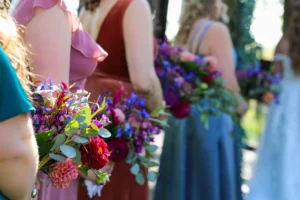
Applicable scenario: This image works for wedding rental companies, wholesalers, florists, event businesses, artificial flower factories, and private-label bouquet programs.
I Create a Bouquet Recipe
For commercial production, I record every approved design.
I record the flower varieties.
I record the colors.
I record the approximate number of each stem.
I record the bouquet diameter.
I record the finished handle length.
I record the ribbon.
I also keep clear photos.
This turns one beautiful sample into a repeatable product.
Without a recipe, different workers may produce slightly different results.
One person may add more greenery.
Another person may make the bouquet tighter.
Another person may place the focal flower too high.
These differences become obvious when ten bridesmaid bouquets appear together.
I Produce Matching Wedding Collections
I also encourage wedding businesses to think beyond one bouquet.
A buyer may use the same floral recipe across:
- Bridal bouquets
- Bridesmaid bouquets
- Table centerpieces
- Welcome table arrangements
- Bar flowers
- Aisle flowers
- Floral columns
- Wedding arches
- Photo backdrops
I saw the value of this approach clearly with my Australian wedding rental client.
She did not only need one arrangement.
She was building a full wedding environment.
Once I understood the main flower language, I could use the same colors, orchids, greenery style, and design feeling across several product types.
This makes sourcing much easier.
It also helps a wedding business present complete packages instead of individual products.[3]
My guide to reusable artificial wedding flowers for rental businesses covers this business model in more detail.
I Prepare Components in Batches
I can save production time by preparing repeated work together.
I can open and shape the same flower variety in one batch.
I can cut similar stems together.
I can prepare greenery groups.
I can pre-wrap handles.
I can prepare labels and packaging before final assembly.
I still complete each silk flower wedding bouquet carefully, but I avoid repeating the same preparation process one bouquet at a time.
I Use a Reference Sample for Every Bulk Order
I believe the approved sample is one of the most important tools in B2B bouquet production.
I keep the sample or detailed reference photos beside the production team.
The sample becomes the standard.
I compare bulk bouquets against it before packing.
I check color.
I check fullness.
I check size.
I check the flower ratio.
I check the ribbon.
I check the overall feeling.
This is especially useful for repeat orders several months later.
I Design Packaging Around the Bouquet
Packaging cannot be an afterthought.
A badly packed bouquet may arrive with flattened petals and bent flower heads.
I leave enough space around the flower heads.
I secure the bouquet so it cannot move too much.
I protect delicate flowers.
I also avoid unnecessary pressure on the petals.
For rental businesses, I prefer packaging that can also support storage between events.
A well-made silk flower wedding bouquet should not only look good when I finish it. It should still look good after shipping, storage, setup, photography, and repeated use.
Wedding businesses can explore additional artificial wedding flower options in my wedding artificial flowers collection or browse the Botanic Blossoms product catalogue.
My Insight as an Artificial Wedding Flower Manufacturer
After more than a decade in artificial flowers and décor, I have learned that buyers usually notice design first, but long-term customers remember consistency and service.
A beautiful sample can win attention.
A reliable production system wins repeat orders.
When I work on a silk flower wedding bouquet project, I want to know how the buyer plans to use it.
I want to know whether it is for retail, rental, wedding planning, event styling, online sales, or private label.
I also want to understand the full collection.
If a buyer needs a bouquet today and an arch next month, I prefer to plan the color system from the beginning.
This helps me keep the complete range consistent.
I also believe fast sampling matters in the wedding business because trends move quickly.
Clients often work from inspiration photos.
They need to see whether a concept works before they commit to a full collection.
I prefer to solve these questions during sampling instead of after bulk production.
That is how I think about wedding flower manufacturing.
I am not only making one bouquet.
I am helping a wedding business build a product that can be photographed, sold, rented, transported, reused, and reordered.
Conclusion
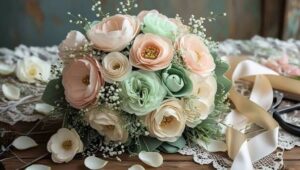
Applicable scenario: This image works for the closing section, product catalog cover, wedding business landing page, bridal portfolio, and wholesale bouquet promotion.
I make a successful silk flower wedding bouquet by combining realistic materials, clear structure, natural movement, secure finishing, and repeatable production that works for real wedding businesses.
Frequently Asked Questions About Silk Flower Wedding Bouquets
1. What flowers work best for a silk flower wedding bouquet?
I often use roses, peonies, hydrangeas, orchids, ranunculus, calla lilies, baby’s breath, and soft greenery. I choose the final mix based on the wedding style and target price.
2. How many flowers do I need for one bridal bouquet?
I do not use one fixed number because flower head sizes vary. I normally create the required bouquet diameter first and then standardize the stem recipe after the sample is approved.
3. Can I customize silk wedding bouquets for my brand?
Yes. I can customize flower combinations, colors, bouquet size, greenery ratio, ribbons, packaging, labels, and other details for suitable B2B projects.
4. Can silk flower wedding bouquets be prepared months before a wedding?
Yes. I can prepare artificial bouquets well before the event. I recommend storing them in a clean, dry space with enough room around the flower heads.
5. Are artificial bouquets suitable for wedding rental businesses?
Yes. I find artificial bouquets especially practical for rental operations because they can be prepared early, transported, cleaned, stored, and reused when the construction is suitable.
6. How do I make a silk flower wedding bouquet look more realistic?
I use matte textures, natural color variation, different flower sizes, flexible stems, uneven flower heights, controlled greenery, and flower heads facing different directions.
7. Can I order matching bridesmaid bouquets and wedding decorations?
Yes. I often develop one floral style across bridal bouquets, bridesmaid bouquets, centerpieces, aisle flowers, arches, columns, garlands, and other wedding décor.
8. How should silk wedding bouquets be packed for international shipping?
I protect the flower heads from pressure, secure the bouquet against movement, protect delicate stems, and use packaging with enough internal space to reduce crushing.
9. Can I request a sample before a bulk bouquet order?
Yes. I strongly recommend sampling for customized projects because the sample lets me confirm color, size, flower ratio, wrapping, and overall design before bulk production.
10. How do I choose a reliable silk wedding bouquet supplier?
I check sample quality, production consistency, communication speed, customization ability, packaging, delivery planning, quality control, and the supplier’s ability to solve problems when requirements change.
Footnotes
-
The Knot,
Artificial Wedding Flowers Guide,
for additional wedding flower styling and planning reference.
↩ -
Brides,
Silk Flower Arrangements for Weddings,
for additional inspiration on silk flower arrangements and wedding applications.
↩ -
Botanic Blossoms,
Reusable Artificial Wedding Flowers for Event Rental Businesses,
for more information about reusable floral collections for commercial wedding rental operations.
↩
Build Your Next Wedding Flower Collection With Botanic Blossoms
I work with wedding planners, rental companies, event businesses, wholesalers, retailers, and online sellers that need realistic artificial wedding flowers with reliable production and customization.
I can help develop a silk flower wedding bouquet from an inspiration photo, existing collection, target color palette, or complete wedding décor concept.
Jasmine
Founder & CEO, Botanic Blossoms
Email: jasmine@cnhycrafts.com